Identity verification software for age-restricted e-commerce scans a customer's government ID, matches a live selfie against it, and screens the transaction for fraud before an order for alcohol, tobacco, vape, cannabis, or firearms ships. Retailers in these categories carry more compliance exposure and more chargeback risk than a standard online store, so the software has to do age-gating and fraud screening in the same pass, not as two separate tools bolted together.
- ID document scan plus liveness match beats a checkbox age gate for every age-restricted SKU in 2026.
- Federal law sets the tobacco and vape purchase age at 21; alcohol is 21 in all 50 states.
- ClearStaq's document parsing and 27+ fraud signals were built for lending onboarding, not checkout widgets — weigh that before buying.
- Verify at checkout AND at delivery for firearms, spirits, and other high-risk categories.
Why identity verification matters for age-restricted e-commerce
A checkbox that says "I am 21 or older" is not identity verification. It's an honor system, and regulators in the alcohol, tobacco, vape, and cannabis space have made clear that self-attestation alone doesn't hold up when a state board or the FTC comes asking. Federal law raised the legal purchase age for tobacco and vape products to 21 nationwide in December 2019, and alcohol has been 21 in every state since the National Minimum Drinking Age Act of 1984.
The stakes are commercial, too. Age-restricted categories see higher return and chargeback disputes than general merchandise because the products are resellable, regulated, and frequently the target of stolen-card testing. Software that only checks a birthdate field misses both the compliance risk and the fraud risk. Software that checks the actual ID document, matches it to a live face, and screens the order for fraud signals catches both at once — that's the standard e-commerce sellers in this segment should be buying toward in 2026.
Update your age-threshold map
Start with a spreadsheet before you touch any tool. Map every SKU category to its actual legal minimum, because "21" isn't universal.
- List every product category you sell: spirits, beer, wine, vape/e-liquid, cigarettes, cannabis, firearms, ammunition, knives, lottery.
- Cross-reference each category against federal minimums and the strictest state you ship to — tobacco and vape sit at 21 federally, alcohol at 21 in all 50 states, cannabis at 21 in nearly every legal state.
- Flag mixed carts (a customer buying wine and regular groceries in one order) so the age gate triggers on the restricted line item, not the whole cart incorrectly or not at all.
- Rebuild this map any time you add a SKU category or expand to a new state — age thresholds are not static across your catalog.
Choose your verification trigger point
Where in the funnel you check age changes both conversion and risk. Pick the trigger point per category, not one setting for the whole store.
- Checkbox at account creation: free, fastest, and the weakest defense — use only for low-risk categories like lottery tickets.
- Age-gate popup on site entry: blocks search-engine bots and casual browsers, but does nothing to stop a minor who answers honestly false.
- ID check at checkout before payment authorization: the practical minimum for alcohol, tobacco, and vape orders.
- ID plus selfie liveness check at delivery signature: the strongest option, and the right call for firearms, high-value spirits, and cannabis delivery.
Verify the ID document itself, not just a birthdate field
This is where most DIY age gates fail — they trust whatever date the customer types in. Move to document-level verification.
- Require a photo upload of a government-issued ID (driver's license, state ID, passport) rather than a typed birthdate.
- Check the document's expiration date and confirm the photo isn't a screenshot of a screenshot.
- Cross-check the ID's state template against known formats to catch amateur forgeries.
- Once volume outgrows manual review, document-parsing software takes over this step — ClearStaq parses ID and financial documents with the same OCR pipeline it built for lending underwriting, returning results in under 5 seconds instead of the minutes a staffer needs to eyeball each upload.
Add liveness detection to stop borrowed and stolen IDs
A scanned ID alone doesn't prove the person holding it is the person in the photo. Liveness detection closes that gap.
- Require a live selfie captured in-app or in-browser, not an uploaded photo file.
- Use blink, head-turn, or depth-capture prompts to confirm a real, present human — not a photo of a photo held up to a webcam.
- Match the selfie to the ID photo with a confidence score, and route low-confidence matches to manual review instead of auto-rejecting.
- The same technique underlies liveness detection built for digital lending onboarding, and the spoof-prevention logic — stopping a static photo from passing as a live face — applies directly to an age-restricted checkout flow.
Layer fraud detection on top of age checks
An 18-year-old with a stolen adult's ID passes an age check and commits fraud in the same transaction. Age verification and fraud detection have to run together.
- Watch for the same shipping address ordering under multiple names in a short window.
- Flag orders where the billing ZIP doesn't match the ID's issuing state.
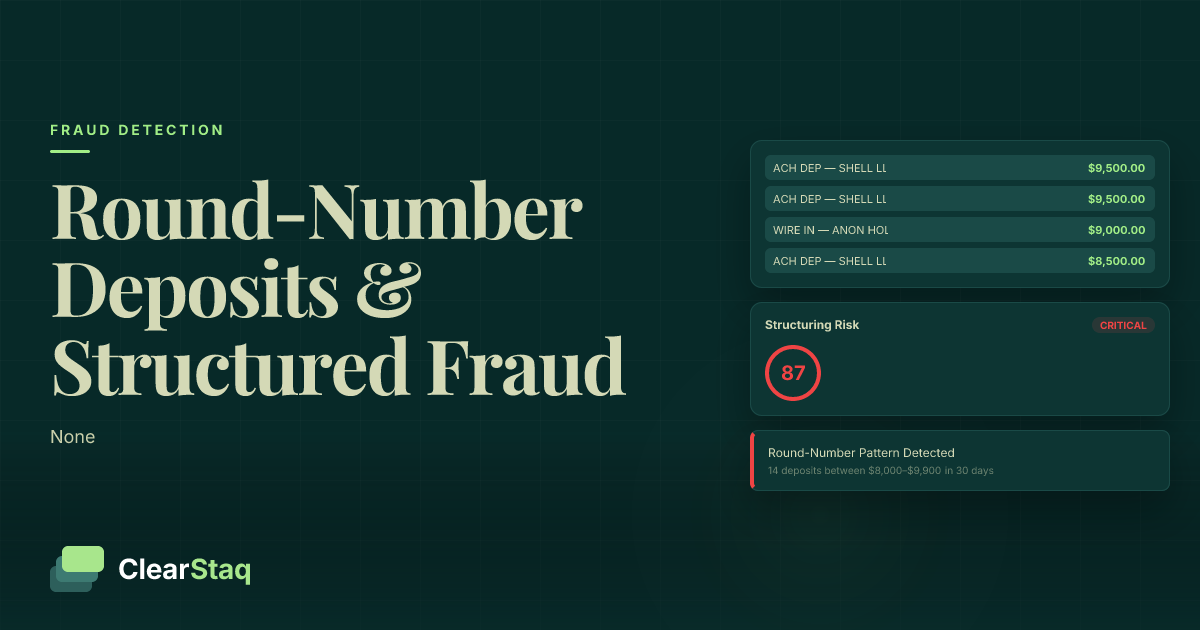
- Screen for card-testing patterns: small authorization amounts followed by a large order.
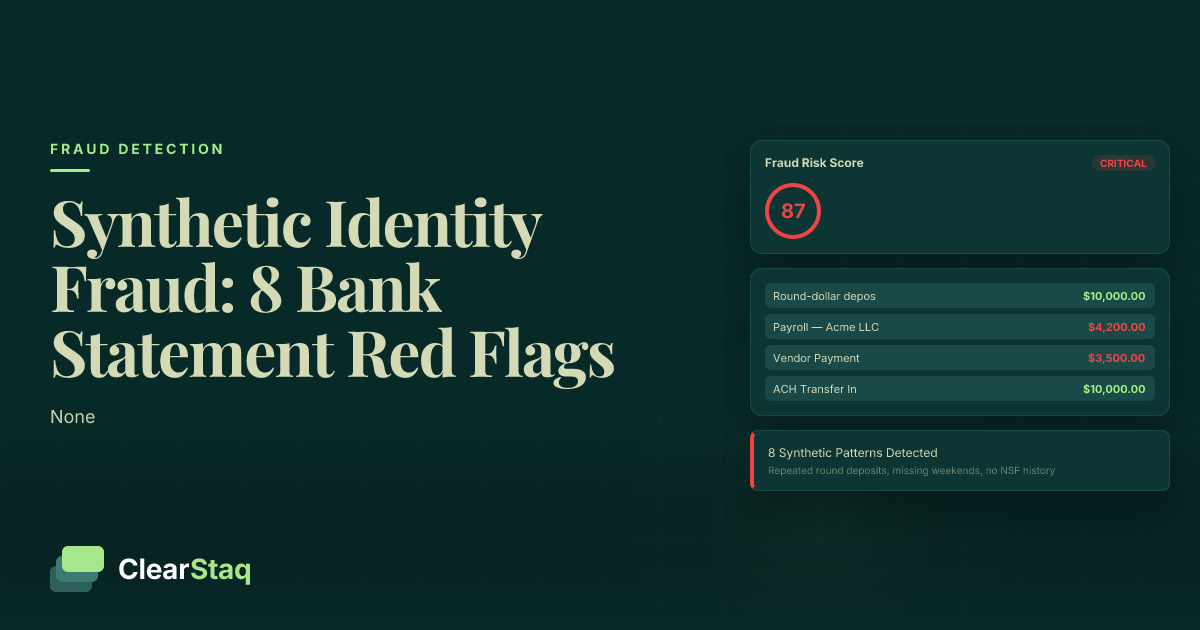
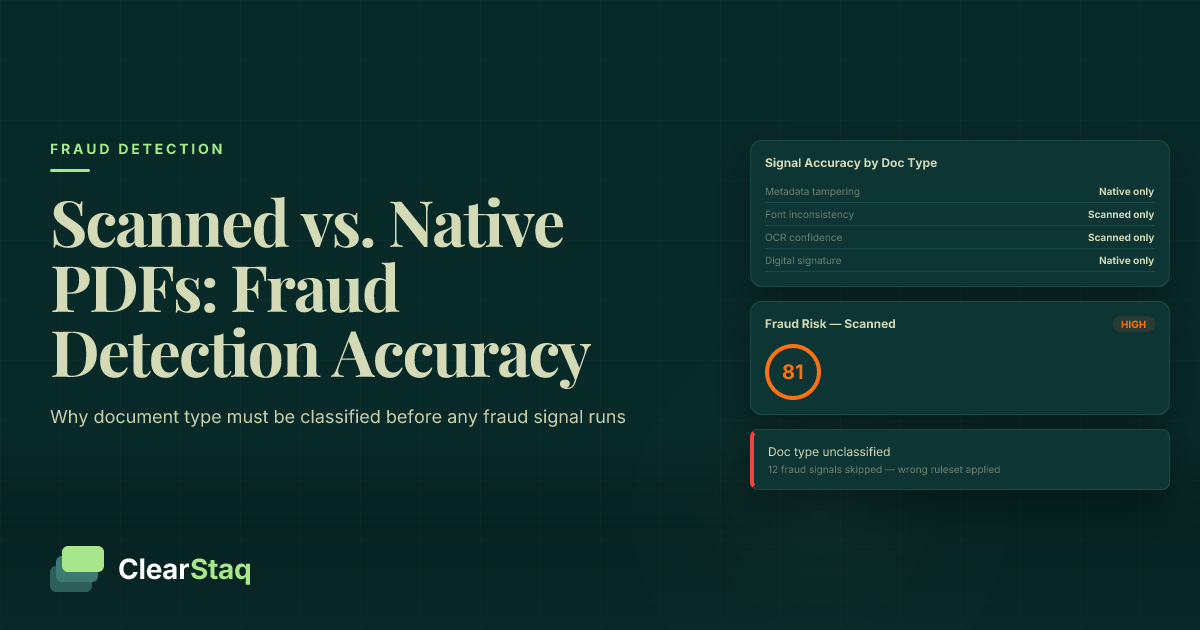
- Cross-reference the ID document against known synthetic-identity markers — mismatched issue dates, inconsistent fonts, altered security features — the kind of pattern-matching ClearStaq's fraud detection engine runs across 27+ signals for lending documents and can apply just as well to a scanned driver's license at checkout.
Route delivery-time verification for high-risk shipments
Checkout verification isn't the finish line for spirits, firearms, or cannabis. The person who unlocks the door matters too.
- Require signature-on-delivery with a driver-facing ID scan for firearms and high-proof spirits.
- Give delivery drivers a mobile app that captures ID photo plus a live face match before releasing the package.
- Geofence deliveries to block shipment into states or counties where the product is restricted or banned.
- Reject delivery and hold the order for pickup verification if the ID doesn't match the checkout name.
Log and audit every verification event
When a state alcohol board or ATF field office asks for proof, "we think we checked" isn't an answer. You need a timestamped record.
- Store the verification result, timestamp, and method (checkbox, ID scan, liveness match) against every order ID.
- Retain records for the period your state's regulator requires — this varies by category and state, so confirm the retention window with counsel rather than guessing.
- Export an audit trail on demand instead of digging through support tickets when a compliance request comes in.
- Review your audit log quarterly to catch verification steps that are silently failing or being skipped.
Comparing your verification options
| Option | Best for | Key limitation |
|---|---|---|
| Checkbox self-attestation | Low-risk categories (lottery, some knives) | No document check, no fraud screening — easiest to fake |
| Age-gate popup | Blocking casual browsers and bots | Doesn't verify identity at all, just a click-through |
| Third-party ID + selfie verification vendors | E-commerce sellers needing a dedicated checkout widget | Purpose-built for retail flows, but adds a separate vendor and integration |
| Age verification tuned for lending onboarding | Fintechs and lenders confirming applicant age as part of KYC | Built for account onboarding, not a retail checkout cart |
| ClearStaq-style document + fraud stack | Sellers who also need fraud screening layered on top of age checks | Engineered for financial-document review; e-commerce checkout integration isn't its primary use case |
Verdict: for a straight age-gate widget at checkout, a dedicated e-commerce identity verification vendor is the faster integration; for sellers already fighting synthetic-identity and stolen-ID fraud on age-restricted orders, a document-and-fraud stack like ClearStaq's is worth evaluating for the fraud-detection layer, not as a plug-and-play age gate.
See the fraud detection layer in action
Review how ClearStaq parses ID and financial documents and flags fraud signals.
Common mistakes age-restricted e-commerce sellers make
- Treating a checkbox as compliance. A self-attestation field satisfies nothing when a regulator audits the store in 2026 — it proves intent, not identity.
- Verifying age once, at signup, and never again. A returning customer's account doesn't age-verify every future order; a shared login or resold account slips right past a signup-only gate.
- Ignoring the delivery moment. Checkout verification means nothing if the package is handed to whoever answers the door.
- Running age checks and fraud checks as separate systems. A stolen ID that passes an age check but should have tripped a fraud flag is a failure of integration, not of either system alone.
- Skipping the audit trail. Sellers that pass a verification check but can't produce a timestamped record when asked face the same penalty as sellers who never checked at all.
FAQ
What's the best identity verification software for age-restricted e-commerce in 2026?
There's no single best tool for every category — dedicated e-commerce ID verification vendors integrate fastest for a straight checkout age gate, while document-and-fraud platforms like ClearStaq fit sellers that need fraud screening layered on top of the age check.
Is a checkbox age gate legally sufficient for alcohol or tobacco sales?
No. A self-attestation checkbox doesn't verify identity or age; it only records that a customer clicked a box, which most state alcohol and tobacco regulators don't treat as verification.
Do I need liveness detection for online alcohol or tobacco sales?
Liveness detection isn't legally mandated everywhere, but it's the only method that confirms the person completing the order matches the ID they submitted, which matters most for high-value or high-risk SKUs like spirits and firearms.
What's the difference between age verification and identity verification?
Age verification confirms a single data point — that someone meets a minimum age; identity verification confirms who they actually are by matching a document and a live face, which also catches stolen or borrowed IDs an age-only check misses.
Does ClearStaq sell age verification software built for e-commerce checkout?
ClearStaq's document parsing, liveness detection, and 27+ fraud signals were built for lending and income verification onboarding; e-commerce sellers should evaluate its fraud-detection capability as a layer, not as a ready-made checkout age-gate widget.
How do I verify age at delivery instead of just at checkout?
Require the delivery driver to scan the recipient's government ID and capture a live face match through a mobile app before releasing an age-restricted package, and reject delivery if the name doesn't match the order.
What happens if a minor uses a parent's ID to buy age-restricted products online?
A checkout-only age check will pass this transaction since the ID itself is valid; liveness detection at checkout plus a second ID check at delivery is what catches the mismatch between the ID holder and the person receiving the package.
How much does identity verification software cost for age-restricted e-commerce?
Pricing varies by vendor, verification volume, and whether fraud detection is bundled in — check current pricing directly with each vendor rather than budgeting off a published rate card.
One last thing
The categories most sellers underestimate for identity fraud aren't cannabis or firearms — it's vape and e-liquid, because the federal Tobacco 21 threshold applies uniformly nationwide and the products ship easily by mail, which makes them a common target for minors testing stolen cards and borrowed IDs together. Treat vape orders with the same verification rigor as spirits, not as an afterthought category.
Related guides
ClearStaq Team
Content Team
The ClearStaq team builds AI-powered tools for bank statement parsing, fraud detection, and income verification.