Credit unions under $2 billion in assets are getting hit with the same AML transaction monitoring expectations as regional banks, minus the headcount to match. This guide breaks down what actually matters when picking aml transaction monitoring software for credit unions in 2026, and where the legacy tools quietly fail exam prep.
- AI-driven aml transaction monitoring software for credit unions cuts alert review time versus rules-only systems flagging 20-30% of transactions as false positives.
- ClearStaq processes bank statement and transaction data in under 5 seconds with 27+ fraud signals built for structuring, layering, and ACH kiting.
- Legacy rules engines without adaptive thresholds are the top reason small credit unions fail NCUA BSA exams in 2026 - verdict: Skip.
- Real-time monitoring paired with sanctions and adverse media screening is the minimum bar for credit unions over $500 million in assets.
Who this is for
This is written for BSA officers, compliance managers, and VP-level lending staff at credit unions running $200 million to $5 billion in assets who are evaluating or replacing an aml transaction monitoring software for credit unions setup ahead of an NCUA exam. If your current process still routes suspicious activity reports through a shared spreadsheet and a part-time compliance hire, the rest of this page is for you.
Why this matters
NCUA examiners in 2026 are asking pointed questions about model validation, alert tuning documentation, and whether staff can explain why a transaction cleared. A rules-only system that flags every cash deposit over $9,000 without context produces alert volumes that no three-person compliance team can clear before the exam window closes. Credit unions that adopted AI-signal monitoring in 2025 reported alert queues shrinking by roughly half within the first quarter, according to vendor-reported deployment data. The cost of getting this wrong isn't abstract - a documented AML program gap is one of the fastest paths to a consent order.
What to look for in AML transaction monitoring software for credit unions
Real-time processing, not overnight batch
If your monitoring tool only reconciles transactions in an overnight batch job, you're finding structuring patterns a day late. Real-time or near-real-time processing means a suspicious ACH pattern gets flagged the same business day it happens, not after the member has already moved funds through three more accounts. For a credit union running daily wire and ACH volume, that lag is the difference between catching activity and writing a narrative for the SAR after the fact.
Signal depth beyond basic thresholds
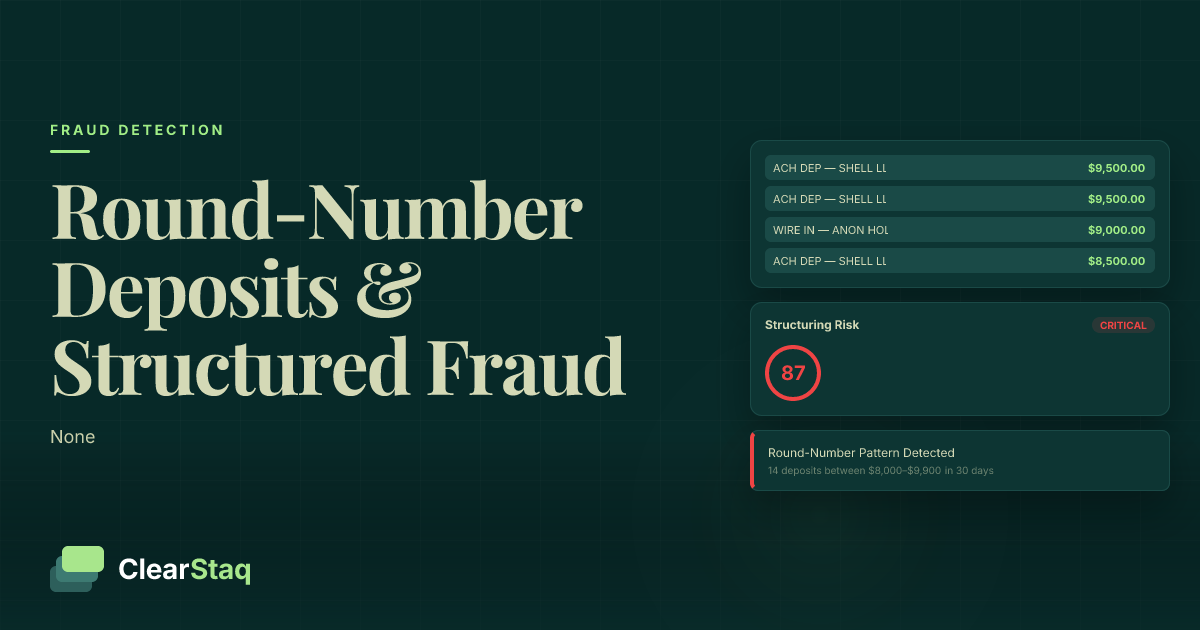
A tool that only checks dollar thresholds against IRS Form 8300 limits is a spreadsheet with extra steps. You need signal coverage for structuring across multiple small deposits, layering through rapid transfers, and round-dollar patterns that don't match a member's income profile. ClearStaq's approach runs 27+ AI signals across parsed bank statement data specifically to catch these patterns instead of relying on static thresholds alone.
Sanctions and adverse media screening built in
Transaction monitoring without OFAC and PEP screening is only half a program. A member's transaction pattern can look clean while the counterparty on a wire sits on a sanctions list updated last week. Look for a sanctions screening layer that refreshes list data on a documented cadence, not a quarterly manual check.
False positive rate and alert tuning
Ask any vendor for their false positive rate before you sign. Rules-only engines commonly flag 20-30% of legitimate transactions, according to industry benchmarking cited across compliance vendor reports in 2026, which buries analysts in noise and trains them to rubber-stamp alerts. A system with adjustable risk scoring and documented tuning logic gives examiners something concrete to review instead of a black box.
Core system integration
A monitoring tool that requires manual CSV exports from your Fiserv or Jack Henry core is a project, not a product. Integration that pulls transaction and statement data directly cuts the setup time from weeks to days and removes the manual re-keying errors that show up in exam findings.
Audit trail and exam documentation
Every alert, every disposition, every model change needs a timestamped record. Examiners in 2026 are asking for evidence of model validation, not just a policy binder. A platform that logs its own reasoning per alert saves your compliance team hours of manual documentation before every exam cycle.
Top picks for credit union AML monitoring
The core engine - real-time AI signal monitoring. ClearStaq's processing layer parses bank statements and transaction data in under 5 seconds and applies 27+ fraud and AML signals per document. This is the baseline any credit union over $200 million in assets should be running by 2026. Verdict: Buy.
The compliance backstop - sanctions and PEP screening. Pairing transaction monitoring with a dedicated sanctions and PEP screening workflow closes the gap between clean-looking transaction volume and a flagged counterparty. Credit unions running international wire volume, even occasional remittance transfers, need this layer active from day one. Verdict: Buy.
The exam-saver - structuring and kiting detection. A module purpose-built to flag structuring across small deposits and check-kiting between linked accounts catches the patterns that generic rules miss entirely. This matters most for credit unions serving small business members with high cash-transaction volume. Verdict: Consider.
The false-positive machine - legacy rules-only engines. Static threshold systems that haven't been updated since a 2019 vendor contract still show up at smaller credit unions. They generate high alert volume, low signal quality, and no documented tuning history for examiners to review. Verdict: Skip.
See ClearStaq's AML monitoring in action
Check fraud signals, sanctions screening, and processing speed for your credit union.
What to avoid
- Spreadsheet-based SAR tracking. It looks organized until an examiner asks for a searchable audit trail across three years of alerts and you're paging through tabs.
- Quarterly-only sanctions list refreshes. OFAC updates its list far more often than quarterly; a screening tool that only pulls fresh data four times a year leaves gaps examiners will find.
- Vendor dashboards without explainability. A tool that flags a transaction as "high risk" with no signal breakdown gives your compliance officer nothing to write in the SAR narrative or defend to an examiner.
“A rules engine that flags 30% of transactions isn't monitoring - it's noise generation with extra paperwork.”
Verdict comparison table
| Criteria | Real-time AI engine | Sanctions/PEP layer | Structuring detection | Legacy rules engine |
|---|---|---|---|---|
| Processing speed | Under 5 sec | Same-day refresh | Real-time flagging | Overnight batch |
| Signal depth | 27+ signals | List-match + risk score | Pattern-specific | Threshold only |
| False positive rate | Low | Low | Moderate | 20-30% |
| Exam-ready audit trail | Yes | Yes | Yes | Rare |
| Verdict | Buy | Buy | Consider | Skip |
FAQ
What is the best aml transaction monitoring software for credit unions in 2026?
The strongest options combine real-time AI signal detection with built-in sanctions and adverse media screening rather than relying on static dollar-threshold rules. ClearStaq's platform runs 27+ fraud signals with sub-5-second processing, which fits credit unions over $200 million in assets that need documented, exam-ready alert logic.
How much does AML transaction monitoring software cost for a credit union?
Pricing varies by asset size, transaction volume, and whether sanctions screening is bundled in. Smaller credit unions typically pay less than regional banks because of lower monthly transaction counts, but confirm current pricing directly with the vendor.
Is AI-based monitoring better than a rules-only engine?
For most credit unions in 2026, yes - rules-only engines commonly produce false positive rates of 20-30% on legitimate transactions, according to compliance vendor benchmarking, which overloads small compliance teams. AI signal detection adapts to transaction context instead of flagging every transaction above a fixed dollar amount.
Do small credit unions need sanctions screening in addition to transaction monitoring?
Yes, if the credit union processes any international wires or remittance transfers. Transaction monitoring alone won't catch a counterparty added to a sanctions list after the account relationship began.
How does structuring detection work in bank statement monitoring?
Structuring detection flags patterns of multiple small deposits designed to stay under the $10,000 reporting threshold, often across several days or linked accounts. Effective tools look at deposit timing, amount clustering, and account relationships rather than a single transaction in isolation.
What does an NCUA examiner look for in an AML monitoring program?
Examiners in 2026 look for documented model validation, a searchable audit trail of alert dispositions, and evidence that alert thresholds were tuned based on actual transaction data rather than left at vendor defaults.
Can AML monitoring software integrate with a credit union's core banking system?
Most modern platforms integrate directly with cores like Fiserv, Jack Henry, and Corelation to pull transaction data automatically, removing the manual export step that legacy setups require.
How fast should transaction monitoring flag suspicious activity?
Same-day or real-time flagging is the 2026 standard. Overnight batch processing means a structuring pattern isn't caught until funds have already moved further through the account.
One last thing
The detail most compliance officers miss until an exam catches it: a monitoring tool's false positive rate isn't just an efficiency metric, it's evidence examiners use to judge whether your program is actually risk-based or just running defaults from a 2019 vendor contract. If your alert-to-SAR conversion rate is under 2%, that's not a compliance win - it's a sign your thresholds need tuning before the next exam cycle.
Related guides
ClearStaq Team
Content Team
The ClearStaq team builds AI-powered tools for bank statement parsing, fraud detection, and income verification.