NSF patterns show up as clusters, not single events. Spotting them in a business bank statement underwriting workflow in 2026 means counting frequency, separating true NSF fees from overdraft transfers, and lining up the timing against deposit cycles — not just scanning for the letters "NSF" on a statement.
- Detecting NSF patterns in business bank statement underwriting means counting frequency, clustering by month, and isolating true NSF from overdraft fees.
- Three or more NSF fees inside a 90-day window signals cash flow stress most single-pass manual review misses.
- ClearStaq flags NSF clusters, check kiting, and commingled funds across 27+ fraud signals in under 5 seconds.
- Seasonal businesses can show NSF spikes that reflect revenue timing, not fraud — separate the two before declining.
Why this matters
A single NSF fee tells you almost nothing. A borrower can bounce one payment because of a timing mismatch with a supplier and still run a healthy business.
The pattern is the signal. Recurring NSF fees clustered around the same week each month, or spiking right after a large deposit clears, point to a business living paycheck to paycheck — the exact profile most MCA and small business lenders want flagged before funding, not after a default.
Manual review catches the obvious cases: a statement with ten NSF line items jumps out. It misses the subtler pattern — five NSF fees spread across three accounts, or NSF fees that stop the month before the application because the borrower opened a new account to reset the appearance of their history. Underwriters reviewing 12 months of statements by eye in 2026 are still working from a static PDF; pattern detection requires categorizing every transaction and running frequency math across the full lookback window, not skimming for red flags.
What you'll need
- 12 months of business bank statements, not 3 — NSF seasonality only shows up over a full cycle
- A transaction categorization method that separates NSF fees from overdraft fees and returned-item fees (banks label these differently)
- A way to flag same-day clusters: NSF fees that land on the same date as ACH debits or check deposits
- A fraud detection layer that can cross-reference NSF timing against deposit patterns automatically — this is where a platform like ClearStaq replaces hours of manual line-by-line review
- A threshold policy already defined before you start reviewing — decide what "too many" means before you're looking at a specific file
The steps
1. Pull the full transaction history and isolate NSF line items
Extract every transaction coded NSF, returned item, or insufficient funds across all 12 months, across every linked account. Missing an account is the single most common way NSF patterns get underreported — a borrower with three accounts and NSF fees concentrated in the one they didn't disclose will look clean on the primary statement.
Common mistake: reviewing only the account submitted with the application instead of requesting all business accounts tied to the EIN.
2. Count frequency and cluster by month
Total NSF fees per month, then look at the distribution, not just the sum. A business with 12 NSF fees spread evenly at one per month reads differently than one with 12 NSF fees packed into two months.
Benchmark: three or more NSF fees inside any rolling 90-day window is the threshold most underwriting teams treat as a stress signal in 2026. Below that, treat it as noise unless it's trending upward month over month.
3. Separate true NSF from overdraft protection transfers
Banks record these differently, and mixing them inflates or deflates the real picture. An NSF fee means the payment was rejected. An overdraft transfer fee means the bank covered it from a linked account or credit line — the payment cleared, but the business still ran short.
Both matter, but they answer different questions. NSF frequency tells you how often the business can't cover an obligation at all. Overdraft transfer frequency tells you how often it's borrowing from itself to stay current.
4. Cross-reference NSF timing against deposit cycles
Check whether NSF fees cluster right before a known deposit date — payroll runs, marketplace payouts, or a recurring B2B invoice cycle. NSF fees that consistently hit two to three days before a predictable deposit suggest a timing gap, not insolvency, and that changes how you weight the finding.
NSF fees with no relationship to deposit timing — scattered randomly across the month — point to a structural cash shortfall instead of a cash flow timing issue. That's a different underwriting conversation.
5. Flag same-day clusters against other fraud indicators
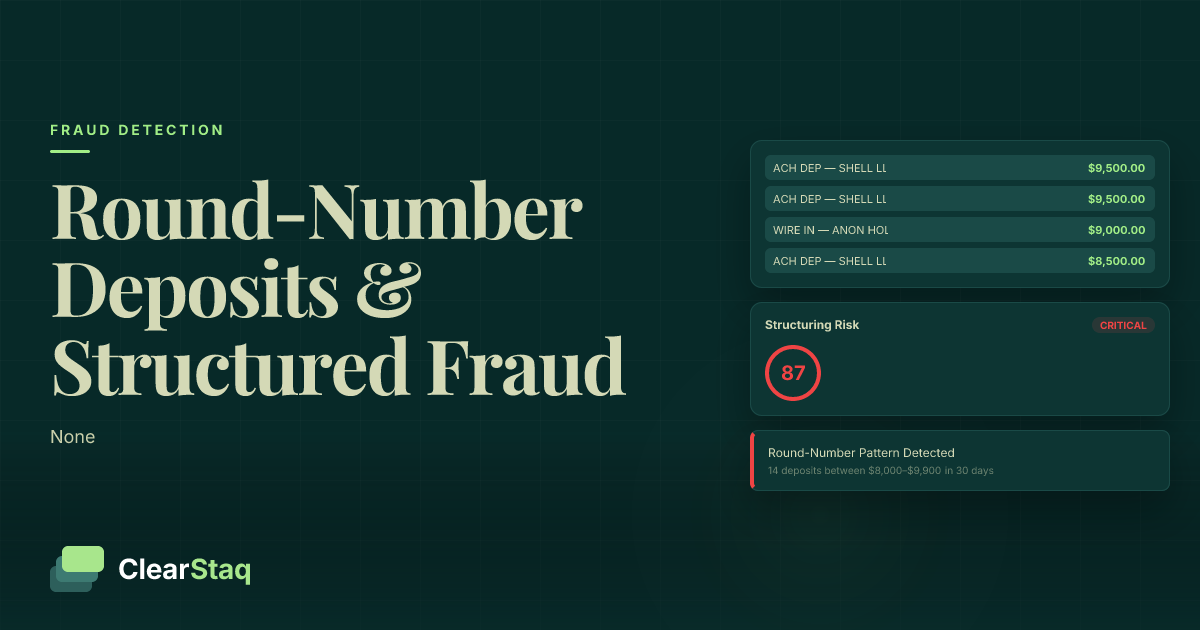
NSF fees that land on the same date as a large check deposit, or that cluster around dates matching structuring patterns, deserve a second look before you treat the NSF as a standalone cash flow issue. NSF activity paired with round-dollar deposits just under reporting thresholds is a combination worth escalating, not scoring in isolation.
The same logic applies to check kiting between linked accounts — NSF fees on one account paired with same-day transfers from another can mask a float scheme that looks like ordinary cash flow stress on a single statement.
Automate NSF pattern detection
Flag NSF clusters and fraud signals across 12 months of statements in under 5 seconds.
6. Score severity against a seasonal baseline
A restaurant or landscaping business with NSF fees concentrated in its historically slow months isn't showing the same risk profile as one with NSF fees spread evenly year-round. Pull the business's own 12-month baseline before comparing it to a generic threshold — seasonal revenue patterns change what "normal" NSF frequency looks like for that specific borrower.
Common mistake: applying the same NSF threshold to every applicant regardless of industry seasonality, which over-penalizes seasonal businesses and under-flags year-round operators with a genuine problem.
7. Document the decision threshold and escalate or decline
Once frequency, timing, and severity are scored, apply the policy you set before starting the review. Escalate files that cross the NSF threshold combined with any secondary fraud signal — same-day clusters, commingled funds, or check kiting indicators — for manual underwriter sign-off rather than an automatic decline.
Troubleshooting
| Problem | Fix |
|---|---|
| NSF and overdraft fees look identical on the PDF | Match the fee description text exactly; banks like Chase, Bank of America, and Wells Fargo each use different labels for the same event |
| Borrower submits only 3-4 months of statements | Require the full 12 months before scoring — a short window hides seasonal NSF clusters entirely |
| NSF count looks low but multiple accounts exist | Request a full account list tied to the business EIN, not just the account on the application |
| NSF fees appear right after a large deposit clears | Check for commingled funds — personal and business cash mixing can distort the true NSF-to-revenue ratio |
| Manual reviewers disagree on what counts as a "pattern" | Set a documented numeric threshold (e.g., 3+ NSF in 90 days) so scoring is consistent across underwriters |
| OCR misreads NSF transaction codes | Use format-aware parsing rather than generic OCR — statement layouts vary enough between banks that generic tools misclassify fee types |
Tools and resources
- 12 months of consolidated bank statements across every business account
- A fee-type classification list specific to the borrower's bank (NSF, overdraft transfer, returned item all read differently)
- A documented NSF frequency threshold tied to your credit policy
- Fraud detection software that scores NSF clusters alongside other signals automatically — ClearStaq runs this across 27+ fraud signals with 99.5% accuracy, which replaces the manual cross-referencing step entirely
- A workflow for automating bank statement review once NSF scoring is standardized, so the same logic applies to every file without a manual pass
What to do next
Once NSF pattern detection is standardized, the next bottleneck is usually review time, not the NSF logic itself. Teams still running this by hand spend hours per file cross-referencing fee timing against deposits. Automating the categorization step — not just the NSF flag, but the full transaction breakdown — is what actually cuts review time, and it's the same underlying process regardless of loan type.
FAQ
What counts as an NSF pattern in business bank statement underwriting?
An NSF pattern is three or more NSF fees inside a rolling 90-day window, especially when they cluster around the same week each month. A single isolated NSF fee is not a pattern on its own.
How many NSF fees is too many for loan approval?
Most underwriting teams in 2026 treat three or more NSF fees in a 90-day window as a stress signal worth escalating. The exact threshold should account for the borrower's industry seasonality before triggering a decline.
Is NSF frequency more important than NSF amount?
Frequency matters more than the dollar amount of individual NSF fees. A business with frequent small NSF fees shows recurring cash flow stress, while a single large NSF event can be a one-time timing issue.
Can NSF patterns indicate check kiting?
NSF fees on one account paired with same-day transfers from another linked account can indicate check kiting, not just cash flow stress. Cross-referencing NSF timing against inter-account transfers catches this pattern that single-account review misses.
How do you tell NSF fees apart from overdraft fees on a statement?
NSF fees mean a payment was rejected outright; overdraft transfer fees mean the bank covered the payment from a linked account or credit line. Banks label these differently, and mixing the two categories distorts the real NSF frequency.
Does one bad month of NSF fees disqualify a borrower in 2026?
No — a single month of NSF activity should be checked against the business's 12-month seasonal baseline before it affects a decision. Seasonal businesses can show a temporary spike that isn't representative of year-round cash flow.
How long should the bank statement lookback period be for NSF pattern detection?
Twelve months is the standard lookback for NSF pattern detection in 2026, since shorter windows hide seasonal clusters. A 3-month statement set can look clean while masking a recurring problem in the business's slow season.
Can automated software catch NSF patterns humans miss?
Automated fraud detection platforms cross-reference NSF timing against deposits and other accounts in seconds, catching clusters that a single-pass manual review often misses. ClearStaq scores this across 27+ signals in under 5 seconds per file.
One last thing
The NSF fees that matter most aren't the biggest ones — they're the ones that stop appearing the month before the application gets submitted. A borrower who cleaned up their NSF history for exactly one month right before applying is a bigger red flag in 2026 than one with a steady, low-level NSF pattern across all 12 months. Check the month immediately before submission as closely as the worst month in the file.
ClearStaq Team
Content Team
The ClearStaq team builds AI-powered tools for bank statement parsing, fraud detection, and income verification.