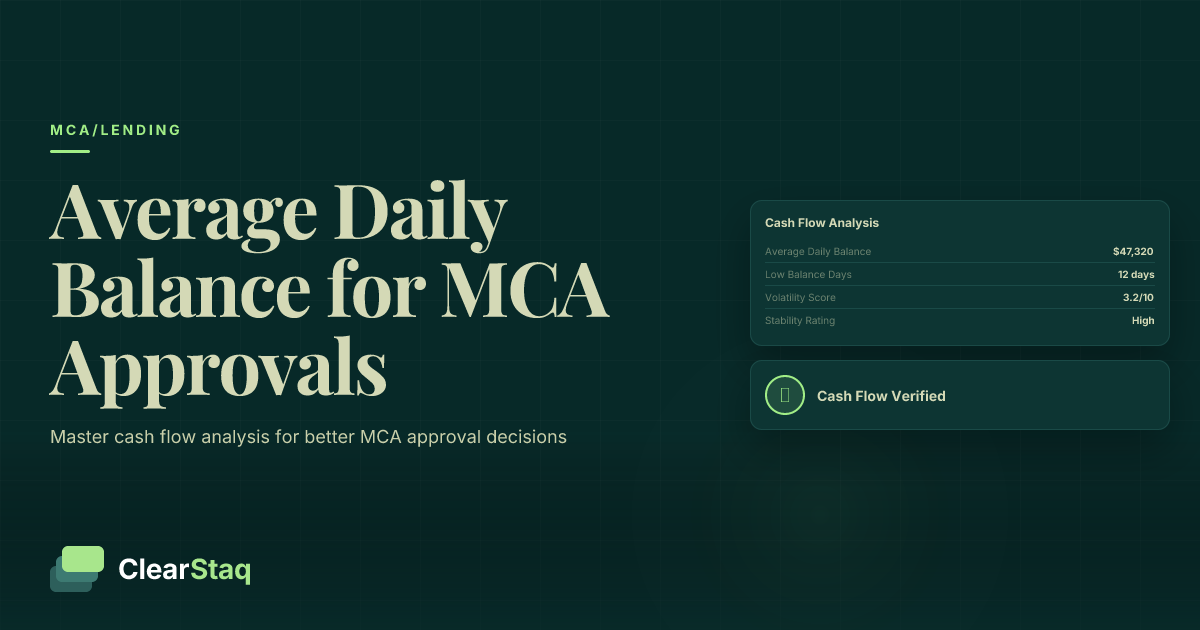
Average daily balance calculation adds all daily account balances over a period and divides by the number of days. For MCA underwriting, this metric reveals cash flow stability, seasonal patterns, and borrower risk more accurately than ending balance alone, helping lenders assess repayment capacity and set appropriate terms.
What you'll learn
- Average daily balance reveals cash flow patterns that ending balance snapshots completely miss
- The formula is straightforward: sum all daily balances divided by number of days in the period
- Negative balance days must be included in calculations to accurately assess repayment risk
- Manual calculation takes 15-30 minutes per application with 12-18% error rates
- Automated systems calculate daily balance in under 10 seconds with 99.9% accuracy
Average daily balance calculation adds all daily account balances over a period and divides by the number of days. For MCA underwriting, this metric reveals cash flow stability, seasonal patterns, and borrower risk more accurately than ending balance alone, helping lenders assess repayment capacity and set appropriate terms.
What is Average Daily Balance in MCA Underwriting?
Average daily balance is the sum of all daily account balances divided by the number of days in the analysis period. In merchant cash advance underwriting, this metric provides a window into true cash flow patterns that ending balances simply can't reveal.
Unlike traditional loans that rely on monthly snapshots, MCA lenders need to understand daily liquidity patterns because merchants repay advances through daily ACH withdrawals or credit card receivables splits. This makes MCA cash flow analysis fundamentally different from conventional lending risk assessment.
Average Daily Balance vs. Ending Balance
Ending balance shows only one moment in time—often the worst possible indicator for MCA risk assessment. Consider two merchants with identical $50,000 ending balances:
| Merchant A Daily Pattern | Merchant B Daily Pattern |
|---|---|
| Consistently $45,000-$55,000 | Swings from $500 to $99,500 |
| Average daily balance: $50,000 | Average daily balance: $50,000 |
| Low volatility risk | High volatility risk |
Both merchants have the same ending and average balances, but Merchant B's extreme volatility signals cash flow instability that could impact daily repayment capacity.
Why MCA Lenders Use This Metric
MCA lenders face unique risks that traditional metrics miss. Merchants in retail, restaurants, and seasonal businesses experience dramatic daily cash flow swings. Average daily balance calculations reveal:
- Seasonal patterns — Tourism businesses might show 300% higher balances in summer months
- Weekly cycles — B2B merchants often see Friday deposits, Monday lows
- Operational stability — Consistent daily balances indicate predictable operations
- Repayment risk — Low average balances relative to requested advances signal potential defaults
Average Daily Balance Formula and Calculation
The core formula for average daily balance is straightforward, but MCA applications require specific considerations for accuracy and risk assessment.
The Basic Formula Explained
The mathematical foundation is simple:
Average Daily Balance = (Sum of all daily balances) ÷ (Number of days in period)
However, MCA underwriting demands precision in period selection and data handling. A 90-day analysis period typically provides the best balance between recent relevance and seasonal pattern capture.
Simple averaging of statement balances won't work because it treats all days equally regardless of actual balance duration. True daily balance calculation requires examining the account balance at the end of each business day throughout the entire period.
Business Days vs Calendar Days
MCA lenders typically use business days (Monday through Friday, excluding holidays) because:
- Most merchant deposits occur on business days
- ACH repayments process on business days
- Weekend balances often don't reflect operational cash flow
Calendar day calculations include weekends and holidays, which can artificially inflate averages for businesses with strong weekend sales but weekday-heavy expenses.
Handling Negative Balance Days
Negative balances require special attention in average daily balance calculations because they indicate cash flow stress. Include negative amounts in the calculation rather than treating them as zero—this provides honest risk assessment.
For example, if a merchant has five days at -$2,000 and 25 days at +$15,000, the calculation should be:
(5 × -$2,000) + (25 × $15,000) ÷ 30 days = $11,667 average daily balance
These negative balance days signal potential repayment difficulties and should trigger additional risk analysis.
How to Calculate Average Daily Balance: Step-by-Step
Accurate average daily balance calculation requires systematic data extraction and validation to ensure underwriting decisions rely on complete information.
Manual Calculation Example
Here's a step-by-step walkthrough using a 30-day analysis period:
Step 1: Extract daily ending balances from bank statements for each business day in your analysis period.
Step 2: Create a spreadsheet with columns for Date, Daily Balance, and Running Total.
Step 3: Sum all daily balances. For our example: $450,000 total across 30 business days.
Step 4: Divide by the number of days: $450,000 ÷ 30 = $15,000 average daily balance.
Common calculation errors include using calendar days instead of business days, excluding negative balance days, and failing to account for statement period overlaps.
Dealing with Data Gaps
Bank statements sometimes have missing transaction days or incomplete data. Handle gaps by:
- Using the previous day's ending balance for missing days
- Requesting additional statement periods to fill gaps
- Noting data quality issues in underwriting notes
Never interpolate or estimate balances for missing days—this introduces artificial data that compromises risk assessment accuracy.
Validation and Error Checking
Cross-check calculations against statement summaries and deposit totals. Red flags include:
- Average daily balance higher than highest statement balance
- Calculations that don't account for statement period overlaps
- Missing weekend or holiday adjustments
Modern bank statement parsing technology eliminates these manual errors by automatically extracting and validating daily balance data across multiple statement formats.
6 fields extracted automatically • 99.8% accuracy
Why Average Daily Balance Matters for MCA Approvals
Average daily balance directly impacts every aspect of MCA approval decisions, from advance amounts to factor rates and repayment terms.
Risk Assessment Applications
MCA underwriters use average daily balance to determine:
- Advance amount limits — Typically 10-20% of average daily balance
- Factor rate pricing — Higher balances often qualify for lower rates
- Repayment percentage — Daily ACH amounts based on balance stability
A merchant with $50,000 average daily balance might qualify for a $10,000 advance at 1.2x factor rate, while the same merchant with $10,000 average daily balance might only qualify for $2,000 at 1.4x factor rate.
Seasonal Business Considerations
Retail and hospitality businesses show dramatic seasonal variations that require adjusted average daily balance analysis:
| Business Type | Peak Season | Low Season | Analysis Adjustment |
|---|---|---|---|
| Beach resort | Jun-Aug: $200K avg | Jan-Mar: $20K avg | Use 12-month average |
| Tax preparation | Jan-Apr: $150K avg | May-Dec: $15K avg | Weight recent 6 months |
| Garden center | Mar-Jun: $80K avg | Nov-Feb: $10K avg | Analyze by quarters |
Industry Benchmarks and Standards
Average daily balance benchmarks vary significantly by industry and business size. Understanding these benchmarks helps set realistic approval criteria:
- Restaurants: $25,000-$75,000 average for established locations
- Retail stores: $40,000-$100,000 depending on inventory cycles
- Professional services: $20,000-$60,000 with monthly billing patterns
Include average daily balance analysis as part of your comprehensive MCA underwriting checklist to ensure consistent risk evaluation across all applications.
Red Flags in Daily Balance Patterns
Sophisticated borrowers sometimes manipulate bank statements to inflate average daily balance calculations, making fraud detection crucial for accurate risk assessment.
Balance Manipulation Tactics
Common manipulation methods include:
- Temporary fund transfers — Moving money from other accounts just before statement periods
- Coordinated deposits — Timing large deposits to coincide with statement cycles
- Shell company transactions — Creating artificial transactions between related entities
These tactics create artificially high average daily balances that don't reflect actual operational cash flow, leading to inappropriate advance amounts and terms.
Fraudulent Pattern Recognition
AI-powered fraud detection identifies suspicious patterns humans often miss:
- Too-consistent daily balances (lacks natural business volatility)
- Round number deposits that perfectly maintain target balances
- Balance patterns that don't correlate with stated business operations
- Sudden balance increases immediately before MCA applications
These bank statement fraud red flags require immediate investigation and often reveal coordinated attempts to inflate lending qualifications.
Warning Signs in Calculation Results
Be suspicious of average daily balance calculations that show:
- Consistently perfect ratios to stated revenue
- No seasonal variation in seasonal businesses
- Average balances that significantly exceed peer benchmarks
- Perfect correlation between multiple related business applications
Manual vs. Automated Balance Calculation
The difference between manual and automated average daily balance calculation extends far beyond speed—automation provides accuracy, fraud detection, and scalability that manual processes can't match.
Stop Calculating Daily Balance Manually
See how ClearStaq automates balance extraction and calculation in seconds, not hours. Get instant risk insights with built-in fraud detection. Start your free trial today.
Manual Calculation Challenges
Manual average daily balance calculation creates multiple operational challenges:
- Time requirements: 15-30 minutes per application for basic calculations
- Error rates: Human calculation errors occur in 12-18% of manual processes
- Scalability limits: Processing bottlenecks during high-volume periods
- Fraud detection gaps: Humans miss subtle manipulation patterns
The hidden costs of manual bank statement review compound quickly when processing hundreds of MCA applications monthly.
Automated Calculation Advantages
Automated systems transform average daily balance calculation from a time-consuming manual task into an instant, accurate process:
- Instant processing: Calculate average daily balance from any bank statement format in under 10 seconds
- 99.9% accuracy: Eliminate human calculation errors and data entry mistakes
- Fraud detection integration: Identify balance manipulation patterns during calculation
- Scalable processing: Handle unlimited applications without additional staff
API Integration Benefits
Modern MCA lenders integrate average daily balance calculation directly into their underwriting workflows through APIs:
- Real-time calculation results within existing loan origination systems
- Webhook notifications for completed calculations and fraud alerts
- Seamless data flow from application intake to approval decision
Tools for Automating Balance Analysis
ClearStaq's automated average daily balance calculation transforms MCA underwriting by providing instant, accurate calculations with built-in fraud detection across 900+ bank statement formats.
ClearStaq's Balance Calculation Features
ClearStaq's platform provides comprehensive average daily balance analysis:
- Universal format support: Process statements from 900+ banks and credit unions
- Instant calculation API: Get results in seconds via RESTful API
- 27 fraud signal integration: Detect balance manipulation during calculation
- Historical analysis: Calculate averages across multiple statement periods
- Cash flow pattern recognition: Identify seasonal trends and operational cycles
The platform automatically handles business day calculations, negative balance integration, and data validation that would require hours of manual work.
Implementation and Integration
Implementing automated average daily balance calculation takes minutes, not months:
- Set up your ClearStaq API credentials and authentication
- Configure webhook endpoints for real-time calculation notifications
- Test the integration with sample bank statements from your typical application flow
- Deploy to production and begin processing live applications
Most MCA lenders complete integration within one business day and see immediate improvements in underwriting speed and accuracy.
Data Security and Compliance
Financial data security remains paramount in automated balance calculation:
- SOC2 Type II certification: Independently verified security controls
- 256-bit encryption: Data encrypted in transit and at rest
- Zero data retention: Optional immediate deletion after processing
- GDPR compliance: European data privacy regulation adherence
Explore MCA underwriting solutions that include automated average daily balance calculation, fraud detection, and complete financial analysis in one integrated platform.
Frequently Asked Questions
How do you calculate average daily balance for MCA underwriting?
Add all daily account balances over your analysis period (typically 3-12 months) and divide by the number of days. Include negative balance days in the calculation as they indicate cash flow risk patterns important for MCA approval decisions.
What is the formula for average daily balance?
The formula is: (Sum of all daily balances) ÷ (Number of days in period). For MCA lending, use business days only and include negative balances to get an accurate picture of cash flow volatility.
Why is average daily balance important for MCA approvals?
Average daily balance reveals true cash flow patterns, seasonal variations, and repayment capacity better than ending balances. It helps MCA lenders assess risk, determine advance amounts, and set appropriate factor rates based on actual liquidity.
How does average daily balance differ from ending balance?
Ending balance is just one snapshot in time, while average daily balance shows consistent cash flow patterns. A business might have a high ending balance but terrible daily cash flow, making average daily balance a better risk indicator.
What tools can automate average daily balance calculation?
ClearStaq's API automatically extracts and calculates average daily balance from 900+ bank statement formats in seconds, with built-in fraud detection and SOC2 compliant processing for secure underwriting workflows.
Transform Your MCA Underwriting Today
Get instant average daily balance calculations with built-in fraud detection from every bank statement. Transform your MCA underwriting with automated balance analysis that reveals true borrower risk. Start your free trial now.
Frequently Asked Questions
How do you calculate average daily balance for MCA underwriting?
Add all daily account balances over your analysis period (typically 3-12 months) and divide by the number of days. Include negative balance days in the calculation as they indicate cash flow risk patterns important for MCA approval decisions.
What is the formula for average daily balance?
The formula is: (Sum of all daily balances) ÷ (Number of days in period). For MCA lending, use business days only and include negative balances to get an accurate picture of cash flow volatility.
Why is average daily balance important for MCA approvals?
Average daily balance reveals true cash flow patterns, seasonal variations, and repayment capacity better than ending balances. It helps MCA lenders assess risk, determine advance amounts, and set appropriate factor rates based on actual liquidity.
How does average daily balance differ from ending balance?
Ending balance is just one snapshot in time, while average daily balance shows consistent cash flow patterns. A business might have a high ending balance but terrible daily cash flow, making average daily balance a better risk indicator.
What tools can automate average daily balance calculation?
ClearStaq's API automatically extracts and calculates average daily balance from 900+ bank statement formats in seconds, with built-in fraud detection and SOC2 compliant processing for secure underwriting workflows.
ClearStaq Team
Product Team
The ClearStaq team builds AI-powered tools for bank statement parsing, fraud detection, and income verification.