Fraud detection means nothing if it sits outside the workflow where underwriters actually make decisions. This guide walks through where to place fraud checks in a loan origination pipeline, what signals to pull at each stage, and how to avoid the two failure modes that kill most integrations: too much friction or too little coverage.
- Run fraud detection at document intake, not after underwriting starts — ClearStaq processes statements in under 5 seconds so it doesn't add queue time.
- 27+ AI signals catch doctored PDFs, altered balances, and synthetic identities before a human reviewer opens the file.
- Integrating fraud detection into loan origination workflow design cuts manual review time by up to 95% when placed at the right checkpoint.
- API-based integration beats manual upload-and-check for lenders processing more than 50 applications a month.
Why this matters
Most lenders bolt fraud detection onto the end of underwriting, right before funding. That's the worst place to put it. By the time a file has gone through income calculation, DSCR checks, and a credit pull, an underwriter has already sunk 30-45 minutes into a file that a fake bank statement should have killed on arrival.
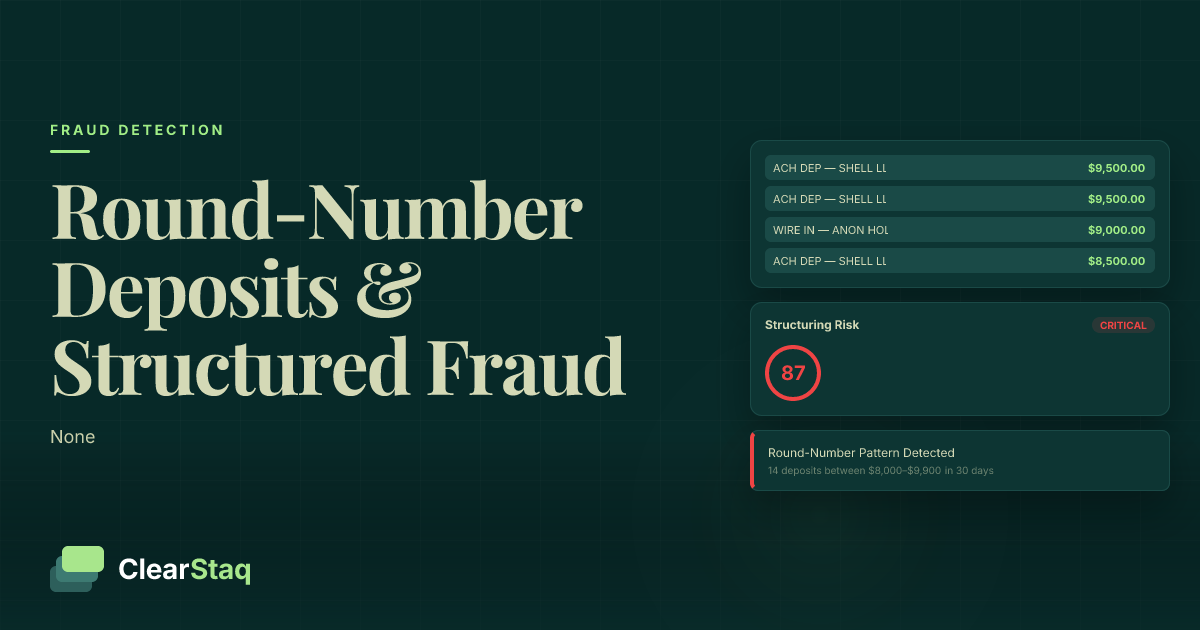
The fix isn't a new fraud tool. It's placement. Fraud detection integrated at intake catches altered documents before anyone spends time on them, and it catches structuring and commingling patterns that only surface once statement data is parsed. Get the sequencing wrong and you either slow every file down with redundant checks, or you miss fraud that a later-stage credit decision engine was never built to catch.
What you'll need
- A document intake point (email, portal upload, or API) where bank statements and tax returns first enter the system
- A parsing layer that converts PDFs into structured transaction data — ClearStaq handles 900+ statement formats and returns results in under 5 seconds
- Defined fraud thresholds for your risk team (which signals trigger a hard stop vs. a flag for manual review)
- API or webhook access from your loan origination system (LOS) so fraud scores write back to the file automatically
- A fallback manual review queue for flagged files — don't let fraud detection become a black box with no human escalation path
The steps
1. Map every document touchpoint in the current workflow
Before adding any tool, list every place a document enters your pipeline: broker portal, email attachment, borrower self-upload, or CPA-submitted PDF. Fraud enters at the weakest touchpoint, usually the one with the least verification — often a broker submission that's been forwarded three times and re-saved as a new PDF.
Write down the format mix too. Lenders working commercial deals in 2026 see statements from regional banks, credit unions, and neobanks in the same week, and inconsistent formats are exactly where manual reviewers miss doctored entries.
Common mistake: teams map only the primary upload channel and miss the side-door submissions (email, fax, broker CRM exports) where most tampered documents actually arrive.
2. Run parsing and fraud scoring at the same step, not sequentially
Don't parse a statement, hand it to underwriting, and then run fraud detection as a separate pass. Combine them. When parsing and fraud scoring happen in the same API call, you get transaction-level data and a fraud score back together — no second round trip, no second wait.
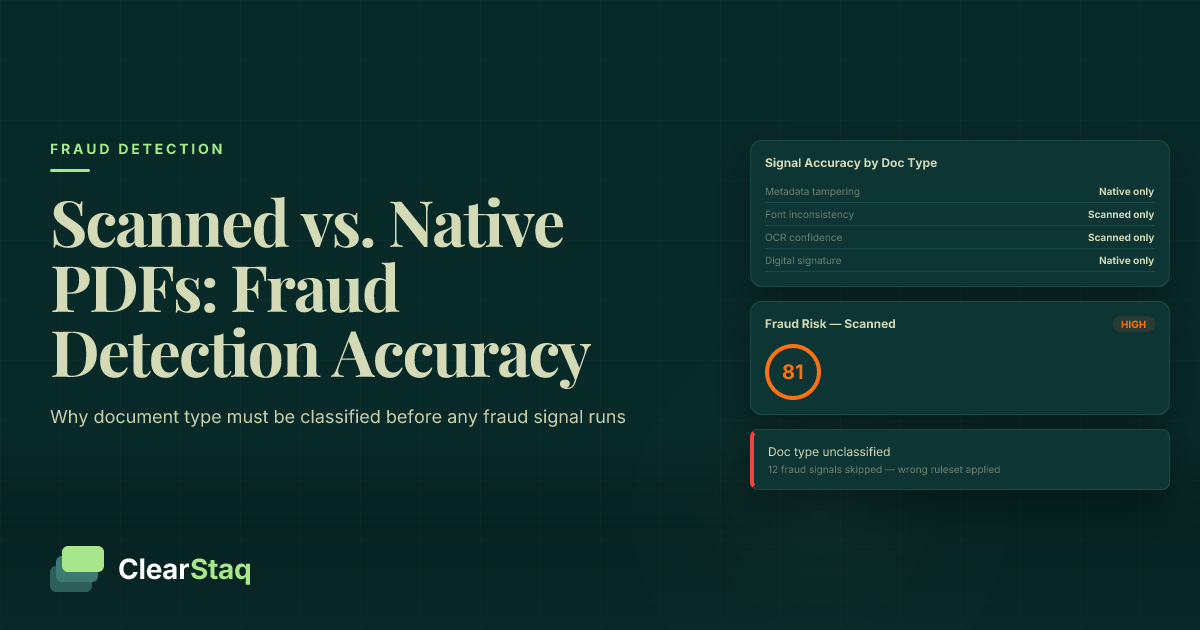
This is where the 27+ AI signals matter: font inconsistencies, metadata mismatches, altered running balances, and transaction pattern anomalies all get checked against the same parsed data set the underwriter will use for income calculation. One pass, one output.
Expected outcome: a file enters the queue already tagged clean, flagged, or rejected — before an underwriter opens it.
3. Set hard-stop thresholds for document-level fraud
Not every flag needs a human. Define which signals auto-reject: cloned PDFs, mismatched bank routing metadata, or balance sequences that don't reconcile mathematically. These are binary — a document is either internally consistent or it isn't.
Detail on the specific tampering patterns that should trigger auto-rejection versus manual review is covered in how to detect fake bank statements in loan applications — use it to calibrate your own threshold list rather than guessing at cutoffs.
Common mistake: setting thresholds too loose because "we don't want to reject good borrowers," which just pushes tampered files into the manual queue where they get missed anyway.
4. Add identity-layer checks before income verification
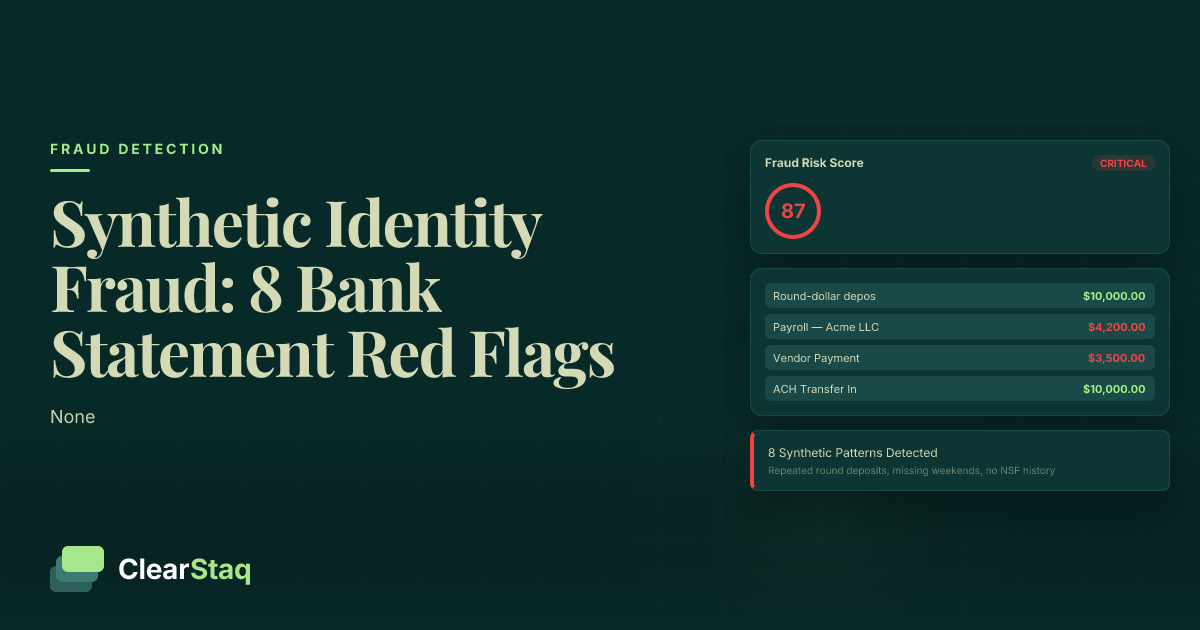
Document fraud and identity fraud are different problems that need different signals. A statement can be internally consistent and still belong to a synthetic identity — a fabricated SSN paired with a real address, or a thin-file identity built up over 18-24 months specifically to pass a credit pull.
Run identity verification before income calculation, not after. If the borrower doesn't exist as claimed, the income number is irrelevant. The specific signal combinations that catch synthetic identities — velocity of account opening, cross-bureau inconsistencies, device fingerprint mismatches — are broken down in how to detect synthetic identity fraud in loan applications.
Expected outcome: identity-flagged files get pulled before your team spends time calculating DSCR on an application that shouldn't reach that stage.
5. Route flagged files to a review queue with the fraud signal attached
A flag with no context creates more work than manual review did. When a file gets flagged, the underwriter needs to see which of the 27+ signals triggered — altered balance, inconsistent font, transaction pattern anomaly — not just a red badge.
Build the review queue so the specific signal and its confidence score travel with the file. This turns a 30-minute manual re-review into a 2-minute confirmation.
Common mistake: sending flagged files back into the general underwriting queue instead of a dedicated fraud review lane, which buries urgent flags under routine files.
6. Write fraud scores back to the LOS automatically
Manual re-entry of fraud scores into your loan origination system is where integrations break down in practice. If a fraud score requires someone to copy a number from one screen into another, it will get skipped during high-volume weeks.
Use API or webhook write-back so the fraud score, confidence level, and flagged signals populate the LOS file automatically the moment parsing completes. This is the difference between fraud detection as a process and fraud detection as a tool nobody opens.
Expected outcome: every file in the LOS carries a fraud score by the time an underwriter is assigned, with zero manual data entry.
7. Audit false positive and false negative rates monthly
Fraud patterns shift. Structuring techniques, doctored pay stub styles, and synthetic identity tactics evolve month to month, and a threshold set in early 2026 may be too loose or too tight by Q3.
Pull a sample of flagged files and a sample of clean files each month. Check how many flagged files were actually clean (false positives slowing down good borrowers) and how many clean files later showed fraud indicators in servicing (false negatives). Adjust thresholds based on that data, not gut feel.
Common mistake: setting thresholds once at implementation and never revisiting them as fraud patterns change.
Troubleshooting
- Fraud scores arrive after underwriting already started: the parsing and fraud-scoring API calls are running sequentially instead of combined — check your integration for redundant round trips.
- Too many false positives on legitimate self-employed borrowers: self-employed income patterns look irregular by nature; tighten thresholds specifically for that segment rather than applying commercial lending cutoffs across the board.
- Reviewers ignore flags: flags without the underlying signal context get treated as noise — attach the specific triggered signal, not just a pass/fail flag.
- Different bank formats produce inconsistent fraud scoring: a format-aware parser matters here — inconsistent scoring across Chase, Bank of America, and regional bank formats usually means the parsing layer isn't normalizing statement structure before scoring.
- LOS write-back fails intermittently: check webhook retry logic; a single failed write-back with no retry silently drops fraud scores from the file.
- Manual review queue backs up during high-volume weeks: re-check your hard-stop thresholds — if too few signals trigger auto-rejection, your manual queue absorbs volume it shouldn't have to handle.
Tools and resources
- Format-aware parsing layer covering major bank formats (900+ formats, sub-5-second turnaround)
- Defined fraud threshold matrix reviewed monthly against false positive/negative rates
- API or webhook connection between the parsing layer and your LOS
- Dedicated fraud review queue separate from standard underwriting
- A process reference for cutting review time further once fraud detection is live: how to automate bank statement review for underwriting teams
What to do next
Once fraud detection is running at intake, the next bottleneck is usually manual review time on the files that pass fraud checks but still need income verification. Fixing the fraud layer without addressing that step leaves half the time savings on the table.
FAQ
Where should fraud detection sit in a loan origination workflow?
Fraud detection should run at document intake, combined with parsing, before an underwriter opens the file. Placing it later means underwriters waste time on files that should have been auto-rejected at submission.
How to integrate fraud detection into a loan origination workflow without slowing down approvals?
Combine parsing and fraud scoring in a single API call so results return in under 5 seconds instead of running two sequential passes. Write scores directly to the LOS via webhook so no manual data entry adds delay.
What fraud signals matter most in bank statement review?
Altered running balances, metadata mismatches, font inconsistencies, and transaction pattern anomalies catch the majority of doctored statements. A parser scoring 27+ signals covers both document-level and pattern-level fraud in one pass.
Is API integration better than manual fraud checks for lenders?
Yes, for any lender processing more than roughly 50 applications a month. Manual fraud review doesn't scale past that volume and introduces inconsistent judgment calls across reviewers.
How much does fraud detection reduce underwriting review time?
Lenders integrating fraud detection at intake report review time cuts of up to 95% on files that would have otherwise required full manual document review before rejection.
How often should fraud detection thresholds be reviewed?
Monthly, at minimum. Fraud tactics shift throughout 2026, and thresholds set at implementation get stale within one or two quarters without a false positive/negative audit.
Does fraud detection replace manual underwriting review entirely?
No. It removes the document-level triage work so underwriters spend their time on judgment calls — DSCR, cash flow trends, risk tolerance — rather than checking whether a PDF was altered.
What's the biggest mistake lenders make integrating fraud detection?
Running fraud checks as a separate step after underwriting has already started, instead of at document intake. This wastes reviewer time on files that should never have reached them.
One last thing
The lenders getting the most out of fraud detection in 2026 aren't the ones with the most signals turned on — they're the ones who moved the check earlier in the pipeline. A 27-signal fraud engine sitting after underwriting catches the same fraud a 5-signal engine would catch at intake, just 40 minutes too late.
Related guides
ClearStaq Team
Content Team
The ClearStaq team builds AI-powered tools for bank statement parsing, fraud detection, and income verification.