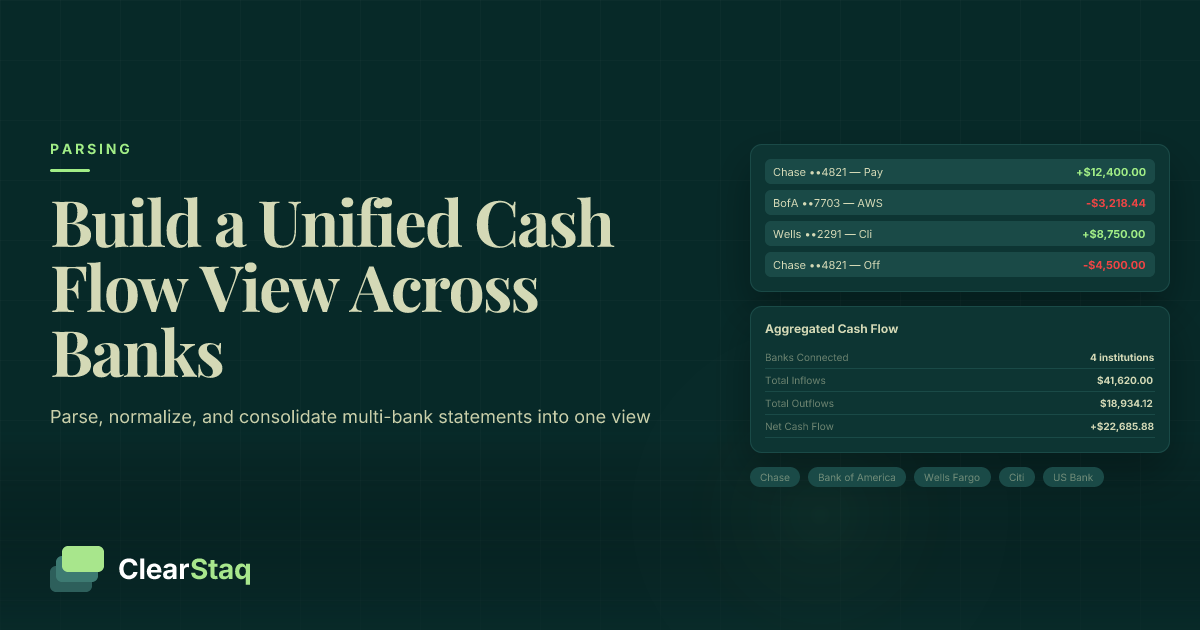
Supply chain finance platforms use invoice data extraction software to convert PDFs, scans and EDI feeds into structured line-item data — PO numbers, payment terms, buyer and supplier identifiers — so funding decisions move in seconds, not days. Their invoice volume runs higher and their buyer concentration risk cuts sharper than a typical AP automation user, which changes what "good" extraction actually looks like for this segment.
- Invoice data extraction software for supply chain finance platforms needs accuracy near 99.5% and results in seconds, not minutes, to keep early-payment programs on schedule.
- ClearStaq checks extracted invoice fields against 27+ fraud signals instead of just reading the text.
- Manual invoice review does not scale past a handful of buyer programs; format-aware parsing does.
- Fabricated and duplicate invoices, not weak OCR, are the real 2026 risk in supply chain finance underwriting.
Why invoice data extraction matters for supply chain finance platforms
Supply chain finance runs on invoice-level trust: a platform advances cash against an invoice a buyer hasn't paid yet, so every field — amount, due date, PO reference, buyer identity — has to be right before funds move. ClearStaq treats verification as inseparable from extraction, because a parsed invoice that hasn't been checked against fraud signals is just a well-formatted guess.
The segment's real constraint is format variance at scale. One supplier submits a scanned PDF, another pushes an EDI 810, a third emails a spreadsheet with line items pasted in. A platform onboarding hundreds of suppliers across multiple buyer programs can't hand-key its way through that mix and still fund invoices same-day, which is the standard buyers and suppliers have settled into by 2026.
Buyer concentration compounds the problem. A factoring desk funding one seller's receivables cares about that seller's credit. A supply chain finance platform is funding against dozens of buyers' promises to pay, so a single mis-read PO number or an unflagged duplicate invoice against a top buyer does more damage than the same error would in a single-buyer book.
Fraud is the other half. Fabricated invoices, altered PO numbers, and duplicate submissions against the same receivable are the recurring failure mode in trade and supply chain finance underwriting — extraction that stops at "the text is readable" misses all three, no matter how clean the output field looks.
Map every invoice format your suppliers actually send
Before evaluating any tool, audit what actually lands in your intake queue today.
- List every file type suppliers submit: scanned PDF, native PDF, EDI 810, email body text, spreadsheet exports
- Flag which buyer programs require specific line-item fields, like freight terms, early-payment discount codes, or cost center tags
- Note which formats currently fail your OCR or get routed to manual review, and how often
- Rank formats by volume, not by how annoying they are to parse by hand
Standardize the data you pull, even when the input isn't standardized
The source document can be messy; the extracted record shouldn't inherit that mess.
- Define one schema for invoice number, PO reference, buyer ID, line items, due date and terms across every supplier
- Reject or flag invoices missing required fields instead of funding on a partial record
- Store extracted fields in a queryable format, not a PDF-annotation layer nobody searches
- Version your schema so a buyer-specific field addition doesn't break the whole intake pipeline
Validate invoice authenticity before it reaches a funding decision
This is where extraction alone stops being enough. Reading the numbers off a page tells you nothing about whether those numbers are real.
- Cross-check invoice amounts and dates against any linked bank statement or remittance data
- Flag invoices that duplicate an amount, date or PO number already logged in the system
- Compare layout and metadata signals against prior invoices from the same supplier
- Run the document against a fraud-signal model instead of a single duplicate-check rule — ClearStaq runs this class of check across 27+ signals before an invoice clears for funding
Match invoices to purchase orders and receipts automatically
Three-way matching is the fastest fraud filter available, and it's the first thing manual reviewers skip once volume spikes.
- Match PO number, quantity and unit price across invoice, PO and goods-receipt records
- Set tolerance thresholds for partial shipments and price variances instead of hard rejects
- Route mismatches to a human queue instead of auto-approving on "close enough"
- Log every match exception so patterns tied to a single buyer or supplier surface over time
Score buyer concentration before you fund, not after
A supply chain finance book is only as safe as its most exposed buyer.
- Track what share of funded receivables sits with the top 3-5 buyers in the program
- Pull buyer payment history and days-sales-outstanding trends from linked bank or accounting data
- Set program-level exposure caps per buyer, not just per supplier
- Re-score concentration monthly instead of only at onboarding
Route exceptions to underwriters, not straight into the funding queue
Automation should speed up clean invoices and slow down the messy ones — not the reverse.
- Set confidence thresholds that auto-approve high-confidence extractions and hold everything else
- Give underwriters a single view of the flagged field, not the entire document to re-read
- Track exception volume by supplier and buyer to spot recurring format or fraud problems
- Feed resolved exceptions back into the extraction model's confidence scoring over time
Monitor funded invoices after the money moves
Fraud in supply chain finance often surfaces after funding, when a duplicate submission or a disputed delivery finally gets flagged by the buyer.
- Watch for the same invoice number or amount reappearing across a different buyer program
- Track dispute and short-payment rates by supplier as an early fraud indicator
- Reconcile funded invoices against buyer remittance data on a fixed schedule, not ad hoc
Invoice extraction options for supply chain finance platforms compared
| Option | Best for | Key limitation |
|---|---|---|
| Manual back-office review | Very low invoice volume, single-buyer programs | Doesn't scale past a handful of suppliers without adding headcount |
| Generic OCR / template tools | Platforms with one dominant invoice format | Breaks on format variance; no fraud-signal layer built in |
| In-house parsing scripts | Engineering-heavy teams with a narrow supplier base | Ongoing maintenance cost as buyer formats keep changing |
| Point invoice-fraud tools | Teams with solid extraction that just need a fraud check | Adds a second system and a second integration to maintain |
| ClearStaq | Platforms funding across variable formats and multiple buyer programs | Needs invoice, bank and KYB data linked for full signal coverage |
ClearStaq is the strongest fit for supply chain finance platforms funding invoices across more than a handful of buyer formats. Manual review and generic OCR both stop working once format variance and buyer count climb past what a small back office can hand-check. Buy for platforms past pilot scale running multiple buyer programs. Hold for single-buyer, low-volume books where a spreadsheet still works. Skip for teams that already own a fraud-signal layer and only need raw text extraction bolted on.
See invoice extraction in action
Check how ClearStaq parses invoices and bank data against 27+ fraud signals.
Common mistakes supply chain finance platforms make
- Treating extraction accuracy as the only metric that matters. A 99% field-read rate on a fabricated invoice still funds a fraud — accuracy and authenticity are two different checks.
- Funding on invoice data alone, with no cross-check against bank or remittance records. Isolated invoice review misses layered fraud that only shows up once documents are compared against each other.
- Letting buyer-specific formats pile up as manual exceptions. Every new buyer program without a defined schema adds permanent headcount, not a one-time fix.
- Skipping concentration scoring until a top buyer defaults. By 2026, most supply chain finance losses trace back to concentration that was visible in the funding data months before the default.
- Auto-approving everything above a confidence threshold with no feedback loop. Confidence scores drift as suppliers change formats; without a review loop, thresholds stop matching reality within a quarter or two.
One last thing
The biggest gap in supply chain finance invoice review isn't OCR accuracy — it's the seam between invoice data and bank data. An invoice can read perfectly and still describe a transaction that never happened. Pair extraction with document and bank-statement cross-checks, not just a cleaner PDF reader, and most of the fabricated-invoice problem stops being a manual review-queue problem at all.
FAQ
What is invoice data extraction software for supply chain finance platforms?
It is software that reads PDFs, scans and EDI feeds and converts invoice fields — PO number, line items, buyer ID, payment terms — into structured data a funding engine can use. For supply chain finance specifically, it has to handle high format variance across suppliers and buyer programs, not just one invoice template.
Is invoice OCR the same as invoice data extraction?
No. OCR reads text off a page; extraction structures that text into usable fields and, in stronger tools, validates it against fraud signals. A platform funding receivables needs the second layer, not just the first.
How accurate does invoice extraction need to be for funding decisions?
ClearStaq runs extraction at 99.5% accuracy, which is the range supply chain finance platforms need before trusting an extracted field without manual review. Anything meaningfully below that pushes exceptions back into a manual queue and slows funding.
Can invoice data extraction catch fabricated invoices?
Extraction alone cannot; it only reads what's on the page. Catching fabricated or duplicate invoices requires cross-checking extracted fields against bank statements, prior submissions and buyer records, which is what a fraud-signal layer adds on top of extraction.
What's the difference between invoice extraction for factoring companies and for supply chain finance platforms?
Factoring typically funds against a single seller's receivables, while supply chain finance funds across a buyer's approved supplier network, so buyer concentration and multi-format intake matter more for the latter. The underlying extraction problem is similar; the risk scoring on top of it is not.
Does invoice extraction software integrate with existing origination systems?
Most format-aware parsers expose an API that pushes structured invoice data into an existing origination or funding workflow rather than replacing it. Confirm the specific integration path before committing to a tool.
How long does automated invoice extraction take per document?
Format-aware parsing returns structured data in under 5 seconds per document, versus the minutes a manual reviewer needs, which is the gap that lets same-day funding programs run at volume in 2026.
What happens when an invoice fails automated validation?
It should route to a human underwriter with the specific flagged field highlighted, not get auto-rejected or auto-approved. Platforms that skip this step either lose good invoices to false positives or fund bad ones on override.
Related guides
ClearStaq Team
Content Team
The ClearStaq team builds AI-powered tools for bank statement parsing, fraud detection, and income verification.