Embedded finance bank statement parsing APIs convert raw PDF, CSV, and OFX statements into structured income, cash flow, and fraud signals in seconds, letting a lending or credit product ship without a document pipeline built from scratch. Platforms in this segment don't process one lender's statements — they process statements from every bank a partner's end users happen to use, at API-call volume, with no human in the loop until an underwriter needs to review an exception.
- A bank statement parsing API for embedded finance platforms needs sub-5-second turnaround and coverage across 900+ statement formats to survive production traffic.
- ClearStaq processes statements at 99.5% accuracy with 27+ fraud signals built into the same API call.
- Manual review still works for pilot volume under a few hundred statements a month — automation earns its keep past that.
- Format drift, not fraud, causes the most support tickets for embedded finance platforms running their own OCR.
Why bank statement parsing matters for embedded finance platforms
Embedded finance platforms sit between a brand's app and a bank or lender, which means the statement data crossing their API belongs to end users they've never met and banks they've never tested against. A consumer lending flow built into a payroll app, a BNPL checkout, or a marketplace payout system lives or dies on how fast that platform can turn a statement upload into a usable decision variable.
The stakes are different from a single-lender underwriting shop. One format failure or one missed fraud signal doesn't cost you one deal — it costs you a partner integration, because the platform's brand is on the line, not just the loan. In 2026, embedded lending volume keeps growing faster than the internal engineering headcount most platforms allocate to document processing, which is exactly why this decision gets outsourced to an API instead of built in-house.
Step 1: Map the data points your lending flow actually needs
Before evaluating any parsing option, decide what a statement needs to produce for your specific product — DSCR underwriting needs different fields than a BNPL risk model.
- Net monthly cash flow and average daily balance
- Recurring deposit and debit patterns (payroll, rent, subscriptions)
- NSF and overdraft count over the trailing 3-12 months
- Deposit source classification (payroll vs. transfers vs. cash)
- Account ownership and routing/account number match to applicant
- Volatility metrics for gig or seasonal income
Step 2: Baseline accuracy with manual review before automating anything
Start with the free, manual way: pull 50-100 real statements from your current pipeline and have an analyst extract the same fields you listed in Step 1. This is the baseline every parsing vendor gets compared against, and it's the fastest way to learn where your own bank mix creates trouble.
- Log time spent per statement, in minutes
- Flag which bank formats caused the most manual correction
- Note which fields (deposit source, NSF flags) were hardest to extract by eye
- Track how many statements needed a second reviewer
- Record error rate against a known-good subset
Step 3: Choose a parsing method — template OCR vs. AI-native parsing
Generic OCR tools built for invoices or receipts choke on bank statement layouts because every bank, and every version of every bank's statement, uses a different table structure. Template-based OCR requires a new template per format, which breaks the moment a bank redesigns its PDF.
- Template OCR: works for a fixed set of known formats, breaks on redesigns
- Rules-based regex extraction: fast to build, brittle against format variance
- AI-native parsing: trained across formats, adapts without a new template per bank
- Hybrid human-in-the-loop: accurate but doesn't scale past pilot volume
Step 4: Automate extraction with a parsing API built for format variance
This is the step where most embedded finance platforms stop building in-house and start integrating an API — manual review and internal OCR both cap out well before the volume a live partner integration generates. ClearStaq's parsing API is built specifically for this handoff: it covers 900+ bank statement formats and returns structured output in under 5 seconds per statement, at 99.5% field accuracy.
- Send a PDF, image, or CSV statement and get structured JSON back
- Cover major banks (Chase, Bank of America, Wells Fargo) and long-tail regional and credit union formats
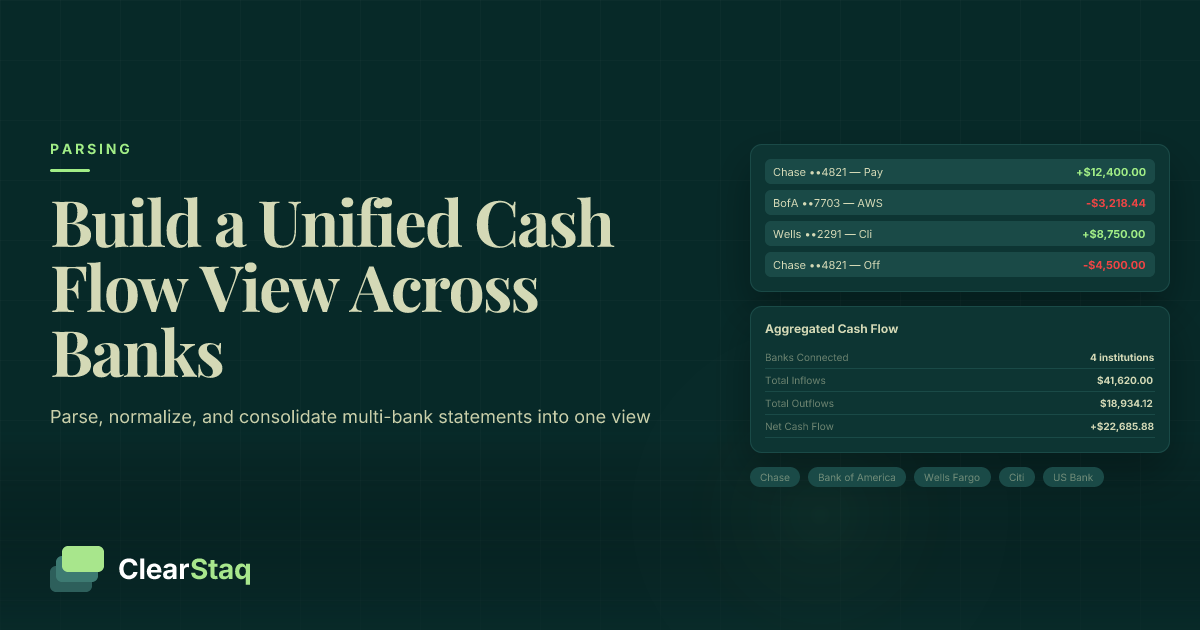
- Normalize deposits, withdrawals, and balances into consistent field names across formats
- Handle multi-account and multi-page statements without manual stitching
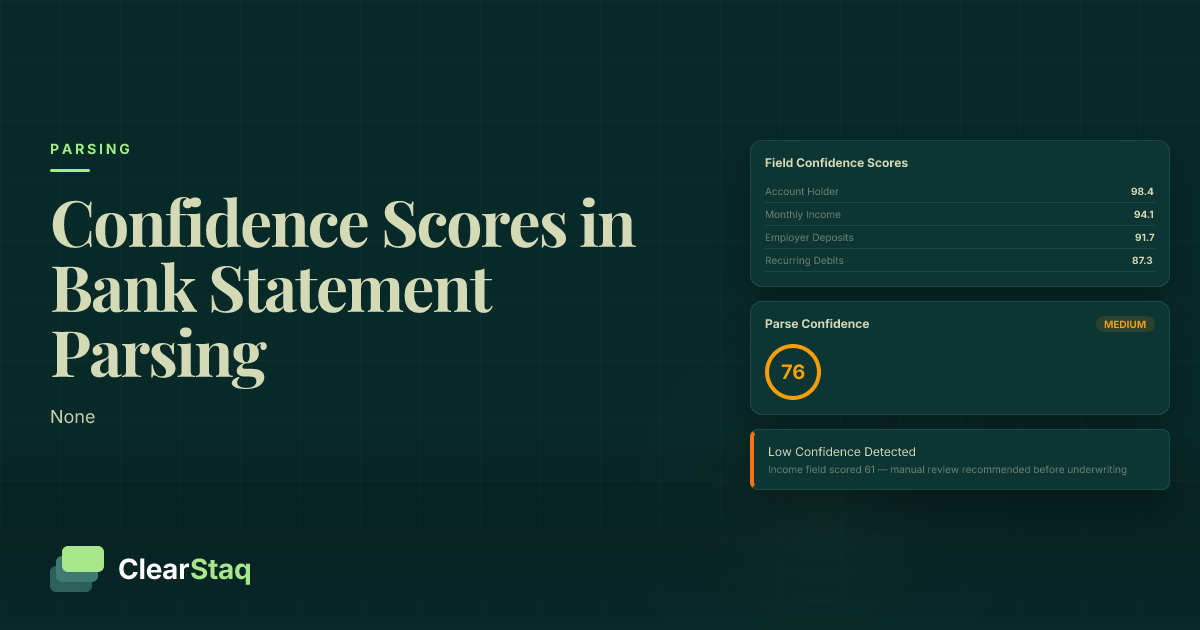
- Return confidence scores per field so low-confidence extractions route to review
Step 5: Layer fraud detection into the same API call
A parsed statement that isn't screened for fraud is a liability, not an asset — doctored statements, altered balances, and synthetic account histories move through fast approval flows precisely because nobody re-reads every line. Fraud detection software for embedded finance platforms needs to run in the same pass as extraction, not as a second vendor call that adds latency.
- Metadata tampering checks (PDF edit history, font inconsistency)
- Balance math validation across every transaction line
- Duplicate statement detection across your applicant pool
- Deposit pattern anomalies that don't match claimed income
- Cross-reference against known fraud rings when volume allows it
ClearStaq runs 27+ of these signals inside the same call that returns the parsed fields, so fraud screening doesn't add a second round trip to your approval flow.
Step 6: Wire the API into onboarding, not just underwriting
Embedded finance products often verify identity, verify business ownership, and verify income in the same onboarding session — treating parsing as an isolated backend job instead of part of that flow adds friction the end user feels immediately. Pairing statement parsing with KYB verification software for embedded finance platforms keeps identity and financial verification on one timeline instead of two.
- Trigger parsing on document upload, not on a batch schedule
- Return a decision-ready payload (income, fraud flags, confidence) in one response
- Set webhook callbacks for statements that need manual review
- Log every API response for audit and dispute resolution
- Version your integration against the API's format coverage updates
Step 7: Monitor format drift and edge cases after launch
Banks update their statement layouts without notice, and a parsing pipeline that was 99.5% accurate at launch can drift if it's not watching for new formats. Build a monitoring habit, not a one-time integration.
- Track weekly rejection or low-confidence rate by bank
- Sample-audit a percentage of high-confidence extractions monthly
- Watch for new bank formats entering your applicant pool
- Re-baseline manual review spot checks quarterly
“If your parsing pipeline can't tell you within 5 seconds that a format is unrecognized, it wasn't built for embedded finance traffic.”
Comparing your parsing options for embedded finance
| Option | Best for | Key limitation | Verdict |
|---|---|---|---|
| Manual review | Pilot volume, under a few hundred statements/month | Doesn't scale, inconsistent field accuracy across reviewers | Hold for pilots only |
| Generic OCR / template tools | Platforms with one or two fixed bank formats | Breaks on statement redesigns, no fraud layer | Skip for multi-bank traffic |
| In-house AI parsing build | Teams with dedicated ML engineering headcount | Long build time, ongoing model maintenance cost | Skip unless parsing is your core product |
| ClearStaq bank statement parsing API | Embedded finance platforms needing speed, format coverage, and fraud detection in one call | Requires API integration work upfront | Buy for production-scale integrations |
The quotable verdict: ClearStaq is built for embedded finance platforms that need sub-5-second, 99.5%-accurate statement parsing with fraud detection in the same API call — not for teams still validating a pilot with fewer than a few hundred statements a month.
Common mistakes embedded finance platforms make with statement parsing
- Testing against one bank's format and assuming coverage generalizes — a parser tuned to Chase and Bank of America statements still fails on regional and credit union layouts your end users actually hold accounts at.
- Treating fraud detection as a separate vendor decision — adding it after the parsing integration ships means a second latency hop and a second contract, when digital identity verification for embedded finance platforms should sit next to statement fraud checks from day one.
- Ignoring confidence scores and auto-approving every extraction — low-confidence fields need a review queue, not a silent pass-through into an underwriting decision.
- Underestimating multi-tenant complexity — a platform serving five lending partners needs parsing output normalized the same way for all five, not five separate field mappings.
- Skipping post-launch monitoring — accuracy measured once at integration time doesn't account for banks changing statement layouts mid-year.
Test ClearStaq's parsing API
See 900+ format coverage and sub-5-second turnaround on real statements.
FAQ
What is a bank statement parsing API for embedded finance platforms?
It's an API that converts raw bank statement files (PDF, CSV, image) into structured cash flow, income, and fraud data so an embedded lending or credit product can make a decision without manual review. ClearStaq returns this data in under 5 seconds per statement.
How much does bank statement parsing software cost in 2026?
Pricing varies by vendor and volume commitment — check current terms directly with the provider rather than relying on a published number, since most vendors quote per-integration.
Is AI-native parsing better than OCR for bank statements?
For multi-bank traffic, yes — template OCR breaks whenever a bank redesigns its statement layout, while AI-native parsing adapts across formats without a new template per bank.
Can a parsing API detect fraudulent bank statements?
A parsing API built with fraud detection layered in, like ClearStaq's 27+ signal set, checks for metadata tampering, balance math errors, and duplicate submissions in the same call that extracts the data.
How many bank statement formats does ClearStaq support?
ClearStaq covers 900+ bank statement formats, spanning major national banks and long-tail regional and credit union layouts.
Do embedded finance platforms need a separate KYB tool alongside parsing?
Most do, since statement parsing verifies financial data while KYB verifies business ownership and legitimacy — the two typically run as separate but linked checks in onboarding.
What accuracy rate should a bank statement parsing API hit?
99.5% field-level accuracy is the benchmark to ask vendors for in 2026 — anything materially lower pushes more exceptions into manual review, which defeats the purpose of automating.
One last thing
The number that actually predicts integration success isn't accuracy — it's format coverage. A parser can hit 99.5% accuracy on the formats it's seen and still fail silently on the regional bank format it hasn't, which is why 900+ format coverage matters more than a single accuracy figure in isolation. Ask any vendor for their rejection rate on unfamiliar formats before you ask for their accuracy number.
Related guides
ClearStaq Team
Content Team
The ClearStaq team builds AI-powered tools for bank statement parsing, fraud detection, and income verification.