Fabricated invoices are the single most common fraud vector in trade finance underwriting — a borrower submits a PDF that looks clean, and the deal closes on a receivable that never existed. This guide walks through the exact checks that catch a fabricated invoice before funding, step by step.
TL;DR
Catching a fabricated invoice in trade finance underwriting comes down to seven checks: metadata history, invoice number sequencing, independent buyer confirmation, bank deposit matching, entity registry verification, round-dollar pattern detection, and a fraud signal score. Manual review of these seven checks takes 4-6 hours per file in 2026; a parsing platform like ClearStaq runs the same checks in under 5 seconds with 99.5% accuracy across 900+ statement and document formats. Verdict: run the metadata and deposit-match checks on every invoice-backed file — skipping either one is how factoring fraud gets through underwriting.
Why this matters
Trade finance and invoice factoring run on a simple promise: the receivable is real and the buyer will pay it. When that promise is fake, the lender is left holding paper against a debtor who never ordered anything.
Double-pledging — the same invoice sold to two different factoring companies — and wholly fabricated invoices against shell buyers are the two patterns underwriters see most in 2026. Both patterns pass a visual review. Both fail a metadata and cross-reference check almost every time. The gap between what looks right and what is right is exactly where fabricated invoice fraud lives, and it's why manual underwriting still misses files that automated cross-checking catches in seconds.
What you'll need
- The submitted invoice PDFs, not screenshots or re-typed copies
- The borrower's business bank statements for the same period (60-90 days minimum)
- A way to pull PDF metadata (creation date, modification date, producing software)
- Access to a public business entity registry (Secretary of State or equivalent)
- A method to contact the named buyer independently of the borrower
- A document fraud detection platform if you're processing more than a handful of files a month — manual cross-checking doesn't scale past 10-15 files
The steps
1. Pull the metadata history on every submitted invoice PDF
Metadata tells you when a document was actually created, not when the borrower says it was created. Check the "Created" and "Modified" timestamps and the producing application field.
An invoice dated March 2026 but created in a PDF editor in September 2026 is a fabrication, full stop. Watch for files produced in generic tools like "Microsoft Print to PDF" or "Adobe Acrobat Pro" on a document that should have come from the buyer's own invoicing system — most enterprise buyers issue invoices through ERP platforms with identifiable metadata signatures.
Common mistake: stopping at the visible date field on the invoice and never opening the file properties. The visible date is whatever the borrower typed in; the metadata is what the software recorded.
2. Cross-check invoice numbers against sequence and issuance dates
Real invoicing systems assign sequential numbers. If a borrower submits invoice #4021 dated January and invoice #4019 dated March, the sequence is broken and one of the two dates is fabricated.
Line up every submitted invoice number against its date and look for gaps, repeats, or reversed order. A single anomaly might be a typo. Three or more in one file is a pattern, not an accident.
3. Verify the buyer independently — never through the borrower
Call or email the named buyer using contact information you source yourself, not contact information provided by the borrower. Confirm the invoice amount, the goods or services, and the expected payment date.
This single step catches the majority of wholly fabricated invoices in 2026 underwriting reviews, because a fabricated buyer either doesn't exist, doesn't answer, or actively denies the invoice when reached. Common mistake: accepting a "buyer confirmation" email that arrived through an address the borrower supplied — that's not independent verification, that's the borrower confirming their own fraud.
4. Match invoice amounts against bank statement deposits
A legitimate receivable eventually shows up as a deposit, even if it's a partial payment or a different amount due to early-pay discounts. Pull the borrower's bank statements and look for a deposit that lines up with the invoice amount within a reasonable window of the stated due date.
If 60-90 days of statements show zero deposits matching any of the submitted invoices, the receivables are either not real or already collected and hidden — both are underwriting-stopping findings. Parsing platforms that extract deposit-level detail from bank statements make this check fast; manually scanning three months of statement line items against ten invoices is where reviewers burn hours and still miss matches.
5. Run the buyer and vendor entities against a public registry
Search the named buyer in the Secretary of State (or equivalent) business registry for the state on the invoice. A buyer that doesn't exist as a registered entity, or that was dissolved before the invoice date, is a hard stop.
Check registration dates too — a buyer entity formed two weeks before a six-figure invoice was issued is a shell company pattern seen repeatedly in fabricated trade finance files in 2026.
6. Flag round-dollar and duplicate-value patterns
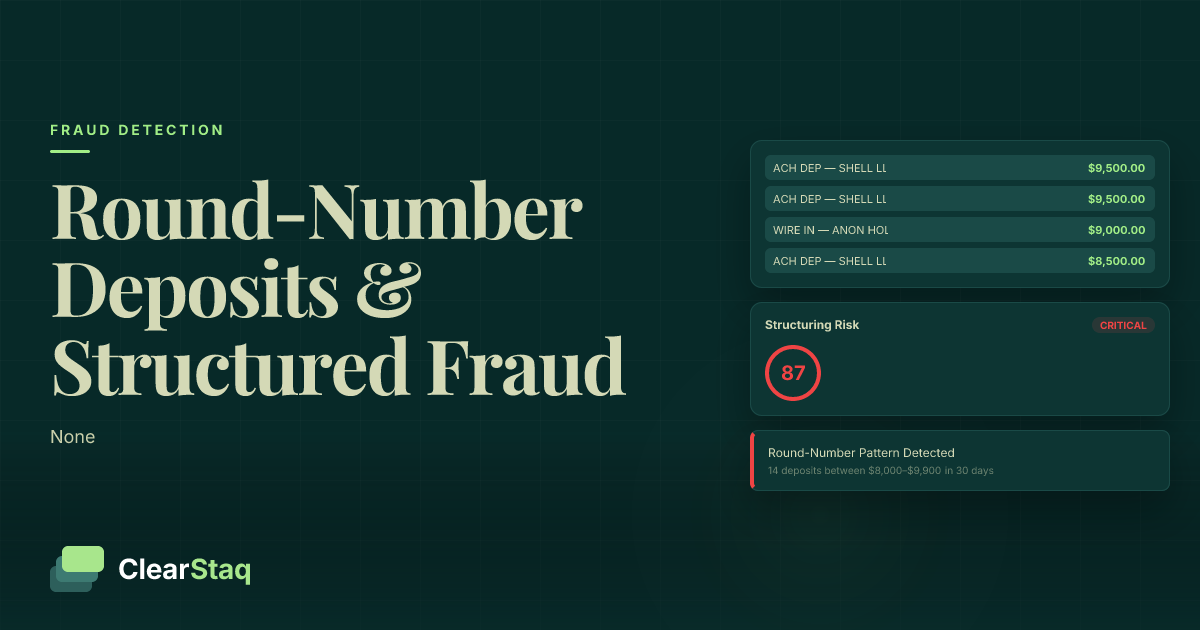
Real commercial invoices rarely land on exact round numbers like $50,000.00 or $75,000.00 across multiple submissions. Fabricated invoice sets often show clusters of round or near-identical amounts because the fabricator is working off a template rather than actual line-item billing.
Sort every submitted invoice by amount and flag anything that repeats or clusters suspiciously. Common mistake: treating one round number as normal — retainer and subscription invoices are legitimately round. Treat a cluster of three or more round, near-identical amounts across different buyers as the flag.
7. Score the file with a fraud signal model
Each of the six checks above produces a signal — a broken sequence, an unreachable buyer, a metadata mismatch. No single signal should sink a deal on its own, but two or more together should stop funding until resolved.
A platform running 27+ fraud signals in parallel across bank statements and supporting documents turns this from a judgment call into a score you can act on consistently, file after file. Manual review applies these checks inconsistently across different underwriters; a signal-based score doesn't.
Troubleshooting
The invoice PDF has no extractable metadata. Scanned or image-based invoices strip metadata by default — that's not automatically fraud, but it removes one of your seven checks. Lean harder on buyer verification and deposit matching for these files.
The buyer confirms the invoice but won't put it in writing. Get a callback number independently, note the date and time of the verbal confirmation, and follow up with a written request. A buyer that avoids written confirmation on a legitimate invoice is unusual enough to note as a soft flag.
Bank deposits don't match invoice amounts because of factoring already in place. If the borrower already factored the receivable elsewhere, the deposit shows up as a payoff from a different factoring company, not a direct payment from the buyer. This is the double-pledging pattern — check factoring UCC filings before assuming the mismatch is benign.
Round-dollar invoices keep triggering false positives on retainer clients. Build an exception list for confirmed recurring retainer buyers rather than disabling the round-dollar check entirely — most fabricated invoice fraud in 2026 still clusters around one-time large receivables, not recurring retainers.
The entity registry search returns nothing for a buyer with a plausible-sounding name. Search variations (LLC vs Inc, DBA names) before concluding the entity is fake — legitimate buyers do operate under DBAs that don't match the invoice header exactly.
Manual review is taking longer than the deal timeline allows. This is the most common failure point in trade finance underwriting in 2026 — reviewers either rush the seven checks or skip the ones that take longest (independent buyer verification, registry search). A parsing platform that automates the deposit-match and metadata checks frees up reviewer time for the buyer call, which still needs a human.
Tools and resources
- Secretary of State business registry for the buyer's state of incorporation
- PDF metadata viewer (built into most PDF readers under file properties)
- UCC filing search for existing factoring liens on the receivable
- Document fraud detection software for factoring companies for automated signal scoring across invoice-backed files
- Bank statement analysis software for factoring companies for deposit-matching at scale without manual line-item review
What to do next
Once the invoice checks are clean, the underwriting review isn't done — the borrower's own bank statements still need the same scrutiny for fabrication. Read how to detect fake bank statements in loan applications for the parallel checklist on the statement side of the file.
FAQ
What's the fastest way to detect a fabricated invoice? Independent buyer verification is the single fastest check — a phone call to a buyer sourced outside the borrower's provided contact info either confirms or kills the invoice in minutes. Pair it with a metadata check for a two-step screen that catches most fabrications in 2026 underwriting.
Is metadata checking reliable for catching fabricated invoices? Metadata checking is reliable for catching timeline inconsistencies but not foolproof — sophisticated fabricators can alter metadata timestamps. Use it as one signal among several, not a standalone verdict.
How much does document fraud detection software cost for trade finance lenders? Pricing varies by platform and file volume; check current pricing directly with the vendor rather than relying on published list prices, which change through 2026.
Can a legitimate invoice fail the round-dollar check? Yes — recurring retainer or subscription invoices are legitimately round. The flag is for clusters of round, near-identical amounts across different one-time receivables, not isolated round figures.
Does bank statement matching replace buyer verification? No. Deposit matching confirms money moved; it doesn't confirm the buyer relationship is real. Both checks catch different fraud patterns and neither substitutes for the other.
What's the difference between fabricated invoices and double-pledged invoices? A fabricated invoice references a receivable that never existed; a double-pledged invoice is a real receivable already sold to another factoring company. UCC filing searches catch double-pledging; buyer verification and metadata checks catch fabrication.
How many fraud signals should a file trigger before funding stops? One signal alone — a scanning artifact, a hard-to-reach buyer — often has an innocent explanation. Two or more signals together across the seven checks in this guide should pause funding until resolved.
Do smaller trade finance deals need the same level of invoice scrutiny? Deal size doesn't change the fraud pattern — fabricators target the underwriting process, not the dollar amount. Smaller deals just get less scrutiny in practice, which is exactly why they're targeted more often in 2026.
One last thing
The fabrication pattern that catches the most experienced underwriters off guard isn't a fake invoice — it's a real invoice with a real buyer that's already been factored somewhere else. Double-pledging passes every check on this list except the UCC filing search, so if that search isn't part of your standard file review in 2026, it's the single highest-value addition you can make this quarter.
Related guides
ClearStaq Team
Content Team
The ClearStaq team builds AI-powered tools for bank statement parsing, fraud detection, and income verification.