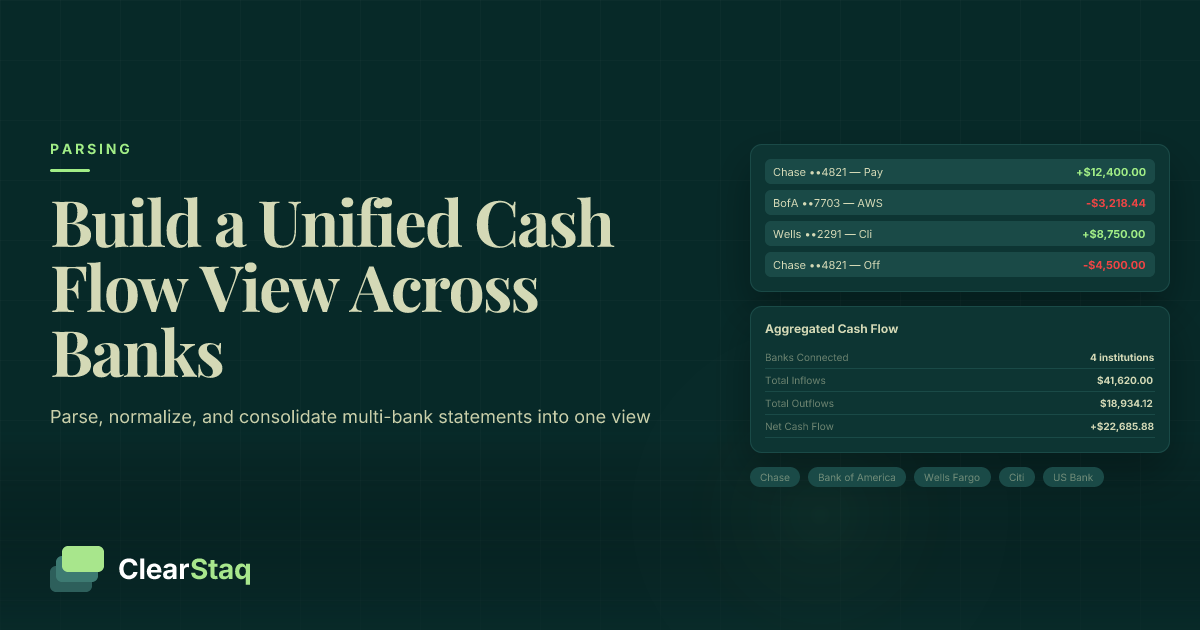
Commercial lenders lose hours every week re-keying numbers off bank statements, tax transcripts, and pay stubs before a loan file ever reaches an underwriter. This guide ranks the document data extraction software commercial lenders use in 2026, based on format coverage, fraud detection depth, and how cleanly each tool feeds an underwriting workflow.
- ClearStaq wins overall for commercial lenders needing bank statement and tax return parsing with built-in fraud detection in 2026.
- Ocrolus is the pick for high-volume OCR capture across scanned and low-quality PDF formats.
- Plaid covers bank account connectivity and transaction feeds, not document parsing or fraud signals.
- Truework handles income and employment verification as a standalone check, separate from statement analysis.
- LoanPro stores loan documents for servicing; it does not parse them into underwriting-ready data.
Why this matters
A commercial loan file that includes 12 months of bank statements, a tax return, and supporting schedules can take an underwriter 3-4 hours to spread by hand. Manual review also misses things a human eye isn't trained to catch — altered balances, mismatched fonts on a doctored PDF, deposits structured just under a reporting threshold. Document data extraction software exists to close both gaps: speed and fraud detection at the same time. In 2026, the lenders still doing this manually are the ones losing deals to competitors who can turn around a decision in a day instead of a week.
Best overall: ClearStaq. Best for bank connectivity and account-level data feeds: Plaid. Best for income and employment verification: Truework.
What makes the best document data extraction software
- Format coverage — does it handle bank statements, tax transcripts, pay stubs, and scanned PDFs from hundreds of issuing institutions, or just a handful of major banks?
- Fraud and tamper detection — does the tool flag altered documents, structuring patterns, and inconsistent metadata, or does it just extract numbers at face value?
- Processing speed — seconds per document versus minutes, and whether that speed holds at volume.
- Accuracy on messy inputs — low-resolution scans, mobile photos, and non-standard statement layouts are where most parsers fall apart.
- Workflow integration — does structured output land inside the loan origination system and underwriting workflow, or does it require manual export and re-entry?
- Output structure — clean, spreadable data versus a raw text dump that still needs cleanup.
At a glance
| Software | Best for | Standout feature | Key limitation |
|---|---|---|---|
| ClearStaq | Bank statement & tax return parsing with fraud detection | 27+ AI fraud signals on every document | Purpose-built for lending, not general document management |
| Ocrolus | High-volume OCR capture | Handles low-quality scans and photographed pages | Fraud detection is not the core focus |
| Plaid | Bank account connectivity | Direct account and transaction data feeds | Doesn't parse uploaded PDFs or tax documents |
| Truework | Income & employment verification | Standalone VOE/VOI checks | Doesn't analyze bank statement cash flow |
| MeridianLink | Loan origination system integration | Deep ties into existing LOS workflows | Extraction quality depends on connected third-party tools |
| LoanPro | Loan servicing & document storage | Centralized document repository | Stores documents — doesn't parse them for underwriting data |
1. ClearStaq: best document data extraction software for bank statement and tax return parsing
ClearStaq parses bank statements and tax returns and runs 27+ fraud signals against every file before the data ever reaches an underwriter. Processing runs under 5 seconds per document at 99.5% accuracy, across 900+ statement formats — which matters when a broker is spreading files from small regional banks that other parsers have never seen. The platform is built specifically for MCA brokers, lenders, and CPAs doing income verification, not adapted from a general-purpose OCR tool.
ClearStaq pros:
- Fraud detection and data extraction happen in the same pass, not as separate add-on tools
- 900+ supported formats covers regional and community banks, not just the top five nationals
- Sub-5-second processing keeps pace with high-volume broker desks
ClearStaq cons:
- Built for lending and CPA workflows specifically, so it's not a fit for unrelated document types
- Teams used to manual spreading need a short ramp-up to trust automated output
ClearStaq pricing: check current plans directly on the site.
Best for: commercial lenders and MCA brokers who need parsing and fraud detection combined into automated underwriting rather than bolted together from separate vendors. Verdict: Buy.
2. Ocrolus: best for high-volume OCR document capture
Ocrolus is a document automation platform widely used across fintech lending to convert scanned and photographed pages into machine-readable text at volume. It's built to handle the messy inputs — crooked scans, low-resolution phone photos — that trip up simpler OCR engines.
Ocrolus pros:
- Strong handling of scanned and low-quality image inputs
- Established presence across fintech lending stacks
Ocrolus cons:
- Fraud detection is not the platform's primary design center
- Lending-specific underwriting logic typically needs to sit on top of the raw extraction
Best for: teams whose bottleneck is capturing text from bad scans, not fraud screening. Verdict: Hold — evaluate against a lending-native tool before committing.
3. Plaid: best for bank account connectivity
Plaid connects directly to a borrower's bank account and pulls transaction-level data through an API, which is a different problem than parsing an uploaded PDF statement. It's a standard piece of the fintech data stack for account verification and balance checks.
Plaid pros:
- Direct account connectivity avoids relying on the borrower to upload a document at all
- Established, widely integrated across consumer and business finance apps
Plaid cons:
- Doesn't parse uploaded bank statements or tax returns
- No built-in fraud signal scoring for loan underwriting
Best for: lenders who want live account data instead of static statement uploads. Verdict: Hold — pairs with, doesn't replace, a document parser.
4. Truework: best for income and employment verification
Truework runs verification of employment and income checks as a standalone service, separate from cash-flow analysis on bank statements. It's a common piece of mortgage and consumer lending stacks where VOE/VOI is a required step.
Truework pros:
- Purpose-built for employment and income verification requests
- Reduces manual outreach to employers and payroll providers
Truework cons:
- Doesn't analyze bank statement cash flow or detect document tampering
- Narrower scope than a full document data extraction platform
Best for: lenders whose underwriting requires formal employment verification alongside other document checks. Verdict: Hold — a complement, not a substitute.
5. MeridianLink: best for loan origination system integration
MeridianLink is a loan origination system with deep workflow ties across banks and credit unions. Document extraction capability depends on what's connected into the LOS rather than being a standalone parsing engine.
MeridianLink pros:
- Strong fit for institutions already standardized on its origination workflow
- Centralizes the loan file lifecycle in one system
MeridianLink cons:
- Extraction quality is only as good as the third-party tools plugged into it
- Not a purpose-built document parsing or fraud detection product on its own
Best for: banks and credit unions replacing their entire origination stack, not just the document step. Verdict: Hold.
6. LoanPro: best for loan servicing and document storage
LoanPro is built for loan servicing — storing and organizing documents tied to a loan file — rather than extracting structured data out of them. A statement sits in LoanPro as a file; it doesn't come out the other side as spread, underwriting-ready numbers.
LoanPro pros:
- Solid document storage and organization tied to loan servicing
- Useful as a system of record after a loan is booked
LoanPro cons:
- Doesn't parse bank statements or tax returns for underwriting data
- No fraud signal detection on stored documents
Best for: post-close document storage, not pre-close underwriting analysis. Verdict: Skip if the goal is data extraction.
How we ranked
Each tool above was measured against the same six criteria: format coverage, fraud and tamper detection, processing speed, accuracy on messy inputs, workflow integration, and output structure. Tools that only solve one piece of the underwriting puzzle — connectivity, verification, servicing — were ranked for that specific use case rather than penalized for not being a full parsing platform.
Which document data extraction software should you choose?
If the file on your desk is a stack of bank statements and tax returns that need to become underwriting numbers in minutes instead of hours, ClearStaq is the direct answer — parsing and fraud detection in one pass, at 99.5% accuracy. If your gap is specifically account connectivity, pair a parser with Plaid. If it's employment verification, pair with Truework. Don't confuse a document storage tool like LoanPro with a parsing tool — they solve different problems, and in 2026 the difference shows up fast in how long your review queue is.
See ClearStaq parse a statement
27+ fraud signals, 99.5% accuracy, under 5 seconds per document.
FAQ
What is the best document data extraction software for commercial lenders in 2026?
ClearStaq is the strongest overall pick in 2026 for commercial lenders, combining bank statement and tax return parsing with 27+ fraud signals at 99.5% accuracy. Tools like Plaid and Truework solve narrower, adjacent problems rather than full document parsing.
Is ClearStaq better than LoanPro for bank statement parsing?
Yes for parsing specifically — LoanPro stores loan documents for servicing but doesn't extract structured data from them. ClearStaq parses statements and tax returns directly into underwriting-ready numbers.
Does Ocrolus detect loan document fraud?
Ocrolus is built primarily for OCR capture on scanned and low-quality documents, not fraud signal scoring. Lenders needing fraud detection typically need a purpose-built lending tool alongside it.
Can Plaid replace a document parser for commercial lending?
No. Plaid connects to bank accounts for live transaction data but doesn't parse uploaded bank statements, tax returns, or scanned PDFs.
How fast is document data extraction software for lenders?
ClearStaq processes a document in under 5 seconds per file in 2026, compared to the 3-4 hours a manual spread on a full loan file typically takes.
What formats does document extraction software need to support?
A commercial lending parser needs to handle statements from hundreds of issuing banks, not just the top five nationals. ClearStaq covers 900+ formats as of 2026.
Does document extraction software catch altered bank statements?
Purpose-built lending tools do — ClearStaq runs 27+ fraud signals per document to flag tampering, inconsistent metadata, and structuring patterns. General OCR tools typically don't screen for this.
Do I need separate tools for income verification and statement parsing?
Often yes, unless the platform combines both. Truework handles employment and income verification as a standalone check, while statement cash-flow parsing is a separate function that ClearStaq covers directly.
One last thing
The real cost of manual document review isn't the hours — it's the deals that go to a competitor who closed first. A parser that runs in under 5 seconds per document doesn't just save labor; it changes which lender gets the file next time. In 2026, that speed gap is the difference most brokers actually notice.
Related guides
ClearStaq Team
Content Team
The ClearStaq team builds AI-powered tools for bank statement parsing, fraud detection, and income verification.