Automating commercial loan underwriting with bank statements means running parsing, cash flow calculation, and fraud detection as one pipeline — not stacking a PDF viewer on top of a spreadsheet and calling it a process improvement.
- Automating commercial loan underwriting with bank statements cuts per-file review from hours to under 5 seconds.
- ClearStaq parses 900+ statement formats and checks 27+ fraud signals before a human opens the file. Buy.
- Structuring and commingled funds are the two patterns manual reviewers miss most in 2026 underwriting queues.
- Pull 12 months of statements per borrower, not 3 — seasonal revenue swings break shorter windows.
- Automated cash flow metrics replace the 4-8 hours a commercial file traditionally takes to spread by hand.
Why this matters
A commercial loan file with 12 months of statements across two or three accounts commonly takes a human underwriter 4 to 8 hours to spread, categorize, and reconcile by hand. That's before anyone checks whether the PDF was doctored.
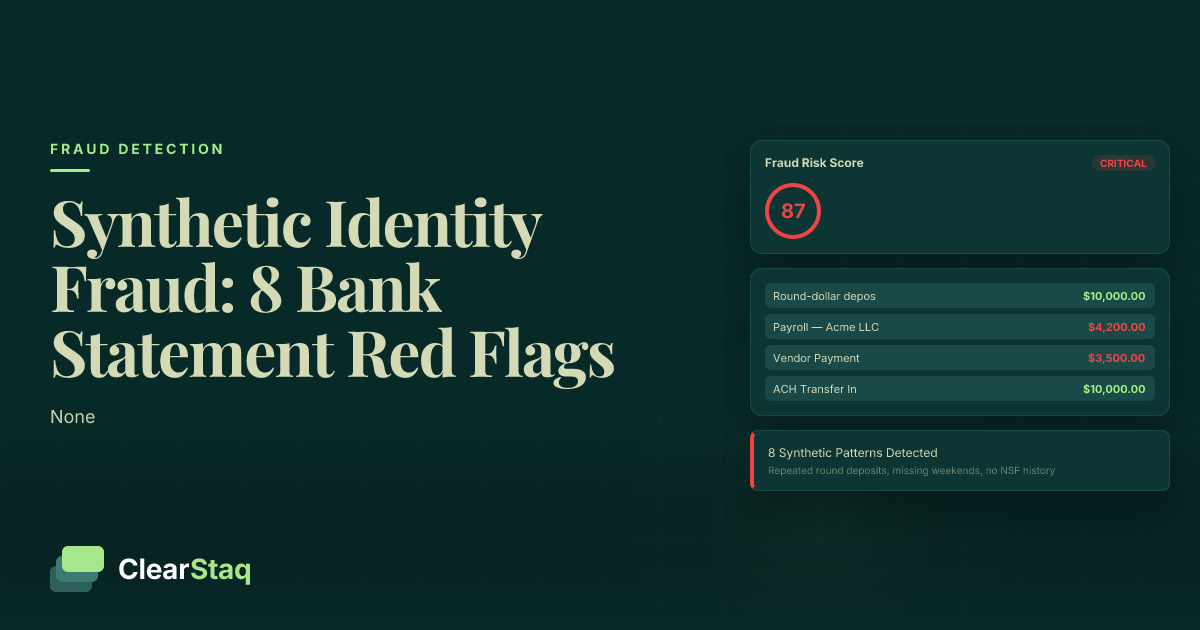
Manual review doesn't scale past a handful of files a week per underwriter, and it misses patterns that only show up algorithmically — deposit structuring under reporting thresholds, commingled personal and business funds, or a synthetic identity built from a stitched-together statement. Automating bank statement review for underwriting teams turns that manual pass into a parsing and flagging step, so the underwriter only touches files that actually need judgment.
By 2026, lenders running commercial books without this layer are the ones still eyeballing PDFs line by line while competitors close in days.
What you'll need
- A parsing engine that handles 900+ statement formats, including scanned PDFs and bank-native exports
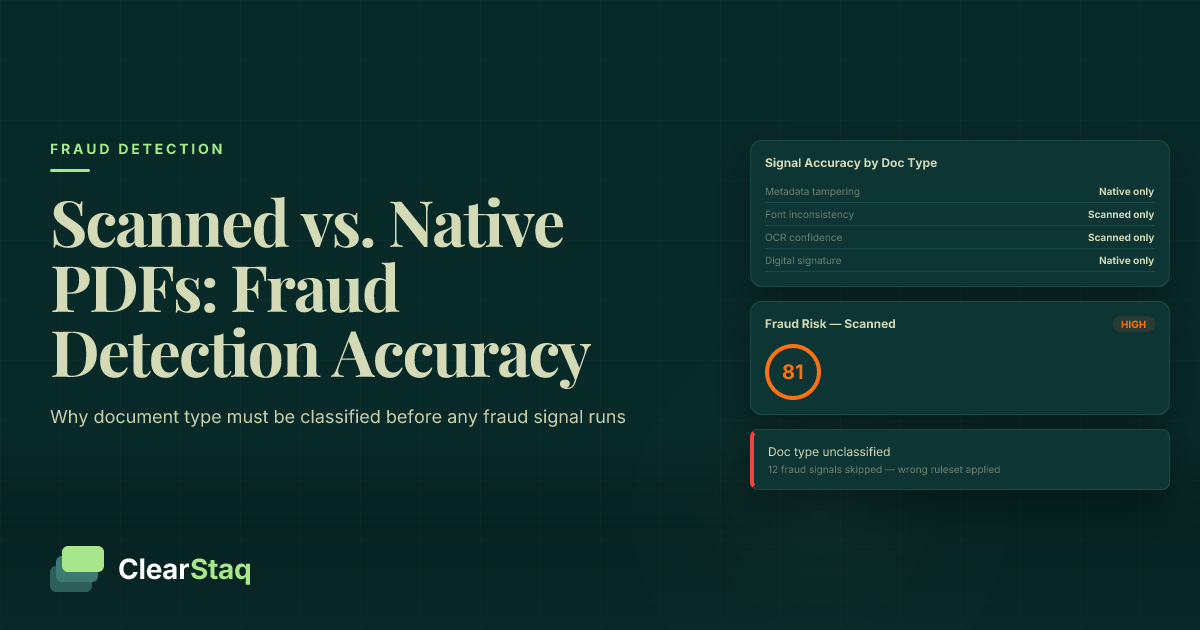
- A fraud detection layer that checks metadata, font consistency, and edit history across 27+ signals
- Underwriting thresholds defined in advance: minimum average daily balance, NSF count ceiling, DSCR floor
- 12 months of statements per borrower, across every business account, not just the primary one
- An API or upload workflow that feeds your loan origination system directly, no manual re-entry
- A CPA or underwriter assigned to flagged exceptions only — not every file needs a human pass in 2026
The steps
1. Centralize document intake
Every statement format that shows up — Chase, Bank of America, Wells Fargo, a regional credit union, a scanned fax — needs to land in one intake point instead of three inboxes and a shared drive. This accomplishes the single biggest time save in the whole process: no one is manually converting or re-typing numbers before the real work starts. Set up an upload portal or API connection that accepts PDFs, CSVs, and images without a format restriction. Common mistake: restricting intake to clean digital PDFs and routing everything else to manual review, which quietly recreates the bottleneck you're trying to remove.
2. Parse and normalize every transaction
Run the statements through a parser that categorizes deposits, withdrawals, transfers, and fees automatically instead of a template built for one bank's layout. This step accomplishes standardization — a Wells Fargo statement and a community bank statement end up in the same schema. Expect 99.5% accuracy on format-aware extraction and results in under 5 seconds per statement. Common mistake: trusting a generic OCR tool that wasn't built for bank statement layouts, which produces category errors on transfers between the borrower's own accounts.
3. Calculate the core cash flow metrics
Once transactions are normalized, calculate average daily balance, average monthly revenue, deposit count and consistency, and NSF frequency automatically. This accomplishes the actual underwriting math — the numbers a credit memo needs — without a spreadsheet built from scratch for every file. Set your DSCR floor and average daily balance minimum before this step runs, not after, so the output already flags files below threshold. Common mistake: calculating average monthly revenue off 3 months of statements instead of 12, which overstates or understates revenue for any borrower with seasonal swings.
4. Run fraud detection signals in parallel
While cash flow metrics calculate, run the fraud check across metadata tampering, font mismatches, altered balances, and inconsistent transaction sequencing — 27+ signals checked per file. This accomplishes early fraud catch, before the file reaches a decision-maker who's only looking at the bottom-line numbers. A doctored statement can pass a human eyeball review in seconds; it doesn't pass a metadata and font-consistency check. Common mistake: running fraud checks only on flagged or suspicious files instead of every file — fraud that looks clean is the fraud that gets funded.
5. Flag exceptions instead of reviewing every file
Set the system to route only files that fail a threshold — DSCR below floor, fraud signal triggered, NSF count over ceiling — to a human underwriter. This accomplishes the actual automation gain: an underwriter reviewing 5 flagged files a day instead of 25 clean-and-flagged files mixed together. Everything else moves to decision with a generated summary attached. Common mistake: keeping a review-everything-anyway policy alongside the automated flags, which erases the time savings you just built.
6. Generate the underwriting summary automatically
The system should output a one-page summary per file — cash flow metrics, fraud signal results, threshold pass/fail — without anyone building it manually. This accomplishes a consistent credit memo format across every underwriter and every file, which matters for audit and compliance review later. Common mistake: letting each underwriter format their own summary, which makes portfolio-level review across files inconsistent and slow.
7. Route decisions by risk tier
Clean files that pass every threshold with no fraud flags route to auto-approval or fast-track underwriter sign-off. Files with one flag route to a single-reviewer exception queue. Files with fraud signals route to a senior underwriter, full stop. This accomplishes speed differentiation — most of your commercial file volume in 2026 should be clean, and clean files shouldn't wait behind exception files in the same queue. Common mistake: a single queue for every file regardless of risk tier, which means your fastest deals wait behind your slowest ones.
8. Log the audit trail
Every parsed file, every fraud signal check, every threshold pass/fail needs a timestamped record attached to the loan file — not a note in someone's inbox. This accomplishes compliance defensibility if a regulator or investor asks how a decision got made. Common mistake: logging the final decision but not the underlying signal data, which leaves nothing to show if a loan gets questioned six months later.
Troubleshooting
Seasonal businesses trigger false declines. A landscaping company or a retailer with holiday-heavy revenue can look like a decline risk on a 3-month window and healthy on 12. Pull the full year before setting a DSCR floor for any seasonal borrower.
Multiple business accounts aren't consolidated. A borrower running payroll from one account and deposits into another will show artificially low revenue if only one account gets parsed. Require every business account on the application, not just the primary.
Low-quality scans fail parsing. A faxed or heavily compressed PDF can drop line items a clean digital statement wouldn't. A parser built for 900+ formats handles most of these, but flag any file with an unusually low confidence score for manual spot-check rather than auto-approving it.
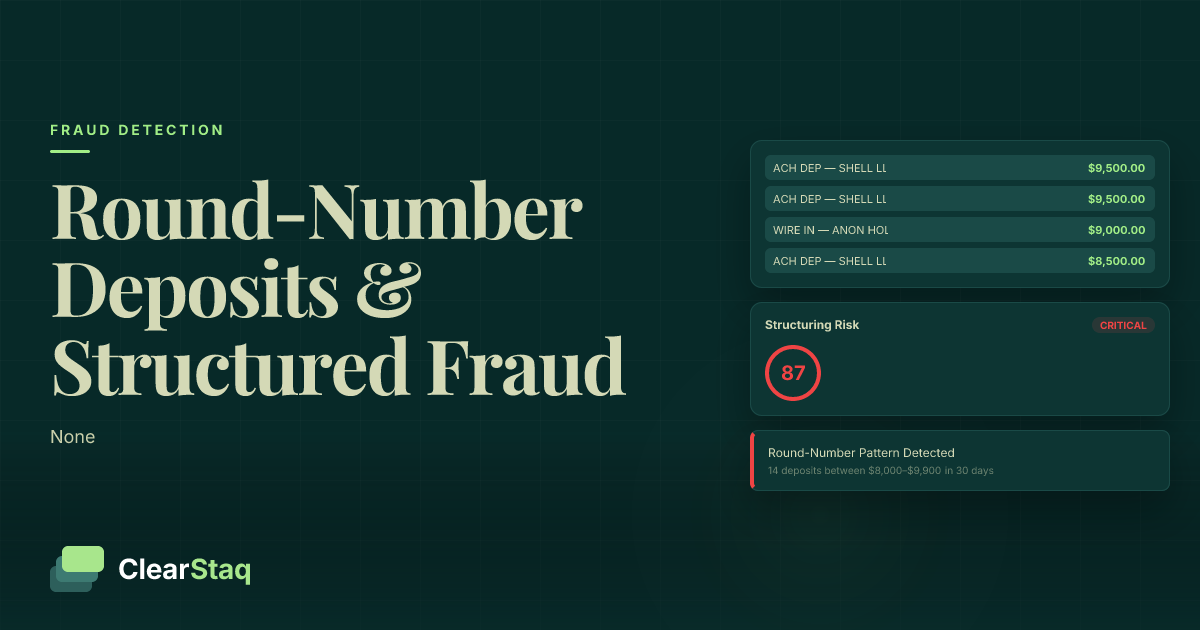
Structuring patterns fall under the reporting threshold. Deposits kept just under $10,000 to avoid currency transaction reporting are a specific pattern, not a hunch — spotting structuring patterns in business bank statements requires checking deposit clustering, not just deposit totals.
Personal and business funds get commingled. A sole proprietor running rent, groceries, and payroll through the same account will produce a distorted revenue number either way. Flag any account with recurring non-business transaction categories for manual review before trusting the automated cash flow figure.
NSF fees get miscounted as revenue events. An NSF fee reversal can show up as a deposit in a naive parser, inflating deposit count and masking cash flow trouble. Confirm your parser categorizes fee reversals separately from actual revenue deposits.
Tools and resources
- A parsing and fraud detection platform covering 900+ statement formats and 27+ fraud signals
- Commercial loan underwriting software built for community banks if your book skews toward local and regional borrowers
- Defined DSCR, average daily balance, and NSF thresholds documented before the first file runs through automation
- An exception queue in your loan origination system, separate from the auto-approve path
- An audit log retained per file, not per decision
What to do next
Once the pipeline is running, the next problem underwriting teams hit is commingled funds slipping through on borderline files — detecting commingled funds in business underwriting covers the specific transaction patterns that separate a legitimate sole proprietor from a file that needs a second look.
If you're carrying manual review well into 2026, the delay isn't the underwriters — it's the intake step still routing every file through a human first.
FAQ
How do you automate commercial loan underwriting with bank statements?
You automate it by parsing statements into normalized transaction data, calculating cash flow metrics like average daily balance and DSCR, and running fraud detection in parallel — then routing only flagged files to a human underwriter. Clean files move straight to decision.
How many months of bank statements does commercial underwriting need?
Commercial underwriting needs 12 months of statements per borrower, not 3. Shorter windows overstate or understate revenue for any borrower with seasonal swings.
Can automated parsing catch doctored bank statements?
Yes. Format-aware parsing paired with a fraud detection layer checks metadata, font consistency, and edit history across 27+ signals, which catches tampering a human eyeball review typically misses.
How long does it take to parse a bank statement in 2026?
Format-aware parsing runs in under 5 seconds per statement in 2026, versus 4 to 8 hours for a manually spread commercial file.
What's the biggest mistake in manual commercial loan underwriting?
The biggest mistake is pulling only 3 months of statements and reviewing every file equally instead of flagging exceptions. Both slow down clean files and miss seasonal revenue patterns.
Does automating underwriting replace the underwriter?
No. It replaces the manual spreading and initial fraud check, routing only flagged or borderline files to a human. The underwriter still makes the final call on exceptions.
What accuracy rate should bank statement parsing hit?
Format-aware parsing should hit around 99.5% accuracy across formats including scanned and non-standard PDFs. Anything lower means manual reconciliation eats back the time saved.
How does structuring show up in bank statement underwriting?
Structuring shows up as deposits clustered just under reporting thresholds, like repeated deposits near $9,900. It requires checking deposit clustering patterns, not just totals, to catch.
One last thing
The files that cost lenders the most aren't the obviously bad ones — those get declined fast either way. It's the borderline file with 8 months of clean statements and 4 months of commingled personal spending that gets waved through because nobody checked account-by-account.
“If a lender needs three days to read twelve months of statements, the deal is already stale by the time it reaches a decision.”
Related guides
ClearStaq Team
Content Team
The ClearStaq team builds AI-powered tools for bank statement parsing, fraud detection, and income verification.