Verifying business ownership structures for KYB compliance means tracing every layer of an entity until you land on a real person who owns 25% or more of it, then checking that person's identity against sanctions, PEP, and adverse media data. Skip one layer and you've approved a shell company instead of a borrower.
- Verifying business ownership structures for KYB compliance means identifying every beneficial owner with 25% or more equity or control.
- Cross-check formation documents, UBO declarations, and state registry filings before running sanctions and PEP screens.
- Layered LLCs, trusts, and holding companies hide true ownership until you trace each entity to a natural person.
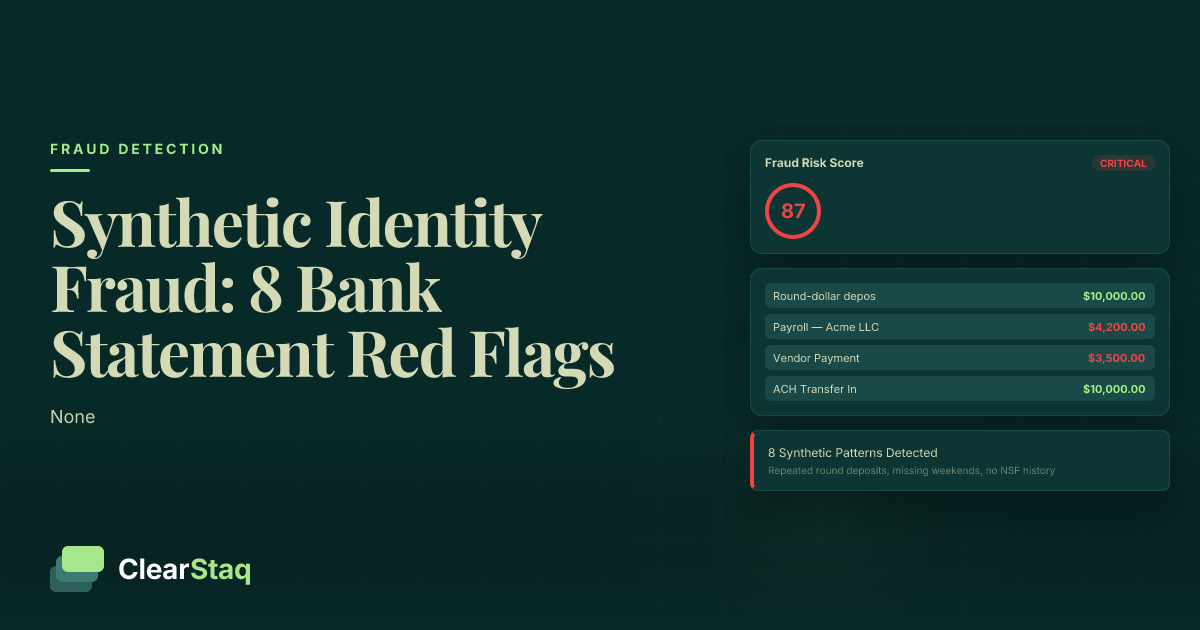
- Bank statement patterns often expose shell-company ownership that paperwork alone never flags.
Why this matters
KYB compliance exists because ownership fraud is cheap to fake and expensive to catch after the loan funds. A borrower who lists a nominee owner, or nests the real owner three LLCs deep, can clear a document check in 2026 and still be a straw borrower or a sanctioned party underneath the paperwork.
Lenders, CPAs, and MCA brokers who skip ownership verification inherit that risk the moment they wire funds. A KYB verification workflow built around beneficial ownership, not just a business license and an EIN, catches the structures a single-document review misses.
The stakes scale with entity complexity. A single-member LLC takes minutes to verify. A three-layer holding structure with a foreign parent entity can take days when it's done by hand instead of matched against registry and bank data.
How do you verify business ownership structures for KYB compliance?
The process runs in a fixed order because each step depends on the one before it. Skipping the sequence is how missed owners slip through.
- Collect formation documents - articles of incorporation, operating agreements, or partnership agreements that name registered owners.
- Identify beneficial owners - anyone holding 25% or more equity, plus at least one person with substantial control, the standard financial institutions apply under the FinCEN Customer Due Diligence Rule.
- Verify each owner's identity - government-issued ID matched against the name on file, not just a self-reported declaration.
- Cross-reference state registry filings - Secretary of State records should match the ownership percentages claimed in the application.
- Screen every owner against sanctions, PEP, and adverse media lists - a clean business license means nothing if an owner is on OFAC's list.
- Trace parent and holding entities to a natural person - stop only when you reach an individual, not another LLC.
- Document the chain and re-screen on a schedule - ownership changes, and a KYB file built in 2023 is stale by 2026.
Beneficial ownership verification: the 25% threshold
The 25% threshold isn't arbitrary. It's the line financial institutions already use under the FinCEN Customer Due Diligence Rule to define a beneficial owner. Anyone who owns a quarter or more of an entity, or exercises significant management control, has to be identified and verified.
That threshold catches a lot but not everything. Four owners each holding 24% sit below the line while collectively controlling the company, so KYB reviews that stop at the 25% test alone leave gaps in multi-owner structures.
Verifying ownership in shell companies and layered entities
Shell companies are built to defeat exactly this check. A borrower nests the real owner behind two or three holding LLCs, each registered in a different state, so the registry filing on top shows a management company instead of a person.
The fix is to keep tracing. If the formation document lists another business entity as the owner, pull that entity's filing too, and repeat until a natural person's name appears. A KYB file that stops at the first LLC layer is not verified - it's incomplete.
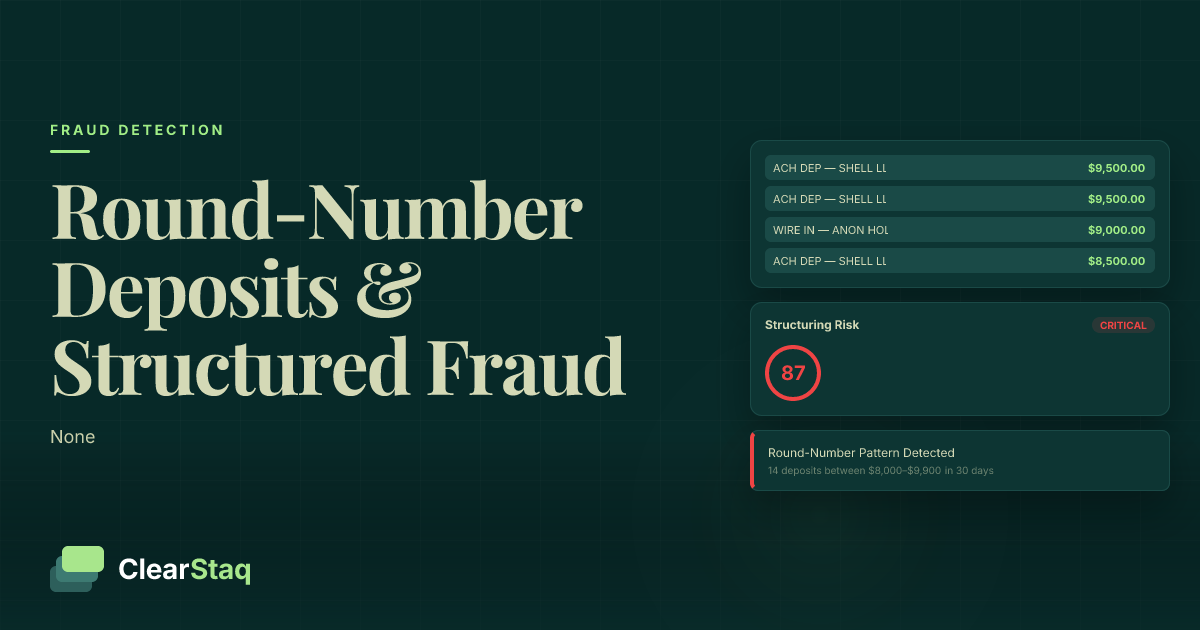
Bank statement patterns catch what paperwork misses. Transfers between the applicant's account and accounts tied to the same registered agent, or deposits routing straight to a holding company with no operating history, are markers reviewed in shell company bank statement analysis - and they surface whether or not the ownership documents look clean.
This is where ClearStaq fits a KYB workflow. Its parsing engine reads transaction patterns alongside 27+ fraud signals, flagging commingled funds and layered transfers that point to an undisclosed owner even when formation documents pass on their own. For brokers running high application volume in 2026, pairing that with KYB verification software for commercial lenders cuts the manual tracing time on multi-entity applicants.
Catch shell-company patterns automatically
Flag layered transfers and undisclosed owners in seconds.
Why ownership verification gets complicated
A handful of structural factors turn a five-minute check into a multi-day investigation:
- Multiple LLC layers - each additional holding entity adds a registry lookup and a document request.
- Foreign parent entities - ownership records outside the US often aren't searchable through domestic registries.
- Nominee shareholders - a name on file that isn't the person who actually controls the business.
- Trusts and estates - beneficial ownership through a trust requires the trustee's identity, not just the trust's name.
- Frequent ownership changes - a KYB file verified in 2025 can be wrong by 2026 if equity changed hands.
- Bearer-share jurisdictions - a small number of countries still allow ownership without a named registry entry, which forces manual investigation.
What's the difference between KYC and KYB?
KYC verifies an individual person's identity. KYB verifies a business entity and, by extension, the people who own and control it. KYC checks one person against one ID; KYB traces an entity structure down to every owner above the 25% threshold and checks each of them.
How do you confirm a beneficial owner is a real person?
You confirm a beneficial owner by matching their government-issued ID against the name listed in ownership documents, then screening that name against sanctions, PEP, and adverse media databases. A name that matches on paper but fails identity or sanctions screening means the disclosure is incomplete, not confirmed.
What documents prove business ownership for KYB?
Formation documents - articles of incorporation, operating agreements, or partnership agreements - are the starting proof of business ownership for KYB, backed by a current state registry filing. Beneficial ownership certifications and government ID for each owner above 25% complete the file, and anything older than a year should be re-verified before approval in 2026.
FAQ
What is KYB verification in lending?
KYB verification confirms a business entity is legitimate and identifies every beneficial owner holding 25% or more equity or control. Lenders run it alongside KYC on individual applicants before funding.
How much ownership triggers KYB beneficial owner reporting?
25% ownership or more triggers beneficial owner identification under the FinCEN Customer Due Diligence Rule. At least one person with significant management control must also be identified regardless of equity percentage.
Can a business hide its real owner through an LLC?
Yes. An LLC can list another LLC or holding company as its owner, which hides the real person until you trace each layer. KYB reviews that stop at the first registered entity miss this entirely.
Is KYB the same as beneficial ownership verification?
Beneficial ownership verification is one part of KYB, not the whole process. KYB also includes formation document review, registry cross-checks, and sanctions screening on every identified owner.
How do bank statements help verify business ownership?
Bank statements show transaction patterns, like transfers to related entities or commingled funds, that point to an undisclosed owner even when formation paperwork looks clean. They act as a cross-check against what an applicant submits.
What happens if a lender skips KYB ownership checks?
Skipping KYB ownership checks means a lender can fund a shell company, a straw borrower, or a sanctioned party without knowing it. The exposure surfaces later as default, fraud loss, or a regulatory finding.
Do sole proprietorships need KYB ownership verification?
Sole proprietorships still need identity verification on the owner, but the multi-layer tracing that holding structures require does not apply since there is only one owner. The check is simpler, not optional.
One last thing
The layer most reviewers skip isn't the ownership document - it's re-verification. An entity structure confirmed clean in 2024 can look completely different by 2026 if equity changed hands, and most KYB workflows have no trigger to catch that drift. Build a re-screen cadence into the file instead of treating origination as the only checkpoint.
Related guides
ClearStaq Team
Content Team
The ClearStaq team builds AI-powered tools for bank statement parsing, fraud detection, and income verification.