Banks buying KYB verification software in 2026 need more than a business name lookup — they need UBO checks, sanctions screening, and document fraud detection that holds up when an examiner starts asking questions. This guide breaks down what a compliance team should require, what looks solid but isn't, and where each piece of a real KYB stack fits.
- KYB verification software for banks needs five pieces: UBO checks, sanctions/PEP screening, adverse media, document fraud detection, and continuous monitoring.
- Consumer KYC tools rebranded as KYB verify a person, not a business entity — Skip them for commercial onboarding.
- ClearStaq's fraud detection layer catches doctored formation documents and altered bank statements with 27+ signals and 99.5% accuracy — Buy for the document layer.
- Banks opening 500+ business accounts a month hit a manual-review wall long before their compliance team notices it.
Why this matters
A bank that gets KYB wrong doesn't find out at onboarding — it finds out during an exam, when an examiner asks why a shell company with three linked accounts cleared review in 45 seconds. KYB verification software for banks exists to close that gap: confirm the business is real, confirm who controls it, and flag the paperwork that doesn't match. The market split into pieces — UBO lookups, sanctions screening, adverse media, document fraud detection — and most banks stitch two or three vendors together instead of buying one platform that covers all of it. ClearStaq's KYB verification software for commercial lenders breaks down how that stack fits together on the lending side; the same logic runs through a bank's onboarding queue.
Miss a piece and the cost shows up twice: once in fraud losses, once in the matters-requiring-attention finding when the exam team pulls a sample of new accounts opened in 2026.
Who this is for
This guide is for compliance officers, BSA/AML leads, and commercial onboarding teams at community banks, regional banks, and de novo banks pulling in more business accounts than their manual KYB process can handle. If your team still cross-references a Secretary of State portal, the OFAC SDN list, and a scanned formation document by hand for every new business account, you're the buyer this is written for. Banks opening fewer than 500 business accounts a month can sometimes get by on a lean, manual-heavy stack. Above that volume, manual review becomes the bottleneck that pushes account opening past the two-to-three-day window most commercial customers expect in 2026.
What to look for in KYB verification software for banks
1. Beneficial ownership (UBO) verification depth
FinCEN's Customer Due Diligence rule requires banks to identify any individual owning 25% or more of a legal entity customer. Software that stops at confirming the business exists and skips ownership resolution leaves the exact gap examiners test for first.
2. Sanctions and PEP screening coverage
A business can pass every registry check and still have a sanctioned individual sitting on its cap table. Sanctions screening software for banks needs to run against OFAC's SDN list and politically exposed persons databases at onboarding and on a recurring schedule, not once at signup.
3. Adverse media screening
A UBO can clear sanctions and PEP lists and still show up in a fraud indictment from six months ago. Adverse media screening catches reputational risk that structured lists miss entirely, though it produces more false positives than sanctions matching and needs a human review step.
4. Document fraud detection on formation docs and financials
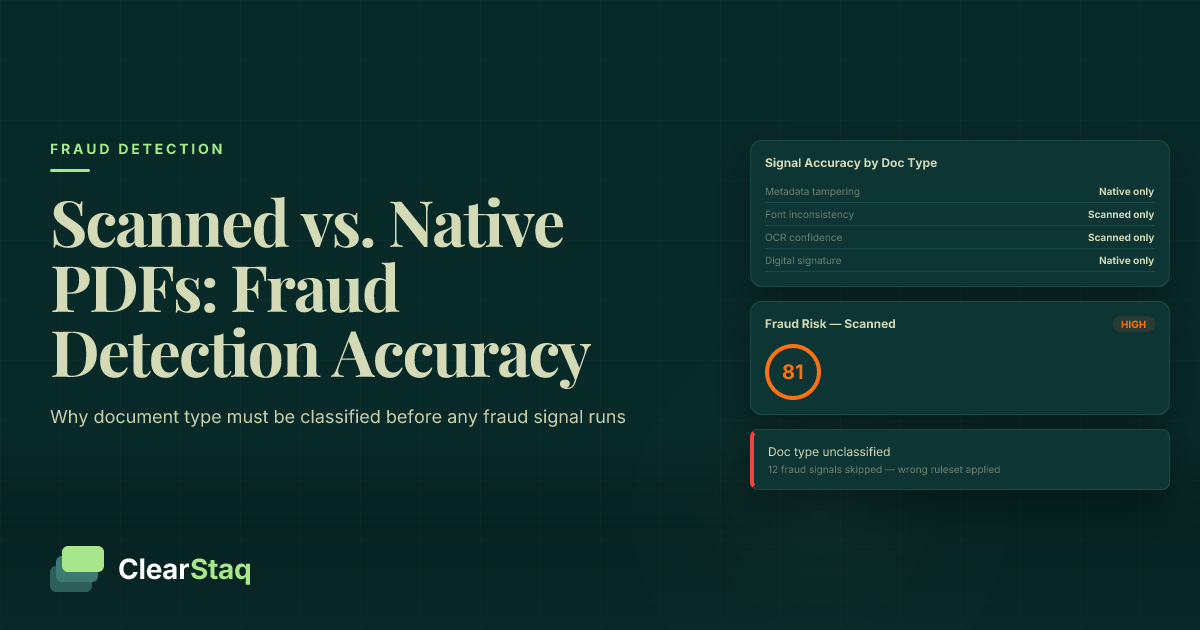
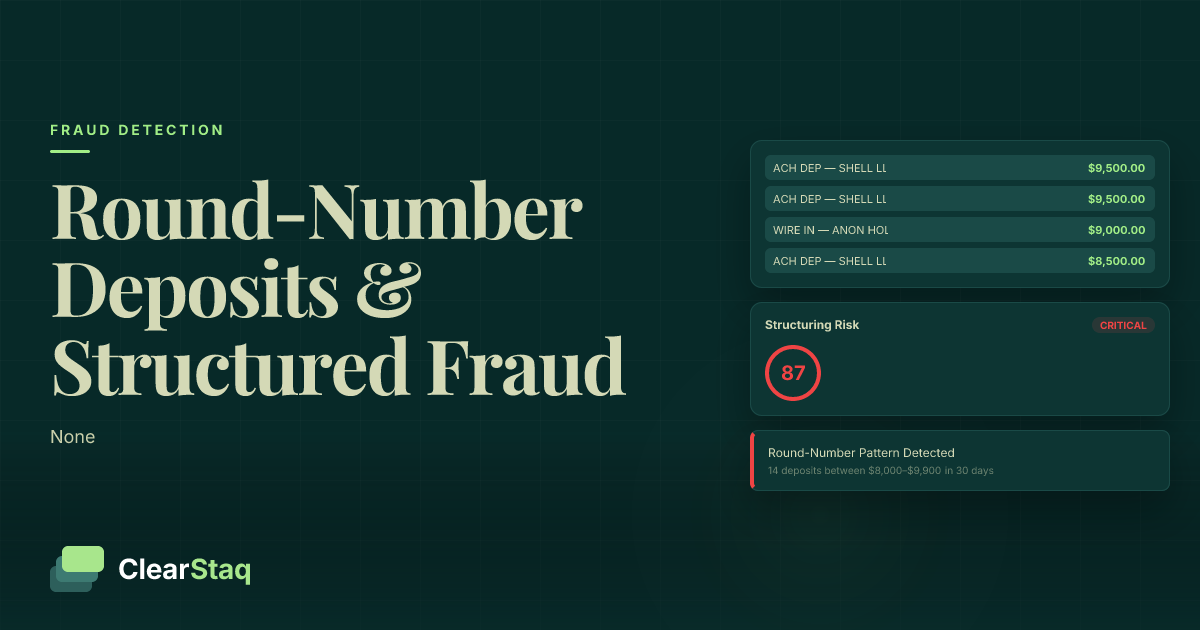
Formation documents and bank statements get doctored more than banks assume — altered EINs, mismatched addresses, edited account numbers. This is the layer most KYB tools treat as an afterthought, and it's where ClearStaq's document fraud detection does the heavy lifting: 27+ fraud signals, under 5 seconds per file, and 99.5% extraction accuracy on formation documents and bank statements alike.
5. Integration with core banking and loan origination systems
KYB software that lives outside your core banking platform or LOS means someone re-keys results by hand. That re-keying step is where data entry errors and missed flags creep into the file.
6. Audit trail and examiner-readiness
Every check needs a timestamped record: what was screened, against which list version, and who reviewed the hit. Software without a clean audit trail turns every exam into a scramble to reconstruct what happened.
The KYB stack for banks: five pieces, ranked by priority
1. Business registry and UBO verification — the foundation. Confirms the entity exists and identifies anyone with 25%+ ownership, per FinCEN's CDD rule. Without this piece nothing downstream matters. Buy.
2. Sanctions and PEP screening — non-negotiable. Every regulator expects this at onboarding and on a recurring cadence. Skipping it isn't a corner-cutting option in 2026, it's a finding waiting to happen. Buy.
3. Adverse media screening — the wildcard. Catches what structured lists can't, but expect a higher false-positive rate that needs a review workflow, not full automation. Consider.
4. Document fraud detection on formation docs and bank statements — the layer most banks skip. This is where doctored EINs, altered account numbers, and fabricated financials get caught before funding. ClearStaq runs this layer at 27+ signals per document, under 5 seconds, 99.5% accuracy. Buy.
5. Continuous monitoring — the one nobody budgets for. A business that passes clean at onboarding can add a sanctioned owner eighteen months later. Software that only screens once, at signup, misses this entirely. Consider, but push for it once the onboarding stack is stable.
What to avoid
- Consumer KYC tools rebranded as KYB. They verify a person's driver's license, not a legal entity's ownership structure — the wrong tool for a business account.
- One-time screening with no rescreen cadence. A clean sanctions check on day one means nothing if the same list isn't rerun after the account is open.
- OCR-only extraction with no fraud layer. Pulling text off a formation document isn't the same as flagging that the EIN was altered or the address doesn't match the registry. ClearStaq's fraud detection sits on top of extraction specifically to catch that gap.
See ClearStaq's fraud detection layer
27+ signals, sub-5-second processing, 99.5% accuracy on formation docs and bank statements.
Verdict comparison table
| Criterion | What it catches | Priority for banks in 2026 |
|---|---|---|
| UBO verification | Undisclosed 25%+ ownership | Buy |
| Sanctions & PEP screening | OFAC and PEP list hits | Buy |
| Adverse media | Reputational risk, unproven allegations | Consider |
| Document fraud detection | Doctored formation docs, altered statements | Buy |
| Core system integration | Manual re-keying, onboarding delays | Buy |
| Audit trail | Exam findings, unreconstructable history | Buy |
FAQ
What is KYB verification software for banks?
KYB verification software for banks confirms a business entity is real, identifies its beneficial owners, and screens both against sanctions, PEP, and adverse media lists. Banks use it during commercial account onboarding to meet FinCEN's Customer Due Diligence rule and catch fraud before funding.
Is KYB the same as KYC?
No. KYC (Know Your Customer) verifies an individual's identity, while KYB (Know Your Business) verifies a legal entity and its ownership structure. A bank onboarding a business customer needs both — KYC on the signer, KYB on the entity.
How much ownership triggers a UBO disclosure requirement?
FinCEN's Customer Due Diligence rule sets the threshold at 25% or more ownership of a legal entity. Anyone below that threshold doesn't need to be identified as a beneficial owner under the rule, though many banks set internal thresholds lower.
How often should banks rescreen business customers against sanctions lists?
Most banks rescreen on a recurring schedule rather than only at onboarding, since the OFAC SDN list changes without a fixed calendar. A business that's clean at account opening can have a newly sanctioned owner added months later.
Can document fraud detection catch a doctored formation document?
Yes, when the software checks for tampering signals beyond basic text extraction — altered EINs, mismatched addresses, inconsistent formatting. ClearStaq runs 27+ fraud signals per document at 99.5% accuracy, which is built specifically to catch this category of fraud.
Do small community banks need the same KYB stack as large regional banks?
The core requirements are the same because they come from the same FinCEN rule, but the volume changes the buying decision. A bank opening under 500 business accounts a month can manage more of the process manually; above that, manual review becomes the bottleneck.
What's the biggest gap in most banks' current KYB process?
Document fraud detection on formation paperwork and supporting financials is the most commonly skipped layer. Banks often verify registry status and run sanctions checks but never check whether the submitted documents themselves were altered.
One last thing
Most banks budget for sanctions screening and UBO checks and stop there — continuous monitoring after onboarding rarely gets its own line item. That's the gap fraud rings exploit: pass clean at account opening, add a flagged owner or shift transaction patterns once the account is live and nobody's rechecking. A KYB verification software for banks decision that only covers day-one screening is half a decision.
Related guides
ClearStaq Team
Content Team
The ClearStaq team builds AI-powered tools for bank statement parsing, fraud detection, and income verification.