Underwriting an equipment leasing deal from bank statements means checking 3-12 months of deposit history, calculating debt service coverage against every existing obligation, and screening the PDF itself for signs of alteration before you fund. Skip any one of those three checks and you either decline a lessee who can actually make the payment or fund one who can't.
- Underwriting equipment leasing deals with bank statements starts with 3-12 months of deposit history, a DSCR calculation, and a fraud check on the file itself.
- ClearStaq parses statements across 900+ bank formats and flags fraud across 27+ signals in under 5 seconds per file.
- A DSCR below 1.25x on the proposed lease payment is the standard cutoff most equipment lessors use to decline or downsize a deal.
- Seasonal lessees in construction, agriculture, or landscaping need 12 months of statements — 3 months hides the off-season cash gap.
- Manual review of a stack of statements can eat most of an underwriter's hour; automated parsing cuts that time by 95%.
Why this matters
Equipment leasing underwriting runs on cash flow, not just a credit score. A lessee with a 680 FICO and three months of overdrafts is a worse bet than a 620 FICO borrower with steady deposits and no NSFs, and a bureau report won't tell you which is which. Bank statements show the deposit pattern, the existing debt stack, and — when someone's trying to game the file — the seams where a PDF got edited.
ClearStaq exists because equipment lessors were burning underwriter hours re-typing numbers from statement PDFs into a spreadsheet, then still missing the fraud. In 2026, that manual step is the single biggest bottleneck between application and funding for most independent leasing shops.
How to underwrite equipment leasing deals using bank statements
The process has five checkpoints. Each one is independently disqualifying — a deal can fail underwriting on any single line item below, regardless of how strong the rest of the file looks.
| Checkpoint | Standard threshold | Why it matters |
|---|---|---|
| Statement window | 3-12 months | Seasonal businesses need the full cycle, not a snapshot |
| Average daily balance | Trending flat or up | Declining balances signal cash burn before it hits the credit report |
| NSF/overdraft count | 3 or fewer in trailing 90 days | More than that suggests the business is already stretched |
| DSCR on the new lease | 1.25x or higher | Covers the new payment plus a buffer for a slow month |
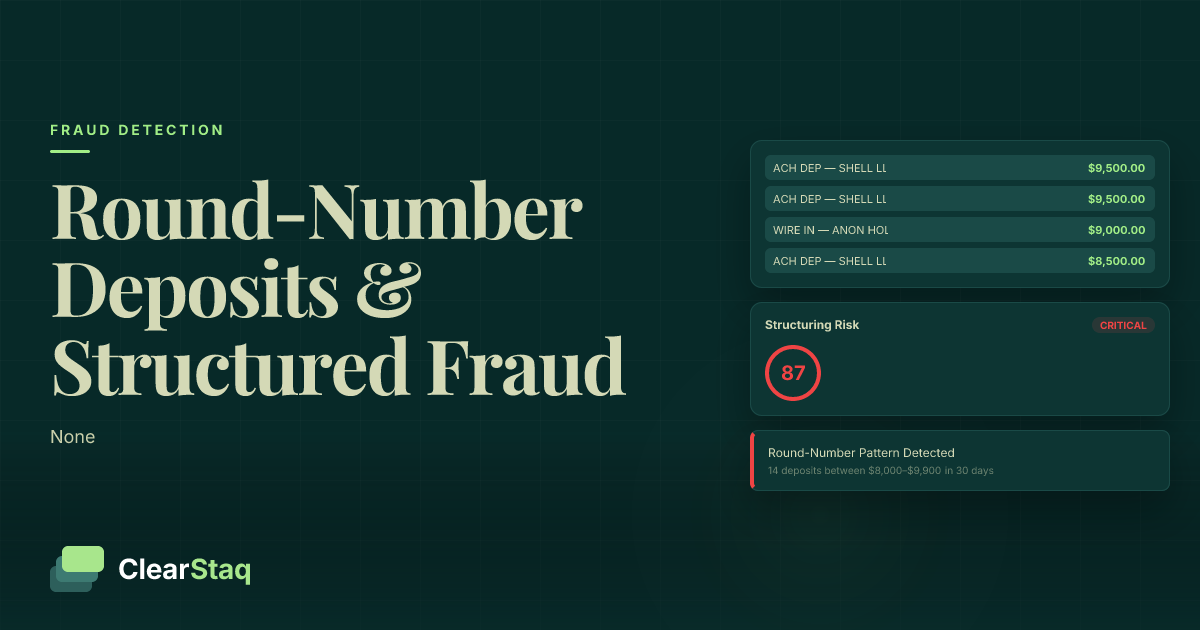
| Deposit consistency | No unexplained lump sums | Large one-off deposits often mask a bridge loan or a related-party transfer |
Run the statements through these five checkpoints in order. Balance trend and NSF count are fast disqualifiers — check them first before spending time on a full DSCR calculation for a file that's going to get declined anyway.
Debt service coverage ratio: 1.25x is the standard cutoff
DSCR on an equipment lease is net operating cash flow divided by total debt service — the new lease payment plus every existing loan, lease, and merchant cash advance payment already coming out of the account. A ratio under 1.0x means the business can't cover its current obligations, let alone a new one; 1.25x is the floor most lessors use because it leaves room for a slow month without triggering a default. Lessees financing equipment with a long useful life (a CNC machine, a delivery truck) can sometimes get approved closer to 1.15x if the asset itself has strong resale value, but that's a judgment call, not a rule.
NSF and overdraft frequency: more than 3 in 90 days flags the file
One NSF in three months is noise. Four or more in the same window is a pattern, and it usually means the account is running thinner than the deposit totals suggest. Cross-reference the NSF dates against payroll and rent debits — a business that overdrafts around payroll twice a month has a cash timing problem that a bigger lease payment will make worse, not better.
Why equipment leasing underwriting varies deal to deal
No two equipment leases underwrite the same way, and the bank statements are usually why:
- Equipment type and resale value — a lease on a forklift with strong resale value carries less risk than one on custom-built machinery with no secondary market
- Industry seasonality — construction, agriculture, and landscaping businesses show revenue swings of 40-60% between peak and off-season months, which changes how you read a 3-month statement window
- Existing lease stack — a business already carrying two equipment leases and an MCA advance has less DSCR headroom, even if gross deposits look healthy
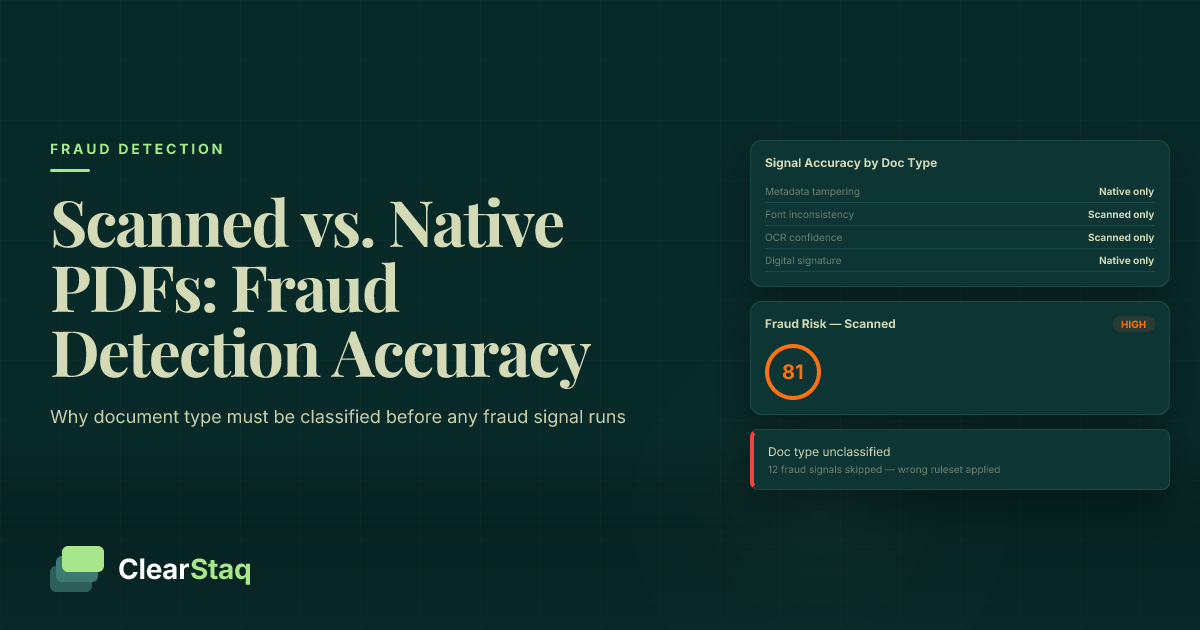
- Statement format and quality — some banks produce clean, parseable PDFs; others produce scanned images that hide altered totals unless the parser checks for it
- Deal size relative to average monthly revenue — a lease payment above roughly 8-10% of average monthly deposits starts to strain most small business cash flows
- Guarantor's personal banking history — for smaller shops, the owner's personal account often reveals financial stress the business account doesn't show yet
Automate equipment leasing underwriting
Parse statements, score DSCR, and flag fraud signals in one pass.
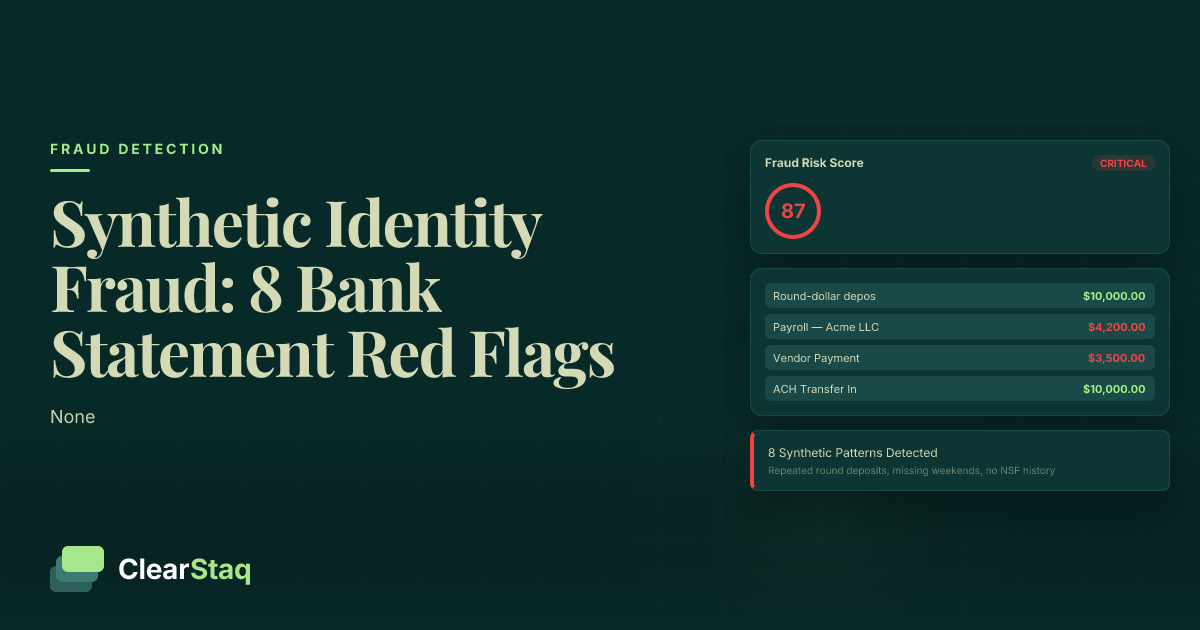
Catching fraud early in the process matters more than most underwriting checklists admit. A statement with re-flowed text, mismatched fonts, or a balance that doesn't reconcile against the running total is a decline before DSCR math even applies — and manual review often misses those seams entirely. ClearStaq's parsing checks for exactly that across 27+ signals, at 99.5% accuracy, before a human underwriter ever opens the file. For a deeper look at the DSCR side specifically, the cash flow underwriting software for equipment leasing companies breakdown covers how automated scoring handles the ratio calculation across 900+ bank formats.
How many months of bank statements do lenders need for equipment leasing?
Most equipment lessors require 3 months of bank statements for a straightforward deal, and 12 months for any business with seasonal revenue. Three months is enough to confirm current cash position and NSF activity, but it will miss an off-season revenue dip that only shows up across a full year — which is exactly the gap that catches lessors off guard on agriculture and construction deals every year, including 2026.
What DSCR do you need to qualify for an equipment lease?
A DSCR of 1.25x on the proposed lease payment is the standard qualifying threshold in 2026. That means net operating cash flow needs to run at least 1.25 times the total of the new lease payment plus every existing debt obligation already coming out of the account, giving the business a buffer if a month comes in soft.
Can you underwrite an equipment lease without tax returns?
Yes — bank statements alone can support an equipment leasing decision, particularly for smaller deals or businesses whose tax returns are more than a year stale. Tax returns still add value for larger transactions since they confirm net income the bank statements can't isolate on their own, so most lessors use statements as the primary source and returns as a secondary check when the deal size warrants it.
FAQ
What's the minimum number of bank statement months required to underwrite an equipment lease?
Three months is the minimum most lessors accept, though seasonal businesses need 12 months to show the full revenue cycle. Anything shorter than 3 months won't reliably capture NSF patterns or balance trends.
Is a DSCR of 1.0x enough to approve an equipment lease?
No, 1.0x only covers current obligations with zero buffer. Most equipment lessors require 1.25x or higher on the proposed lease payment before approval.
How fast can bank statements be parsed for equipment leasing underwriting?
ClearStaq processes a statement in under 5 seconds at 99.5% accuracy across 900+ bank formats, replacing manual line-by-line review.
What fraud signals matter most in equipment leasing bank statements?
Altered PDF metadata, mismatched running balances, deposit structuring just under reporting thresholds, and re-flowed text are the highest-value signals. ClearStaq checks for these among 27+ total fraud signals per file.
Do seasonal businesses need more months of bank statements for equipment leasing?
Yes, seasonal lessees in construction, agriculture, and landscaping need 12 months of statements. A 3-month window can miss a 40-60% seasonal revenue swing and lead to an approval that fails during the off-season.
Can equipment leasing underwriters skip tax returns and use bank statements only?
Yes, bank statements alone can qualify a lease, especially on smaller deals. Larger transactions typically still pull tax returns as a secondary confirmation of net income.
Is ClearStaq built specifically for equipment leasing underwriting?
ClearStaq parses bank statements and tax returns for lenders across asset classes, including equipment leasing, at 99.5% accuracy with 27+ fraud signals per file. It's used by brokers, lenders, and CPAs running income verification, not just one lease type.
One last thing
Most declined equipment leasing deals in 2026 aren't DSCR failures — they're fraud catches on the statement file itself. A PDF with re-flowed text or a balance that doesn't reconcile line to line kills the deal before the ratio math ever gets run, and that's the check most manual review processes skip because it's tedious to do by eye on every file. Run the fraud check first, not last.
Related guides
ClearStaq Team
Content Team
The ClearStaq team builds AI-powered tools for bank statement parsing, fraud detection, and income verification.