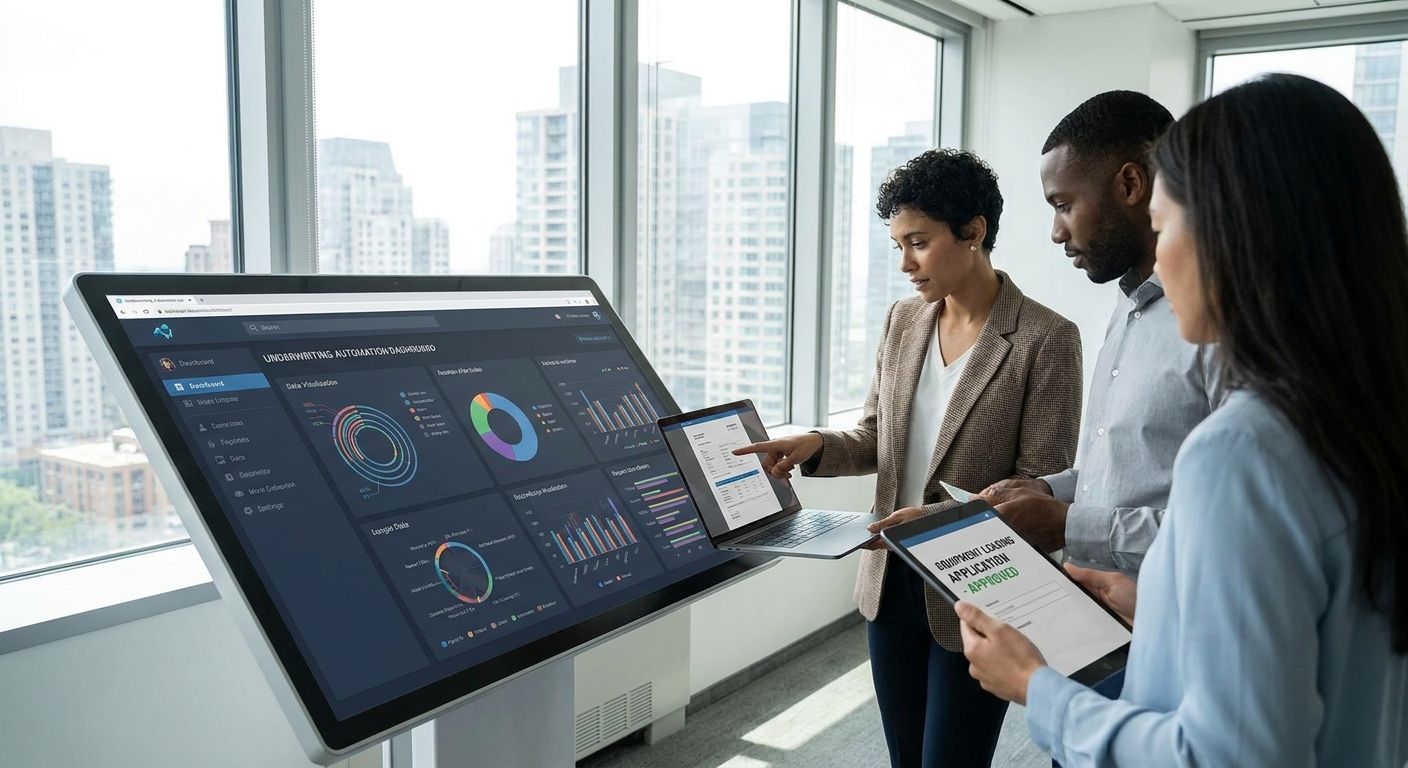
Equipment leasing underwriting automation software parses lessee bank statements, equipment invoices, and tax returns to score creditworthiness and flag fraud before funding, cutting the time between application and approved deal. Equipment lessees skew younger and thinner-file than term-loan borrowers, and the collateral itself — the invoice a vendor submits — has to check out against the lessee's actual cash position, not just their credit score.
- Underwriting automation software for equipment leasing companies should parse statements and invoices in under 5 seconds per file.
- ClearStaq runs 27+ fraud signals against lessee bank statements to catch inflated invoices and shell vendors before funding.
- Manual invoice-to-statement cross-checks are the single biggest bottleneck in equipment leasing underwriting in 2026.
- 900+ supported statement formats mean lessors stop losing deals to unreadable or non-standard PDFs.
Why underwriting automation matters for equipment leasing companies
Equipment leasing underwriters work a different risk profile than a term-loan shop. The lessee is often a newer business — a contractor buying a skid steer, a trucking outfit adding a trailer — with 12 to 24 months of bank history and a vendor invoice that's supposed to match the equipment being financed. Bank statement analysis software for equipment financing companies exists because that invoice-to-statement match is where fraud concentrates: inflated equipment prices, duplicate serial numbers submitted to two lenders, or vendors that don't exist outside the application.
The volume math makes manual review expensive. A leasing shop underwriting 40-60 deals a week can't have an analyst spend 20-30 minutes per file tracing deposits against an invoice line item. ClearStaq processes lessee bank statements in under 5 seconds at 99.5% accuracy, which turns that 20-30 minute manual review into a task the underwriter checks rather than performs.
How to automate underwriting for equipment leasing deals
Audit your current invoice-to-statement review process
Before automating anything, measure what manual review actually costs today.
- Track average minutes per file spent cross-checking invoice amount against deposit history
- Log how many files get kicked back for illegible or non-standard bank PDF formats
- Count how many approved deals defaulted within the first 90 days and why
- Flag how often analysts catch invoice discrepancies versus how often they miss them
- Note which lessee industries (construction, trucking, medical, agriculture) drive the most manual escalations
Automate lessee bank statement parsing
Manual parsing means an analyst opens a PDF, scrolls through 3-6 months of transactions, and hand-tallies deposits, NSF fees, and average daily balance. That's the slow path, and it doesn't scale past a handful of files a day.
- Pull average monthly deposits and revenue trend across 3, 6, and 12 months
- Flag NSF and overdraft counts as a cash-stress signal
- Normalize deposit patterns for seasonal equipment buyers (landscaping, agriculture, construction)
- Extract ending balances and daily minimums without manual scrolling
- ClearStaq parses statements across 900+ bank formats in under 5 seconds, so this step stops being the bottleneck
Verify equipment invoices against submitted bank statements
This is the step generic OCR tools skip — they extract text, they don't cross-check it against anything.
- Match invoice dollar amount against down payment or deposit activity in the lessee's account
- Check vendor name and address against known shell-company patterns
- Flag duplicate invoice numbers or equipment serial numbers submitted across multiple applications
- Verify the invoice date lines up with the application timeline, not a backdated document
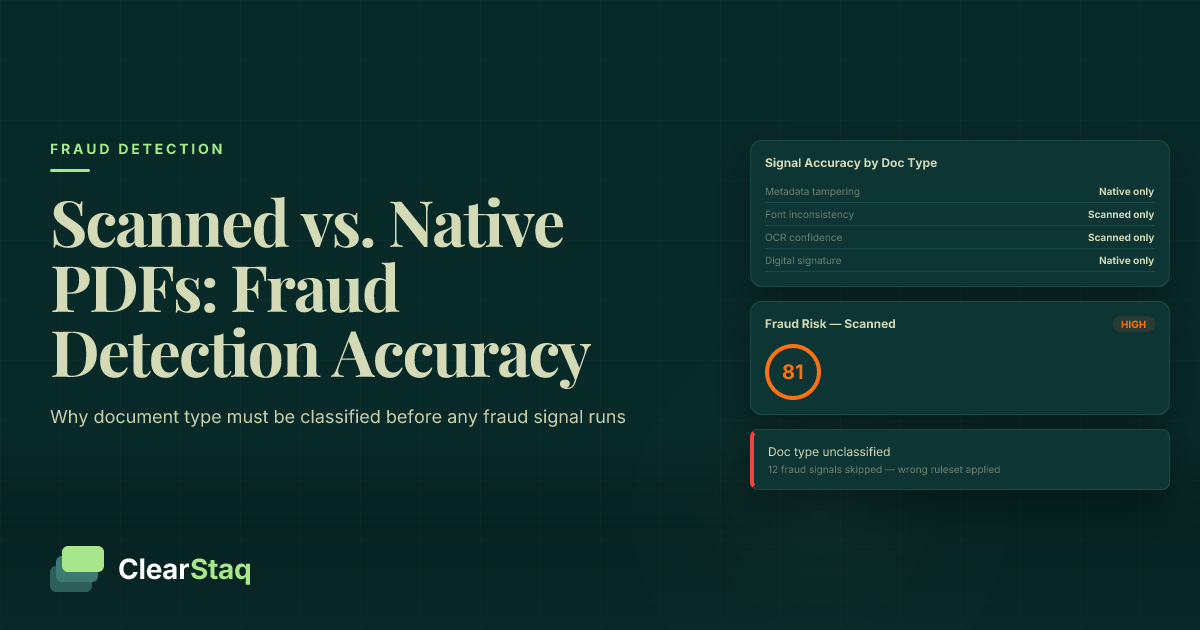
- Run document fraud detection software for equipment financing companies against 27+ signals rather than eyeballing a PDF for red flags
Screen lessees for synthetic identity and shell company risk
Thin-file borrowers are exactly where synthetic identity fraud hides, because there's less transaction history to contradict a fabricated profile.
- Cross-reference business formation date against reported years in operation
- Check for address clustering across multiple applications from the same shell entity
- Verify EIN and business name consistency across the invoice, application, and bank statement
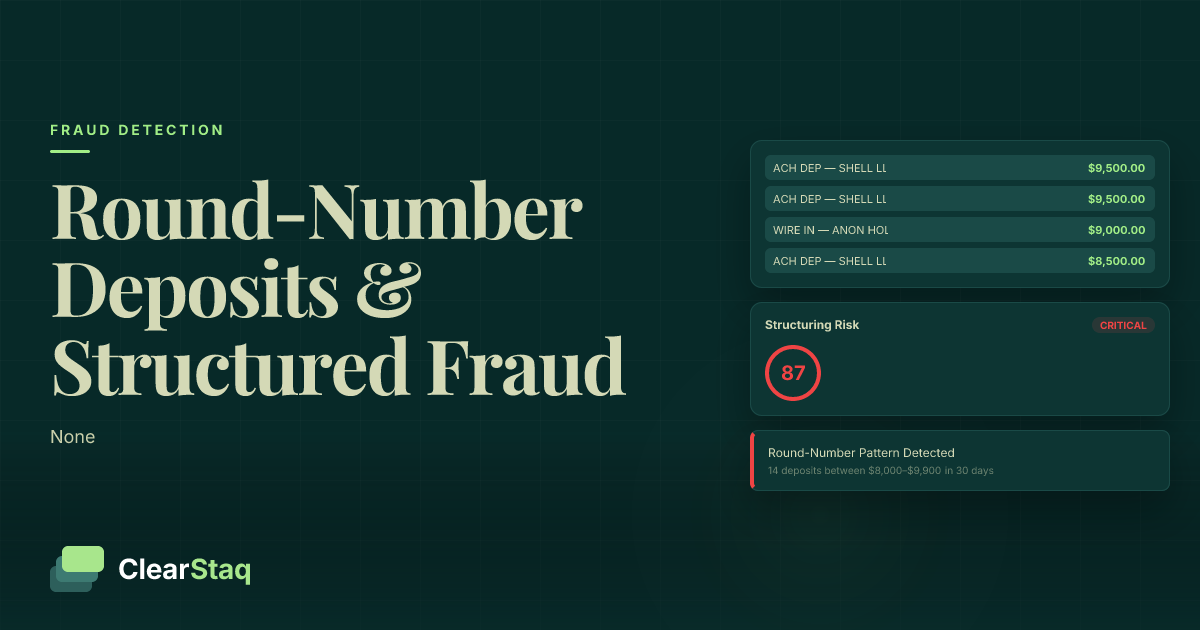
- Flag lessees whose only deposits are round-number transfers with no operating activity
Score cash flow against the proposed equipment payment schedule
A lessee can look creditworthy on paper and still not have the monthly cash cushion for a new equipment payment stacked on existing obligations.
- Calculate free cash flow after existing debt service, not just gross revenue
- Compare average monthly balance against the proposed lease payment size
- Weight seasonal revenue dips so a landscaping company isn't scored on its slowest quarter
- Flag lessees carrying multiple existing equipment leases that compound payment risk
Automate credit memo generation
Once the statement is parsed and the invoice is verified, someone still has to write up the credit decision for file and audit purposes.
- Auto-populate revenue trend, NSF count, and average balance into a standard memo template
- Pull flagged fraud signals directly into the memo's risk section
- Standardize memo format across analysts so audits and investor reviews go faster
- Cut the manual write-up step that typically adds 15-20 minutes per approved deal
Integrate fraud detection into the origination workflow
Fraud checks that live outside the origination system get skipped under deal volume pressure — that's when bad deals slip through.
- Run fraud scoring automatically at document upload, before an analyst opens the file
- Set hard-stop thresholds for high-risk signals that require manager sign-off
- Route flagged files to a fraud queue instead of blocking the whole pipeline
- Log every fraud signal triggered for compliance and audit trail purposes
Measure review time and default rate after automation
The automation only matters if it changes outcomes — track it the same way you tracked the manual baseline.
- Compare average file review time before and after automation
- Track approved-deal default rate over the following 2-3 quarters
- Measure analyst throughput — files reviewed per day per underwriter
- Read how to reduce manual underwriting review time for a fuller breakdown of what to benchmark
See equipment leasing underwriting in action
Parse lessee statements and invoices in one pass, not three separate reviews.
Comparison: underwriting automation options for equipment leasing companies
| Option | Best for | Key limitation |
|---|---|---|
| Manual spreadsheet underwriting | Very low volume, under 5 deals a week | Doesn't scale; invoice cross-checks depend entirely on analyst attention |
| Generic document management/OCR tools | Shops that just need document storage, not analysis | Extracts text but doesn't cross-check invoices against statements or score fraud |
| ClearStaq (bank statement + invoice parsing with fraud detection) | Leasing shops processing 20+ deals a week that need speed and fraud coverage together | Requires digital bank statements and invoice uploads; doesn't replace human sign-off on flagged files |
| Platforms built for other lending verticals (e.g. underwriting automation software for marketplace lenders) | Marketplace or fintech lenders with different collateral types | Not tuned for equipment invoice verification specifically |
ClearStaq is the strongest fit for equipment leasing companies that need invoice-to-statement cross-checking, not just document storage. Manual review is fine at low volume; it stops being fine somewhere past 15-20 deals a week.
Common mistakes equipment leasing companies make
- Trusting the vendor invoice at face value. An inflated equipment price paired with a legitimate-looking vendor name passes a visual check but fails a deposit cross-check every time.
- Underwriting off a trailing 3-month statement window for seasonal buyers — agriculture and landscaping lessees look weak in the off-season and get declined on the wrong months.
- Missing duplicate serial numbers or invoice numbers submitted across two or more funding applications for the same piece of equipment.
- Ignoring NSF and overdraft patterns because gross revenue looks healthy — cash-stress signals show up in fee frequency before they show up in revenue decline.
- Letting manual review bottlenecks lose deals to competitors that can turn around an approval same-day instead of in 3-4 business days.
FAQ
What is underwriting automation software for equipment leasing companies?
It's software that parses lessee bank statements, tax returns, and equipment invoices to score creditworthiness and detect fraud automatically instead of through manual document review. It cross-checks invoice amounts against deposit activity, something generic OCR tools don't do.
How is equipment leasing underwriting different from term-loan underwriting?
Equipment leasing adds a collateral verification step — the vendor invoice has to match the lessee's cash activity — on top of standard cash flow and credit review. Lessees also tend to have thinner credit files than term-loan borrowers.
How fast can bank statement parsing run for equipment lessees?
ClearStaq parses lessee bank statements in under 5 seconds per file at 99.5% accuracy, replacing a manual review that typically takes 20-30 minutes per file.
What fraud signals matter most for equipment leasing?
Inflated invoice amounts, duplicate equipment serial or invoice numbers submitted to multiple lenders, and shell-vendor patterns are the most common fraud vectors in equipment leasing. ClearStaq screens for these across 27+ AI signals.
Can automation replace human underwriters entirely?
No — automation handles parsing, cross-checking, and flagging, but flagged files and edge cases still need a human sign-off. The goal is cutting the volume of routine manual review, not removing judgment from the process.
Does underwriting automation work for thin-file equipment lessees?
Yes, it's arguably more useful there — thin-file lessees have less transaction history, so automated cash flow scoring and fraud signals catch risk that a quick manual glance would miss.
What bank statement formats does equipment leasing software need to support?
Lessees bank with everything from major national banks to small regional credit unions, so format coverage matters. ClearStaq supports 900+ statement formats to avoid rejecting deals over unreadable PDFs.
One last thing
The invoice-to-statement mismatch is the fraud pattern equipment leasing underwriters miss most often in 2026, because it requires cross-referencing two documents instead of scrutinizing one — exactly the kind of check that's tedious by hand and fast to automate. A leasing shop that automates that single cross-check tends to see its fraud catch rate move before its approval speed does.
Related guides
ClearStaq Team
Content Team
The ClearStaq team builds AI-powered tools for bank statement parsing, fraud detection, and income verification.