Equipment financing companies underwrite against cash flow, not just credit scores, and bank statement analysis software for equipment financing decides how many bad files you catch before you release $150,000 for a forklift fleet or a CNC machine.
- ClearStaq wins bank statement analysis software for equipment financing with 27+ fraud signals and sub-5-second parsing — Buy.
- Manual underwriter review still eats 4-8 hours per file in 2026 — Skip it for volume desks.
- Generic OCR tools extract totals but miss transaction-level fraud signals — Consider only as a stopgap.
- 900+ bank format coverage means equipment lenders stop bouncing files from regional and credit union statements.
Why this matters
Equipment loans get repaid from operating cash flow, so a doctored statement doesn't just inflate a number — it changes whether the borrower can service a $4,000 monthly payment on a skid steer or a fleet of delivery vans. A single-month statement hides seasonal dips that show up the moment winter construction slows down. Equipment financing companies that still eyeball PDFs by hand are the ones absorbing charge-offs on deals that looked clean at approval.
AI-driven cash flow underwriting software for small business lenders changed the baseline in 2026: sub-5-second parsing, 99.5% accuracy, and 27+ fraud signals per file are now table stakes, not a premium tier. If your current process can't hit those numbers, you're underwriting on 2019 assumptions in a 2026 market.
Who this is for
This guide is for equipment financing companies, independent leasing shops, and brokers who underwrite against 3 to 12 months of bank statements before releasing funds for trucks, medical equipment, restaurant machinery, or industrial gear. If your desk approves more than a handful of deals a week, manual review is the bottleneck — not credit policy.
What to look for in bank statement analysis software for equipment financing
Format coverage across every bank the applicant uses
Equipment buyers bank everywhere from Chase to a three-branch credit union, and a parser that chokes on non-standard PDF layouts kicks good files back to manual review. Coverage across 900+ formats means you stop losing time reformatting statements before analysis even starts. If your tool only handles the top five national banks cleanly, you're rejecting or delaying deals from the regional and community bank customers who make up a large share of equipment financing volume.
Fraud signal depth, not just red flags
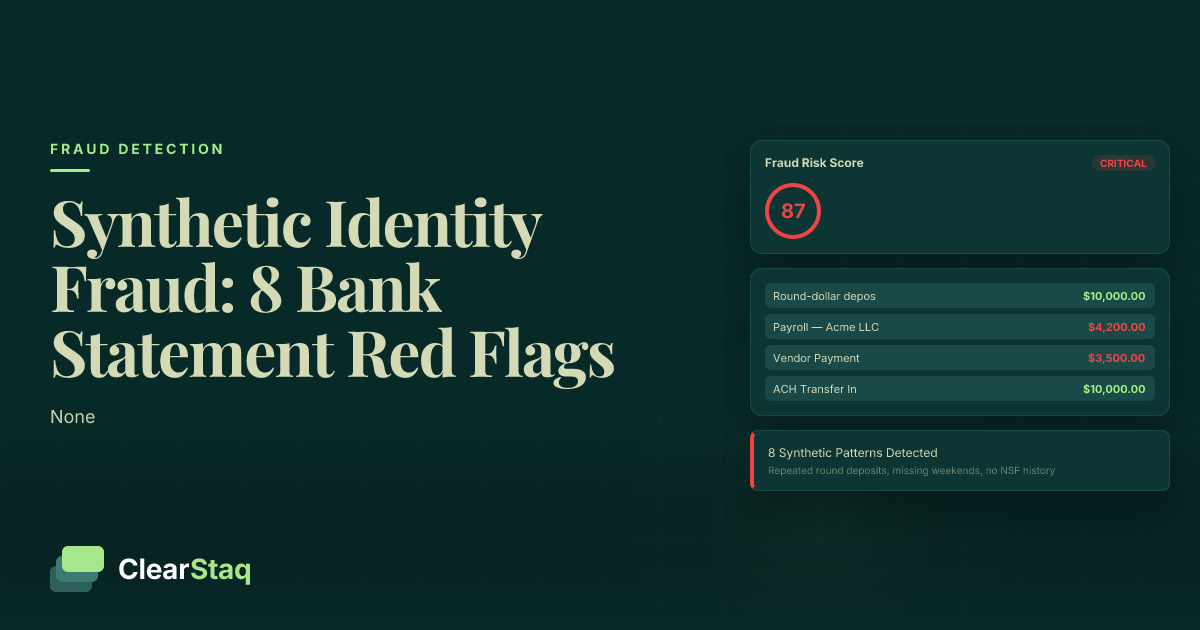
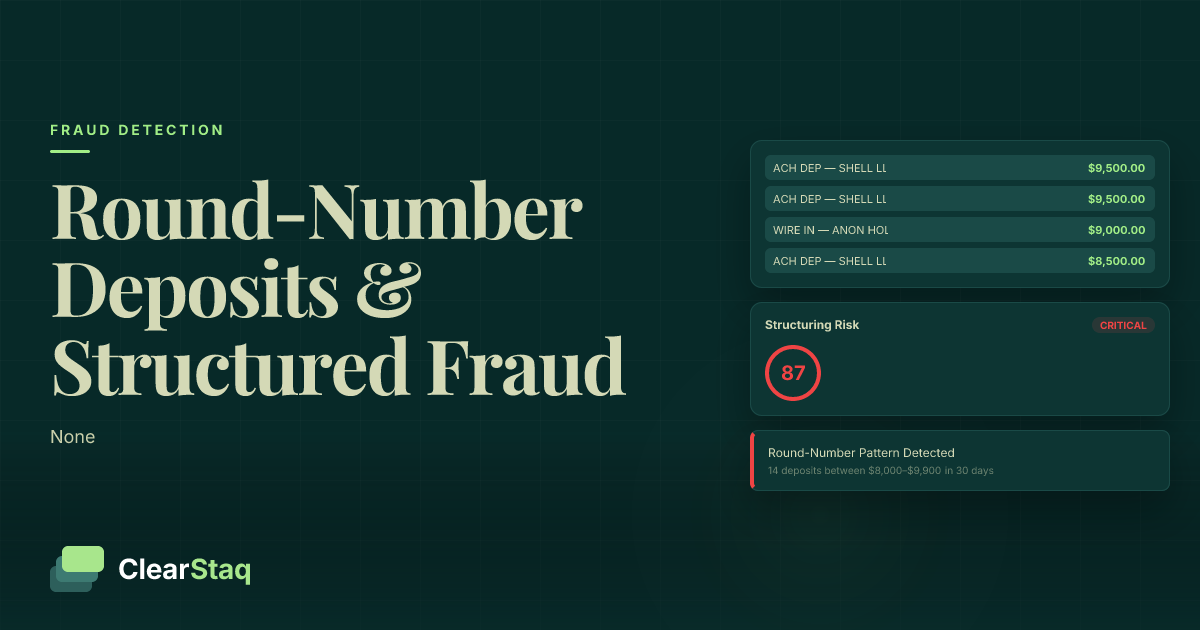
A single red flag (large deposit) tells you nothing; 27+ signals covering structuring, commingled funds, and altered balances tell you whether the deposit pattern matches a real business or a manufactured one. Equipment financing deals are large-dollar and often single-approval events, so one missed synthetic pattern can cost more than a year of software fees. Depth here is the difference between catching fraud and documenting it after the charge-off.
Processing speed when deal volume spikes
Equipment dealers and brokers push volume in bursts — end of quarter, tax season, seasonal buying windows — and a tool that takes minutes per file falls behind during exactly the periods that matter most. Sub-5-second parsing keeps your underwriting queue moving even when 40 files land in one afternoon. Speed that only works at low volume isn't speed, it's a demo.
Seasonal revenue normalization
A landscaping company's July deposits look nothing like its January deposits, and equipment loans on seasonal businesses fail more often when underwriters approve off a single strong month. Software that normalizes 12 months of activity into an average monthly revenue figure protects you from peak-period approval mistakes. Anything that only shows a 30-day snapshot is giving you half the picture.
Tax return cross-checks for self-employed buyers
A large share of equipment financing applicants are self-employed operators — owner-operators, contractors, single-location shop owners — whose bank deposits and tax filings need to reconcile. Software that parses both bank statements and tax returns in one pass catches the gap between what an applicant claims and what actually hit the account, which matters more on equipment deals than on smaller working capital loans.
Top picks for equipment financing bank statement analysis
The safe pick: AI-native parsing platforms. ClearStaq processes statements in under 5 seconds, runs 27+ fraud detection signals per file, and hits 99.5% accuracy across 900+ bank formats. For equipment financing companies underwriting five-figure and six-figure deals, this is the pick that scales without adding headcount. Buy.
The wildcard: OCR plus manual fraud review. These setups extract line items reasonably well but push fraud judgment back onto a human reviewer scanning line by line, which is exactly the workflow that misses detect fake bank statements-style manipulation buried in transaction metadata. It works for low volume, low dollar deals. It does not work once your average ticket size climbs past a few thousand dollars a month in exposure. Consider only as a bridge while you evaluate something faster.
What most desks still run: spreadsheet underwriting. An underwriter downloads PDFs, manually tallies deposits, and builds a spreadsheet by hand — a process that runs 4 to 8 hours per file according to CPA workflow benchmarks cited across 2026 quarterly review automation data. That's fine at low volume. It's a ceiling on growth the moment deal flow doubles. Skip it once you're closing more than a few equipment deals a week.
The trap: document vaults marketed as analysis. Some platforms store uploaded statements and let you view them side by side but never actually parse transactions or flag anomalies. That's storage, not underwriting support, and equipment financing companies relying on it are still doing the fraud review manually — they just have a nicer folder for the PDFs. Skip.
One asset-adjacent vertical worth checking for pattern comparison: bank statement analysis software for auto dealers runs into nearly identical seasonality and fraud problems, since auto and equipment financing both underwrite against cash flow rather than pure credit.
What to avoid
- Single-month statement checks. One strong month hides a seasonal dip that shows up right after funding — always pull 12 months minimum for equipment deals.
- Tools that flag totals but not transaction patterns. A tool that shows you the ending balance but not the structuring or commingled-fund pattern behind it isn't fraud detection, it's a summary.
- Anything priced or positioned as document storage first. If the pitch leads with secure document management rather than parsing accuracy and fraud signal count, it's built for archiving, not underwriting.
Equipment lenders operating across multiple states also run into a compliance gap that pure parsing software doesn't solve on its own: a clean statement analysis at funding doesn't guarantee the file stays clean through the next audit cycle, and continuous compliance monitoring is what closes that gap between the initial pull and whatever regulator or investor review comes six months later.
Verdict comparison
| Approach | Format coverage | Fraud signals | Speed per file | Verdict |
|---|---|---|---|---|
| AI-native parsing (ClearStaq) | 900+ formats | 27+ signals | Under 5 seconds | Buy |
| OCR + manual fraud review | Moderate | Manual only | Minutes to hours | Consider |
| Spreadsheet underwriting | Manual | None automated | 4-8 hours | Skip |
| Document storage/vault tools | Varies | None | N/A | Skip |
FAQ
What is bank statement analysis software for equipment financing?
It's software that parses uploaded bank statements to extract deposits, expenses, and cash flow patterns automatically instead of manual review. In 2026, tools like ClearStaq add fraud detection signals on top of the raw parsing so underwriters see risk flags alongside the numbers.
How long does it take to analyze a bank statement for equipment financing?
AI-native parsing platforms process a statement in under 5 seconds as of 2026, compared to 4-8 hours for manual spreadsheet review. Speed matters most for desks handling more than a handful of deals per week.
What fraud signals matter most for equipment financing?
Structuring patterns, commingled personal and business funds, and altered balance figures matter most because equipment deals are large single-approval events. A tool covering 27+ signals catches patterns a single red flag would miss entirely.
Can bank statement software replace tax return review for equipment financing?
No — the strongest setups parse both bank statements and tax returns and cross-check them rather than replacing one with the other. This matters most for self-employed equipment buyers whose reported income and deposit activity need to reconcile.
How much revenue history do lenders need for equipment loans?
Twelve months is the standard for equipment financing because seasonal businesses can look strong or weak depending on which single month gets reviewed. A 30-day snapshot alone misses that variance entirely.
What's the difference between OCR and true bank statement parsing?
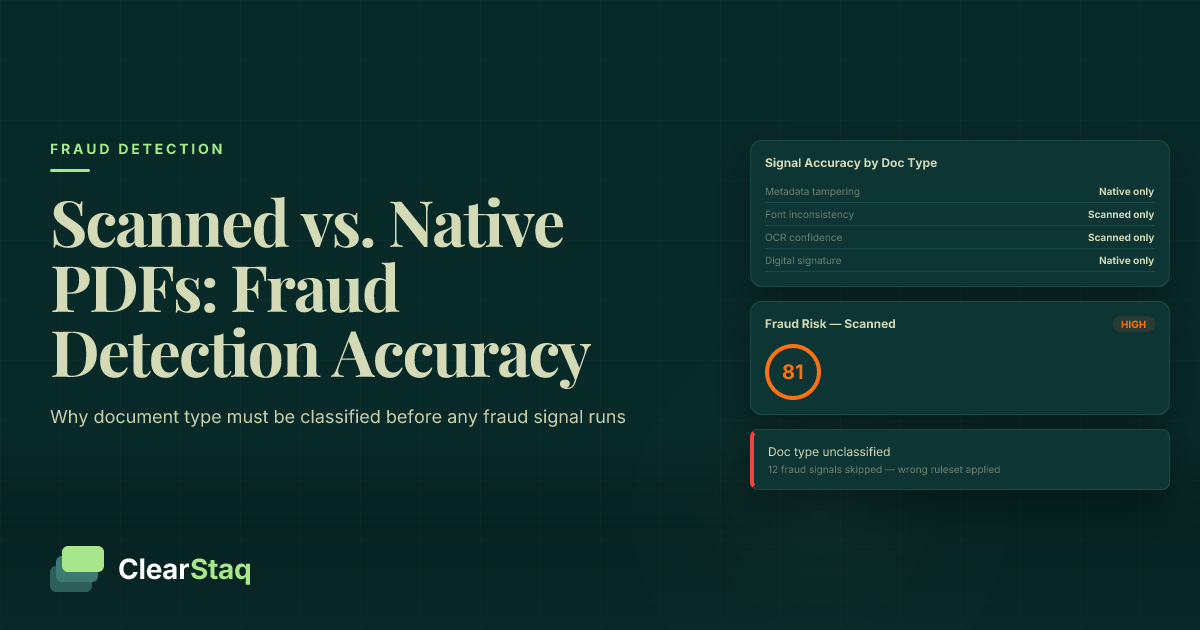
OCR extracts text and totals from a document image, while true parsing categorizes transactions and runs fraud detection logic against the patterns. OCR alone leaves fraud judgment to a human reviewer scanning line by line.
Is bank statement analysis software worth it for small equipment financing shops?
Yes, once you're closing more than a few deals a week, because manual review at 4-8 hours per file becomes the bottleneck before credit policy does. Smaller shops often see the fastest payback since a single missed fraud pattern can cost more than a year of software fees.
How accurate is AI bank statement parsing in 2026?
Leading platforms report 99.5% accuracy across 900+ bank statement formats as of 2026. Accuracy at that level is what allows underwriters to trust automated output instead of re-checking every line manually.
One last thing
The equipment financing deals that go bad rarely fail on a single obvious red flag — they fail on a pattern spread across three or four transactions that a human reviewer scanning a PDF for ten minutes simply won't cross-reference. That's the actual argument for 27+ signals over a checklist: it's not about catching more fraud, it's about catching the fraud that's designed to look like nothing at all.
Related guides
ClearStaq Team
Content Team
The ClearStaq team builds AI-powered tools for bank statement parsing, fraud detection, and income verification.