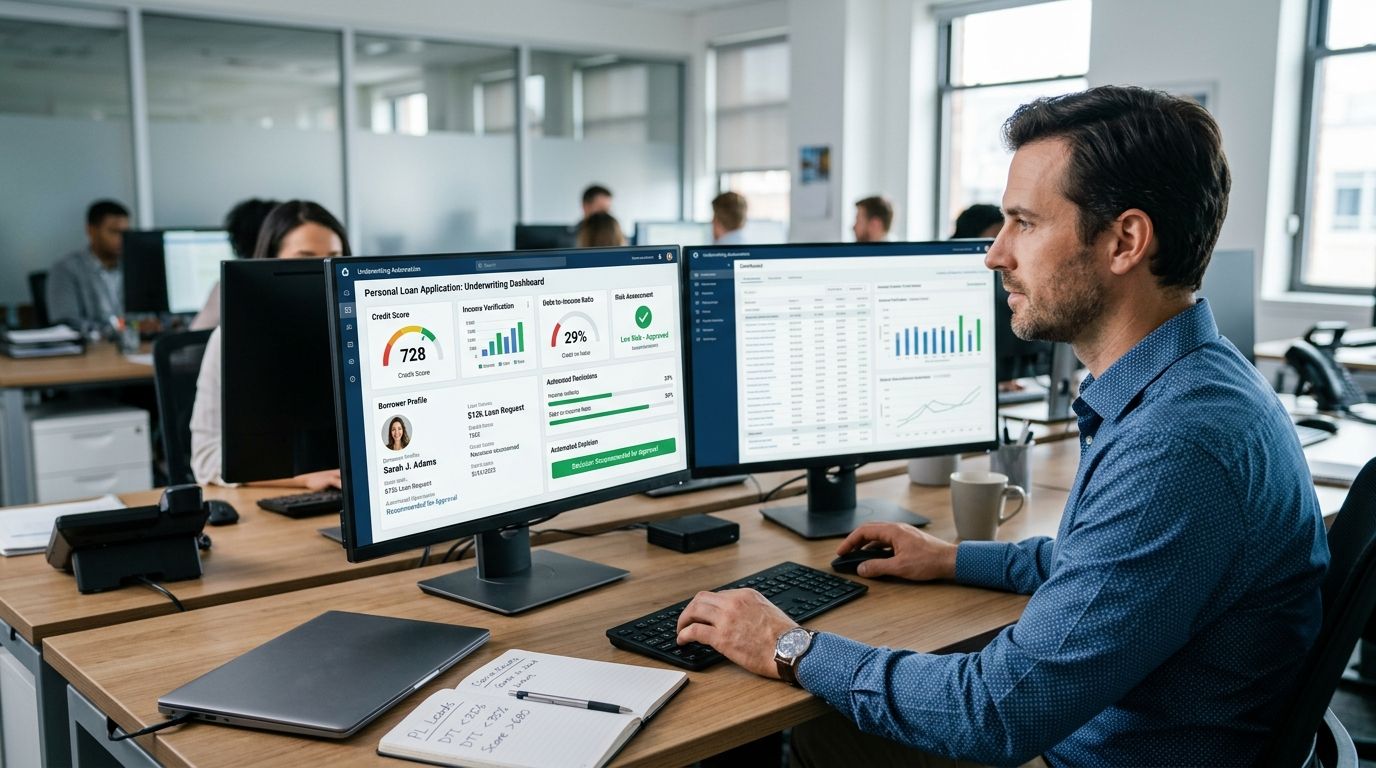
Marketplace lenders underwrite off gig payouts, platform revenue splits, and thin credit files that traditional scorecards miss — and manual review can't keep pace with same-day funding promises. This guide breaks down what underwriting automation software for marketplace lenders actually needs to do in 2026, and which capabilities separate a real parsing engine from a document locker.
- ClearStaq parses 900+ bank statement formats in under 5 seconds — the baseline for underwriting automation software for marketplace lenders in 2026.
- 27+ AI fraud signals catch synthetic identities and doctored statements before funding — Buy for marketplace and P2P platforms.
- Document storage tools like LoanPro save PDFs but don't parse them — Skip if you need automated underwriting.
- 99.5% parsing accuracy and a 95% cut in manual review time make automation the default in 2026, not the upgrade.
Why This Matters
Marketplace lenders don't underwrite off W-2s and FICO alone — they price risk off gig payouts, marketplace revenue splits, and payment histories that live inside a bank account, not a credit bureau file. That data arrives messy: hundreds of statement formats, deposits mixed with platform fees, and borrowers with three months of history instead of three years.
Manual review doesn't scale against that mess at the speed marketplace platforms promise borrowers. A team scanning PDFs by hand in 2026 is competing against lenders running automated bank statement parsing and fraud detection in under 5 seconds per file. The gap shows up in two places: approval speed, and fraud losses from synthetic identities and doctored statements that a rushed manual review misses.
Underwriting automation software for marketplace lenders closes both gaps at once — faster decisions, and more signals checked per file than a person can realistically review by hand.
Who This Software Is For
Underwriting automation software for marketplace lenders is built for ops and credit teams at platforms that price loans off gig payouts, embedded-finance revenue splits, and marketplace payment history — not W-2 pay stubs. Think peer-to-peer lending platforms, revenue-based financing shops, and working-capital lenders funding sellers on Amazon, Etsy, DoorDash, or Stripe-connected marketplaces.
If your underwriting team spends more than an hour per file manually scanning bank statements for gig deposits, verifying marketplace payout patterns, or flagging thin-file borrowers, this guide is for you. ClearStaq builds around that exact workflow: bank statement parsing, fraud signal detection, and income verification in one pass, aimed at lenders who can't afford a slow underwriting queue in 2026.
What to Look For in Underwriting Automation Software for Marketplace Lenders
Format-aware bank statement parsing
Marketplace borrowers bank everywhere — Chase, regional banks, neobanks, embedded accounts — each with a different statement layout. A parser that only handles the top three banks fails on exactly the population marketplace lenders serve: thin-file, non-traditional borrowers. Look for coverage across 900+ statement formats so accuracy doesn't drop the moment a borrower uses a credit union or a fintech-issued account.
Marketplace payout verification
Gig and marketplace income shows up as periodic ACH deposits from Stripe, PayPal, or platform payroll processors, not a steady paycheck. Underwriting automation needs to separate gross payout from net income after platform fees, and flag volatility across a 90-day or 12-month window instead of averaging it into one flat number.
Fraud signal depth
Instant-funding pressure makes marketplace lending a target for synthetic identities and doctored bank statements. Software with a shallow signal set — balance checks, deposit totals — misses structuring, voided-check fraud, and fabricated payout screenshots. 27+ signals per statement is the depth that catches what a reviewer scanning a PDF for 90 seconds will not.
Processing speed at approval-time volume
Marketplace lenders compete on same-day or same-hour funding decisions. If parsing takes minutes per file, that speed promise breaks the moment volume spikes. Sub-5-second processing per statement keeps the underwriting queue from becoming the bottleneck during a funding rush.
KYB and sanctions screening for business borrowers
Many marketplace lending programs fund business sellers, not just consumers, which pulls in KYB verification and sanctions screening obligations. Automation that stops at bank statement parsing and skips business verification pushes that compliance work back onto the underwriting team manually.
Audit-ready output for compliance review
Regulators and warehouse lenders want to see how an approval decision got made. Automation that outputs a black-box score without underlying signals creates rework during audits — look for software that shows which fraud signals triggered and why, file by file.
Top Picks: What Actually Belongs in a Marketplace Underwriting Stack
The marketplace-specific pick: payout verification. Marketplace and gig platforms don't hand borrowers pay stubs; they hand them a stream of Stripe, Uber, or DoorDash deposits mixed with fees and chargebacks. Software built to verify marketplace payouts for working capital loans separates platform fees from net income and flags deposit volatility instead of smoothing it away. In 2026, that distinction is what keeps a lender from approving a seller whose gross revenue looks healthy but whose net payout dropped after a marketplace fee change. Buy if more than a quarter of your book is gig or marketplace income.
The foundation: bank statement parsing. Every underwriting decision downstream depends on getting the raw statement data right first. A bank statement parsing API built for fintech lenders covering 900+ formats means Chase, Bank of America, and a regional credit union all come back structured the same way, in under 5 seconds per document. Parsing that only handles a handful of major banks quietly fails on exactly the thin-file, non-traditional borrowers marketplace lenders fund. Buy — this is the layer every other capability sits on top of.
The safety net: fraud signal depth. Instant-funding pressure is a fraud magnet, and marketplace lenders feel it more than balance-sheet lenders because approval speed is the product itself. Fraud detection software built for non-bank lenders running 27+ signals per statement catches synthetic identities, doctored PDFs, and structuring patterns that a reviewer scanning a document quickly will miss. ClearStaq's fraud detection layer runs those signals in the same pass as parsing. Buy for any platform funding same-day or same-hour.
The wildcard: document storage platforms. Some loan management systems get sold as "underwriting automation" when they're really e-vaults. LoanPro, for example, stores uploaded statements and organizes them by loan file — it doesn't parse the transaction data or generate fraud signals from it. If your team still exports PDFs to read manually after the software "processes" them, that's a storage tool, not automation. Skip it for underwriting, and pair it, if at all, with an actual parsing layer.
What to Avoid
- Manual spreadsheet spreading for marketplace income. Averaging three months of gig deposits into one "average monthly revenue" number hides the volatility that predicts default — it looks like normal underwriting but erases the exact signal marketplace lending needs most.
- OCR tools without format-aware parsing. A generic OCR layer reads text off a PDF; it doesn't know that Wells Fargo formats a statement differently than a neobank. That gap shows up as garbage line items exactly when the borrower's file matters most.
- Fraud checks that stop at balance verification. Confirming an account balance is real is not the same as detecting a synthetic identity or a doctored payout screenshot. A shallow check clears the file and passes the fraud risk downstream to whoever holds the loan.
Verdict Comparison
| Capability | What to Look For | Where ClearStaq Lands | Verdict |
|---|---|---|---|
| Statement parsing coverage | Broad format support across banks and neobanks | 900+ formats | Buy |
| Fraud signal depth | Signals beyond balance checks | 27+ AI signals per statement | Buy |
| Processing speed | Sub-minute turnaround at volume | Under 5 seconds per statement | Buy |
| Parsing accuracy | Consistent structured output | 99.5% accuracy | Buy |
| Manual review time | Meaningful reduction, not marginal | Cut by 95% | Buy |
See the underwriting stack marketplace lenders use
Bank statement parsing, 27+ fraud signals, and income verification in one platform.
FAQ
What is underwriting automation software for marketplace lenders?
It's software that parses bank statements, verifies gig or marketplace payout income, and runs fraud signals automatically instead of a human reviewing each file by hand. In 2026, platforms like ClearStaq combine parsing, fraud detection, and income verification into one pass.
How is marketplace lender underwriting different from bank underwriting?
Marketplace lenders price risk off gig payouts and platform revenue splits instead of W-2 income and FICO scores alone. That means the software needs to separate net income from gross platform payouts and flag volatility across months, not just verify a single pay stub.
Is underwriting automation software worth it for a small marketplace lending platform?
Yes, if manual review is taking more than an hour per file or fraud losses are showing up from doctored statements. A parser processing statements in under 5 seconds pays for itself once file volume passes a few dozen per week.
How much does underwriting automation software cost in 2026?
Pricing varies by vendor and volume, so check current rates directly rather than budgeting off a published list price. Most platforms price around statement volume or per-seat access rather than a flat license fee.
Can underwriting automation software catch synthetic identity fraud?
Yes, if it runs enough signals per statement — ClearStaq runs 27+ AI signals designed to catch synthetic identities, doctored PDFs, and structuring patterns. A tool that only checks account balances will miss most of this.
Does underwriting automation replace manual review entirely?
No, it removes the repetitive first pass — reading statements, flagging anomalies — so underwriters spend time on judgment calls instead of data entry. ClearStaq's automation cuts manual review time by 95% rather than eliminating human sign-off.
How fast is automated bank statement parsing?
ClearStaq processes a bank statement in under 5 seconds with 99.5% accuracy across 900+ supported formats. That's the benchmark to compare any underwriting automation vendor against in 2026.
What's the difference between document storage software and parsing software?
Storage software like LoanPro holds uploaded PDFs organized by loan file but doesn't extract or structure the transaction data inside them. Parsing software turns those statements into structured data and fraud signals automatically, which is what underwriting automation actually requires.
One Last Thing
Marketplace lenders that flatten three months of gig deposits into one "average monthly revenue" figure are underwriting on a number that already hid the risk. A 12-month view catches the seasonal dip or platform-fee change a 3-month snapshot smooths over — the same reason a single recent statement is the weakest input in a marketplace underwriting file, not the strongest.
Related Guides
ClearStaq Team
Content Team
The ClearStaq team builds AI-powered tools for bank statement parsing, fraud detection, and income verification.