Fintech lenders shopping for a bank statement parsing API for 2026 need more than an accuracy number on a landing page — they need format coverage, fraud signal depth, and processing speed that holds up at volume.
- ClearStaq's bank statement parsing API for fintech lenders processes statements in under 5 seconds. Buy for high-volume underwriting teams.
- 900+ bank formats and 27+ fraud signals separate real parsing APIs from OCR wrappers in 2026.
- 99.5% accuracy on parsed transaction data matters more than raw speed once volume scales past 500 files a month.
- Skip document storage tools rebranded as parsing APIs. They don't extract structured transaction data.
Why this matters
Manual bank statement review still eats 4-8 hours per file at most non-bank lenders and MCA shops in 2026. That's the bottleneck that decides whether you fund a deal in a day or lose it to a competitor who quotes faster.
A parsing API isn't a nice-to-have anymore. It's the difference between reviewing 20 files a week per underwriter and reviewing 200. ClearStaq's bank statement parsing API exists specifically to close that gap for fintech lenders, MCA brokers, and CPAs who verify income at scale.
Who this is for
This guide is for engineering and underwriting leads at digital lenders, MCA brokers, revenue-based financing companies, and embedded finance platforms evaluating a bank statement parsing API to replace manual PDF review. If your team still eyeballs statements for round-dollar deposits or copy-pastes numbers into a spreadsheet, this is your buyer profile.
What to look for in a bank statement parsing API for fintech lenders
Format coverage across bank statement layouts
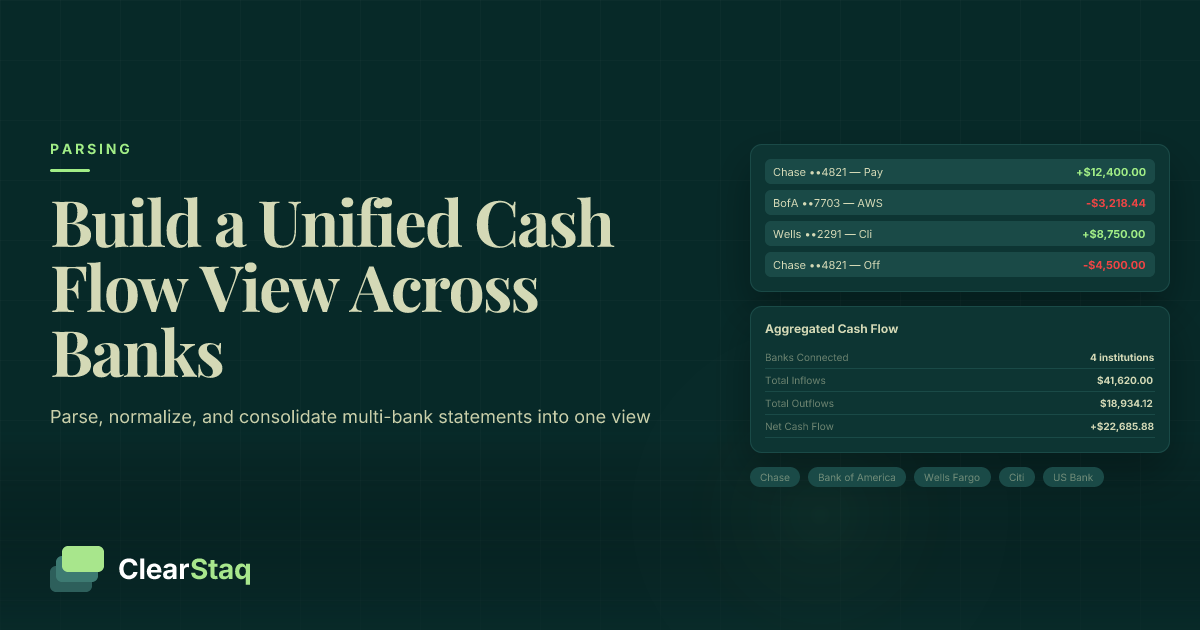
Every bank formats statements differently. Chase, Bank of America, and Wells Fargo don't share a layout, and regional banks add another 900+ variations. An API that only handles the top five banks forces manual fallback for the rest of your pipeline, which defeats the purpose of automating in the first place.
Processing speed under real volume
Speed only matters if it holds under load. A parsing API that returns results in under 5 seconds per statement keeps underwriters moving through a queue instead of waiting on a spinner between files.
Fraud signal depth
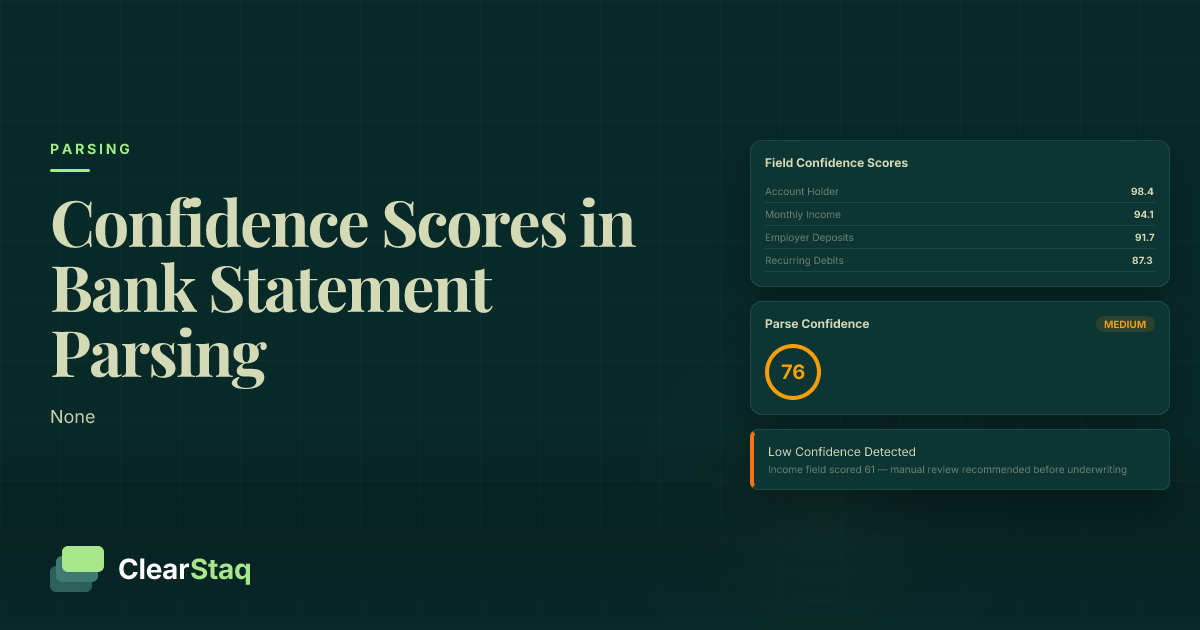
A parser that only extracts numbers misses the point. You need signals that flag altered PDFs, structuring, commingled funds, and income smoothing before the deal reaches underwriting. Look for 27+ distinct fraud signals, not a single confidence score that hides how the flag was generated.
Accuracy and false-positive rate
99.5% accuracy on parsed line items is the benchmark to test against with your own sample files, not a vendor's cherry-picked demo. Every point below that threshold means more manual QA time added back into the process you're trying to remove.
API integration and developer experience
An API-first architecture matters more than a slick dashboard if your team is building this into an existing LOS or origination stack. Check for clean webhook support, sane rate limits, and documentation that doesn't require a sales call to understand.
Audit trail and compliance documentation
Every flagged transaction and fraud signal needs a documented reason a compliance officer can review later. If the API can't show its work, it's a liability in an audit, not a shortcut.
Top picks for fintech lenders
The volume play — commercial loan underwriting automation. Parses statements in under 5 seconds and cuts manual review time by up to 95% for teams running high file counts. ClearStaq's commercial loan underwriting automation is built for lenders moving 500+ files a month who need the parsing-to-decision pipeline automated end to end. Buy if your bottleneck is underwriter hours, not deal flow.
The fraud layer — document fraud detection for fintech lenders. 27+ fraud signals catch altered PDFs, structuring patterns, and income smoothing before a deal reaches funding. ClearStaq's document fraud detection software for fintech lenders is the layer to run before you approve anything without in-person verification. Buy for any lender funding six-figure lines on remote applications.
The vertical fit — synthetic identity detection for online lenders. Catches synthetic identity patterns across linked accounts and application data, which matters most for lenders that never see an applicant in person. ClearStaq's synthetic identity detection tooling targets exactly this gap in digital-only origination. Consider if your book is fully remote; Skip if you still do branch-based underwriting.
The scale test — cash flow underwriting for small business lenders. Normalizes revenue across 900+ bank statement formats so seasonal small business books don't get flagged as declining revenue by mistake. ClearStaq's cash flow underwriting model is built for MCA renewals and small business books with irregular deposit patterns. Buy if your portfolio skews toward small business or MCA.
“If your parsing API can't tell you why a transaction was flagged, it's not a fraud tool. It's a black box.”
What to avoid
- Generic OCR tools that extract raw text but not structured transaction fields. You'll still categorize manually, just from a text file instead of a PDF.
- Document storage platforms marketed as parsers. They hold the file, they don't extract the data or flag fraud patterns inside it.
- Fraud tools that only check identity documents. A clean ID doesn't catch commingled funds or a doctored statement, and those are where lending losses actually happen.
Verdict comparison
| Pick | Best for | Key spec | Verdict |
|---|---|---|---|
| Commercial loan underwriting automation | High file-volume lenders | Under 5s processing, up to 95% less review time | Buy |
| Fraud detection for fintech lenders | Remote approvals | 27+ fraud signals | Buy |
| Synthetic identity detection | Digital-only origination | Cross-account pattern matching | Consider |
| Cash flow underwriting | Small business / MCA books | 900+ format coverage | Buy |
FAQ
What is a bank statement parsing API for fintech lenders?
It's an API that extracts structured transaction data and fraud signals from uploaded bank statements automatically, instead of requiring manual review. ClearStaq's version returns results in under 5 seconds with 99.5% accuracy in 2026.
How much does a bank statement parsing API cost in 2026?
Pricing typically scales with monthly file volume rather than a flat license fee. Ask any vendor for a per-file rate at your expected volume before committing.
Is ClearStaq better than manual bank statement review?
Manual review runs 4-8 hours per file at most non-bank lenders; automated parsing cuts that to seconds per statement. The tradeoff is upfront integration time against an API.
How many bank formats does a good parsing API need to cover?
900+ formats is the practical benchmark for 2026 given how many regional and community banks issue statements in non-standard layouts. Anything under that forces manual fallback on a meaningful share of your pipeline.
Can a parsing API detect fraud, or just extract data?
A parsing-only API extracts numbers; a fraud-aware API flags structuring, commingled funds, and altered documents using dozens of signals. Look for 27+ distinct fraud signals, not a single generic score.
Do fintech lenders need a separate fraud tool alongside a parsing API?
Not if the parsing API already runs fraud detection on the same data pass. Running two separate tools usually means duplicate review work and conflicting flags.
What accuracy rate should a bank statement parser hit?
99.5% is the benchmark to test against with your own sample files in 2026. Below that, manual QA time creeps back into the process you automated.
One last thing
The number that gets overlooked most in vendor demos isn't accuracy. It's format coverage. A parser can hit 99.5% accuracy on the five bank formats it was trained on and still fail silently on the sixth, which is exactly where fraud tends to hide in 2026: in the statements the parser doesn't fully understand.
Related guides
ClearStaq Team
Content Team
The ClearStaq team builds AI-powered tools for bank statement parsing, fraud detection, and income verification.