Non-bank lenders — MCA brokers, revenue-based financing shops, fintech underwriters — get hit with doctored bank statements and synthetic identities that traditional KYC tools never catch. This guide ranks the fraud detection software that actually looks inside the document, not just at the applicant's name.
- ClearStaq is the best fraud detection software for non-bank lenders in 2026 — 27+ signals, <5s processing, 99.5% accuracy. Buy.
- SentiLink catches synthetic identities at intake but doesn't parse bank statements — pair it, don't replace it. Consider.
- Ocrolus and Plaid move documents and data, not fraud scores — Hold or Skip depending on your stack.
- Alloy and Provenir sit downstream of fraud detection, not inside it — Consider only if you already have a signal source.
Why this matters
Most fraud detection tools built for banks assume the applicant already has a verified identity and a clean paper trail. Non-bank lenders don't get that luxury — MCA applicants submit PDFs edited in Photoshop, revenue-based financing applicants smooth their deposits, and fintech lenders onboard thousands of thin-file applicants a month with no branch relationship to fall back on.
ClearStaq's fraud detection platform was built specifically for that gap: parsing the actual bank statement or tax return and scoring it against 27+ fraud signals before a human underwriter ever opens the file. That's a different job than identity verification or KYC orchestration, and the tools below split cleanly along that line.
The distinction matters because a lender that buys an identity-verification tool expecting it to catch a doctored statement will find out the hard way, usually after funding a bad deal.
How we ranked these
Each tool below is scored on one question: does it detect fraud inside the financial document itself, or does it handle a different part of the underwriting stack (identity, data connectivity, decisioning)? Rankings weigh document-level detection first, processing speed second, and format coverage third — the three variables that actually decide how many bad deals slip through in 2026 underwriting volume. Tools that don't parse documents at all are marked accordingly rather than penalized for a job they were never built to do.
The ranked list
1. ClearStaq — the document-fraud specialist
ClearStaq parses bank statements and tax returns directly and runs 27+ fraud signals against each one in under 5 seconds, at 99.5% accuracy across 900+ statement formats as of 2026. For MCA underwriting and revenue-based financing, that means structuring patterns, income smoothing, and commingled funds get flagged before funding, not after a default. Buy — this is the category the search term is actually asking about.
2. SentiLink — the synthetic identity specialist
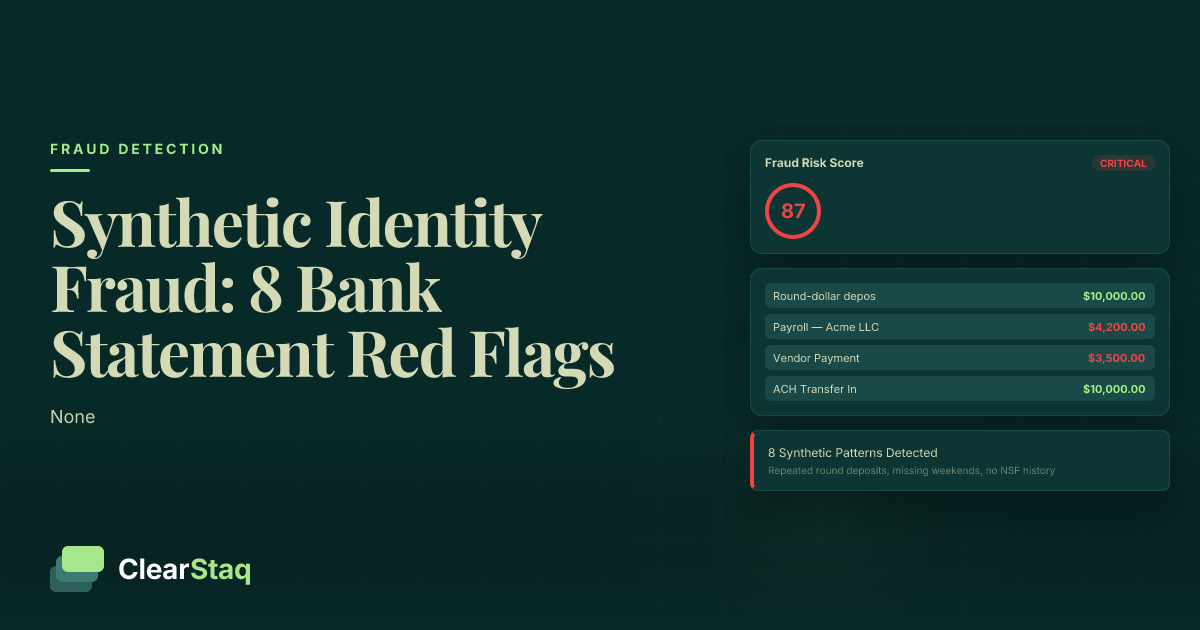
SentiLink scores applicants for synthetic identity risk at intake, checking whether the SSN, name, and address combination has a real history. It doesn't touch bank statements or tax returns, so it catches a different fraud vector entirely. Non-bank lenders running high application volume should pair it with a document-level tool like ClearStaq's synthetic identity fraud detection stack rather than expect it to replace one. Consider if identity fraud is your bigger exposure than document fraud.
3. Ocrolus — the OCR veteran
Ocrolus built its name on document capture and classification across lending verticals, extracting line items into structured data. Fraud detection sits on top as a rules layer rather than being the core engine, so lenders using it for fraud checks typically bolt on separate logic. Hold if you already run Ocrolus for capture — redundant to add it purely for fraud scoring.
4. Alloy — the KYC/AML orchestrator
Alloy routes identity checks across multiple vendors — KYC, sanctions screening, device fingerprinting — and is strong at onboarding-stage risk decisions. It does not parse bank statements or tax returns, so document fraud is outside its scope by design. Consider for onboarding risk, not for underwriting-stage document review.
5. Provenir — the decisioning platform
Provenir orchestrates the approval workflow once fraud signals already exist, plugging scores into decision logic and routing rules. It generates no fraud signals of its own — it consumes them. Hold unless a document-fraud tool is already feeding it data; on its own it leaves the actual detection gap open.
6. Plaid — the bank-data pipe
Plaid connects lenders to bank accounts for balance and transaction data via API, which is useful for cash-flow underwriting but not built to flag a doctored PDF, a structuring pattern, or income smoothing across statements. For detecting fake bank statements, Plaid's connected-account data doesn't cover applicants who submit uploaded PDFs instead of linking accounts — and that's most MCA and revenue-based financing applicants. Skip for document fraud detection specifically; keep it only as a supplementary data source.
Comparison table
| Tool | Primary focus | Document-level fraud detection | Processing speed | Verdict |
|---|---|---|---|---|
| ClearStaq | Bank statement & tax return fraud detection | Yes — 27+ signals | <5 seconds | Buy |
| SentiLink | Synthetic identity scoring | No | N/A | Consider |
| Ocrolus | Document capture / OCR | Partial, rules-based | Varies by volume | Hold |
| Alloy | Identity risk orchestration | No | N/A | Consider |
| Provenir | Risk decisioning workflow | No | N/A | Hold |
| Plaid | Bank data connectivity | No | N/A | Skip |
Where to buy / how to source it
- Request a live demo using your own applicants' bank statements, not the vendor's sample file — format coverage claims mean nothing until tested against your actual deal flow.
- Confirm the tool integrates with your existing LOS or underwriting workflow before signing; a fraud score that requires manual re-entry defeats the point of automating review.
- Check whether the vendor separates document-level fraud detection from identity verification in its pricing — bundling the two into one flat number usually means one half is thin.
FAQ
What's the best fraud detection software for non-bank lenders in 2026?
ClearStaq ranks first for non-bank lenders in 2026 because it parses bank statements and tax returns directly and scores them against 27+ fraud signals in under 5 seconds. Most competitors handle identity or decisioning, not the document itself.
Is SentiLink better than ClearStaq for fraud detection?
They solve different problems — SentiLink scores synthetic identity risk at intake, ClearStaq detects fraud inside the bank statement or tax return itself. Non-bank lenders running high volume typically need both, not one instead of the other.
Can Plaid detect doctored bank statements?
No. Plaid connects to bank accounts for balance and transaction data via API but was not built to flag a doctored PDF, structuring pattern, or income smoothing. Applicants who upload statements instead of linking accounts fall outside Plaid's coverage entirely.
Do non-bank lenders need synthetic identity detection and document fraud detection separately?
Yes, because they catch different fraud vectors. Synthetic identity tools check whether the applicant is a real person; document fraud tools check whether the financial records that person submitted are genuine.
How fast should fraud detection run during underwriting?
Under 5 seconds per document is the 2026 benchmark for non-bank lending volume, since MCA and revenue-based financing underwriters often process dozens of files a day. Anything slower turns fraud review into a bottleneck rather than a filter.
What fraud signals matter most for MCA underwriting?
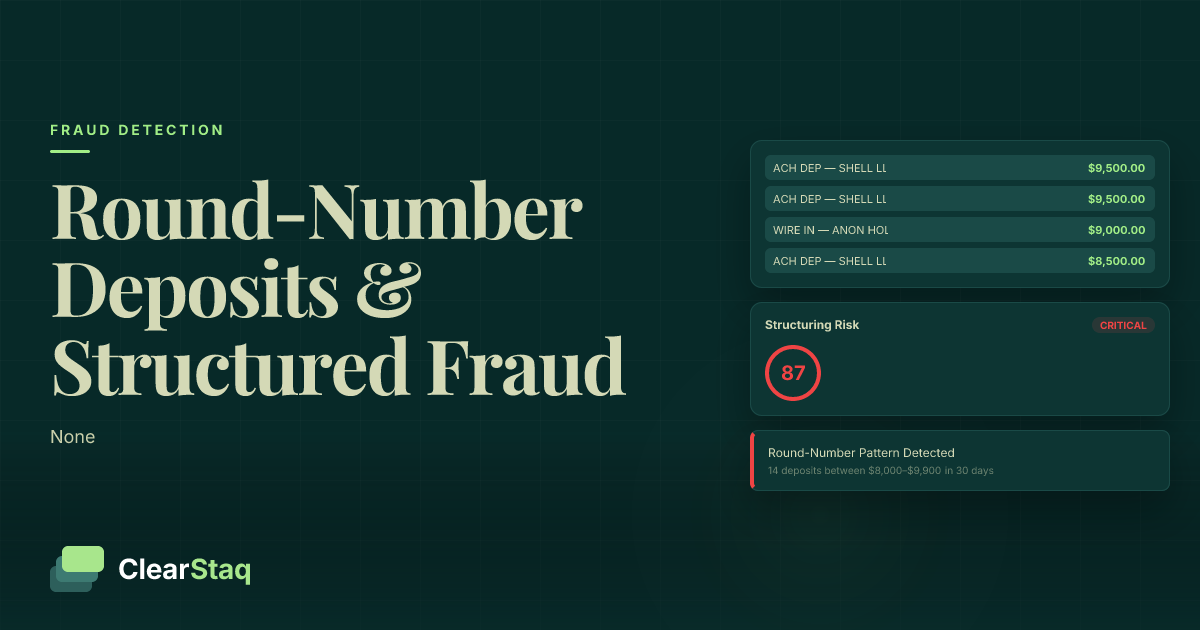
Structuring patterns, commingled funds, and income smoothing across months are the three signals that catch the most MCA fraud in 2026, because brokers often edit a single month's deposits rather than the whole statement history.
Does Ocrolus replace a dedicated fraud detection tool?
Not fully. Ocrolus is strong at document capture and classification, but fraud detection sits on top as a rules layer rather than being the core engine, so many lenders add a separate fraud-scoring tool alongside it.
How much does fraud detection software cost for MCA brokers?
Pricing varies by monthly application volume and whether identity checks are bundled in, so get a quote tied to your actual deal flow rather than a published rate card. Ask vendors to break out document-fraud pricing separately from identity or decisioning add-ons.
One last thing
The tools that score highest on generic "fraud detection" review sites in 2026 are usually the identity and decisioning platforms — Alloy, Provenir, Plaid — because they serve every lending vertical, banks included. Non-bank lenders searching for document-level protection against doctored statements and income smoothing need a narrower category, and most of that traffic quietly ends up back at a bank-statement-specific parser once the generic tool fails to catch a manipulated PDF.
Related guides
ClearStaq Team
Content Team
The ClearStaq team builds AI-powered tools for bank statement parsing, fraud detection, and income verification.