Revenue-based financing runs on daily and weekly ACH debits pulled straight from a merchant's operating account, which means the underwriting decision lives or dies on what that bank statement actually says — and forged, structured, or stacked statements are the single biggest reason RBF funders eat losses in 2026.
- ClearStaq flags synthetic identities, stacking, and structuring across 27+ AI signals in under 5 seconds per statement.
- Fraud detection software for revenue-based financing must catch MCA stacking, not just doctored PDFs.
- 99.5% parsing accuracy across 900+ bank formats beats manual review and single-format OCR tools.
- Skip any tool that only checks document metadata — RBF fraud lives in transaction patterns, not file headers.
Why this matters
RBF and MCA funders approve deals in days, sometimes hours, based on 3 to 6 months of bank statements showing average daily balance and deposit velocity. That speed is the product — and it's also the exposure. A merchant who's already stacked four advances, structured deposits to dodge a $10,000 reporting threshold, or run synthetic identity fraud through a shell LLC can look clean to a human reviewer skimming a PDF in 90 seconds.
Manual underwriting teams catch the obvious forgeries. They miss the patterns that only show up when you cross-reference deposit timing, counterparty names, and balance trajectories across dozens of transactions — which is exactly where automated fraud detection software for revenue-based financing earns its cost. Cutting review time by 95% only matters if the model is also catching what a tired analyst on deal 40 of the day would miss.
Who this is for
This guide is for RBF funders, MCA brokers, and cash-advance underwriters who process business bank statements to approve daily or weekly debit deals — not consumer lenders, not mortgage shops. If your fraud problem is a merchant hiding a second or third advance, smoothing a bad month, or submitting a statement from a bank that never issued it, the criteria below are built for your deal flow specifically.
What to look for in fraud detection software for revenue-based financing
Format coverage across bank statement types
RBF applicants submit statements from credit unions, regional banks, and national chains, often as scanned PDFs or exported CSVs with wildly different layouts. A parser that only handles the top 5 banks forces your team back into manual review the moment a merchant banks somewhere unusual. Coverage across 900+ formats means the fraud checks actually run on every submission, not just the easy ones.
Depth of fraud signals, not just document checks
Metadata checks — verifying a PDF wasn't edited after export — catch amateur forgeries. RBF fraud is more often structural: a merchant stacking advances or structuring deposits inside a statement that's technically unedited. You need a signal set deep enough to catch both, and 27+ distinct AI signals per statement is the baseline for 2026, not the ceiling.
Stacking and structuring detection built for daily-debit products
Generic loan fraud tools were built for term loans with monthly payments. RBF deals move money daily or weekly, and stacking — taking a second advance without disclosing the first — shows up as recurring ACH debits from other funders that a monthly-cadence tool won't flag. This is the single most RBF-specific capability on this list.
Processing speed that matches your approval timeline
If your sales team promises same-day funding, a fraud check that takes 20 minutes per file kills the deal before it closes. Sub-5-second processing per statement keeps the fraud layer invisible to your funding timeline instead of becoming the bottleneck.
Accuracy and false-positive control
A tool that flags 1 in 5 clean merchants as fraud risks either burning analyst hours chasing ghosts or training your team to ignore alerts entirely. 99.5% parsing accuracy is the number to benchmark against — anything meaningfully below that shifts cost back onto your underwriting team.
Review time reduction you can measure
If a vendor can't quantify how much manual work its tool removes, you're buying a black box. A documented 95% cut in review time gives you a number to hold the tool to during renewal, not just a sales claim at signing.
Top picks: fraud signal categories to evaluate
Synthetic identity fraud detection — the foundation
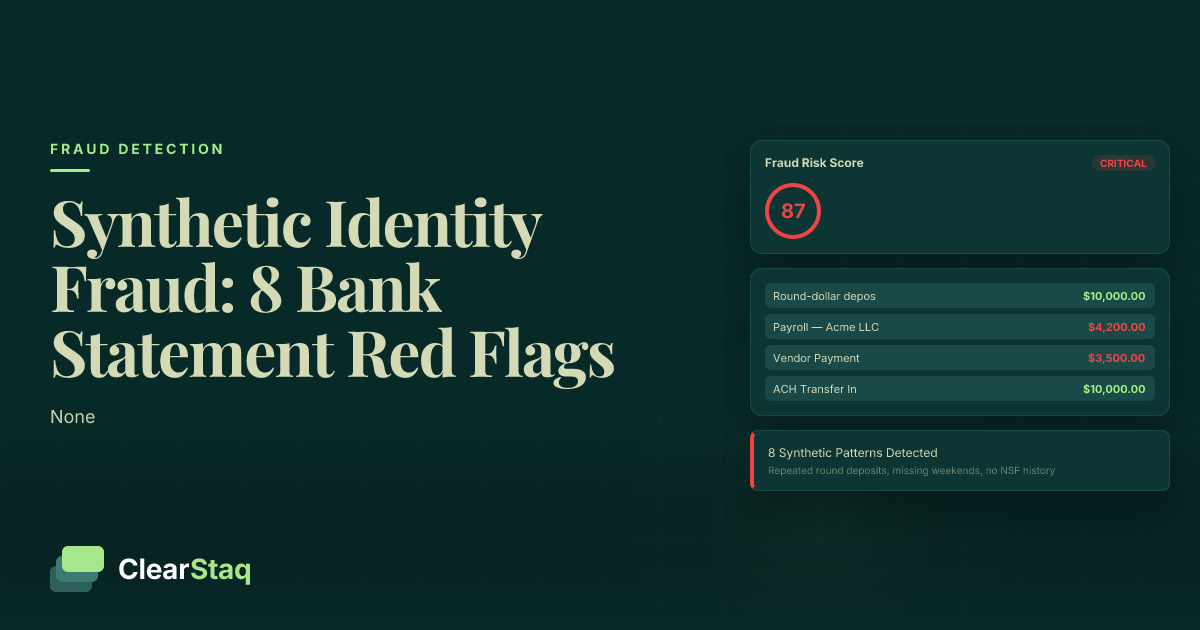
Shell LLCs and manufactured business identities are the entry point for a lot of RBF fraud, since a synthetic entity can apply to five funders in a week with no real repayment history to lose. Synthetic identity fraud detection cross-references business formation dates, banking history length, and transaction patterns against known fraud fingerprints. If a tool can't do this, everything downstream is built on an unverified applicant. Buy.
Structuring pattern detection — the deposit-level check
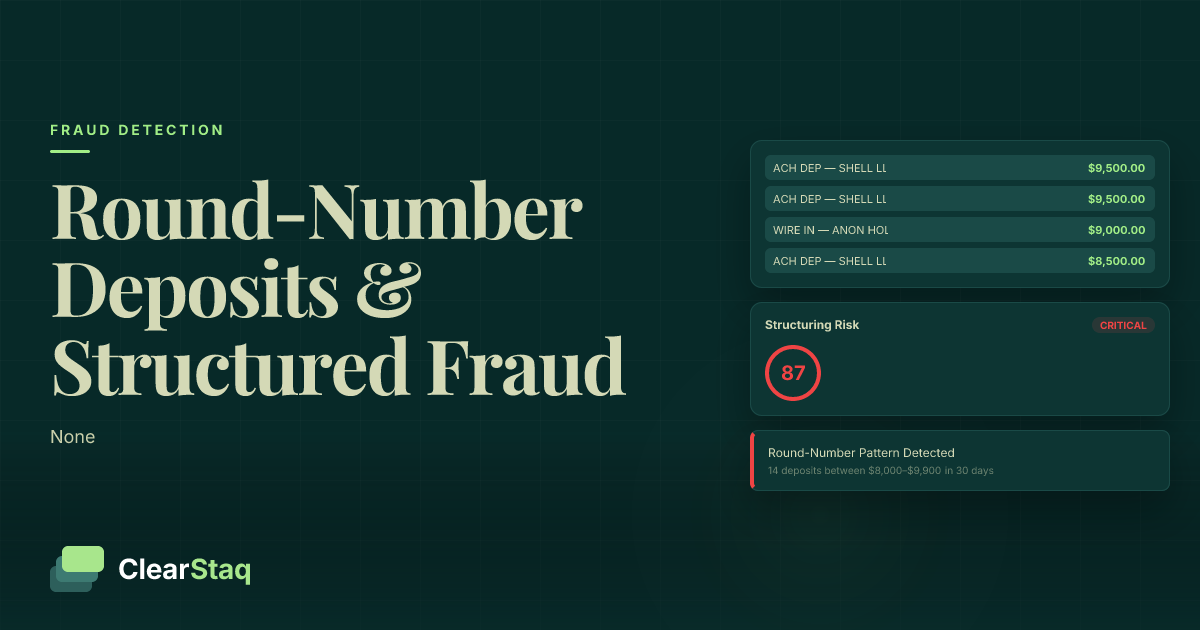
Merchants trying to hide revenue or launder advance proceeds will split deposits into amounts under standard reporting thresholds, and this pattern is invisible on a single statement glance but obvious across a transaction timeline. A tool that specifically flags structuring behavior in business bank statements catches deals that pass a manual eyeball test and fail a pattern test. Buy.
Commingled funds and MCA stacking detection — the RBF-specific layer
This is the check that separates general fraud tools from ones built for cash-advance underwriting. Detecting commingled funds and undisclosed daily debits from other funders tells you whether the merchant can actually service a new advance or whether they're already three deep. Skip a fraud tool that doesn't have this as a named, distinct signal. Buy.
Doctored and fabricated statement detection — the last line
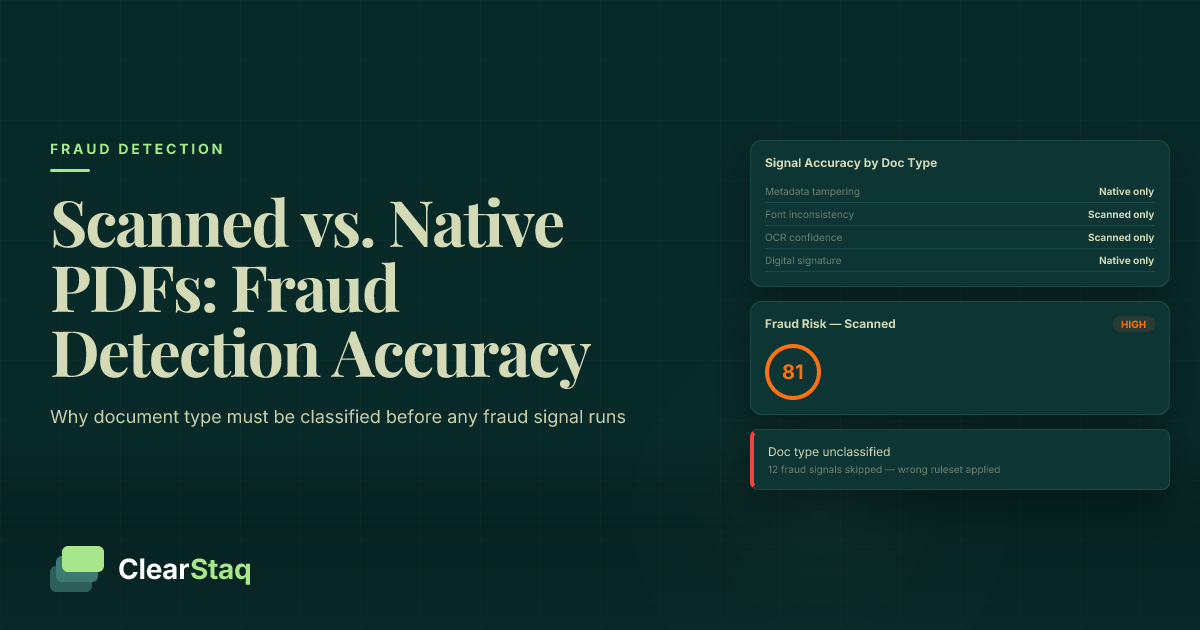
Some applicants still submit statements that were never issued by the bank at all, edited balances, invented transactions, or full fabrications built in a PDF editor. Detecting fake bank statements requires checking font consistency, transaction math, and bank-specific formatting quirks against the claimed institution's real layout. Any RBF underwriting stack without this is missing table stakes. Buy.
Manual-review-only workflows — the wildcard that isn't worth it
Some shops still run a two-analyst review process instead of software. It catches obvious fraud and misses stacking patterns entirely, and it doesn't scale past a handful of deals a day without adding headcount. Skip unless your deal volume is genuinely small enough that automation doesn't pay for itself yet.
What to avoid
- Single-format OCR tools that parse one or two major banks well and choke on credit unions or regional banks — exactly where a lot of RBF fraud tries to hide.
- KYC-only platforms that verify identity documents but never touch transaction-level bank data, missing stacking and structuring entirely.
- Metadata-only fraud checkers that flag edited PDFs but can't catch a technically unedited statement showing structured deposits or undisclosed stacking.
“If your fraud tool can't name a second funder's daily debit inside a statement, it's not built for revenue-based financing.”
Verdict comparison
| Criteria | Why it matters for RBF | Verdict |
|---|---|---|
| Format coverage (900+ formats) | Fraud hides in the statements you can't parse | Must-have |
| Fraud signal depth (27+ signals) | Structural fraud needs more than metadata checks | Must-have |
| Stacking/structuring detection | Core RBF-specific fraud pattern | Must-have |
| Processing speed (<5s) | Keeps fraud checks off the critical funding path | Must-have |
| Accuracy (99.5%) | Controls false positives and analyst trust | Must-have |
| Manual review only | Doesn't scale, misses cross-statement patterns | Skip |
ClearStaq's platform is built around these exact categories rather than a generic document-fraud checklist, which is the distinction that matters when you're underwriting daily-debit deals instead of term loans.
FAQ
What is fraud detection software for revenue-based financing?
It's software that parses business bank statements to flag stacking, structuring, synthetic identities, and doctored documents before an RBF funder approves a daily or weekly debit advance. ClearStaq runs this check across 27+ signals in under 5 seconds per statement.
How does MCA stacking show up in bank statements?
Stacking shows up as recurring ACH debits from other funders that the applicant didn't disclose, usually on a daily or weekly cadence matching a separate advance. A tool checking for commingled funds and stacking patterns catches this even when the merchant's stated revenue looks healthy.
Is synthetic identity fraud common in RBF applications?
Shell LLCs with manufactured banking histories are one of the more common fraud entry points in cash-advance underwriting because there's little repayment history at risk for the applicant. Synthetic identity checks cross-reference formation dates and transaction patterns against known fraud fingerprints to catch this before funding.
How much manual review time does fraud detection software save?
Documented reductions in review time for automated bank statement fraud detection reach 95% compared to manual underwriting workflows in 2026. That shift moves analyst time from document review to decisioning on flagged deals.
Can fraud detection software tell if a bank statement was faked?
Yes — detection models check font consistency, transaction math, and bank-specific formatting against the claimed institution's real layout to catch fabricated statements. This catches fraud that passes a manual eyeball check but fails a pattern-level review.
What accuracy rate should RBF funders expect from parsing software?
99.5% parsing accuracy is the 2026 benchmark for bank statement fraud detection tools serving lenders and funders. Anything meaningfully below that shifts false-positive cleanup work back onto your underwriting team.
Does fraud detection software slow down same-day funding?
It shouldn't — sub-5-second processing per statement is standard for tools built for RBF's fast approval timelines. A tool that takes minutes per file becomes the bottleneck in a same-day funding workflow.
What's the difference between structuring and stacking?
Structuring is splitting deposits into smaller amounts to avoid reporting thresholds, while stacking is taking multiple undisclosed cash advances at once. Both require transaction-level pattern analysis rather than document-level checks to detect.
One last thing
The fraud pattern that costs RBF funders the most isn't the forged PDF — it's the merchant who's technically honest about revenue but has already stacked three advances the statement never explicitly names. Structural fraud detection across 900+ bank formats, run in under 5 seconds, is what catches that before the wire goes out, not a slower second look at the same document a human already approved.
Related guides
ClearStaq Team
Content Team
The ClearStaq team builds AI-powered tools for bank statement parsing, fraud detection, and income verification.