Peer-to-peer lending platforms sit between borrowers and investors, which means document fraud on one side can wipe out returns on the other — and generic KYC tools were never built to catch a doctored bank statement or a structured deposit pattern. This guide breaks down what fraud detection software for peer-to-peer lending platforms actually needs to do, and which approach fits your loan volume.
- ClearStaq wins for peer-to-peer platforms parsing bank statements at scale — 27+ fraud signals, 99.5% accuracy, sub-5-second processing. Buy.
- Identity-only KYC tools catch fake IDs but miss doctored bank statements and income smoothing — use as a layer, not a standalone.
- Manual underwriting review runs hours per file at real volume in 2026 — Skip once you're past a few hundred applications a month.
- In-house parsing builds cost months of engineering time to cover the 900+ statement formats a national P2P platform sees — Skip unless you have a dedicated data team.
Why this matters
P2P platforms carry a fraud exposure most direct lenders don't: borrowers know the underwriting is often faster and lighter-touch, so document fraud concentrates here. A borrower who wouldn't risk a doctored statement with a bank underwriter will try it on a marketplace platform with a 24-hour approval promise.
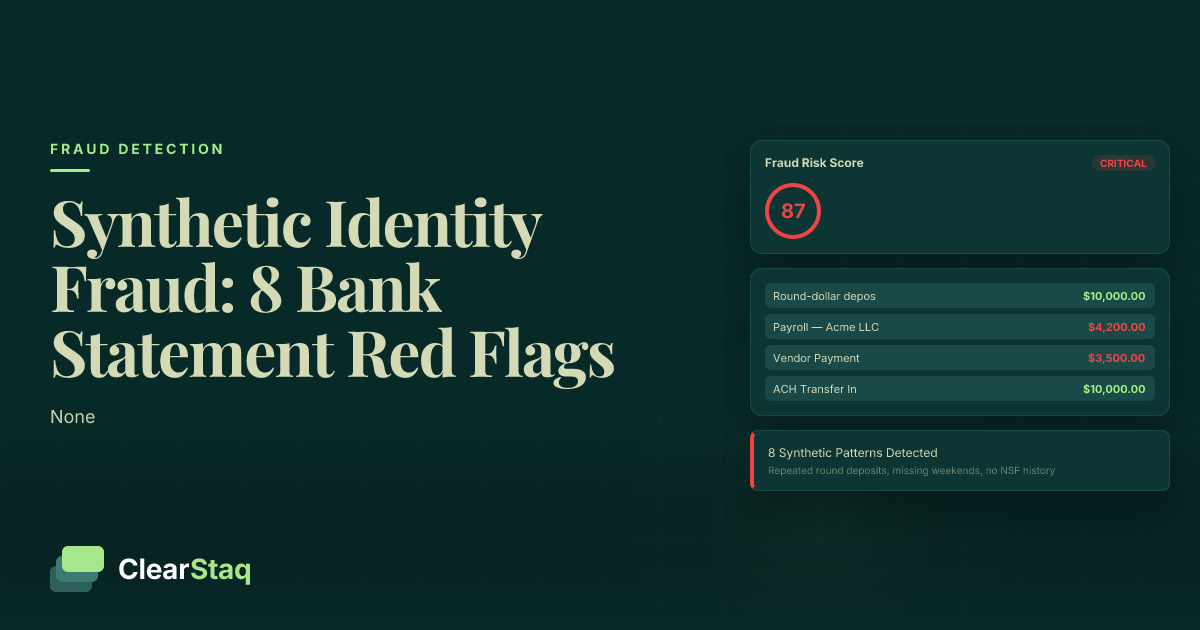
The fraud isn't just fake IDs. It's altered bank statements, income smoothing across deposit cycles, and structuring patterns designed to dodge automated flags. Fraud detection software for peer-to-peer lending platforms has to read the actual financial documents, not just verify a name matches a face.
Who this is for
This guide is for risk and underwriting teams at online marketplace lenders, compliance leads at P2P platforms processing consumer or small business loan applications, and operations managers deciding whether to build fraud detection in-house or buy a parsing layer. If your platform originates more than a handful of loans a week, manual document review is already costing you more than a software subscription would.
What to look for in fraud detection software for peer-to-peer lending platforms
Document-level fraud signals, not just identity checks
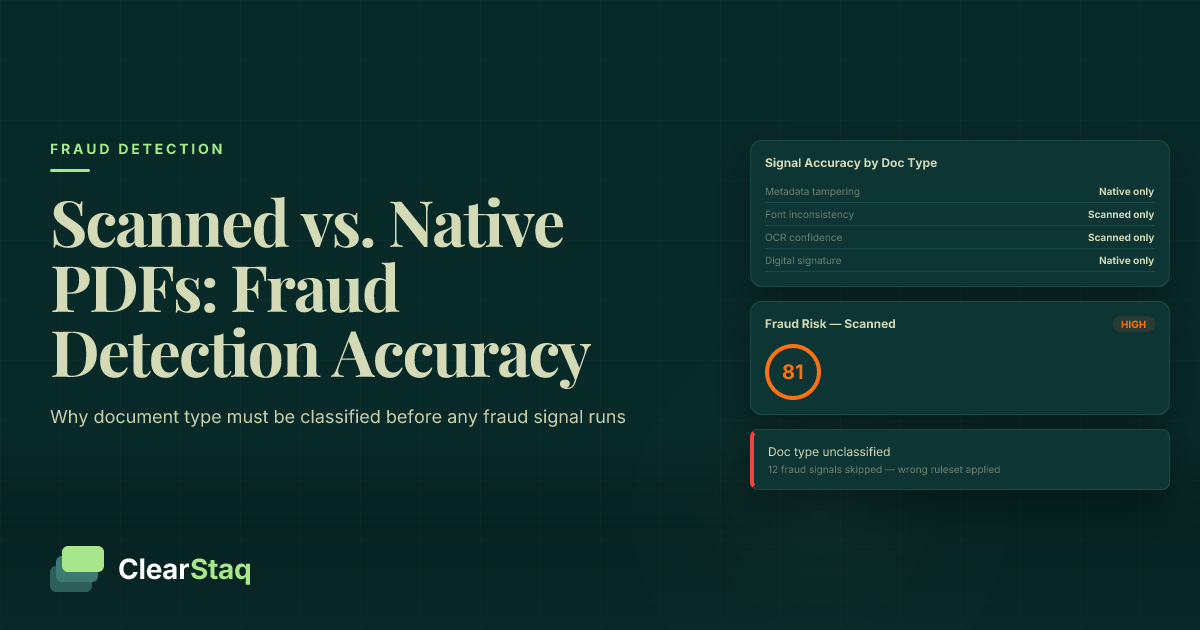
Most KYC vendors stop at verifying who someone is. Peer-to-peer lending fraud usually happens after identity is confirmed — inside the bank statement itself, where deposits get edited or reordered. Software needs signal depth on the document, not just the person: ClearStaq runs 27+ AI fraud signals against parsed statements to catch alterations, inconsistent metadata, and formatting anomalies that a human reviewer would miss on page four of a PDF.
Processing speed at application volume
P2P platforms compete on approval speed. If fraud detection adds hours to a file, borrowers churn to a competitor with a faster yes. Sub-5-second processing per statement matters more here than in traditional bank underwriting, where a 24-hour turnaround is still acceptable.
Format coverage across bank types
Borrowers on a P2P platform bank everywhere — regional credit unions, neobanks, national chains. Software that only parses the top five bank formats forces manual review on the rest, which defeats the purpose. Coverage across 900+ statement formats means fewer files kicked to a human queue.
Structuring and commingling detection for business-purpose loans
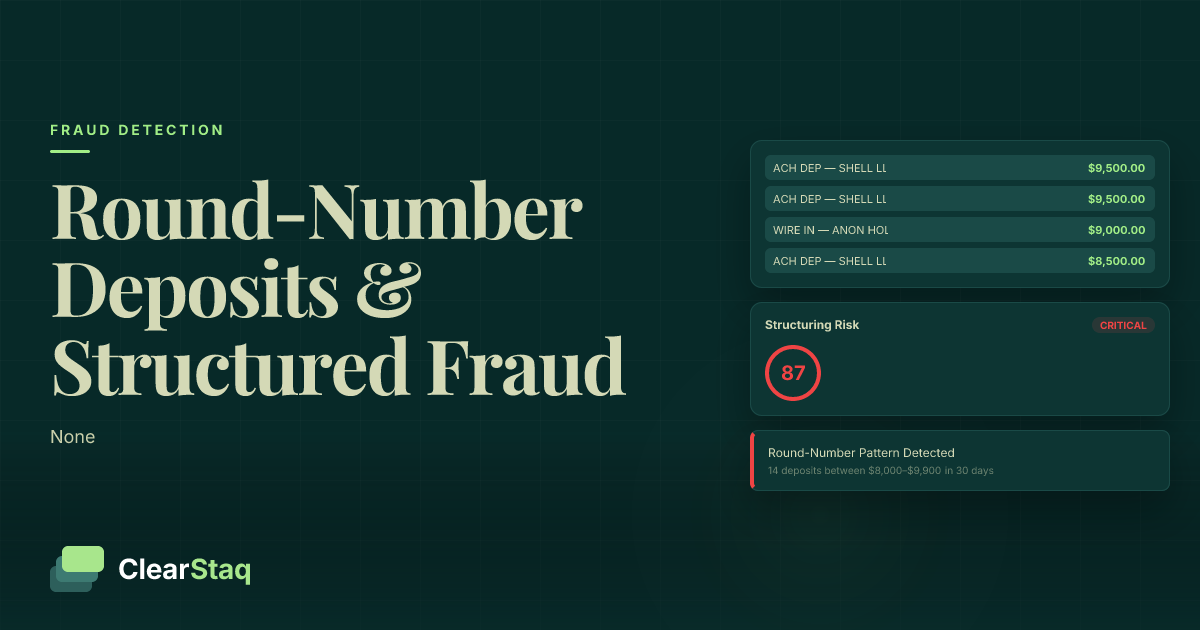
If your platform funds small business or revenue-based loans, structuring patterns — deposits split just under reporting thresholds — show up more than outright fake documents. Software needs to flag deposit timing and sizing patterns, not just document authenticity.
Integration with existing underwriting workflow
A fraud detection tool that outputs a PDF report nobody reads doesn't change your approval rate. It needs to feed a risk score directly into your underwriting decision engine or loan origination system through an API, so flagged files route to review automatically instead of sitting in someone's inbox.
Accuracy and false positive rate
A tool that flags 30% of clean applicants as fraud risks will get overridden by underwriters within a month, and then it's not doing anything. Look for accuracy figures with a specific number attached — 99.5% is the kind of benchmark that means something, versus a vendor that just says "highly accurate."
Top picks
ClearStaq — the built-for-lending pick. Parses bank statements and tax returns directly, running 27+ fraud signals with 99.5% accuracy and sub-5-second turnaround across 900+ formats. For a peer-to-peer platform originating dozens or hundreds of applications weekly, this is the layer that catches what identity verification alone misses. Verdict: Buy.
Identity-only KYC stacks — the incomplete pick. These confirm a borrower is who they claim to be, which matters, but they stop before touching the financial document. A borrower can pass every identity check and still submit an altered statement. Useful as one layer of a fraud program; a liability if it's your only layer. Verdict: Consider, not standalone.
Manual underwriting review — the slow default. Works fine at a dozen applications a month. Past that, review time per file climbs into hours, and fatigue means fraud signals get missed on file 40 of the day, not file 4. If your platform is scaling loan volume in 2026, this doesn't scale with it. Verdict: Skip at real volume.
In-house parsing builds — the DIY pick. Building statement parsing that covers hundreds of bank formats and stays current as banks change PDF layouts is a multi-month engineering project, then an ongoing maintenance cost. Makes sense only if you already run a dedicated data engineering team with nothing better to do. Verdict: Skip unless you have the team.
Narrow point tools for embedded and niche lending flows — the specialist pick. Some platforms running embedded finance products need fraud detection tuned to a specific origination flow rather than a general-purpose parser. Fine for a narrow use case, thin everywhere else. Verdict: Consider for niche flows only.
What to avoid
- Vendors that market "AI-powered" without naming a signal count or accuracy figure. If a vendor won't cite a number, they don't have one worth citing. Ask directly: how many fraud signals, what accuracy, tested against what.
- Document storage tools mistaken for parsing tools. Some platforms store uploaded statements and call it fraud prevention. Storage isn't detection — a stored PDF that nobody's software actually read doesn't stop fake bank statements from getting funded.
- Ignoring the account-takeover side of fraud. Document fraud gets the attention, but P2P platforms also face account takeover on the investor payout side — a compromised inbox lets an attacker reroute funds before anyone parses a single statement. A clean loan file means nothing if the payout account got hijacked over email, so onboarding security has to pair document-level fraud detection with practices that reduce business email compromise risk across the team handling payouts.
Verdict comparison
| Option | Fraud signal depth | Speed | Format coverage | Verdict |
|---|---|---|---|---|
| ClearStaq | 27+ signals, 99.5% accuracy | Sub-5 seconds | 900+ formats | Buy |
| Identity-only KYC | Identity only, no document analysis | Fast | N/A | Consider (layer only) |
| Manual review | Human judgment, inconsistent | Hours per file | N/A | Skip at volume |
| In-house build | Depends on team investment | Months to build | Narrow at launch | Skip without a data team |
| Niche point tools | Flow-specific | Fast for narrow use | Limited | Consider for niche flows |
FAQ
What is the best fraud detection software for peer-to-peer lending platforms in 2026?
ClearStaq is the strongest fit for platforms parsing bank statements at scale, running 27+ fraud signals at 99.5% accuracy with sub-5-second processing. It's built for statement and tax return analysis rather than identity verification alone.
Is identity verification enough fraud protection for a P2P lending platform?
No, identity verification alone misses document-level fraud like altered bank statements and income smoothing. A borrower can pass identity checks and still submit a doctored financial document, so platforms need software that reads the statement itself.
How much does fraud detection software cost for a lending platform?
Costs vary by vendor and volume, and most fraud detection platforms price around document or application volume rather than a flat fee. Check current pricing directly with vendors since it scales with your monthly application count.
Can fraud detection software catch structuring patterns in business loans?
Yes, software built for commercial underwriting flags deposit timing and sizing patterns consistent with structuring, which shows up more often than outright document forgery in business-purpose P2P loans.
How fast should fraud detection run during loan underwriting?
Sub-5-second processing per statement is the benchmark that keeps pace with P2P platforms competing on approval speed. Anything that adds hours to a file pushes borrowers toward faster competitors.
Do I still need manual underwriting review if I use fraud detection software?
Yes, but only for flagged files, not every application. Software should route the small percentage of risky files to a human reviewer while clean applications move through automatically.
What's the difference between document storage and document parsing for fraud prevention?
Storage tools save the uploaded file; parsing tools read and analyze it for fraud signals. A stored PDF that nobody's software actually reads doesn't stop a fake bank statement from getting funded.
How many bank statement formats does fraud detection software need to cover?
Coverage across 900+ formats is the benchmark for platforms with a national borrower base, since regional credit unions and neobanks use layouts that generic parsers often miss.
One last thing
The fraud that sinks a P2P platform in 2026 usually isn't the obvious forged ID — it's the bank statement that looks clean at a glance and only fails on the 14th of the 27 signals a real parser checks. Manual reviewers catch the obvious cases and miss the subtle ones; that gap is exactly where structured fraud lives.
Related guides
ClearStaq Team
Content Team
The ClearStaq team builds AI-powered tools for bank statement parsing, fraud detection, and income verification.