Online gambling platform identity verification software confirms a player's age, real identity, and source of funds before a deposit or payout clears, with the aim of blocking underage sign-ups, synthetic-identity fraud rings, and AML violations that put a gambling license at risk. Gambling operators need faster decisions than almost any other regulated industry — a slot player expects account approval in under a minute, not the multi-day turnaround a mortgage lender tolerates — and they face state-by-state licensing rules that a single national KYC vendor rarely covers out of the box.
What makes this segment different from banking or lending KYC: bonus abuse and multi-accounting fraud are constant, cash-transaction thresholds trigger federal reporting duties, and re-verification has to survive dormant accounts, address changes, and payout spikes without slowing the player down.
- Identity verification software for online gambling platforms combines document + biometric checks with AML/sanctions screening — no single check covers both.
- US casinos with over $1 million in annual gaming revenue must run a Bank Secrecy Act AML program and file Currency Transaction Reports over $10,000 in 2026.
- Most US states set the online gambling age floor at 21; verify against each state's rule, not a single national default.
- Bonus abuse and multi-accounting fraud usually surface 30 to 60 days after onboarding, not at signup — ongoing monitoring matters more than the first check.
- Document-level fraud detection built for lenders applies the same logic to high-roller bank statement review: altered PDFs, mismatched metadata, doctored balances.
Why identity verification matters for online gambling platforms
Under the Bank Secrecy Act (Title 31), US casinos with more than $1 million in annual gaming revenue have to run a formal AML program and file Currency Transaction Reports on cash transactions over $10,000. Online gambling platforms inherit the same obligations the moment real money moves through the account — this isn't optional compliance theater, it's federal reporting law in 2026 just as it was before.
Age rules add a second layer most fintech verification stacks weren't built for. Most US states set the online gambling age floor at 21, though some state lotteries and daily fantasy products allow 18 — a platform operating across multiple states needs age verification software that checks the player's actual state, not a single hardcoded rule.
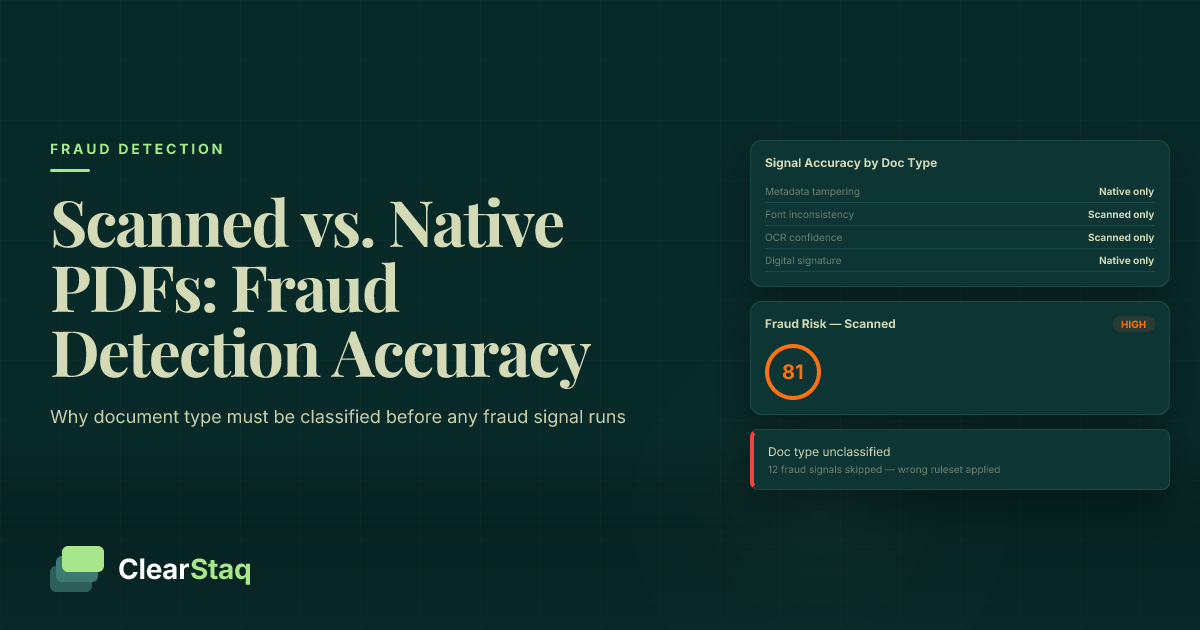
The fraud pattern is different too. Lending platforms worry about a borrower who never repays; gambling platforms worry about a player who signs up five times under five synthetic identities to farm welcome bonuses, or a bust-out ring that cashes stolen card funds through a rigged blackjack table. Document-level fraud detection built for lending underwriting — the kind that flags altered PDFs and mismatched account metadata on ClearStaq's platform — applies the same signal logic when a gambling operator reviews a high-roller's bank statement for source-of-funds checks. The front-end ID scan and the back-end document review are different tools solving related problems.
Update your age and identity checks
Start with the manual baseline before adding automation on top of it.
- Capture a government ID scan and validate the MRZ or barcode against the printed fields
- Run OCR against the document to catch tampering (font mismatches, re-issued expiration dates)
- Match a live selfie to the ID photo
- Cross-check the extracted date of birth against the specific state's minimum age, not a blanket 21
- Flag and reject expired or soon-to-expire documents before account activation
Screen every new account against sanctions and PEP lists
This step exists because your AML program is a legal requirement once revenue crosses the Title 31 threshold, not a nice-to-have.
- Check the applicant against the OFAC Specially Designated Nationals list
- Screen for politically exposed person (PEP) status on higher-limit accounts
- Run adverse media checks on accounts requesting large withdrawal limits
- Set a rescreening cadence — sanctions lists update continuously, a one-time check at signup goes stale
- Log every screening result with a timestamp for the regulator audit trail
Detect synthetic and duplicate accounts before bonus abuse hits
Multi-accounting is the most common fraud pattern gambling platforms see, and it rarely shows up on a single account's ID check.
- Fingerprint the device and browser at signup, not just the IP address
- Watch for velocity spikes — the same payment method or IP creating multiple accounts in a short window
- Cross-reference submitted documents against a document-reuse index
- Flag email and phone number reuse across supposedly unrelated accounts
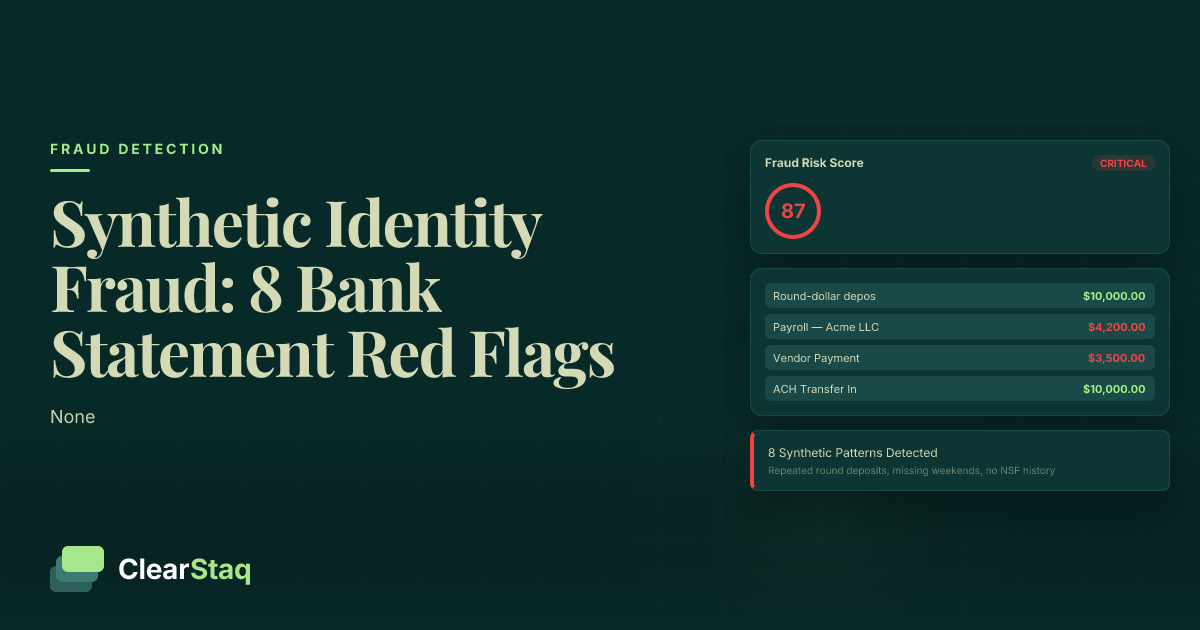
- Review synthetic identity fraud patterns from adjacent lending fraud research — the same blended real-and-fabricated identity data shows up in bonus abuse rings
Verify source of funds on large deposits and withdrawals
A player moving five figures through an account in a single session needs more scrutiny than a $50 recreational deposit, and your AML program should say exactly where that line sits.
- Set a deposit and withdrawal threshold that triggers enhanced due diligence
- Request bank statements or proof-of-funds documentation above that threshold
- Check statement documents for structural red flags: altered balances, inconsistent formatting, metadata that doesn't match the claimed bank
- Document the source-of-wealth explanation on file, not just a pass/fail flag
Review high-value deposit documents faster
Document-level fraud signals built for lenders, applied to source-of-funds review.
Add liveness detection to stop deepfakes and photo spoofing
A static selfie match alone is not enough in 2026 — injection attacks and AI-generated faces beat basic photo comparison.
- Require passive liveness checks (blink, head turn, texture analysis) during the selfie capture
- Add active liveness challenges for higher-risk accounts
- Screen for camera injection attacks, where a fraudster feeds a pre-recorded video instead of a live feed
- Compare the liveness capture against the document photo, not just against a stored profile photo
Automate transaction monitoring after onboarding
The account that passed verification on day one isn't the risk — the account that starts structuring deposits on day 45 is.
- Set velocity rules on deposit and withdrawal frequency
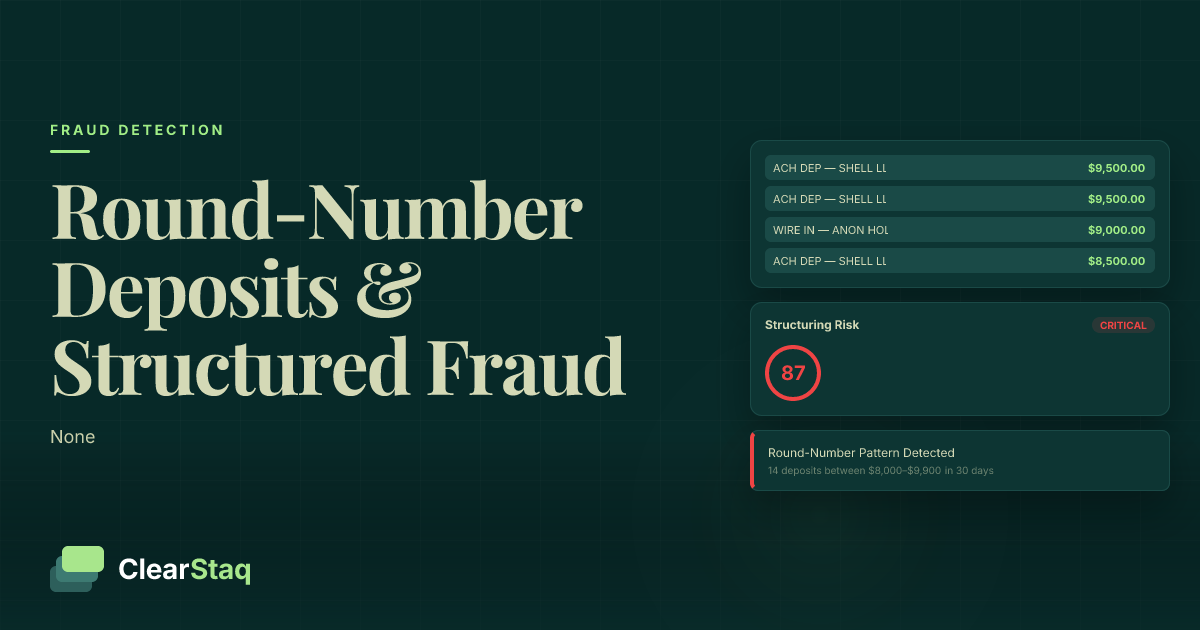
- Watch for structuring: multiple sub-threshold transactions designed to avoid the $10,000 CTR trigger
- Link accounts sharing payment instruments, devices, or documents after the fact, not just at signup
- Re-run sanctions screening on a fixed schedule, not only at account creation
Document the compliance trail for regulators
A gambling license survives an audit on paper trail, not intent.
- Log every verification decision with the data points and vendor result that produced it
- Keep SAR filing templates ready and assign clear ownership for who files them
- Set a retention schedule that matches your state gambling board's requirement, not a generic default
- Review the trail quarterly, not only when an examiner asks for it
Comparing the approaches
| Approach | Best for | Key limitation | Verdict |
|---|---|---|---|
| Document-first ID verification (OCR + selfie match) | Fast onboarding at scale | Weaker against synthetic identities built from real stolen data | Use as your baseline |
| Biometric liveness + injection detection | Stopping deepfake and photo-spoof attacks | Adds signup friction; some players abandon mid-flow | Add for high-limit accounts |
| Sanctions/PEP/AML screening layer | Meeting Title 31 AML program requirements | Needs continuous rescreening, not a one-time check | Non-negotiable in 2026 |
| In-house build on KYC/AML APIs | Teams with engineering headcount wanting full control | Ongoing maintenance across changing state licensing rules | Only if you have dedicated compliance engineering |
A gambling platform that skips the sanctions screening layer to save signup friction is trading a compliance fine it will eventually pay for a conversion rate it didn't need to chase.
Common mistakes online gambling platforms make
- Treating every state the same age and licensing rule. State gambling boards set their own minimums and reporting formats — a hardcoded national rule misses the exceptions.
- Verifying identity once and never again. Address changes, dormancy, and payout spikes all warrant re-verification, but most platforms only check at signup.
- Catching bonus abuse only at the promo redemption step. By then the synthetic accounts are already funded — device and document reuse checks need to run at signup.
- Filing SARs reactively instead of on a schedule. Waiting for an examiner to ask exposes gaps that a quarterly internal review would have caught.
- Skipping source-of-funds checks below the CTR threshold. Structuring exists specifically to stay under $10,000 — a platform that only checks above the line misses it.
FAQ
What's the best identity verification software for online gambling platforms in 2026?
There's no single best tool — the right stack pairs document + biometric ID verification with a sanctions/PEP screening layer, since no vendor category covers both age verification and AML reporting alone. Match the vendor to your state licensing footprint before comparing feature lists.
Is biometric liveness detection required for online casinos?
It's not federally mandated, but it's the standard defense against deepfake and photo-spoof attacks that basic selfie matching misses. Most operators add it for higher-limit accounts even when it's not a licensing requirement.
Do online gambling platforms need OFAC sanctions screening?
Yes — US casinos and online gambling operators generating over $1 million in annual gaming revenue fall under Bank Secrecy Act Title 31 and must screen against OFAC's Specially Designated Nationals list. Screening has to run continuously, not just at account creation.
What's the minimum age for online gambling in the US?
Most US states set the minimum age at 21, though some state lotteries and daily fantasy sports products allow 18. Verify against the specific state the player is registering from, not a single national default.
How does identity verification differ for gambling platforms versus lending platforms?
Lending platforms focus on repayment risk and income verification; gambling platforms focus on age gating, bonus abuse, and AML reporting on cash movement. Both rely on document fraud detection, but the fraud patterns they're built to catch differ.
Can identity verification software stop bonus abuse and multi-accounting?
Device fingerprinting, document-reuse checks, and payment-method velocity rules catch most multi-accounting rings, but no single ID check does it alone. Bonus abuse typically surfaces 30 to 60 days after onboarding, so ongoing monitoring matters as much as the initial check.
Is document verification enough, or do gambling platforms need biometric checks too?
Document verification alone misses injection attacks and AI-generated faces that beat basic OCR and selfie matching. Pairing document checks with liveness detection closes that gap, especially on higher-limit accounts.
How much does identity verification software cost for gambling operators?
Pricing varies by vendor, transaction volume, and which compliance modules you need (age verification, sanctions screening, liveness detection). Check current vendor quotes directly rather than relying on published list prices, which shift often.
One last thing
The fraud that gets caught at signup is the fraud you were already going to catch — the expensive kind shows up 30 to 60 days later, after a synthetic account has farmed a welcome bonus or a bust-out ring has cycled stolen funds through a handful of legitimate-looking transactions. If your compliance program stops investing after the initial ID check, you're only defending against the fraud pattern that was never going to cost you much. Build the transaction-monitoring layer with the same budget you gave the onboarding flow.
Related guides
ClearStaq Team
Content Team
The ClearStaq team builds AI-powered tools for bank statement parsing, fraud detection, and income verification.