Trade finance companies need AML transaction monitoring software that catches trade-based money laundering (TBML) patterns — over-invoicing, phantom shipments, circular trade loops — before a documentary letter of credit funds a sanctioned counterparty. Import/export desks move money through instruments that don't look like retail banking, so monitoring rules built for consumer accounts miss most of what actually happens in trade finance.
- AML transaction monitoring software for trade finance companies must read invoices and shipping documents, not just settlement amounts.
- ClearStaq parses bank statements and trade documents in under 5 seconds per file with 99.5% accuracy.
- Sanctions and KYB screening need to run per-disbursement in 2026, not just at onboarding.
- 27+ fraud signals catch over-invoicing and circular trade loops that rule-based monitoring alone misses.
- Best for: trade finance companies running documentary credits, factoring, or open account terms at volume.
Why AML transaction monitoring matters for trade finance companies
Trade finance sits outside standard AML playbooks. FATF's trade-based money laundering typologies name over-invoicing, under-invoicing, and repeated invoicing of the same shipment as the dominant laundering methods in cross-border trade — not wire structuring, not cash deposits. A monitoring system tuned for retail banking or general commercial lending won't flag an invoice priced far outside the shipment's actual market value, because it was never built to compare invoice line items against shipping documents.
Correspondent banks have spent the last several years de-risking trade finance relationships they can't monitor cheaply, which pushes volume and compliance burden onto smaller trade finance companies directly. Regulators in 2026 expect a documented, per-transaction screening trail — not a quarterly sanctions list refresh. Start with sanctions screening software for trade finance companies to see what that screening layer needs to cover day to day.
Verdict: AML transaction monitoring software built for trade finance beats retail-tuned platforms because it reads invoices and shipping documents, not just settlement amounts.
Map your transaction types to known trade finance laundering typologies
Before you touch software, know which instruments carry which risk.
- List every instrument you originate: documentary letters of credit, open account terms, factoring, forfaiting, standby LCs
- Tag each instrument to known TBML methods — over-invoicing hits LCs and open account hardest, phantom shipping shows up more in factoring
- Pull 12-24 months of settlement history per counterparty before setting alert thresholds
- Flag corridors carrying elevated FATF or Wolfsberg Group trade finance risk ratings for tighter review
Screen counterparties against sanctions and PEP lists before funding
Screening at onboarding only and calling it done is how sanctioned parties slip into a supply chain.
- Run OFAC, UN, and EU consolidated list checks against every buyer, seller, and freight forwarder named on the transaction — not just the applicant
- Re-screen on every disbursement, since sanctions lists update continuously through the year
- Check ultimate beneficial owners two layers deep — front companies are the standard evasion structure in trade finance
- Log every screening hit and disposition so the file holds up under a regulatory audit
Parse bank statements and invoices for over- and under-invoicing red flags
This is the step manual review handles worst, because it takes hours to cross-reference an invoice against a bill of lading by hand.
- Compare invoice unit prices against publicly available commodity or freight benchmarks for the goods category
- Flag settlement amounts that don't reconcile with bill-of-lading quantities
- Cross-check payment timing against shipping schedules — funds arriving before goods clear customs is a phantom-shipment signal
- ClearStaq parses bank statements and trade documents in under 5 seconds per file and runs 27+ fraud signals against the transaction, surfacing invoice mismatches a manual reviewer would spend an afternoon chasing across a full statement set — see the pattern breakdown in how to detect fabricated invoices in trade finance underwriting
Flag structuring and layering in settlement accounts
Circular trade loops and layered deposits are the classic laundering signature once funds clear the border.
- Watch for round-trip payments that route through multiple intermediary accounts before reaching the beneficiary
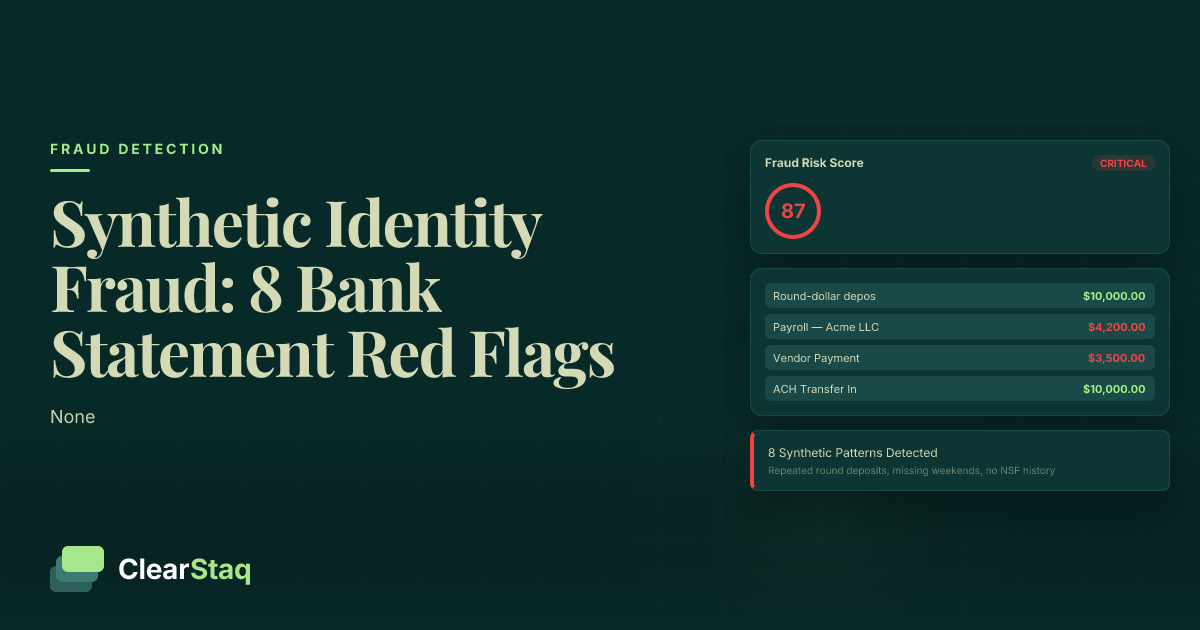
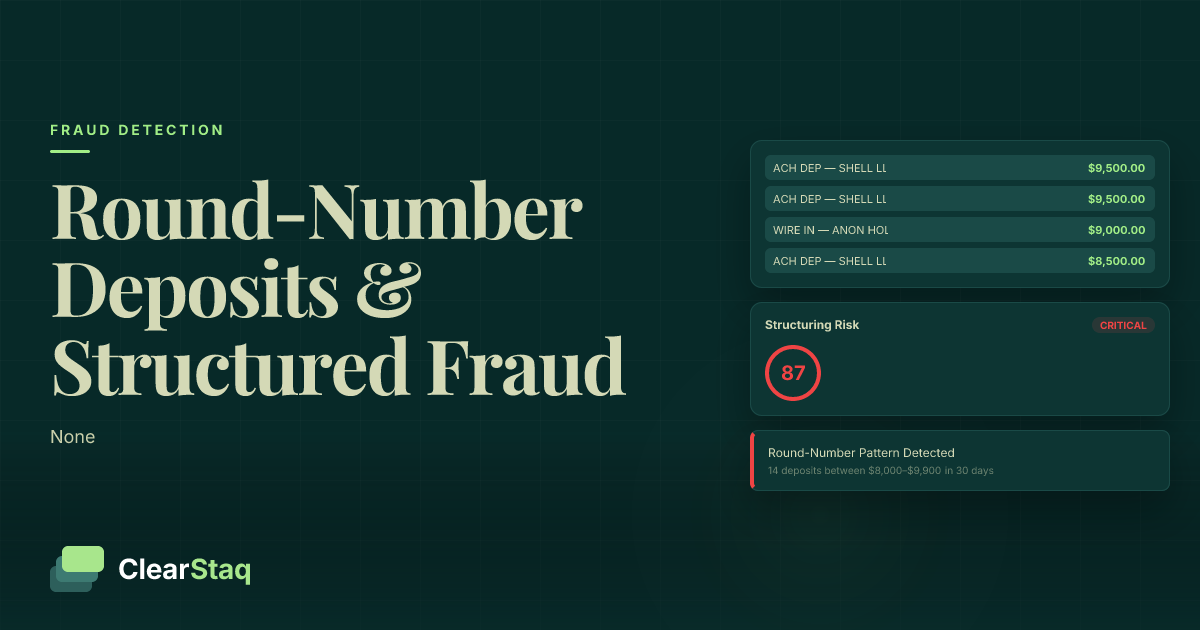
- Flag deposits repeated just under reporting thresholds within a short window
- Track counterparties that appear as both buyer and seller across different transactions — a circular trade signal
- Compare settlement account activity against the counterparty's declared trade volume for the same period
Verify beneficial ownership before disbursement
KYB isn't a one-time onboarding checkbox in trade finance — ownership structures shift, and shell entities are built specifically to obscure them.
- Confirm registered ownership against a corporate registry, not just the paperwork the counterparty submitted
- Re-verify ownership when a counterparty changes banking details or shipping routes mid-relationship
- Flag entities with no operating history that suddenly request large trade credit lines
- Run this check as a standing part of the workflow — see kyb verification software for trade finance companies for how the check integrates with disbursement
Set monitoring thresholds calibrated to trade volume, not retail volume
A threshold tuned for a $5,000 consumer wire will drown a trade finance desk in false positives on a $500,000 LC.
- Set alert thresholds as a percentage of each counterparty's historical transaction size, not a flat dollar figure
- Adjust thresholds seasonally for counterparties with known cyclical trade volume
- Separate alert queues for LC-based transactions versus open account settlements — the risk signals differ
- Review threshold false-positive rates quarterly and retune
Document and escalate alerts for the audit trail
An alert that isn't logged with a disposition doesn't exist as far as an examiner is concerned.
- Record the alert, the reviewer, the decision, and the reasoning for every hit
- Escalate unresolved high-risk alerts to a named compliance officer within a set window
- Keep escalation records separate from routine screening logs for faster examiner review
- Run periodic internal audits of closed alerts to check for reviewer drift
Comparison: monitoring options for trade finance companies
| Option | Best for | Key limitation |
|---|---|---|
| Manual spreadsheet review | Very low transaction volume, one or two analysts | Doesn't scale past a handful of files a day; misses cross-document mismatches |
| Legacy rule-based AML systems | Banks with existing retail AML infrastructure | Thresholds built for wires and cash deposits, not invoices or shipping documents |
| Generic AML SaaS platforms | Fintechs needing broad transaction coverage | Rarely parses trade documents or invoice line items natively |
| ClearStaq | Trade finance companies parsing statements and trade documents at volume | Focused on document parsing and fraud signals — pairs with, not replaces, a full compliance program |
Verdict: ClearStaq is the pick for trade finance companies that need invoice and bank statement parsing built into the monitoring workflow, not bolted on after the fact — manual review still wins for shops closing under a handful of trade finance deals a month.
See ClearStaq's fraud signals in action
Parse bank statements and trade documents in under 5 seconds each.
Common mistakes trade finance companies make
- Applying retail wire thresholds to LC settlements — a $500,000 documentary credit isn't a suspicious retail wire, and flat thresholds bury real alerts in noise
- Screening counterparties once at onboarding — sanctions lists change continuously through 2026, and a clean check from last year means nothing today
- Skipping invoice-to-shipping-document reconciliation — over-invoicing is the single most common TBML method per FATF typologies, and it's invisible without comparing the two documents
- Treating beneficial ownership as a static field — shell structures shift ownership specifically to stay ahead of static KYB checks
- Not logging alert dispositions — see how fraud detection software for trade finance companies handles this in the underlying pattern library, since an undocumented alert doesn't help in an exam
FAQ
What is AML transaction monitoring software for trade finance companies?
It's software that screens trade finance transactions — letters of credit, factoring, open account settlements — for laundering patterns like over-invoicing and phantom shipments. It differs from retail AML tools by reading invoices and shipping documents alongside settlement amounts.
How is trade-based money laundering different from other laundering methods?
Trade-based money laundering moves value through manipulated invoice prices, phantom shipments, and multiple invoicing of the same goods, rather than through cash deposits or wire structuring. FATF names it as one of the primary channels for moving illicit proceeds across borders.
Is generic bank AML software enough for a trade finance company?
No — generic AML platforms are tuned for wires and cash deposits and rarely parse invoices or shipping documents natively. A trade finance company needs monitoring that reconciles invoice values against bills of lading, which most retail-focused AML tools skip entirely.
What documents does trade finance AML software need to parse?
Bank statements, commercial invoices, bills of lading, and letter of credit documentation at minimum. ClearStaq parses these in under 5 seconds per file across 900+ supported formats.
How often should trade finance companies re-screen counterparties?
Re-screen on every disbursement, not just at onboarding. Sanctions and PEP lists update continuously, and a counterparty clean six months ago can appear on a list today.
Does AML transaction monitoring software replace a full compliance program?
No. It automates document parsing, invoice reconciliation, and signal detection, but a trade finance company still needs a compliance officer, escalation policy, and audit process around it.
What's the most common trade-based money laundering red flag?
Over-invoicing and under-invoicing relative to the shipment's actual market value. FATF's trade-based money laundering typologies name this as the dominant method used to move illicit value across borders.
How fast does ClearStaq process a bank statement or trade document?
ClearStaq parses a bank statement or trade finance document in under 5 seconds per file and checks it against 27+ fraud signals immediately, with 99.5% accuracy across 900+ supported formats in 2026.
One last thing
FATF's own typology work names trade-based money laundering as one of the three primary channels criminal networks use to move illicit proceeds internationally, alongside cash smuggling and direct misuse of the financial system. Most trade finance compliance programs still monitor the financial-system channel closely and the invoice channel barely at all — that gap is exactly where over-invoicing and phantom shipments pass through undetected in 2026.
Related guides
ClearStaq Team
Content Team
The ClearStaq team builds AI-powered tools for bank statement parsing, fraud detection, and income verification.