Trade finance companies use KYB verification software to confirm that the buyers, sellers, freight forwarders, and financing intermediaries behind a letter of credit or invoice discounting deal are real, properly licensed, and not tied to a sanctioned entity before capital moves across borders. A single trade finance transaction can touch four or five parties spread across three jurisdictions, so KYB checks here have to cover more entities per deal than a standard commercial loan and re-run faster when paperwork changes hands mid-transaction. Generic KYC tools built for single-borrower lending miss this pattern entirely — they verify one entity, not a chain of counterparties moving goods and invoices.
- KYB verification software for trade finance companies must check entity status, sanctions exposure, and the invoices/bills of lading backing the deal — not just the borrower.
- ClearStaq is best for catching fabricated invoices and doctored bank statements behind a KYB-cleared counterparty, not for full registry or UBO lookups.
- Manual registry and sanctions checklists still work for shops screening under 20 counterparties a month, but they miss document-level fraud.
- Re-verification at each drawdown, not just deal inception, is the single biggest gap in most trade finance KYB programs in 2026.
Why KYB verification matters for trade finance companies
Trade finance deals fail differently than term loans. A borrower defaulting on a working capital loan is a credit problem; a fabricated bill of lading behind a $400,000 invoice discounting deal is a fraud problem that surfaces after the cash is already gone. Fraud detection software for trade finance companies exists because the entity check and the document check are two separate failure points, and most KYB programs only cover the first one.
Sanctions exposure compounds the problem. A counterparty can clear an OFAC SDN list screen and still route goods through a shell entity registered in a jurisdiction on the FATF list of jurisdictions under increased monitoring. Trade finance companies that only screen the named buyer and seller — and skip the freight forwarder, the trading intermediary, or the correspondent bank in the chain — leave the exact gap that layered fraud schemes are built to exploit.
Verify the legal entity behind every counterparty
Start with the basics before any document review happens. This step is manual and it stays manual for most shops — automation here is mostly about speed, not judgment.
- Pull a business registry search in the counterparty's country of incorporation
- Confirm the trade license or import/export permit is current, not expired
- Cross-check the registered address against a commercial mail drop or shared-office database
- Match the legal entity name on the invoice against the registry filing exactly, not approximately
- Flag any entity incorporated in the last 12 months with no prior trade history
Screen for sanctions, PEP, and adverse media exposure
Every party in the chain gets screened, not just the borrower named on the credit application.
- Screen against the OFAC SDN list, the EU consolidated sanctions list, and the UN Security Council list
- Run a politically exposed person (PEP) check on beneficial owners, not just signatories
- Search adverse media for the entity name and known aliases
- Re-screen at each drawdown on a revolving facility, not once at origination
- Log every screen with a timestamp — regulators ask for the re-screen cadence, not just the first pass
Validate the trade documents backing the deal
This is where KYB checks stop and document forensics start, and it's the step most trade finance shops underinvest in relative to entity screening.
- Cross-reference invoice line items against the shipping manifest or bill of lading
- Check for duplicate invoice numbers across separate financing requests
- Verify the invoice date sequence lines up with the shipment date, not a manufactured backdate
- Confirm the bank account on the invoice matches the account on file for that counterparty
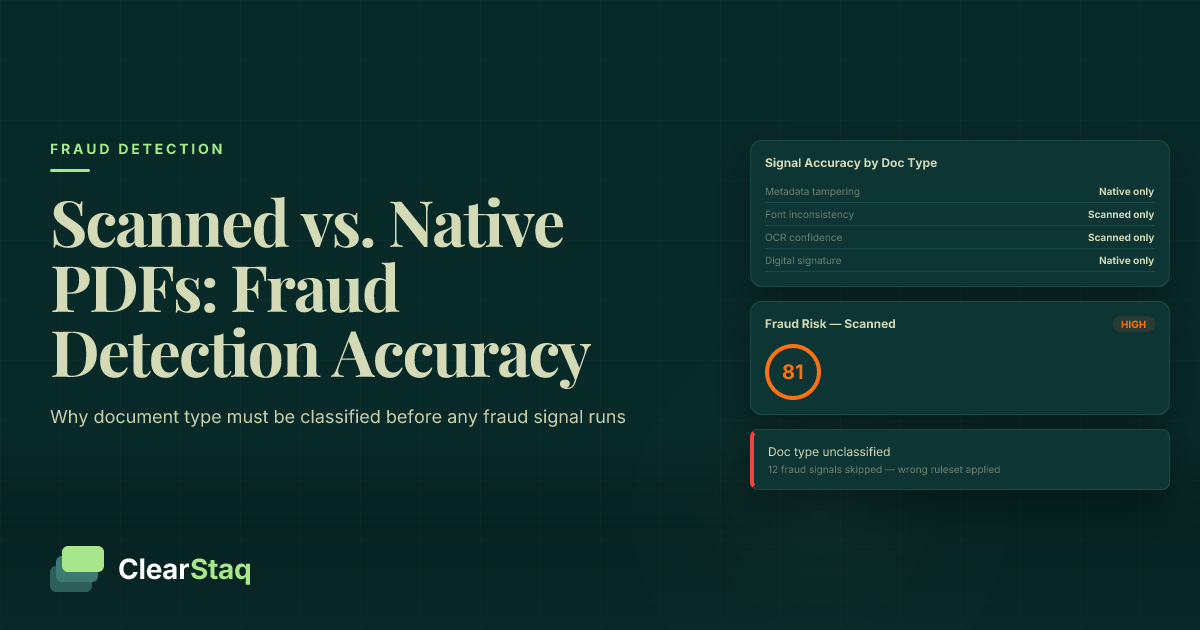
Manual cross-referencing across three documents per deal is where review teams lose the most hours. How to detect fabricated invoices in trade finance underwriting covers the specific patterns — altered totals, mismatched tax IDs, invoice numbering that skips or repeats — that a document parser catches in seconds instead of a manual line-by-line read. ClearStaq runs 27+ fraud signals against uploaded bank statements and financial documents at 99.5% accuracy, which is the layer most KYB platforms skip because they're built to verify identity, not scrutinize the paperwork behind the transaction.
Check beneficial ownership and shell company red flags
- Trace ownership through every layer until you reach a natural person, not a holding company
- Flag UBO structures with more than two layers of nominee or holding entities
- Compare the registered agent address against known shell company registration hubs
- Watch for beneficial owners who also appear on unrelated counterparties in your portfolio
Monitor for structuring and layering after the deal closes
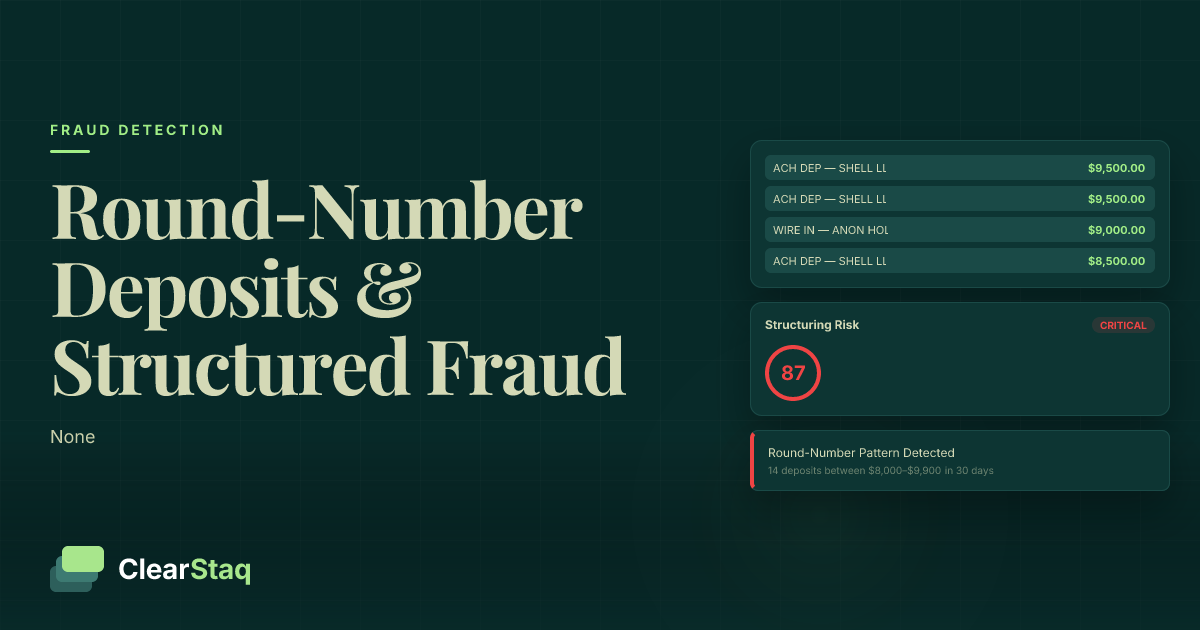
- Watch for deposits just under reporting thresholds spread across multiple accounts
- Flag rapid pass-through transactions with no clear business purpose
- Track round-dollar wires that don't match invoice amounts
- Review account activity against the stated trade volume for the counterparty's industry
Build a repeatable re-verification cadence
A KYB check done once at onboarding is stale by the second drawdown on a revolving facility.
- Set a re-screen trigger tied to facility renewal dates, not a calendar reminder
- Re-pull sanctions and PEP screens every time a new signatory is added
- Re-verify beneficial ownership annually or at any change-of-control event
- Document the re-verification workflow so an examiner can reconstruct it
A documented, repeatable process matters more to examiners than a one-time clean screen. How to build a KYB verification workflow for commercial lending walks through the trigger points that keep re-verification from falling through the cracks between drawdowns.
Comparing KYB verification options for trade finance companies
| Option | Best for | Key limitation |
|---|---|---|
| Manual registry and sanctions checklists | Shops screening under 20 counterparties a month | Hours per file, zero fraud signal detection on supporting documents |
| General-purpose KYC/KYB platforms | Firms verifying entity status and UBO structure across many jurisdictions | Rarely inspects the invoices, bills of lading, or bank statements behind the deal |
| Correspondent bank outsourced due diligence | Companies routing payments through a partner bank with its own enhanced due diligence program | Slows deal cycles; the correspondent bank sets the rules, not you |
| ClearStaq document fraud detection | Trade finance companies that need to catch fabricated invoices and doctored bank statements fast | Doesn't replace formal registry or UBO lookups — pairs with a KYB platform, doesn't stand in for one |
Verdict: pair a registry-and-sanctions KYB platform with document-level fraud detection. Neither one alone covers the full risk surface on a multi-party trade finance deal.
Common mistakes trade finance companies make
- Treating KYB as a one-time gate. A clean check at deal inception doesn't cover the third or fourth drawdown on a revolving facility six months later.
- Trusting self-reported UBO disclosures. Beneficial ownership forms filled out by the counterparty need a registry cross-check, not a signature.
- Screening the buyer and seller but not the intermediary. Freight forwarders and trading companies sitting between the two named parties carry the same sanctions risk.
- Focusing entity verification and skipping document forensics. A counterparty can pass every registry and sanctions check while submitting a fabricated invoice for the actual deal.
- Ignoring structuring patterns after the KYB check clears. A clean entity screen doesn't rule out layered cash movement once financing hits the account.
Catch fraud in the paperwork, not just the entity
See how ClearStaq flags fabricated invoices and doctored statements in your KYB stack.
FAQ
What is KYB verification software for trade finance companies?
KYB verification software confirms the legal identity, ownership structure, and sanctions status of every business entity in a trade finance deal before financing is disbursed. For trade finance specifically, it needs to cover multiple counterparties per transaction, not just the named borrower.
Is KYB different from KYC for trade finance companies?
Yes — KYC verifies individual identity, while KYB verifies the business entity itself, including registration status, beneficial ownership, and trade licensing. Trade finance deals need both, applied to every party in the transaction chain, not just the borrower.
How does ClearStaq detect fraud in trade finance documents?
ClearStaq scans bank statements and financial documents against 27+ AI fraud signals with 99.5% accuracy, flagging patterns like doctored statements and inconsistent invoice data in sub-3-second processing time. It works alongside a KYB registry platform rather than replacing entity-level checks.
What documents does KYB verification check in a trade finance deal?
A full KYB review checks business registration filings, trade licenses, beneficial ownership disclosures, sanctions and PEP screening results, and the invoices, bills of lading, or letters of credit backing the specific transaction. Most KYB platforms stop at the first four and skip document-level review.
How often should trade finance companies re-run KYB checks?
Re-run sanctions and PEP screens at every drawdown on a revolving facility, and re-verify beneficial ownership at least annually or after any change-of-control event. A single check at deal inception in 2026 is not enough to catch fraud introduced mid-facility.
Does ClearStaq replace a dedicated KYB platform?
No — ClearStaq focuses on document-level fraud detection in bank statements and financial records, not entity registry lookups or beneficial ownership tracing. It's designed to run alongside a KYB platform, catching fabricated invoices and doctored statements the registry check won't see.
What sanctions lists matter most for trade finance KYB?
The OFAC SDN list, the EU consolidated sanctions list, and the UN Security Council sanctions list cover most trade finance exposure, with FATF's list of jurisdictions under increased monitoring flagging higher-risk countries. Screen every party in the transaction chain against all three, not just the named borrower.
How much manual review time does automated KYB document checking save?
Manual cross-referencing of invoices, bills of lading, and bank statements across a multi-party deal typically takes hours per file when done by hand. Automated document parsing at sub-3-second processing time per document cuts that review down to minutes, though entity and UBO checks still require separate registry lookups.
One last thing
Most trade finance KYB failures in 2026 trace back to the document layer, not the entity layer — the counterparty checks out clean on every registry and sanctions list, and the fraud sits in an invoice or bank statement nobody cross-referenced. Build the re-verification cadence into the facility terms, not into a compliance calendar reminder, and pair entity-level KYB with document-level fraud screening before the first drawdown, not after a loss.
Related guides
ClearStaq Team
Content Team
The ClearStaq team builds AI-powered tools for bank statement parsing, fraud detection, and income verification.