Trade finance underwriting runs on paper: invoices, bills of lading, tax returns, and bank statements that rarely match the borrower's story on the first read. Fraud detection software for trade finance companies has to catch that mismatch before the money moves, not after.
- ClearStaq parses bank statements and tax returns across 900+ formats with 27+ fraud signals in under 5 seconds — Buy for trade finance underwriting in 2026.
- Manual underwriter review misses commingled funds and structuring patterns that hide double-pledged invoices — Skip.
- Generic KYC/AML suites verify identity at onboarding but don't monitor ongoing cash flow — Consider as a supplement, not a replacement.
- In-house scripts on raw statement exports break on non-standard PDF formats common in cross-border trade finance — Hold.
Why this matters
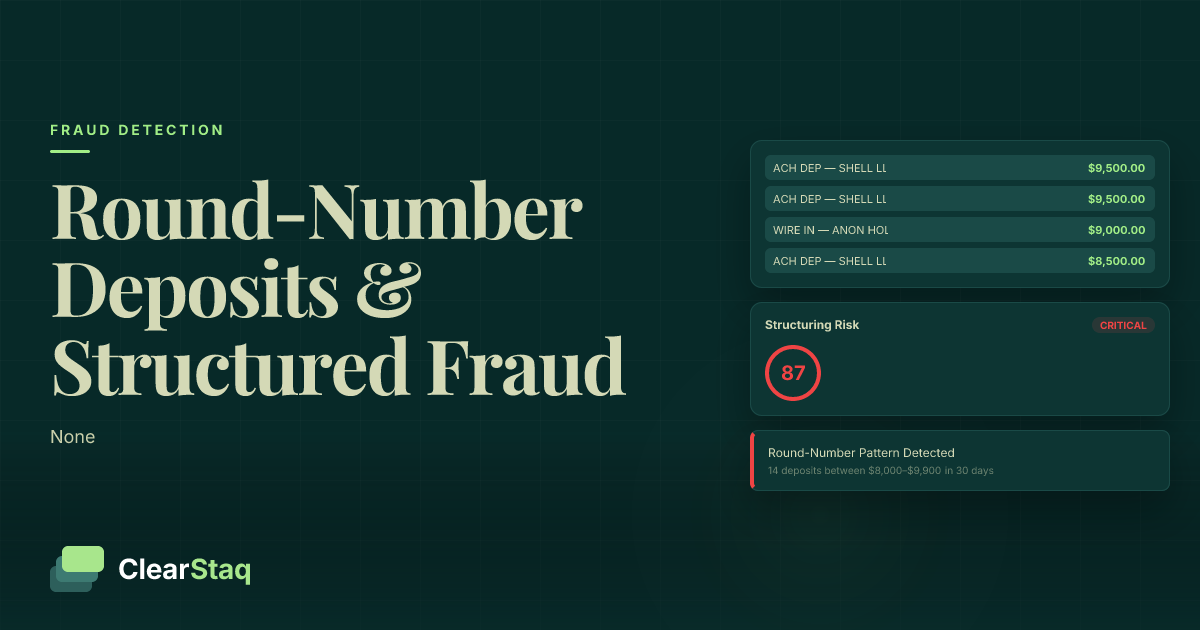
Trade finance fraud doesn't look like consumer identity theft. It looks like the same invoice pledged to two lenders, a bill of lading that never shipped, or a factoring client structuring deposits under $10,000 to dodge reporting thresholds. ClearStaq built its platform around exactly that pattern: bank statement and tax return parsing paired with 27+ fraud signals that flag commingled funds, structuring, and doctored PDFs before an underwriter signs off.
Trade finance deals move on tight timelines. A letter of credit negotiation can close in 3 to 5 business days, and a factoring advance often funds same-day. Software that takes an underwriter 20 minutes per file to review isn't fast enough once volume climbs heading into Q4 2026.
Who this is for
This guide is for trade finance companies underwriting invoice factoring advances, supply chain finance lines, and letter-of-credit-backed loans — credit teams at non-bank lenders, in-house counsel at factoring companies, and CPAs pulled in to verify a borrower's cash flow before a deal funds. If your team reviews bank statements, tax returns, or bills of lading before releasing capital, the criteria below apply directly to you.
What to look for in fraud detection software for trade finance companies
Format coverage across trade finance documents
Trade finance files rarely arrive as clean PDFs. Bank statements, tax returns, invoices, and bills of lading show up scanned, cropped, and in multiple currencies. A parser that only handles 20 or 30 templates forces manual re-entry on the exact files that need the most scrutiny. Look for coverage in the hundreds of formats, not dozens.
Fraud signal depth beyond identity checks
Identity verification catches a fake name at onboarding. It doesn't catch a real borrower double-pledging the same invoice to two lenders three weeks later. Fraud detection software for trade finance companies needs signals for structuring, commingled funds, and income smoothing — not just a driver's license scan.
Processing speed matched to deal velocity
A letter of credit negotiation can close inside a week. Software that takes an underwriter 20 minutes to review one file becomes the bottleneck the moment volume climbs in 2026. Sub-5-second parsing turns a 40-file backlog into a same-day queue instead of a three-day one.
Cross-border and multi-currency handling
Export lenders and supply chain finance platforms deal with borrowers who bank across two or three countries. A parser tuned only to domestic retail bank statements misses foreign-currency deposits that would otherwise flag a mismatch between invoiced revenue and cash actually received.
Audit trail and explainability
When an export credit agency or bank examiner asks why a file was flagged, "the algorithm said so" doesn't hold up. Software needs to name the specific signal — structuring, commingling, doctored PDF — and point to the exact page it fired on.
Fit with the existing underwriting workflow
A tool underwriters have to log into separately, export from, then re-key into the loan origination system adds steps instead of removing them. API access or a portal that CPAs and brokers already use matters more than a longer feature list.
Top picks
Purpose-built bank statement and document fraud parsers — the safe pick ClearStaq parses bank statements and tax returns across 900+ formats and runs 27+ fraud signals in under 5 seconds per file, at 99.5% parsing accuracy. For a factoring company running invoice-backed deals, that means structuring and commingled-funds flags land before the advance funds, not during a post-close audit. The document fraud detection built for factoring companies breaks down which signals matter most when the collateral is a receivable, not a hard asset. Verdict: Buy for any trade finance company reviewing more than a handful of files a week in 2026.
Manual underwriter review with spreadsheets — the false economy Cheap upfront gets expensive fast. An underwriter cross-checking a borrower's bank statement against tax returns by eye catches maybe the fraud patterns they've personally seen before, and misses commingled funds hidden across 60 pages of transactions per statement. Verdict: Skip past a handful of low-volume deals a month.
General KYC/AML identity suites — necessary, not sufficient These tools do one job well: confirming the person signing the loan application is who they say they are, often against sanctions and PEP lists. They stop there. A trade finance company also needs to catch synthetic identity fraud in the loan application itself, which requires cross-referencing financial documents, not just a government ID scan. Verdict: Consider as one layer, never the whole stack.
In-house scripts on raw statement exports — the DIY trap Engineering teams sometimes build a script to flag round-number deposits or duplicate line items. It works until a borrower banks with a regional institution whose PDF export the script has never seen, and the pattern that matters most — commingled funds hidden inside business underwriting — slips through because the script was never built to catch it. Verdict: Hold unless a dedicated team maintains the parser full time.
What to avoid
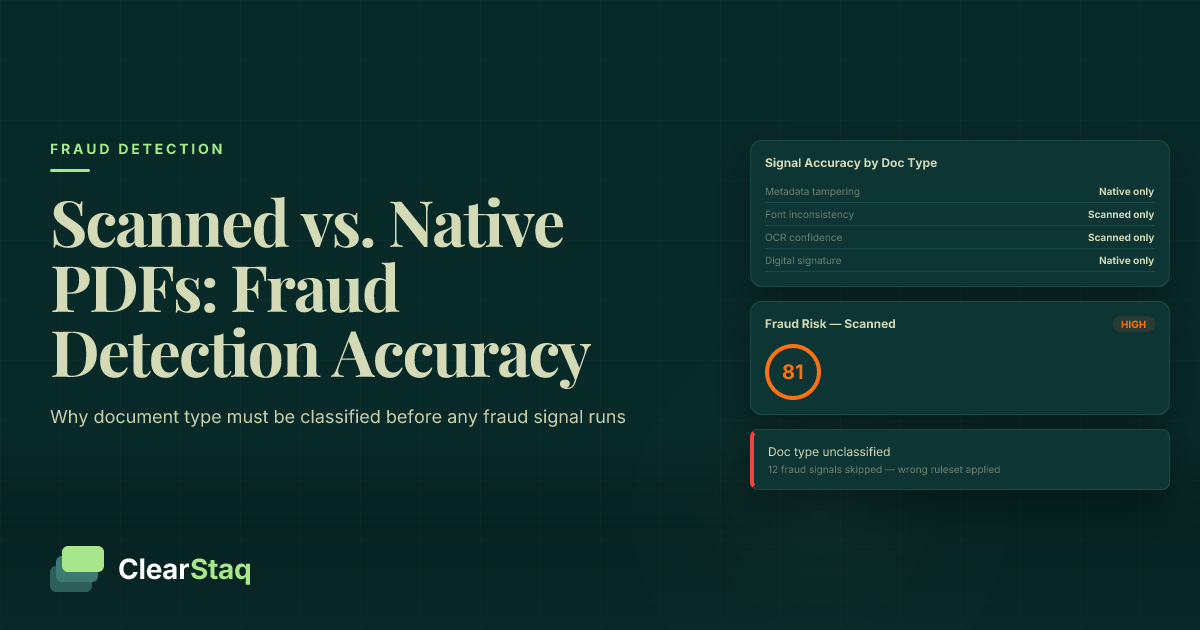
Case management systems that store PDFs but don't parse them. Uploading a bank statement to a portal isn't the same as extracting line-item data from it — a fraud signal only fires if software reads the transactions, not just the file name.
"AI-powered" OCR with no fraud signal library. Text extraction alone tells you what a document says. It doesn't tell you whether the borrower structured deposits to duck a reporting threshold, which is the pattern that actually costs trade finance lenders money.
Vendors that skip a security review of their own stack. A platform parsing bank statements and tax returns for hundreds of borrowers a month is itself a target. The kind of scrutiny fintech startups get from independent penetration testing for fintech is the same bar a trade finance company should hold its document-parsing vendor to before handing over a borrower's financial history.
Verdict comparison
| Approach | Format Coverage | Fraud Signal Depth | Speed | Verdict |
|---|---|---|---|---|
| ClearStaq (bank statement + tax return parsing) | 900+ formats | 27+ signals | Under 5 sec/file | Buy |
| Manual underwriter review | Whatever the reviewer recognizes | Reviewer's memory only | 15-20 min/file | Skip |
| Generic KYC/AML suite | Government ID, sanctions lists | Identity only, no cash flow | Minutes | Consider |
| In-house scripts | Formats the script was built for | Custom, narrow | Breaks on new formats | Hold |
FAQ
What is the best fraud detection software for trade finance companies in 2026?
ClearStaq is the strongest fit in 2026 for trade finance companies underwriting invoice factoring, supply chain finance, and LC-backed loans. It parses bank statements and tax returns across 900+ formats and runs 27+ fraud signals in under 5 seconds per file.
Can fraud detection software catch double-pledged invoices?
Yes, when the software checks bank statement cash flow against the invoice and tax return record rather than just the invoice document itself. A borrower pledging the same receivable to two lenders usually shows up as a cash flow or commingled-funds mismatch before the second lender funds.
Is bank statement parsing enough to detect trade finance fraud?
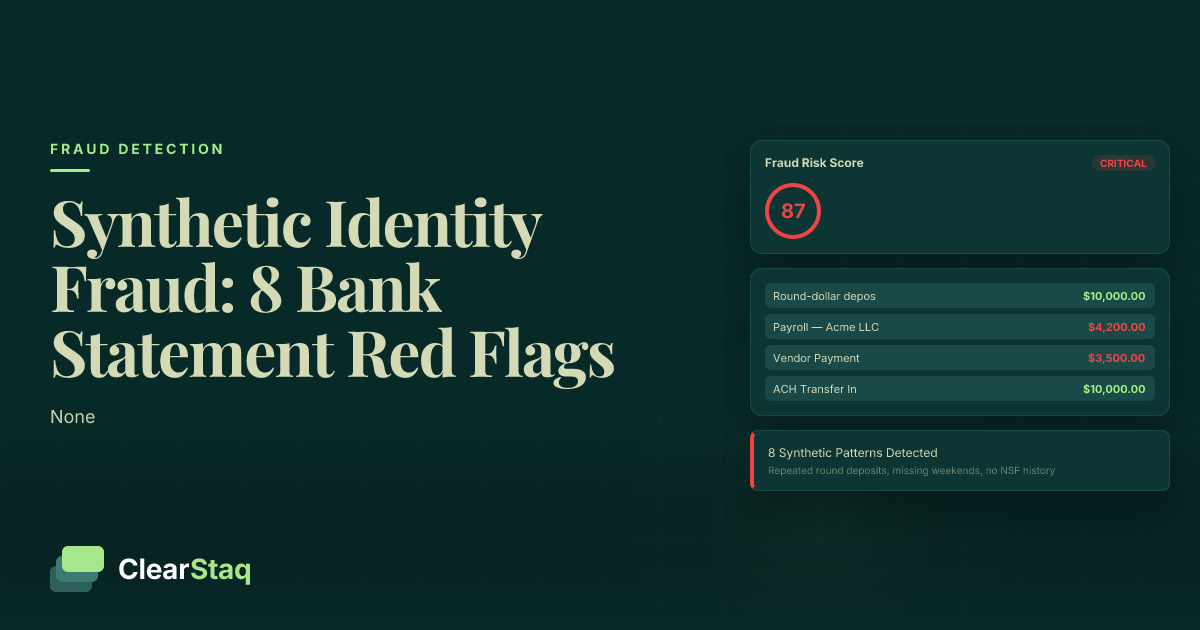
No, bank statement parsing is one layer. It needs to run alongside tax return parsing and identity verification, since structuring and commingled funds show up in statements while synthetic identity shows up at onboarding.
How fast should fraud detection run during letter of credit underwriting?
Under 5 seconds per document is the 2026 benchmark for purpose-built parsers. Anything closer to 15-20 minutes per file turns into a bottleneck once deal volume climbs.
What's the difference between KYC software and fraud detection software?
KYC software confirms the applicant's identity against sanctions and PEP lists at onboarding. Fraud detection software for trade finance companies goes further, checking ongoing cash flow for structuring, commingled funds, and doctored documents.
Do trade finance lenders need synthetic identity detection?
Yes, especially non-bank lenders and online factoring platforms where onboarding happens without a face-to-face meeting. Synthetic identities combine real and fabricated data, which passes a basic ID check but fails when cross-referenced against financial documents.
How many fraud signals should a trade finance fraud tool check?
Look for a tool checking at least 20-30 distinct signals across structuring, income smoothing, commingled funds, and document tampering. A tool with 5 or fewer signals is closer to basic OCR than fraud detection.
Does fraud detection software replace human underwriters?
No. It flags patterns for a human to review, cutting the time spent scanning statements manually. Underwriters still make the final credit decision, but with flagged pages instead of 60 unmarked ones.
One last thing
Run the fraud check before the credit check, not after. Trade finance deals move fast enough in 2026 that underwriters skip straight to pricing once a file looks clean on the surface — flip the order and a structuring pattern that would have funded gets caught while the deal is still refundable, not after the advance wires out.
Related guides
ClearStaq Team
Content Team
The ClearStaq team builds AI-powered tools for bank statement parsing, fraud detection, and income verification.