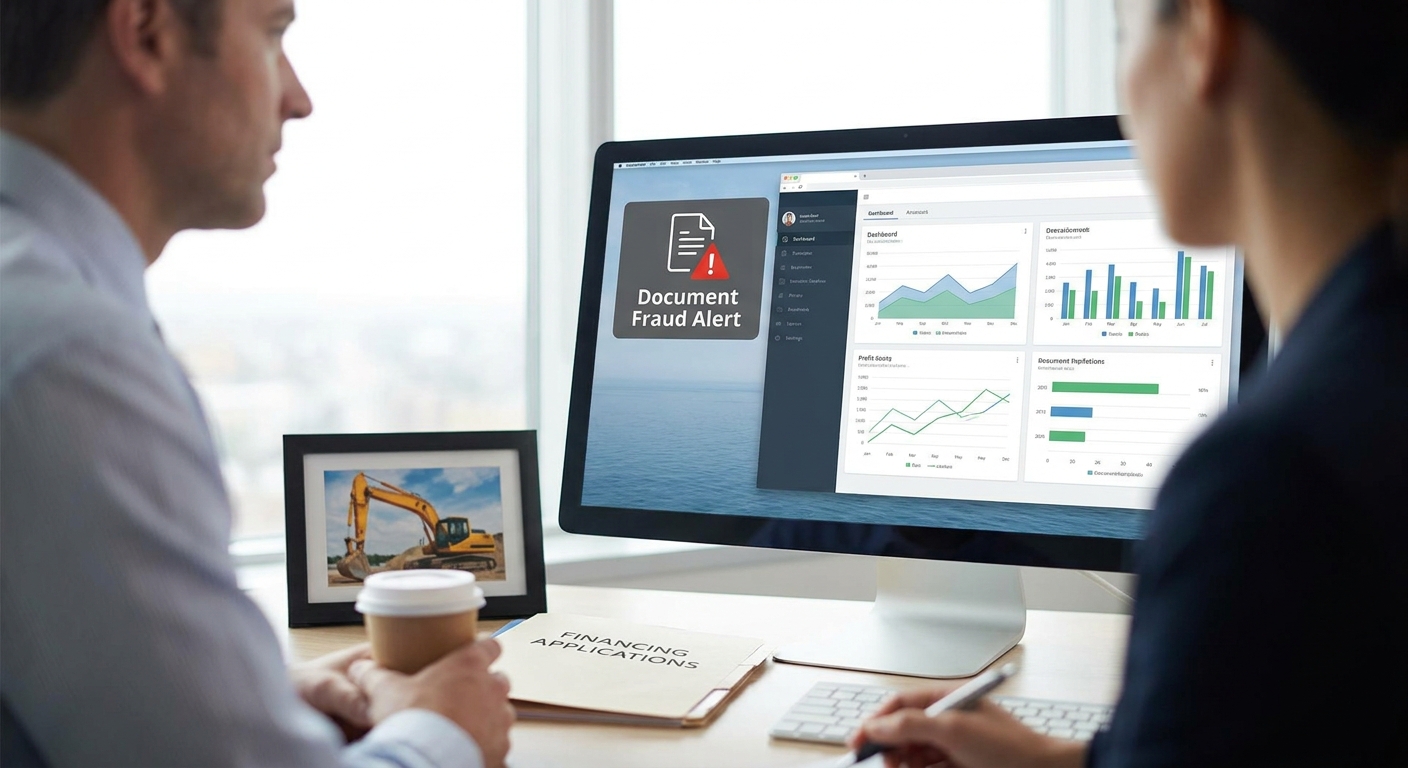
Equipment financing companies underwrite deals where the collateral is a forklift, a CNC machine, or a fleet of box trucks — and the paperwork behind it is bank statements, tax returns, and invoices that are easy to fake and hard to verify by eye. Document fraud detection software for equipment financing companies exists to catch doctored statements, inflated invoices, and synthetic borrowers before funding, not after a repo truck comes up empty.
- ClearStaq flags fraud across 27+ signals in under 5 seconds — Buy for equipment lenders funding 50+ deals a month in 2026.
- Manual bank statement review misses doctored PDFs that pass a visual check; document fraud detection software for equipment financing companies catches pixel-level tampering.
- 900+ bank statement formats matter because equipment buyers span every regional bank and credit union, not just the top five.
- 99.5% parsing accuracy is the floor to demand — anything lower means your underwriters are re-checking the tool's work.
Why this matters
Equipment financing sits in an ugly spot for fraud: ticket sizes are big enough to matter, but small enough that lenders don't always run the underwriting rigor of a commercial bank. A doctored bank statement or an inflated invoice can slip through a stack of PDFs reviewed by an analyst with 40 other files open.
By 2026, most equipment lenders funding more than a handful of deals a month have hit the wall on manual review. Bank statement fraud in equipment financing usually shows up as inflated average daily balances, altered transaction histories, or invoices padded to justify a bigger loan against collateral that isn't worth it. Fraud detection software for equipment financing companies closes that gap by running the same checks a fraud analyst would, at machine speed, on every file — not just the ones that look suspicious.
Who this is for
This guide is for underwriting leads and credit ops managers at equipment financing companies, leasing companies, and independent equipment lenders processing bank statements, tax returns, and vendor invoices as part of the approval file. If your team is funding 20 to 500+ deals a month and still eyeballing PDFs for signs of tampering, document fraud detection software built for lending is the fix, not more headcount.
What to look for in document fraud detection software for equipment financing companies
Fraud signal depth, not just OCR
A tool that just extracts numbers from a PDF isn't fraud detection — it's data entry. Look for platforms running 27+ distinct fraud signals per document, covering metadata tampering, font inconsistencies, altered totals, and transaction pattern anomalies. Equipment deals get funded fast, so the signal check has to run in seconds, not minutes, without slowing the pipeline.
Format coverage across regional and community banks
Equipment buyers aren't all banking with Chase or Bank of America — plenty run accounts through regional banks and credit unions with formats no generic parser has seen. Software that supports 900+ statement formats catches the long tail of formats your applicant pool actually uses. Anything narrower forces manual fallback on exactly the files most likely to hide a problem, since fraudsters gravitate to formats they assume won't be checked closely. This is the same logic covered in the bank statement analysis breakdown for equipment financing companies.
Speed that matches your funding timeline
Equipment financing deals often close in days, not weeks. A fraud check that takes 20 minutes per file bottlenecks the whole pipeline; one that runs in under 5 seconds does not. Speed matters more here than in most lending verticals because dealers and brokers expect same-day decisions.
Accuracy validated against real tampering patterns
Parsing accuracy below 99% means your team is still double-checking the software's output, which defeats the purpose. Demand a stated accuracy figure — 99.5% is the benchmark to compare against — and ask whether it's measured against tampered documents specifically, not just clean ones.
Cross-document verification
A borrower who fakes a bank statement often fakes a tax return too, but the inconsistencies show up when the two are compared side by side. Tools that cross-check income across bank statements and tax returns catch mismatches a single-document check misses entirely.
Integration with your loan origination workflow
Fraud detection that lives outside your LOS creates a manual export-import step that analysts skip under deadline pressure. API-based integration keeps the fraud check inside the same workflow underwriters already use.
Run a fraud check on your next file
See how 27+ signals and sub-5-second processing catch what manual review misses.
Top picks: what to prioritize first
Fake bank statement detection — the non-negotiable. This is the single most common fraud vector in equipment financing files: a real bank statement template edited to inflate balances or hide overdrafts. One number that matters: detection systems flag tampering across 27+ signals per document, including metadata and font-level inconsistencies invisible to the eye. Verdict: Buy — this is the detection layer every equipment lender needs before anything else.
Synthetic identity screening — the wildcard risk. Equipment financing brokers occasionally originate deals for entities that don't fully exist as represented — a shell LLC with a fabricated ownership history. This risk is lower-frequency than statement tampering but higher-severity when it hits, since the collateral often disappears with the borrower. Verdict: Consider if your book includes broker-originated deals or new-entity applicants with thin credit history.
Doctored pay stub and income document checks — for owner-operator deals. Smaller equipment financing applicants, especially owner-operators in trucking and construction, sometimes submit altered pay stubs alongside business bank statements to smooth over a weak month. Verdict: Consider for lenders funding sole proprietors and owner-operators rather than only incorporated fleets.
Manual visual review as your only fraud check — the trap. Reviewing PDFs by eye catches obvious edits but misses metadata tampering, subtle font swaps, and altered transaction timestamps entirely. Verdict: Skip as a standalone process — it's fine as a secondary check on top of automated signal detection, not a replacement for it.
What to avoid
- Generic OCR tools marketed as fraud detection. Extracting text isn't the same as flagging tampering — check whether the vendor names specific fraud signals or just "data extraction accuracy."
- Tools with narrow format coverage that force manual fallback. If a parser only handles the top five national banks, every regional bank statement becomes a manual review, which is exactly where fraud hides.
- Point solutions that check bank statements but ignore tax returns and invoices. Equipment financing fraud often spans multiple document types in the same file — a single-document checker leaves the rest of the package unverified.
Verdict comparison
| Criterion | What good looks like | Red flag |
|---|---|---|
| Fraud signal depth | 27+ signals per document | "AI-powered" with no signal count disclosed |
| Processing speed | Under 5 seconds per file | Batch processing measured in minutes |
| Format coverage | 900+ bank statement formats | Limited to top 5-10 national banks |
| Parsing accuracy | 99.5% or stated equivalent | No accuracy figure published |
| Cross-document checks | Bank statements + tax returns compared | Bank statements checked in isolation |
FAQ
What is document fraud detection software for equipment financing companies?
It's software that automatically checks bank statements, tax returns, and invoices submitted in an equipment financing application for signs of tampering, using signal-based detection rather than manual visual review. In 2026, the strongest platforms run 27+ fraud signals per document in under 5 seconds.
How common is bank statement fraud in equipment financing?
Exact rates vary by lender and deal size, but altered bank statements are consistently one of the top fraud vectors cited across commercial and equipment lending because the documents are easy to edit and time-consuming to check manually. Automated signal detection is built specifically to close that gap.
Is synthetic identity fraud a real risk for equipment lenders?
Yes, particularly for broker-originated deals or new-entity applicants with limited credit history. It's less frequent than document tampering but more severe when it succeeds, since the collateral and the borrower can both disappear.
How much does document fraud detection software cost?
Pricing varies by vendor and deal volume, so check current pricing directly with the provider rather than relying on a published range. Cost should be weighed against the loss avoided from a single fraudulent equipment deal, which typically exceeds the software cost many times over.
Can fraud detection software integrate with an existing loan origination system?
Platforms built with an API-first architecture integrate directly into an LOS so fraud checks run inside the existing underwriting workflow rather than as a separate manual step. Ask any vendor for their integration documentation before buying.
What's the difference between OCR software and fraud detection software?
OCR extracts text and numbers from a document; fraud detection analyzes that extracted data against tampering signals like metadata inconsistencies, font mismatches, and altered totals. A tool can have excellent OCR and zero fraud detection capability.
Do equipment financing companies need tax transcript verification too?
Yes, for deals where self-reported income doesn't match bank statement deposits, cross-checking against tax returns catches inconsistencies a bank-statement-only review would miss entirely.
How fast should a fraud check run to not slow down underwriting?
Under 5 seconds per document is the current benchmark for 2026 — anything slower starts to create a bottleneck in deals that need same-day funding decisions.
One last thing
The fraud pattern most equipment lenders miss isn't the crudely edited statement with a mismatched font — it's the technically accurate statement paired with an invoice inflated just enough to justify a bigger loan against collateral that won't cover the balance if the deal defaults. Signal-based document fraud detection catches the statement tampering; cross-checking the invoice against the collateral value is the step most teams still do by hand in 2026.
Related guides
ClearStaq Team
Content Team
The ClearStaq team builds AI-powered tools for bank statement parsing, fraud detection, and income verification.