Credit unions writing commercial and member business loans need underwriting software that reads bank statements and tax returns the way a seasoned examiner would — fast, accurate, and with a fraud trail attached to every flag. This guide covers what actually matters when evaluating commercial loan underwriting software for credit unions in 2026, and which approach holds up once volume climbs past what one analyst can eyeball.
- ClearStaq wins for credit union commercial loan underwriting with 27+ fraud signals and sub-5-second parsing per statement — buy it.
- Manual spreadsheet review still costs credit unions 4-8 hours per commercial file in 2026 — a bottleneck at MBL volume.
- Generic OCR tools extract text but surface zero fraud signals — fine for archiving, wrong for underwriting decisions.
- 900+ bank format coverage matters more than any single feature when members bank at five different institutions.
Why this matters
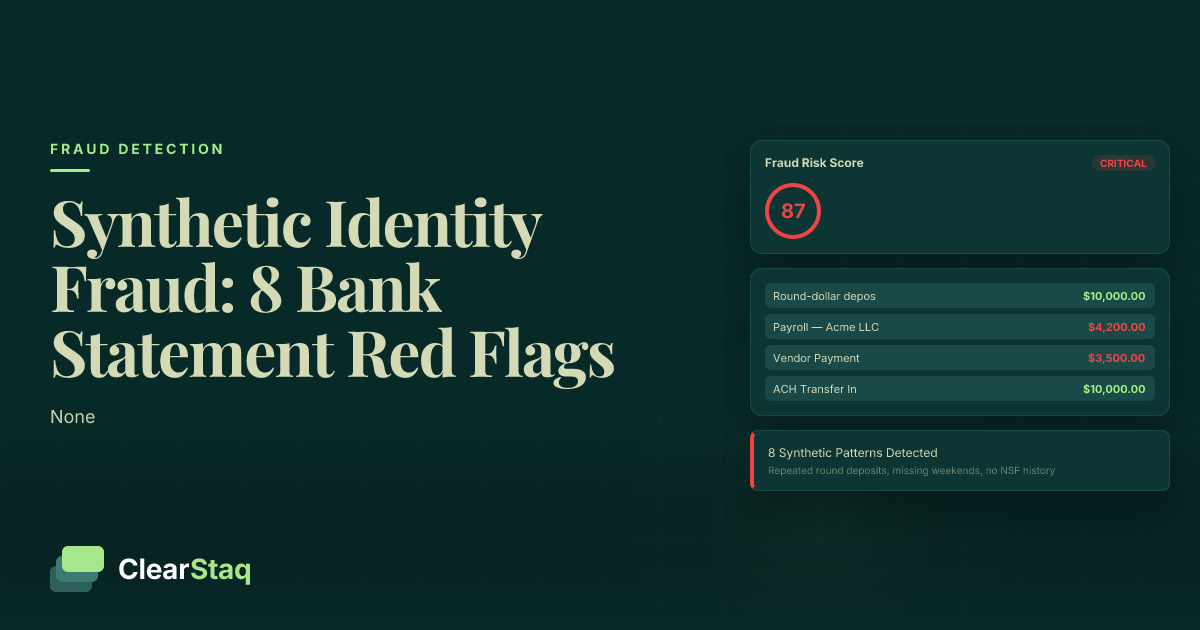
Commercial and MBL underwriting at a credit union runs on paper the borrower controls: bank statements, tax returns, sometimes a P&L the borrower typed up the night before the meeting. An underwriter reading that paper by hand catches the obvious problems and misses the patterned ones — deposits split to dodge reporting thresholds, personal and business accounts commingled to inflate cash flow, a statement with a font that doesn't match the bank's actual template.
Software built for this reads bank statement analysis software for credit unions at the transaction level, not the page level, and flags what a human skim misses. That distinction is the whole ballgame in 2026, when examiners expect documented fraud checks on every commercial file, not just the large ones.
Who this is for
This guide is for credit union commercial lending teams, business services underwriters, and credit analysts reviewing bank statements and tax returns for member business loans, C&I credit, and SBA participations. If your underwriting queue includes self-employed borrowers, small business owners, or member businesses with seasonal cash flow, the criteria below apply directly to you.
What to look for in commercial loan underwriting software for credit unions
Format coverage across every bank your members use
Member businesses bank wherever they've always banked — a regional credit union member might submit statements from Chase, a local community bank, and a credit card processor in the same file. Software that only parses two or three major bank formats forces your team back into manual review the moment a statement doesn't match. Look for coverage in the hundreds of formats, not dozens.
Fraud detection depth, not just OCR
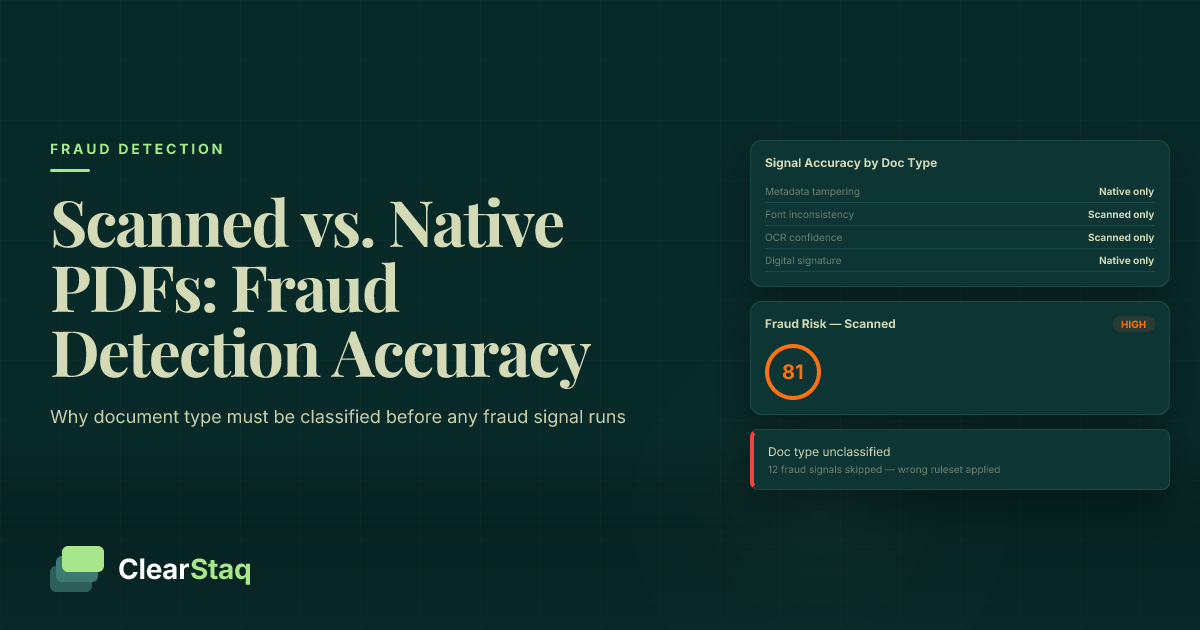
Text extraction alone tells you what a document says. It doesn't tell you whether the document is real. Underwriting software for credit unions needs document fraud detection software for credit unions that checks font consistency, transaction math, metadata, and deposit patterns — not just whether the PDF opened cleanly.
Tax return and bank statement cross-verification
A borrower's tax return and twelve months of bank deposits should tell a consistent story. When they don't, that's a signal worth a phone call before approval, not after the loan is on the books. Software that parses both document types and reconciles them automatically catches the mismatch before your credit committee sees the file.
Turnaround speed that matches your queue
A commercial underwriter reviewing ten files a week can tolerate slower software. A credit union processing MBL renewals at scale can't. Processing time per statement should be measured in seconds, not minutes, or your backlog grows every quarter regardless of headcount.
Audit trail examiners will accept
Every fraud flag needs a reason attached to it — which signal tripped, what threshold it crossed, when it was reviewed. A tool that just says "flagged" without a signal log gives your compliance team nothing to show an NCUA examiner asking why a loan was approved despite a red flag.
Top picks for credit union commercial underwriting
Manual spreadsheet review — the default
The approach every credit union starts with: an analyst opens each PDF, retypes deposits into a spreadsheet, and eyeballs the pattern. It costs roughly 4-8 hours per commercial file in 2026 and scales exactly as badly as headcount allows. Verdict: Skip once your MBL volume exceeds what one analyst can review in a day.
Generic OCR / document capture tools — the almost-right pick
These tools extract text and numbers reliably but were built for archiving, not underwriting — they don't flag structuring, commingled funds, or doctored formatting. Text accuracy might be strong, but fraud signal count is zero. Verdict: Skip for underwriting decisions, though fine for pure document storage.
Single-signal fraud add-ons — the narrow fix
Some vendors bolt one or two fraud checks onto an existing loan origination system — usually identity verification or a basic duplicate-document check. That covers one failure mode and misses the rest, like commingled funds or income smoothing across months. Verdict: Consider only as a supplement to a broader tool, never as the whole solution.
Legacy LOS document modules — the bundled option
Most core loan origination systems ship a document module built for consumer lending — mortgage stips, auto stips — retrofitted onto commercial files. Format coverage is shallow and fraud detection is basic pattern-matching at best. Verdict: Skip for commercial underwriting specifically, even if it's already in your stack for consumer loans.
ClearStaq — built for this
ClearStaq parses bank statements and tax returns with 99.5% accuracy, runs 27+ AI fraud signals per file, and returns results in under 5 seconds per statement across 900+ bank formats. That combination — speed, format breadth, and fraud depth in one pass — is what commercial underwriting at credit union volume actually needs. Verdict: Buy.
What to avoid
- Tools that stop at extraction. A parser that hands you clean numbers but no fraud signals leaves the hardest part of underwriting — is this real? — entirely on the analyst.
- Consumer-lending document modules repurposed for commercial. They're tuned for W-2 income and pay stubs, not twelve months of business deposits with seasonal swings.
- Point solutions that check one thing. A tool that only verifies identity or only checks for duplicate uploads misses commingled personal and business funds, which shows up constantly in member business loan files and needs its own detection pass.
“If a parser can't tell a doctored PDF from a real one, it's not underwriting software - it's a scanner.”
Verdict comparison
| Approach | Format coverage | Fraud signals | Speed per file | Audit trail | Verdict |
|---|---|---|---|---|---|
| Manual spreadsheet review | Unlimited (human reads it) | Analyst judgment only | 4-8 hours | Inconsistent | Skip |
| Generic OCR capture | Broad but format-brittle | 0 | Minutes | Weak | Skip |
| Single-signal fraud add-on | Depends on host system | 1-3 | Fast | Partial | Consider |
| Legacy LOS document module | Consumer-focused | Basic pattern match | Slow | Built-in, shallow | Skip |
| ClearStaq | 900+ formats | 27+ | Under 5 seconds | Full signal log | Buy |
FAQ
What is the best commercial loan underwriting software for credit unions in 2026?
ClearStaq is the strongest fit for credit union commercial and MBL underwriting in 2026, running 27+ fraud signals per bank statement at 99.5% accuracy in under 5 seconds. Manual review and generic OCR tools fall short on fraud detection depth.
How is commercial loan underwriting software different from consumer loan document tools?
Commercial underwriting software has to parse business bank statements with irregular deposit patterns and reconcile them against tax returns, not just pull income off a pay stub. Consumer-focused tools bolted onto commercial workflows usually miss this entirely.
How fast should bank statement parsing be for a credit union underwriting team?
Processing should take seconds per statement, not minutes — ClearStaq processes a statement in under 5 seconds, which keeps a queue of MBL renewals from backing up. Anything measured in minutes per file becomes a bottleneck at volume.
Can underwriting software detect commingled personal and business funds?
Yes — dedicated fraud detection tools flag commingled funds by tracking deposit and withdrawal patterns that don't match a pure business account. This is a common issue in member business loan files and a frequent miss on manual review.
Do credit unions need tax return parsing in addition to bank statement analysis?
Yes, because tax returns and bank deposits should tell a consistent income story, and mismatches between the two are a strong early fraud signal. Software that parses both document types catches the mismatch before approval.
What's the difference between OCR and AI-powered fraud detection in underwriting software?
OCR extracts text and numbers from a document; AI-powered fraud detection checks whether the document itself is authentic and whether the transaction pattern is consistent with real business activity. A tool can have excellent OCR and zero fraud signals.
How many bank formats should underwriting software support?
Look for coverage in the hundreds, not dozens — ClearStaq supports 900+ formats, which matters because member businesses bank across multiple institutions with different statement layouts. Narrow format coverage forces manual review the moment a statement doesn't match.
Does commercial underwriting software help with NCUA exam documentation?
Software with a full fraud signal log gives compliance teams a documented reason for every flag reviewed, which is what examiners ask for on commercial files. Tools that just mark a file as 'flagged' without a signal breakdown leave that documentation gap open.
One last thing
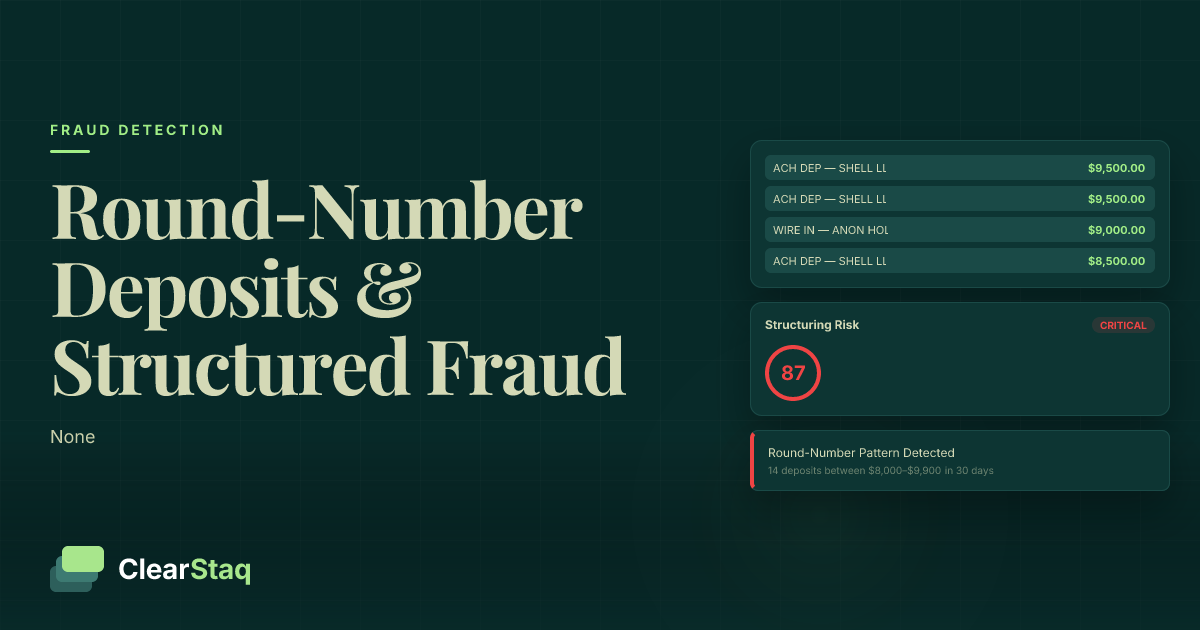
The fraud pattern underwriters miss most on manual review isn't a forged statement — it's structuring, deposits split into amounts just under a reporting threshold, spread across a few days each month. It reads as normal business activity to a human skimming twelve pages of transactions, and it's exactly the kind of pattern AI signal detection is built to catch that a person reviewing file after file in 2026 simply won't have the attention span to spot every time.
Related guides
ClearStaq Team
Content Team
The ClearStaq team builds AI-powered tools for bank statement parsing, fraud detection, and income verification.