Community bank credit teams are underwriting more commercial loans with fewer analysts, and the bank statements piling up on those analysts' desks are getting harder to trust. This guide breaks down what commercial loan underwriting software for community banks actually needs to do, which approaches hold up under exam scrutiny, and where the shortcuts fail.
- Purpose-built parsing platforms like ClearStaq read 900+ statement formats and flag fraud in under 5 seconds — Buy for 2026 underwriting teams.
- Manual spreading still dominates smaller community banks but costs 3-6 hours per file — Skip if loan volume exceeds 20 files a month.
- Generic OCR tools capture text but carry zero built-in fraud signals — Consider only as a stopgap, not a system of record.
- 27+ fraud signals, including structuring and commingled funds, separate real underwriting software from document capture.
Why this matters
Community banks underwrite commercial loans with tighter staffing than regional or national lenders, which means the same credit analyst is spreading statements, checking for fraud, and writing the memo. A document fraud detection platform built for community banks closes that gap by doing the spreading and the fraud check in one pass, not two separate tools bolted together.
The stakes are higher in 2026 than they were three years ago. Doctored PDFs and AI-generated statements are cheap to produce and hard to catch by eye, and examiners are asking sharper questions about how banks verify income on commercial files. Software that only extracts numbers without checking whether those numbers are real is not underwriting software — it's a typing assistant.
Who this is for
This guide is for community bank credit officers, commercial loan underwriters, and SBA lending teams who process business bank statements and tax returns as part of the approval file. If your bank closes fewer than 50 commercial loans a month but still needs exam-ready fraud documentation, the criteria below apply directly to you. If you're a national bank with a dedicated fraud analytics team, your buying calculus is different — you likely need enterprise integrations this guide doesn't cover.
What to look for in commercial loan underwriting software for community banks
Format coverage across real-world statements
Business owners don't bank at one institution, and their statements don't come in one layout. Software that only parses Chase or Bank of America formats cleanly will choke on the regional bank and credit union statements that make up a large share of community bank borrower files. Look for coverage in the hundreds of formats, not dozens — 900+ is the number to benchmark against in 2026.
Fraud signal depth, not just OCR accuracy
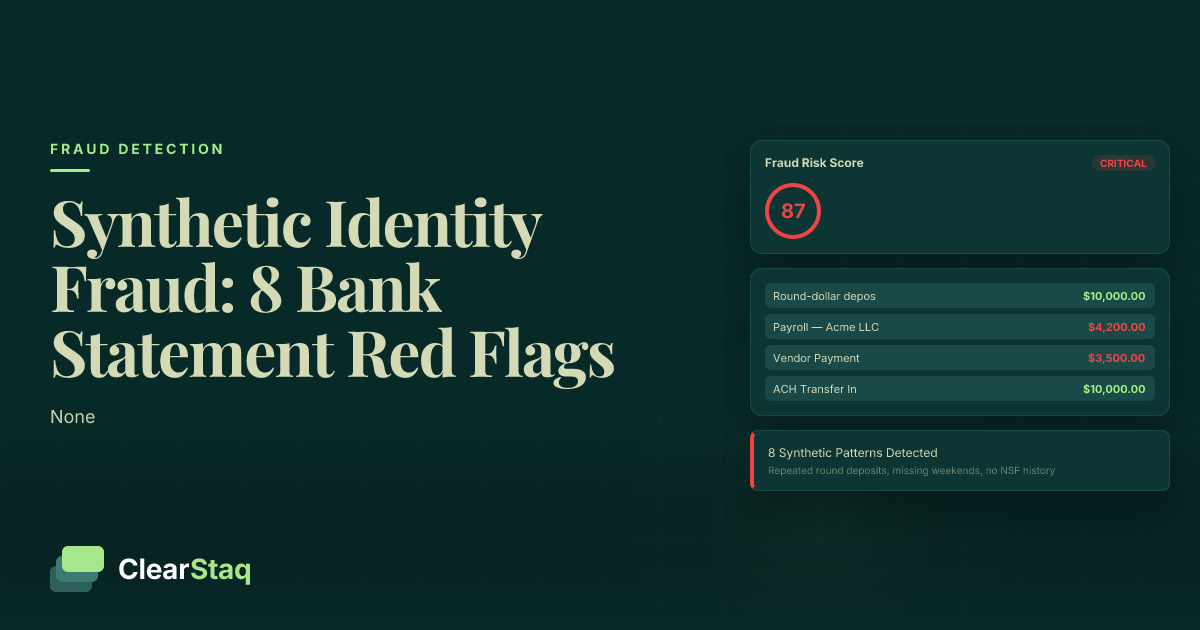
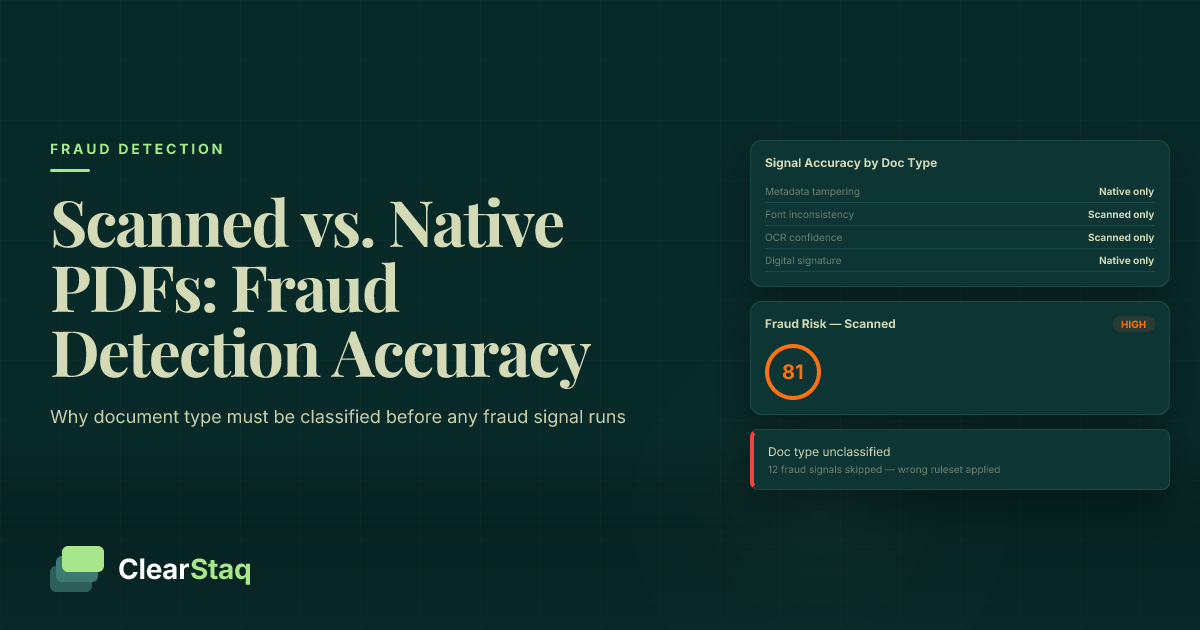
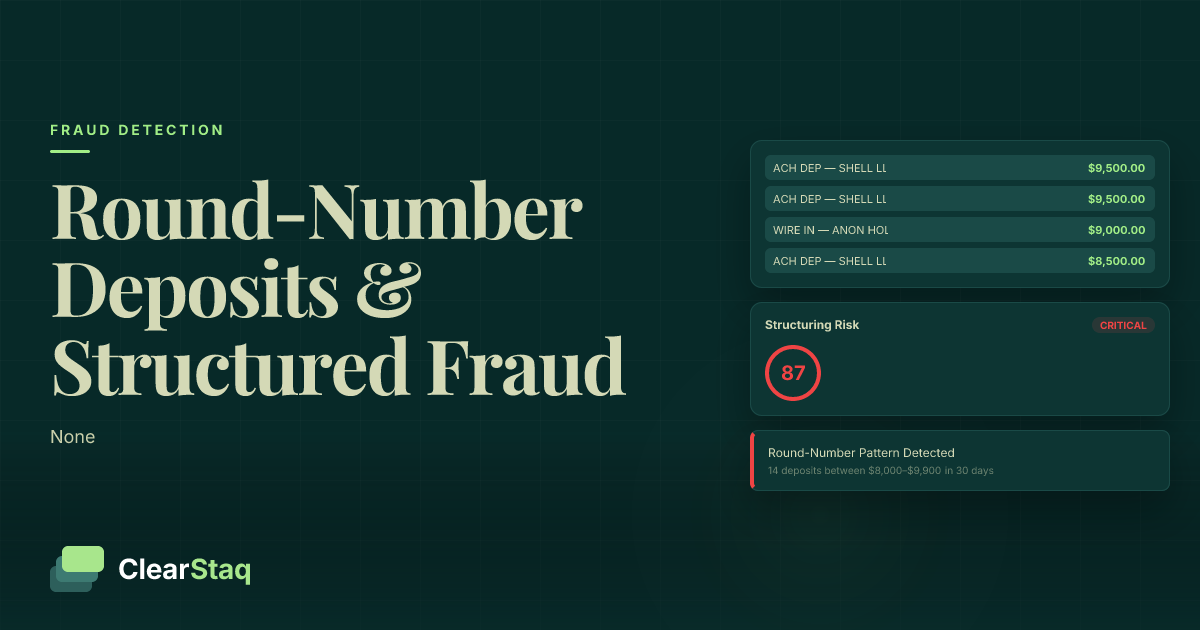
Extracting numbers correctly is table stakes. The software that actually protects your bank checks for structuring patterns, commingled personal and business funds, altered balances, and inconsistent metadata. A platform running 27+ fraud signals catches things a tired analyst on file 40 of the week will miss.
Speed measured in seconds, not hours
Manual spreading of a 12-month statement set runs 3-6 hours per file depending on complexity. Software that parses and flags a statement in under 5 seconds changes what your team can close in a week, not just what one analyst can do in a day.
Audit trail and exam documentation
Every flagged discrepancy needs a paper trail examiners can follow. Software that shows its work — which signal triggered, on which page, against which threshold — holds up in a regulatory review. Software that just says "looks fine" does not.
Integration with your existing loan origination system
A parsing tool that lives outside your LOS creates a second system analysts have to check. The better fit either integrates directly or exports in a format your LOS ingests without manual re-entry.
Pricing that scales with your actual volume
Community banks close a fraction of the loan volume a fintech lender does. Per-seat enterprise pricing built for high-volume shops doesn't map cleanly to a 15-person commercial lending team — confirm the pricing model fits your file count before you sign.
Top picks for community bank underwriting teams
Manual spreading and spreadsheet review — the status quo
One spec that matters: zero fraud signals built in, full reliance on analyst judgment. This is still how a large share of community banks underwrite commercial files in 2026 — an analyst reads the PDF, keys the numbers into a spreadsheet, and eyeballs it for anything odd. It costs 3-6 hours per file and scales only by hiring more analysts. Verdict: Skip once your commercial loan volume exceeds roughly 20 files a month.
Generic OCR and document capture tools — the almost-fit
One spec that matters: text extraction accuracy, with no fraud logic layered on top. These tools digitize a scanned statement into usable text, which beats retyping by hand. But they were built for invoices and forms, not for catching structuring or doctored balances, so the fraud check still falls back on the analyst. Verdict: Consider as a stopgap only if your bank has no budget cycle open until next year — don't treat it as the long-term system of record.
Bundled statement modules inside your core LOS — the bundled option
One spec that matters: format coverage limited to whatever the LOS vendor prioritized. Some loan origination platforms ship a basic statement-reading module as part of the suite. It's convenient because it's already in the workflow, but coverage is usually thin on regional bank formats and fraud checks rarely go beyond duplicate-transaction flags. Verdict: Consider if your borrower base banks almost exclusively at the top five national banks — otherwise the format gaps show up fast.
Purpose-built parsing and fraud detection platforms — the built-for-lending pick
One spec that matters: 27+ fraud signals plus 900+ format coverage in a single pass. Platforms built specifically for lenders and CPAs, like ClearStaq, parse bank statements and tax returns, run structuring and commingling checks automatically, and return a flagged result in under 5 seconds. Underwriting teams that adopt this category report cutting review time by up to 95% compared to manual spreading, which for a community bank means the same three analysts can carry a bigger commercial pipeline without adding headcount. Automated review workflows also standardize how underwriting teams process every incoming statement, so the fraud check doesn't depend on which analyst happens to catch a file that day. Verdict: Buy for any community bank closing commercial loans on a recurring monthly cycle in 2026.
What to avoid
- Consumer-document parsers repurposed for business files. A tool trained on personal checking statements will misread business statement layouts and miss commercial-specific fraud patterns like commingled funds.
- Vendors with multi-month implementation timelines. If onboarding takes longer than a quarter, the software is built for enterprise IT departments, not a community bank credit team that needs results this cycle.
- "Fraud detection" that means duplicate-file checks only. Ask the vendor directly how many fraud signals run per statement and what specific patterns they catch — structuring, income smoothing, doctored PDFs — before assuming coverage.
Verdict comparison
| Approach | Format coverage | Fraud signal depth | Speed per file | Verdict |
|---|---|---|---|---|
| Manual spreading | Whatever the analyst can read | Analyst judgment only | 3-6 hours | Skip |
| Generic OCR / document capture | Template-dependent, breaks on scans | None built-in | Minutes to hours | Consider |
| Bundled LOS statement module | Limited to top formats | Basic duplicate checks | Hours | Consider |
| Purpose-built parsing + fraud platform | 900+ formats | 27+ signals | Under 5 seconds | Buy |
FAQ
What is commercial loan underwriting software for community banks?
It's software that parses business bank statements and tax returns, checks for lending fraud signals, and speeds up the income verification step of a commercial loan file. For community banks in 2026, the best versions cover 900+ statement formats and run 27+ fraud checks per file.
Is manual spreading still viable for community banks in 2026?
It's viable only at low volume, generally under 20 commercial files a month, because manual spreading costs 3-6 hours per file. Above that volume, the analyst hours needed outpace what most community bank teams can staff.
How much does commercial loan underwriting software cost?
Pricing varies by vendor and file volume, so confirm the model fits a community bank's typical monthly commercial loan count before signing. Enterprise per-seat pricing built for high-volume fintech lenders often doesn't map cleanly to smaller teams.
What fraud signals should commercial underwriting software check for?
Look for structuring patterns, commingled personal and business funds, altered balances, and inconsistent statement metadata at minimum. Software running 27+ signals covers meaningfully more ground than a basic duplicate-transaction check.
Can generic OCR tools replace purpose-built underwriting software?
No — generic OCR extracts text but carries no built-in fraud logic, so the fraud check still falls back on the analyst. It works as a short-term stopgap, not a long-term system of record.
How fast should a bank statement parser return results?
Under 5 seconds per statement is the 2026 benchmark for purpose-built platforms. Anything measured in hours suggests the tool is closer to document capture than true underwriting software.
Does underwriting software need to integrate with the loan origination system?
Yes, or it creates a second system analysts have to check manually. Direct integration or a clean export format keeps the fraud flags inside the same workflow the loan file already lives in.
What's the biggest mistake community banks make when choosing this software?
Assuming any tool that says "fraud detection" checks for the same things. Many only flag duplicate files, missing structuring, income smoothing, and doctored PDFs entirely — ask for the specific signal count before buying.
One last thing
The format-coverage number matters more than most credit teams realize going into 2026 — a tool that handles the top five national banks perfectly but chokes on regional bank and credit union statements will quietly miss fraud on exactly the borrowers who bank outside the majors, which in a community bank's own footprint is often most of them.
Related guides
ClearStaq Team
Content Team
The ClearStaq team builds AI-powered tools for bank statement parsing, fraud detection, and income verification.