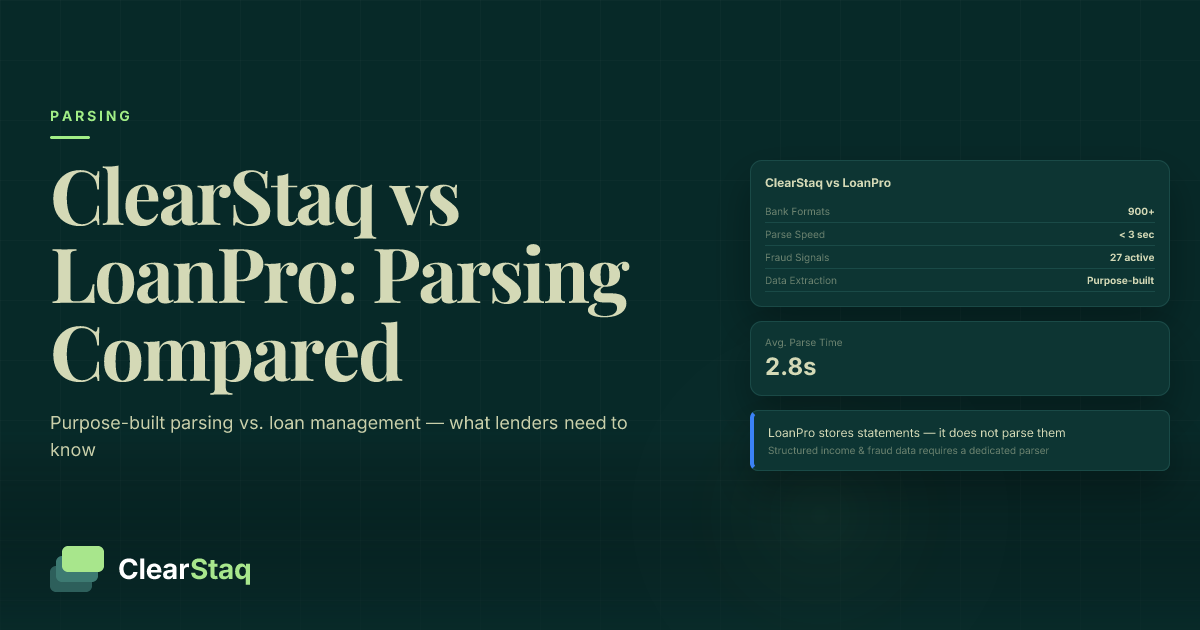
LoanPro is a loan management system, not a bank statement parser — it stores documents but does not extract or analyze financial data. ClearStaq is purpose-built for bank statement parsing, supporting 900+ bank formats, delivering sub-3-second results, and running 27 fraud detection signals simultaneously. For lenders who need structured data, the two tools are not direct competitors.
What you'll learn
- LoanPro is a loan management system that stores documents as files — it does not perform OCR extraction, transaction parsing, or fraud signal analysis
- ClearStaq achieves 99.5% parsing accuracy across 900+ bank formats and returns structured JSON in under 3 seconds
- ClearStaq runs 27 simultaneous fraud detection signals on every bank statement; LoanPro runs zero native fraud signals on its document layer
- ClearStaq and LoanPro are complementary tools — many lenders use ClearStaq for document intelligence and LoanPro for loan servicing in the same workflow
- ClearStaq offers transparent per-statement pricing; LoanPro uses enterprise quote-based pricing calibrated for loan servicing budgets
LoanPro is a loan management system (LMS), not a bank statement parser — it stores documents but does not extract or analyze financial data. ClearStaq is purpose-built for bank statement parsing, supporting 900+ bank formats, delivering sub-3-second results, and running 27 fraud detection signals simultaneously. For lenders who need structured data, the two tools are not direct competitors.
ClearStaq vs LoanPro: Understanding the Core Difference
Searching "ClearStaq vs LoanPro" usually means you're solving a parsing problem — and you've run into LoanPro while researching your options. That's understandable. LoanPro is a well-known name in lending software, and its document management feature sounds like what you need. It isn't.
LoanPro is a cloud-based loan management system. It handles loan origination, servicing, collections, payment automation, and borrower communication. It's a strong platform for managing a loan portfolio from application to payoff.
ClearStaq is a dedicated bank statement parsing and fraud detection API. It ingests PDF bank statements and returns structured financial data — transactions, balances, fraud signals — in under 3 seconds. It doesn't manage loans. It analyzes documents.
This post is a fair comparison of both tools, written to help you choose correctly — or realize you need both.
Why This Comparison Matters for Lenders
Many lenders discover LoanPro's parsing limitations after they've already purchased it. The platform's "Document Management" feature handles upload and storage, which looks like parsing from the outside. It isn't. No OCR runs. No transaction data gets extracted. No fraud signals fire.
This is a common pattern across the lending space — and it's part of why lenders choose purpose-built parsers over general-purpose platforms for document intelligence tasks. Choosing the wrong tool costs integration time, delays underwriting, and often requires a rip-and-replace later.
The good news: ClearStaq and LoanPro aren't mutually exclusive. Many lenders use both, letting each tool do what it was designed to do.
At a Glance: Side-by-Side Summary Table
| Feature | ClearStaq | LoanPro |
|---|---|---|
| Primary function | Bank statement parsing & fraud detection | Loan management & servicing |
| Bank format support | 900+ formats | N/A — stores files, does not parse |
| Parsing accuracy | 99.5% | N/A |
| Fraud detection signals | 27 simultaneous signals | 0 native signals |
| Parsing speed | Under 3 seconds per statement | No parsing pipeline |
| MCA-specific outputs (ADB, NSF, stacking) | Yes | No |
| API response format | Structured JSON with full transaction arrays | Document metadata and storage URLs |
| Webhooks | Yes — parsing completion and fraud alerts | Yes — loan events only |
| Pricing model | Per-statement, volume tiers, public pricing | Enterprise, quote-based |
| SOC2 compliant | Yes | Yes |
What Is LoanPro? (And What It Is Not)
LoanPro is a cloud-based loan management platform built for consumer and commercial lenders. It covers the full loan lifecycle: origination, payment processing, collections, borrower portals, and compliance reporting. For lenders managing large portfolios, it's a capable, purpose-built system.
What LoanPro does well:
- Loan lifecycle management from origination to payoff
- Automated payment processing and collections workflows
- Borrower communication and self-service portals
- Compliance and regulatory reporting tools
- Configurable loan product structures
What LoanPro does not do:
- OCR extraction of bank statement transactions
- Structured data output from PDF documents
- Fraud signal analysis on uploaded files
- Average daily balance or NSF count calculation
- MCA stacking detection
Reviews on G2 confirm this pattern: LoanPro users frequently rely on third-party tools for any document analysis work. That's not a criticism — it reflects that document intelligence simply isn't what LoanPro was built to do.
LoanPro's Document Management Feature
LoanPro includes a Document Management module that allows users to upload, store, and retrieve files attached to a loan record. This is useful for maintaining compliance documentation, signed contracts, and supporting materials.
But this is file storage, not parsing. Documents enter LoanPro as files and exit as files. No text extraction runs behind the scenes. No transaction table gets generated. No balance math is verified. LoanPro's own product positioning never mentions parsing accuracy benchmarks or format support counts — because those metrics don't apply to a storage layer.
Who LoanPro Is Built For
LoanPro is the right choice for:
- Consumer and commercial lenders managing established loan portfolios
- Teams with compliance-heavy workflows requiring audit trails
- Organizations that already have a separate document intelligence solution
- Lenders who need robust borrower communication and payment automation
It's not designed for MCA brokers who need real-time parsed data at the application stage, or for fintech teams building automated credit pipelines that require structured financial outputs.
What Is ClearStaq? Purpose-Built Bank Statement Parsing
ClearStaq is a dedicated bank statement parsing and fraud detection API. Send it a PDF bank statement. Get back structured JSON data in under 3 seconds. That's the core proposition — and it's the only thing ClearStaq does, which means it does it extremely well.
The platform was built by Capital Gurus — an MCA funding operation that needed a better parser and couldn't find one that met the speed, accuracy, and fraud detection bar required for real underwriting decisions. So they built it. That origin story matters: ClearStaq wasn't designed in a vacuum. It was built to solve a real problem experienced firsthand in the MCA lending space.
ClearStaq is SOC2 compliant with bank-grade data security, making it viable for any lender with stringent data handling requirements.
What ClearStaq Extracts from a Bank Statement
Every bank statement processed by ClearStaq returns:
- Transaction-level data: date, description, amount, category, and merchant for every line item
- Summary metrics: average daily balance, total deposits, total withdrawals, NSF count, negative balance days
- MCA-specific outputs: true revenue calculation, stacking indicators, cash flow patterns
- Fraud signals: 27 independent checks run simultaneously across document, visual, mathematical, and behavioral dimensions
- Confidence scoring: a reliability rating on the extraction, flagging low-confidence results for human review
All of this arrives as clean JSON, ready to push into any downstream system — including LoanPro.
Who ClearStaq Is Built For
ClearStaq is purpose-built for:
- MCA brokers and funders who make underwriting decisions in minutes, not days
- Fintech lenders building automated credit assessment pipelines
- Banks and credit unions modernizing their document intake workflows
- Developers and engineering teams who need a reliable, well-documented REST API
Here's how the end-to-end parsing process works — from PDF submission to structured data output:
As the visualization shows, ClearStaq doesn't just pass a file from one storage bucket to another. It transforms an unstructured PDF into decision-ready financial data — a capability LoanPro's document layer simply doesn't have.
Speed Comparison: How Fast Does Each Platform Process Statements?
ClearStaq returns a fully parsed bank statement — transactions, summary metrics, fraud score, and confidence rating — in under 3 seconds via API. For a single statement, that's near-instant. For an underwriter reviewing 30 applications before lunch, that's the difference between a usable tool and a bottleneck.
LoanPro has no parsing speed to benchmark. Documents are uploaded and stored asynchronously. Nothing is extracted. There's no pipeline that produces parsed data, so there's no turnaround time to measure. Comparing parsing speeds between ClearStaq and LoanPro is like comparing a stopwatch to a filing cabinet.
This matters most in MCA underwriting, where funding decisions are often made in hours, not days. A sub-3-second parse at submission time means underwriters have data the moment an application comes in — not after a manual review cycle.
Batch Processing Performance
ClearStaq supports batch API calls, allowing teams to submit multiple statements simultaneously and receive concurrent parsed outputs. For a fuller technical breakdown, see our guide to batch processing bank statements.
For context: a team processing 100 statements per day through ClearStaq's batch API completes the full parsing workload in minutes. Through LoanPro alone, that same stack of documents never gets parsed at all — they sit in storage as unanalyzed files.
For high-volume lending operations — 50 to 500 statements per day — the compounding speed gap is significant. ClearStaq's batch throughput directly translates to faster funding decisions and higher application volume capacity.
Webhook-Based Real-Time Alerts
ClearStaq fires webhooks immediately when parsing completes or when a fraud signal triggers above a risk threshold. This enables lenders to build fully automated decisioning pipelines — no manual polling, no scheduled checks, no human required to move data from one system to another.
LoanPro supports webhooks for loan lifecycle events: payment received, loan status changed, account updated. These are useful for servicing workflows. But LoanPro has no webhook for document parsing completion or fraud detection — because those events don't happen inside LoanPro. For a complete look at how real-time fraud alerts via webhooks work in practice, see our dedicated guide.
Accuracy and Bank Format Coverage
ClearStaq achieves 99.5% parsing accuracy across its supported document library. This benchmark reflects real-world extraction performance — not a controlled lab test — and is validated against structured ground-truth data from processed statements.
LoanPro has no parsing accuracy benchmark. It can't — because it doesn't parse. When evaluating any bank statement parser, accuracy and format coverage are the two most important technical criteria. For LoanPro, neither applies.
ClearStaq's 900+ bank format support covers major US banks, regional institutions, and credit unions. This breadth matters because applicants come from everywhere — and an underwriting tool that fails on a community bank statement is a liability, not an asset.
How ClearStaq Handles Unsupported or Malformed Formats
No parser supports every possible document variation perfectly. What separates reliable parsing tools is what they do when they encounter an unfamiliar layout or a malformed PDF.
ClearStaq's AI-based extraction engine attempts to parse even unfamiliar layouts using pattern matching and structural inference. When extraction confidence falls below threshold, the document is flagged — not silently passed through with bad data. The confidence scoring system ensures lenders always know when a result needs human review.
New formats are continuously added to the 900+ library based on submission data. A format submitted today that's not yet in the library triggers a format addition workflow — so the coverage gap closes over time rather than persisting indefinitely.
This fallback handling is a genuine differentiator that no existing comparison post covers. Silent parsing failures — where a tool returns empty or incorrect data without flagging it — are a real operational risk in lending. ClearStaq's confidence scoring prevents that failure mode.
Major Bank Format Support: Chase, Bank of America, Wells Fargo, and Beyond
The three largest US banks each produce bank statements with meaningfully different formatting conventions. Understanding how Chase, Bank of America, and Wells Fargo formats differ matters when evaluating whether a parser can handle your applicant mix reliably.
LoanPro stores PDFs from any bank — but without parsing, the format is irrelevant. A Chase statement and a community credit union statement look identical to LoanPro's document layer: both are just files in a folder. For lenders dealing with applicants from multiple banks and regions, 900+ format support is a direct underwriting velocity benefit that only a purpose-built parser can deliver.
Fraud Detection: Where the Gap Is Widest
ClearStaq runs 27 fraud detection signals on every bank statement it processes. These signals run simultaneously — not sequentially — so the full fraud assessment is complete before the API response returns. There is no separate fraud scan step, no manual review trigger required.
LoanPro runs zero native fraud signals on its document layer. Documents are stored, not analyzed. A fraudulently fabricated bank statement uploaded to LoanPro looks exactly like a legitimate one — the platform has no mechanism to tell the difference.
That gap is not a minor product difference. It's a fundamental capability divide.
What ClearStaq's 27 Fraud Signals Catch
ClearStaq's fraud detection operates across four signal categories:
- Document-level signals: PDF metadata tampering, creation software fingerprinting, modification timestamps inconsistent with the statement date range
- Visual signals: font inconsistencies across the document, column misalignment, pixel artifacts from image manipulation
- Mathematical signals: running balance arithmetic errors, deposit/withdrawal totals that don't reconcile, implausible balance sequences
- Behavioral signals: round-number deposit patterns, abnormal transaction velocity, missing or generic merchant data, stacking indicators from MCA lender identifiers in transaction descriptions
Each signal produces an individual result. All 27 combine into a single fraud score that gives underwriters an instant risk assessment rather than a list of flags to manually interpret.
Fraud Detection in MCA Underwriting
Bank statement fraud in MCA underwriting is not a rare edge case. According to 2026 MCA fraud data, fabricated and manipulated bank statements are among the fastest-growing fraud vectors in alternative lending. Manual review catches fewer than 40% of document-level fraud signals — the techniques used to falsify statements have become sophisticated enough to fool the human eye reliably.
A single fraudulent MCA deal can exceed $50,000 in direct losses, not counting recovery costs and operational overhead. Automated fraud scoring at submission time prevents fraudulent applications from entering the underwriting pipeline — rather than catching them after funding has already occurred.
For the complete workflow context, see the full MCA underwriting workflow guide, which covers how fraud detection outputs feed into credit decisions.
See All 27 Fraud Signals Run on a Real Bank Statement
Want to see ClearStaq's fraud detection in action? Book a demo and bring a sample document — the full analysis takes under 3 seconds. Our team will walk through every signal and what it means for your underwriting workflow.
API and Integration Capabilities
ClearStaq is built API-first. Every feature available in the platform — parsing, fraud scoring, batch processing, webhooks — is accessible programmatically. The API is designed for developer teams who need to integrate bank statement intelligence into existing lending workflows without building the intelligence layer themselves.
LoanPro also offers a REST API, but it's oriented toward loan data operations: creating loan records, processing payments, updating borrower information. It's a capable API for what it does. What it doesn't do is accept a bank statement and return structured financial data — that's simply not within its scope.
ClearStaq API: What Developers Get
The ClearStaq API accepts a single POST request with either a PDF file upload or a document URL. The response returns:
- Full transaction array with date, description, amount, category, and merchant fields
- Summary metrics block with ADB, NSF count, total deposits, total withdrawals, and negative balance days
- Fraud score with individual signal results and an overall risk classification
- Confidence rating on the extraction, with flagging if below threshold
The ClearStaq API getting started guide covers authentication, request formats, and error handling for new integrations. For a technical deep-dive into the output schema, the PDF to structured JSON developer guide walks through every field in the response object.
{
  "status": "success",
  "fraud_score": 57,
  "transactions": 47,
  "bank": "Chase",
  "processing_time_ms": 238
}LoanPro API: What It Covers (And What It Doesn't)
LoanPro's API handles loan CRUD operations, payment processing, borrower data management, and document upload/retrieval. For loan servicing operations, it's a functional integration target.
Document endpoints in LoanPro support file upload and retrieval — not extraction or analysis. The API returns document metadata and storage references, not parsed transaction data. Multiple G2 reviewers report that LoanPro's API requires significant implementation effort and a steep learning curve.
This isn't a criticism of LoanPro's engineering. It's a reflection of product focus: LoanPro's API was built to manage loan data, not document intelligence. Those are different problems with different API designs.
Pricing Models Compared
ClearStaq uses transparent per-statement pricing with volume tiers. You pay for what you process. No minimum contract at entry level. Pricing is publicly accessible — you can evaluate ClearStaq's cost structure without a sales conversation.
LoanPro uses enterprise pricing that isn't publicly listed. You'll need to book a demo to receive a quote. Multiple reviewers on G2 and Capterra specifically cite pricing complexity and lack of transparency as pain points.
ClearStaq Pricing: Per-Statement and Volume Tiers
ClearStaq's pricing structure is designed to align cost with usage:
- Per-statement pricing: you're billed for statements processed, not for seats or modules
- Volume tiers: higher monthly volumes unlock lower per-statement rates
- No minimum contract: start at whatever volume matches your current deal flow
- Public pricing page: no sales call required to understand what you'll pay
This model is predictable for growing teams. As your application volume scales, your cost scales proportionally — with decreasing per-unit cost at higher tiers.
LoanPro Pricing: What Users Report
LoanPro's pricing is calibrated for loan servicing budgets. It's structured around loan portfolio size and feature module access, not document processing volume. This makes sense for its core use case — a lender managing 10,000 active loans cares about per-loan servicing cost, not per-document parsing cost.
For buyers evaluating LoanPro specifically for document processing, the pricing model creates a mismatch: you're buying a loan servicing platform at loan servicing prices to solve a parsing problem the platform doesn't actually address. That's the pricing story no other comparison article covers directly.
Which Tool Is Right for Your Use Case?
The right choice depends entirely on the problem you're solving. Here are three buyer profiles with clear recommendations:
If You Need Bank Statement Parsing and Fraud Detection
ClearStaq is the straightforward choice. LoanPro doesn't offer native parsing or fraud detection — no workaround inside LoanPro replicates 27-signal fraud detection or 99.5% parsing accuracy. Purpose-built tools outperform general platforms on the specific task they were designed for. That's not marketing — it's how software specialization works.
If you're evaluating the broader market of dedicated parsers, you can see how ClearStaq compares to other parsing tools like Ocrolus, or review the ClearStaq vs Heron Data comparison for another data point.
For a complete overview of ClearStaq's capabilities, the bank statement parsing platform page covers the full feature set.
If You Are Already Using LoanPro
Add ClearStaq as the document intelligence layer. The two tools are designed to complement each other: ClearStaq handles parsing and fraud detection at document submission; LoanPro manages the loan record, servicing, and compliance through the loan lifecycle.
Adding ClearStaq doesn't require replacing or reconfiguring LoanPro. ClearStaq sends structured JSON to your systems via API — including LoanPro's loan record endpoints. Many lenders are already running this combined stack. It's the architecture that gets you the best of both: specialized parsing accuracy plus proven loan management.
Can You Use ClearStaq and LoanPro Together?
Yes — and for lenders who need both loan servicing and document intelligence, this is the recommended architecture. The two tools operate at different stages of the lending workflow and don't overlap in functionality.
The integration is clean and real-time. Here's the workflow:
Integration Pattern: ClearStaq + LoanPro Workflow
- Applicant submits a bank statement through your application portal or intake form
- ClearStaq API receives the document and immediately begins parsing — 27 fraud signals run in parallel
- Structured JSON returns in under 3 seconds — full transaction array, summary metrics, ADB, NSF count, fraud score, confidence rating
- Parsed data is written to the LoanPro loan record via LoanPro's API — structured fields populate the loan file automatically
- Underwriter opens the loan file in LoanPro and finds parsed financial data already attached — no manual data entry, no document re-review required
Webhooks make this handoff happen in real time without manual polling or scheduled batch jobs. For the full technical implementation details, see our guide to building a bank statement processing pipeline with webhooks.
This combined stack is the answer for lenders who want MCA-specific data outputs — average daily balance, NSF counts, stacking detection — surfaced directly inside their LoanPro workflow. Neither tool alone does what both do together.
Frequently Asked Questions
Is LoanPro a bank statement parser?
No. LoanPro is a loan management system designed for loan servicing, payment processing, and borrower management. It includes document upload and storage functionality, but it does not perform OCR extraction, structured data parsing, or fraud signal analysis on bank statements. It stores documents as files — it does not transform them into structured data.
What is the difference between a loan management system and a bank statement parser?
A loan management system like LoanPro manages the full loan lifecycle — origination, servicing, collections, and compliance. A bank statement parser like ClearStaq extracts structured financial data from PDF bank statements and analyzes them for fraud signals. The two tools serve different stages of the lending workflow and are commonly used together by lenders who need both capabilities.
How accurate is ClearStaq bank statement parsing?
ClearStaq achieves 99.5% parsing accuracy across 900+ supported bank formats. The platform uses AI-based extraction with confidence scoring — low-confidence results are flagged for human review rather than passed through silently, preventing bad data from reaching underwriting decisions.
Does LoanPro have fraud detection built in?
LoanPro does not include native bank statement fraud detection. Its document management feature handles file storage and retrieval, but it does not analyze documents for PDF metadata tampering, balance math errors, font inconsistencies, or other fraud indicators. Lenders using LoanPro typically integrate a dedicated fraud detection tool like ClearStaq for this capability.
Can ClearStaq and LoanPro be used together?
Yes — many lenders use ClearStaq as the document intelligence layer and LoanPro as the loan servicing layer. ClearStaq parses the bank statement and returns structured JSON plus a fraud score via API; that data is then written into the corresponding LoanPro loan record. Webhooks enable this handoff to happen in real time without manual intervention.
What is the best bank statement parser for MCA lenders in 2026?
For MCA lenders specifically, a purpose-built parser with MCA-specific outputs is essential — average daily balance, NSF counts, stacking detection, and true revenue calculation are all required for accurate underwriting decisions. ClearStaq is designed for this use case. General-purpose platforms and loan management systems like LoanPro do not produce these outputs natively and cannot substitute for a dedicated parser in an MCA underwriting workflow.
LoanPro Manages Your Loans. ClearStaq Analyzes the Documents Behind Them.
See how the two layers work together — book a 20-minute demo with the ClearStaq team. Bring a sample bank statement and we'll show you what 27 fraud signals and sub-3-second parsing look like in a real underwriting workflow.
Frequently Asked Questions
Is LoanPro a bank statement parser?
No. LoanPro is a loan management system designed for loan servicing, payment processing, and borrower management. It includes document upload and storage functionality, but it does not perform OCR extraction, structured data parsing, or fraud signal analysis on bank statements — it stores documents as files, not structured data.
What is the difference between a loan management system and a bank statement parser?
A loan management system like LoanPro manages the full loan lifecycle — origination, servicing, collections, and compliance. A bank statement parser like ClearStaq extracts structured financial data from PDF bank statements and analyzes them for fraud signals. The two tools serve different stages of the lending workflow and are commonly used together.
How accurate is ClearStaq bank statement parsing?
ClearStaq achieves 99.5% parsing accuracy across 900+ supported bank formats. The platform uses AI-based extraction with confidence scoring, so low-confidence results are flagged for human review rather than passed through silently, preventing bad data from reaching underwriting decisions.
Does LoanPro have fraud detection built in?
LoanPro does not include native bank statement fraud detection signals. Its document management feature handles file storage and retrieval but does not analyze documents for PDF metadata tampering, balance math errors, or other fraud indicators. Lenders using LoanPro typically integrate a dedicated fraud detection tool like ClearStaq for this capability.
Can ClearStaq and LoanPro be used together?
Yes — many lenders use ClearStaq as the document intelligence layer and LoanPro as the loan servicing layer. ClearStaq parses the bank statement and returns structured JSON plus a fraud score via API; that data is then written into the corresponding LoanPro loan record. Webhooks enable this handoff to happen in real time without manual intervention.
What is the best bank statement parser for MCA lenders in 2026?
For MCA lenders specifically, a purpose-built parser with MCA-specific outputs — average daily balance, NSF counts, stacking detection, and true revenue calculation — is essential. ClearStaq is designed for this use case, while general-purpose platforms and loan management systems like LoanPro do not produce these outputs natively.
ClearStaq Team
Product Team
The ClearStaq team builds AI-powered tools for bank statement parsing, fraud detection, and income verification.