
Understanding Your Analysis
Stacking Detection & Advance History
Stacking (a merchant taking advances from multiple funders at once) is the most expensive thing a manual review can miss. ClearStaq recognizes the repayment patterns of 100+ known MCA funders directly in the transaction data and turns them into a position-by-position picture.
The Stacking Detection Alert
On any document's Bank & Debt Summary tab, a stacking alert fires when MCA activity is detected:
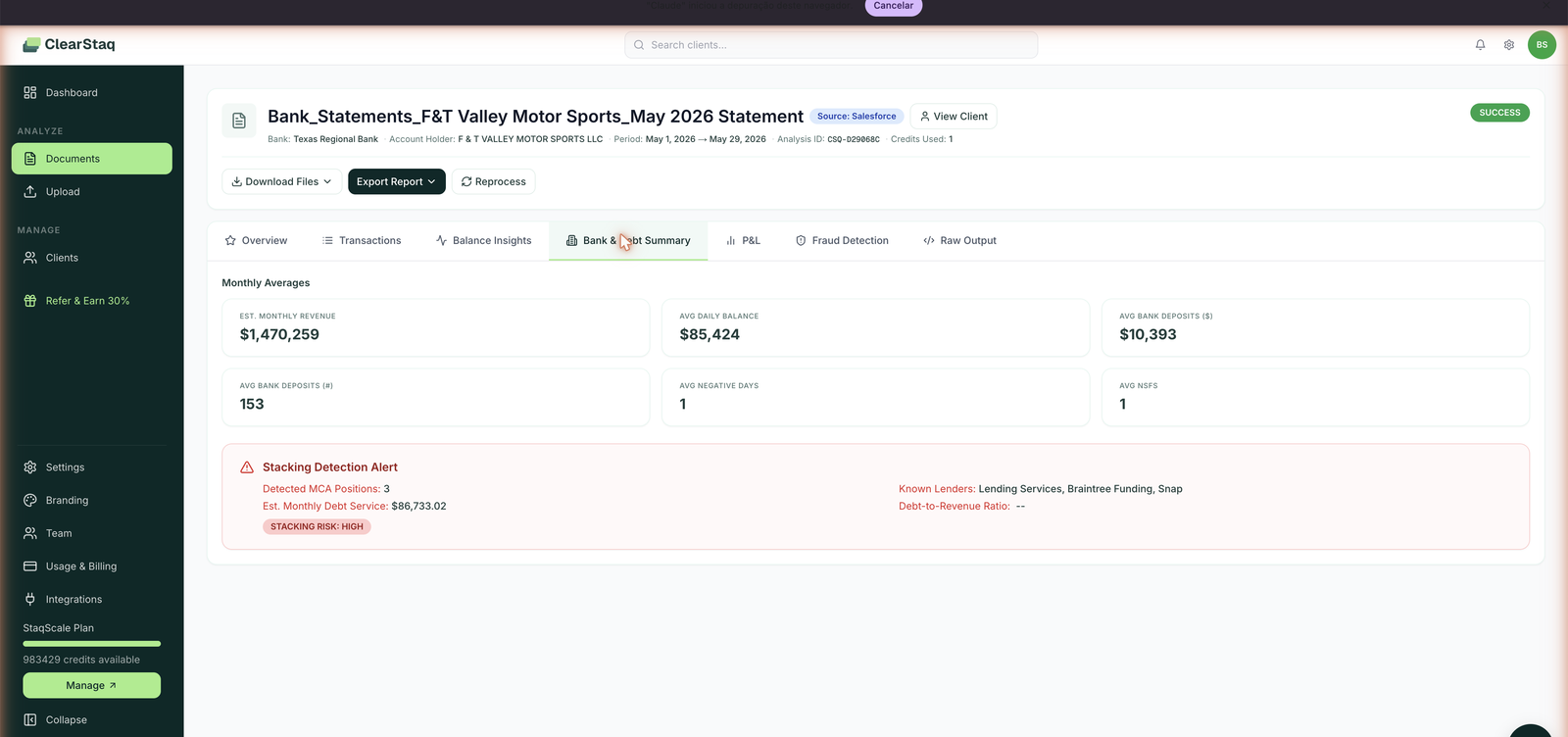
- Outstanding Advances: how many distinct advance relationships are active (e.g. 3)
- Known Lenders: identified by name from transaction patterns (e.g. Lending Services, Braintree Funding, Snap)
- Est. Monthly Debt Service: what the merchant is already paying out per month across all positions (e.g. $86,733)
- Debt-to-Revenue Ratio: debt service as a share of revenue
- Stacking Risk: set by the number of outstanding advances: 1 = LOW, 2 = MEDIUM, 3 or more = HIGH (NONE when there are none)
The same tab shows monthly averages for context: estimated revenue, average daily balance, average deposits, negative days, and NSFs.
Advance History (client level)
Open a client and go to the Advance History tab for the full picture across all their statements:
Outstanding Advances
Every detected position, tracked automatically as statements are uploaded.
Advance Monthly Breakdown: per lender, per month
One table per lender, one row per statement month. Payments are money sent to the lender; funding is money the lender paid into the account.
| Column | Meaning |
|---|---|
| Month | Statement month. Each statement has its own rows, so two accounts covering the same month give two rows. One statement cycle that crosses two calendar months (e.g. Apr 15 – May 14) is a single row, under the month it ends in. |
| Work Days | Business days (Monday–Friday, excluding US federal holidays) of this calendar month that fall inside the statement period: fewer than the full month when the statement starts or ends mid-month, and 0 when the statement has no daily balances. When one statement cycle crosses two calendar months, the row adds up the business days of only those months in which this lender had payments or funding, so it covers the whole cycle only for a lender active in both. |
| Payments # / Payments total | Number of payments to this lender in the month (debits from the account to the lender) and their sum. |
| Withhold % | Payments total ÷ all deposits on the statement in that month (every credit, not only revenue). 0% when the month had no deposits. |
| Funding # / Funding total | Number of credits from this lender in the month (money the lender paid into the account, such as a new advance) and their sum. 0 in months the lender paid nothing in. |
| Frequency | How often this lender's transactions (payments and funding) happen in the month, from the average gap between their dates: Daily (up to 2 days), Weekly (up to 9), Bi-Weekly (up to 18), Monthly (longer). One-Time means a single date; Mixed means one statement cycle crossing two calendar months had a different cadence in each. |
This is how you answer the questions that decide a renewal or a new position: Is the merchant current on their existing advances? Did payments stop mid-month? Is there a new funder in the picture since last quarter? What's the real combined withhold?
How detection works
ClearStaq classifies transactions against known funder patterns (names, ACH descriptors, payment processors used by funders, e.g. recognizable strings like "BRAINTREE FUNDING 7P45SY" or "LendingServices AUTH PAYME"), plus cadence analysis that distinguishes advance repayment pulls from ordinary vendor payments. Detected MCA transactions are:
- Counted as positions, not revenue: advance deposits are excluded from True Revenue
- Tagged in the Transactions explorer under the Non-Traditional Loan category
- Rolled up into the alert and the monthly breakdown
Interaction with True Revenue
This matters more than any single feature: a merchant with $100K of monthly deposits and three active advances might have $40K of actual sales. Because stacking detection and True Revenue share the same engine, the revenue you size against is already net of advance proceeds.
FAQ
Which funders can ClearStaq identify? 100+ known MCA funders and growing. Recognition is based on transaction descriptors and repayment patterns, so new funders are added continuously without you doing anything.
What if a funder isn't recognized by name? The repayment pattern (daily/weekly fixed pulls) is still detected and counted as a position. It shows without a brand name attached.
Does a paid-off advance still show? The monthly breakdown shows the months it was active. If pulls stopped, you'll see the payment activity end, which itself is signal (paid off vs. defaulted is visible in how it ends).
Is stacking detection on every plan? It's included from StaqPro up. StaqCore includes parsing and basic fraud flags only.
Can I get stacking data via the API?
Yes. The analysis.completed webhook payload includes the debt rollups, and the full position data is in the Raw Output JSON.