Merchant Category Codes (MCCs) are four-digit codes assigned by card networks to classify merchant business types. When inferred from bank statement transaction descriptions, MCC mapping enables underwriters to assess industry risk, detect high-risk spending patterns, and flag potential fraud — without requiring a live card data feed or open banking connection.
What you'll learn
- Most bank statement PDFs do not include explicit MCC fields — automated tools must infer categories from raw merchant description strings using hybrid rules-based and AI models
- High-risk MCCs such as 7995 (gambling), 6011 (ATM cash), and 5933 (pawn shops) in business account expense transactions signal financial stress, fund commingling, or fraud
- MCC mapping converts hundreds of raw transaction strings into a structured spending profile in seconds, enabling underwriters to detect business model drift across multi-month statements
- CPAs can reduce manual transaction categorization from two to four hours down to 20–30 minutes using MCC-assisted auto-categorization workflows
- An unclassified MCC rate above 15% of debit transactions is itself a risk signal, often indicating heavy cash activity or structural data quality issues
Merchant Category Codes (MCCs) are four-digit codes assigned by card networks to classify the type of goods or services a merchant sells. When extracted or inferred from bank statement transaction descriptions, MCC mapping enables underwriters to assess industry risk, detect high-risk spending patterns, and flag potential fraud — without requiring a live card data feed or open banking connection.
What Are Merchant Category Codes (MCCs)? A Quick Primer
Visa, Mastercard, American Express, and Discover each maintain a list of four-digit codes that classify every merchant accepting card payments by business type. These codes — Merchant Category Codes (MCCs) — are assigned at onboarding by the payment processor and travel with every card transaction the merchant processes.
MCC ranges are organized by industry segment. Codes 0001–1499 cover agriculture and related industries. Codes 4000–4799 span transportation. Retail falls in the 5000–5999 range, and service businesses occupy 7000–7999. The Visa MCC lookup tool provides a searchable reference for the full code set.
For document reviewers — underwriters, CPAs, and analysts — MCCs answer three questions: what does this business do, what does it spend money on, and do either of those facts raise a risk flag?
MCC vs. SIC Code: What's the Difference and Which Matters for Bank Statement Analysis?
SIC (Standard Industrial Classification) codes are assigned by the IRS and SEC to classify businesses at the entity level for regulatory and tax reporting purposes. They describe what a company does as an organization.
MCCs operate at the transaction level, assigned by card networks at each point of sale. They reflect what was purchased, not just who the buyer is. That granularity is what makes MCCs operationally valuable for bank statement analysis.
When an underwriter reviews a bank statement, they see MCC-derived data — even if it's embedded in merchant description strings rather than a labeled field. SIC codes don't appear in transaction records at all. For anyone analyzing where money is actually flowing, MCCs are the relevant classification layer.
Why Bank Statements Often Don't Include Explicit MCC Fields
Here's the core challenge: most bank statement PDFs don't surface MCC codes as discrete fields. The MCC lives at the card network and processor level. Banks display raw transaction description strings generated by their core processing system — not the enriched card network data behind each transaction.
The result is that bank statement parsing must bridge a gap: extract meaning from unstructured text rather than reading a clean data field. Open banking APIs like Plaid can surface MCCs directly from transaction feeds — but the majority of MCA lenders, community banks, and small business underwriters work with PDF statements, not API-connected data. That makes inference the practical reality.
Why MCCs Matter for Bank Statement Analysis
Raw transaction strings are nearly useless for risk analysis at volume. A statement with 400 debit transactions contains 400 individual description strings that mean nothing until they're organized. MCC mapping transforms that noise into a structured spending profile — the percentage of total debits in each business category — in seconds.
For underwriters, MCC data reveals three things simultaneously: whether the applicant's spending aligns with their stated business type, whether any high-risk spending categories are present, and whether cash flow is concentrated in ways that indicate stress. For CPAs, the same mapping collapses hours of manual categorization into a review-and-confirm workflow.
How MCC Data Differs from Transaction Descriptions Alone
Consider a raw transaction string: SQ *ACME SUPPLY 888-555-0123. Without context, an underwriter has to guess what this is. Once MCC-mapped, it resolves to Hardware Stores (MCC 5251) — immediately signaling legitimate business-use spending for a contractor or construction company.
The practical difference compounds across a full statement. Without MCC mapping, an underwriter manually interprets hundreds of strings like that one. With MCC mapping, they review a spending profile: 34% building materials, 18% fuel, 12% equipment rental, 9% financial services. That profile tells the story of the business in one glance.
Paired with transaction velocity analysis, MCC spending patterns become a powerful predictor of default risk — combining what the money is spent on with how frequently and in what amounts it moves.
Business Model Drift: What MCC Patterns Reveal Over Time
Comparing MCC distribution across consecutive statement months reveals shifts that a single-month review misses entirely. An applicant claiming to operate a landscaping business might show a clean month-one profile — fuel, equipment, and supply purchases as expected. Month three might show 40% of debit volume concentrated in gambling-category MCCs.
That shift is a misrepresentation signal that no competitor content currently addresses. Multi-month MCC trending detects business model drift, seasonal anomalies, and behavioral changes that precede default. It's not just about what the spending profile looks like — it's about whether it's stable, deteriorating, or inconsistent with the stated business narrative.
How MCC Mapping Works in Bank Statement Parsing
MCC mapping from a bank statement PDF follows a defined sequence. Each step is necessary — skipping any one of them degrades output quality significantly.
- Extract raw transaction rows from the PDF: merchant name, date, amount, and running balance.
- Normalize merchant name strings: strip noise like phone numbers, location codes, and payment processor prefixes (SQ *, TST*, PAYPAL *).
- Match normalized strings against an MCC lookup database, or run an AI inference model for unmatched names.
- Assign MCC code and category label to each transaction with a confidence score.
- Aggregate by MCC category to produce a spending profile — percentage of debits in each category across the statement period.
The output at step five is what enables risk analysis. Without the aggregation layer, you have labeled transactions. With it, you have a business spending fingerprint.
Rules-Based MCC Lookup vs. AI Inference: Pros and Cons
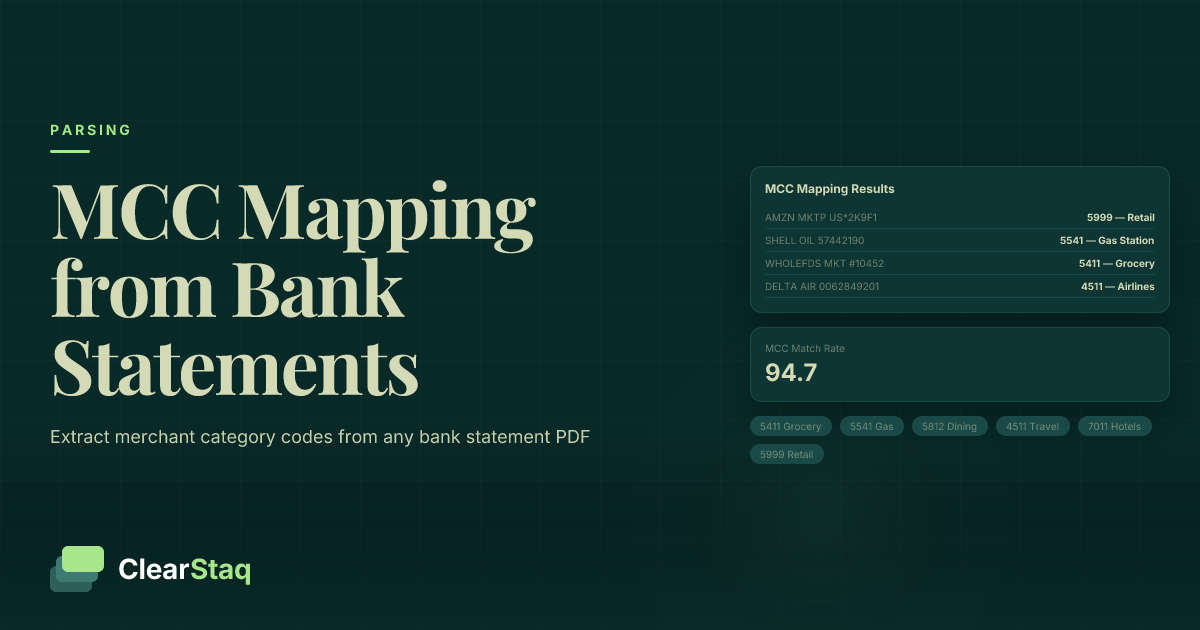
Rules-based lookup works by matching normalized merchant names against a known merchant-to-MCC table. It's fast, deterministic, and fully explainable. Amazon maps to 5999 (Miscellaneous Retail). Walmart maps to 5310 (Discount Stores). For recognized national merchants, this approach is both efficient and accurate.
The limitation appears immediately with local, regional, or ambiguously named merchants. A rules-based system that encounters MARTINEZ TILE & STONE or COASTAL AUTO DETAIL has no match and fails to categorize.
AI inference fills that gap using merchant name keywords, transaction amount patterns, and co-occurrence data to assign a probable MCC. It handles novel and ambiguous names that rules-based systems cannot. The tradeoff is explainability — an ML-assigned category requires a confidence score to communicate its reliability.
Best practice is a hybrid approach: rules-based lookup first, AI inference as fallback. Each MCC assignment should carry a confidence score so downstream users know which categorizations to trust and which to review.
Handling MCC Inference Across 900+ Bank Formats
Chase formats transaction description strings differently than Wells Fargo. Regional credit unions often truncate merchant names at different character counts, use different delimiter conventions, and include different metadata fields in their export strings. A normalization routine tuned for one institution will produce garbage output on another.
Format-specific normalization rules must precede any MCC mapping attempt. This is why 900+ bank format support isn't a convenience feature — it's a prerequisite for reliable, consistent MCC mapping across institutions. Without it, the same merchant appearing in statements from two different banks may produce different (or failed) MCC assignments.
Inferring MCCs When the Code Is Missing from Statement Data
The absence of an explicit MCC field is the norm for bank statement PDFs, not the exception. Every MCC assignment from a static statement requires inference from whatever text the bank's core system happens to output.
Three inference signals make this possible in most cases:
- Merchant name keyword matching — identifying product/service keywords in the description string.
- Transaction amount patterns — small, frequent debits correlate with food and beverage MCCs; large periodic payments correlate with rent or equipment categories.
- Transaction timing patterns — late-night debits cluster around entertainment MCCs; early-morning recurring charges often indicate SaaS subscriptions.
Ambiguous cases require a judgment call. Costco can legitimately map to MCC 5411 (Grocery Stores) or MCC 5300 (Wholesale Clubs) depending on the account type and purchase context. Forcing one assignment where two are plausible introduces error into downstream analysis.
Common Merchant Description Patterns and Their MCC Mappings
The following table provides a practical reference for the most common description patterns and their likely MCC assignments. This is an inference guide, not an authoritative card network list.
| Description Pattern | Likely MCC | Category Label | Notes |
|---|---|---|---|
| SQ * [merchant name] | Varies | Square POS — secondary inference required | Square prefix doesn't determine MCC; merchant name must be analyzed |
| PAYPAL * [merchant] | 4829 or 7372 | Money Transfer / Computer Services | Context-dependent; PayPal business payments may map to vendor category |
| VENMO [name] | 4829 | Money Transfer / Wire | P2P transfers in business accounts are a risk flag |
| ATM or CASH ADVANCE | 6011 | Automated Cash Disbursements | Always flag in business accounts — traceability gap |
| GOOGLE ADS or META ADS | 7319 | Advertising Services | Common for e-commerce businesses — business-use indicator |
| AMZN or AMAZON | 5999 | Miscellaneous Retail | Multi-category merchant; amount context improves inference |
| UBER or LYFT | 4121 | Taxicabs and Limousines | Frequent high-volume ride-share debits may indicate personal use |
| DOORDASH, GRUBHUB, UBEREATS | 5812 | Eating Places and Restaurants | Food delivery platforms map to restaurant category |
| TST * [restaurant name] | 5812 | Eating Places and Restaurants | Toast POS prefix — consistently maps to food service |
| CASINO, BETMGM, DRAFTKINGS | 7995 | Betting / Casino Gambling | High-risk flag in any business account context |
| ACE CASH, CHECK INTO CASH | 6012 | Financial Institutions (Payday Proxy) | Financial distress indicator |
| SHOPIFY PAYMENTS | 5999 | Miscellaneous Retail | Revenue-side indicator for e-commerce businesses |
When Inference Fails: Handling Truly Ambiguous Transactions
Some merchant names are simply too generic or too truncated to classify reliably. Strings like ONLINE PAYMENT, TRANSFER, or a 12-character truncated name with no recognizable keywords can't be responsibly assigned to any MCC category.
The correct response is to maintain an unclassified bucket and report its size as a data quality metric rather than force-assigning a best guess. False categorization — labeling an ambiguous transaction as something plausible but wrong — corrupts the spending profile and misleads downstream analysis.
An unclassified rate above 15% of debit transactions is itself a risk signal. It often indicates heavy cash or wire activity, unusual payment channels, or a statement with structural data quality issues. Flag high-value unclassified transactions for manual review rather than including them silently in aggregate totals.
High-Risk MCC Categories Every Underwriter Should Know
High-risk MCCs appear in two distinct contexts, and the distinction matters for how you interpret them. When a business's revenue comes from a high-risk MCC category — gambling, adult entertainment, cryptocurrency — that signals elevated chargeback rates and regulatory exposure. When high-risk MCCs appear in a business's expense transactions — the debits on the statement — it signals something different: financial stress, fund commingling, or behavioral risk.
Both contexts matter for fraud red flags in bank statements, but expense-side high-risk spending is the signal most underwriters miss because it requires MCC-level analysis rather than a simple document check. The FFIEC BSA/AML Examination Manual provides regulatory guidance on elevated-risk categories for transaction monitoring programs.
For a comprehensive overview of how using MCC transaction data for smarter lending decisions integrates with broader credit risk frameworks, see our companion guide.
High-Risk MCC Reference Table for MCA and Small Business Lenders
This table is a practitioner reference for identifying elevated-risk spending patterns in business account debit transactions. It is not an exhaustive regulatory list — refer to the FFIEC BSA/AML manual for full compliance guidance.
| MCC Code | Category Name | Risk Type | Underwriter Notes |
|---|---|---|---|
| 7995 | Betting / Casino Gambling | Financial stress, character risk | Any meaningful volume in a business account expense stream warrants explanation |
| 6011 | Automated Cash Disbursements (ATM) | Traceability, potential structuring | Heavy ATM usage reduces auditable cash flow — flag frequency and amounts |
| 6050 / 6051 | Quasi-Cash / Currency Dealers | AML, structuring risk | Common in structuring patterns — cross-reference with deposit amounts |
| 5933 | Pawn Shops | Financial distress | Direct indicator of liquidity stress — rarely appears in healthy businesses |
| 6012 | Merchandise / Services — Financial Institutions | Payday lending proxy | Used by payday lenders and cash advance services — distress signal |
| 7273 / 7297 | Dating / Escort / Adult Entertainment | Reputational, chargeback risk | Elevated chargeback rates; personal/business commingling indicator |
| 5199 | Non-Classified Goods | Regulatory, crypto-adjacent | Frequently used by cryptocurrency-adjacent merchants — elevated regulatory scrutiny |
| 4829 | Wire Transfer / Money Orders | AML, fund transfer risk | High-volume wire transfer patterns trigger BSA/AML review thresholds |
How High-Risk MCC Spending Signals Business Account Misuse
Personal expenses run through a business account serve a common purpose in fraudulent applications: they inflate apparent revenue and distort cash flow metrics. A business depositing $30,000/month and spending $8,000 of it at personal retail and entertainment MCCs looks healthier on paper than it actually is.
Gambling MCCs in business account debits indicate one of two things: liquidity stress that leads the operator to seek alternative income, or character risk that compounds the probability of strategic default. Neither outcome is acceptable for a lender extending credit.
Disproportionate ATM and cash advance MCCs suggest the business operates heavily in cash — reducing the traceability of funds and creating a verification gap that underwriters can't close without additional documentation.
A practical starting threshold: when high-risk MCC spending exceeds 5% of total debit volume, flag the application for manual review. That's not a hard disqualification — it's a prompt to gather more information before making a credit decision.
MCC Mapping for CPAs: Faster Expense Categorization and Chart of Accounts Alignment
CPAs reviewing bank statements for bookkeeping, tax preparation, or financial statement compilation face the exact same raw-description problem as underwriters. The difference is the outcome they're working toward: not a lending decision, but a chart-of-accounts entry.
MCC mapping converts raw merchant strings into standardized expense categories that align with QuickBooks, Xero, or any custom chart of accounts. The time savings are significant. Manual categorization of 300 transactions typically takes two to four hours per client. An MCC-assisted workflow — where the system auto-categorizes and the CPA confirms or overrides — reduces that to 20–30 minutes.
For deeper context on how AI handles the classification layer, see our guide to automated expense categorization.
Mapping MCCs to Chart of Accounts: A Practical Framework
The following table shows standard MCC-to-chart-of-accounts mappings for common transaction categories. Custom rules are required for industry-specific clients — a restaurant owner's MCC 5812 spending may map to COGS rather than Meals & Entertainment, depending on context.
| MCC Code | Category Name | Default Chart of Accounts Mapping | Notes |
|---|---|---|---|
| 5411 | Grocery Stores / Supermarkets | Meals & Entertainment or COGS | Industry-dependent — food service clients may classify as COGS |
| 5541 / 5542 | Service Stations / Automated Fuel | Vehicle & Travel Expense | Pair with mileage log for IRS documentation requirements |
| 7372 | Computer Programming / Data Processing | Technology & Software Expense | Covers SaaS subscriptions, cloud services, software licenses |
| 5065 | Electrical Parts & Equipment | Equipment & Supplies | Common for trades and construction businesses |
| 5812 | Eating Places and Restaurants | Meals & Entertainment | 50% deductibility limit applies — flag for Schedule C note |
| 4511 | Airlines and Air Carriers | Travel Expense | Verify business purpose for IRS substantiation |
| 5943 | Stationery / Office / School Supplies | Office Supplies & Expense | Fully deductible; clean IRS deduction category |
| 7011 | Hotels and Motels | Travel Expense | Domestic lodging — verify business trip documentation |
| 5047 | Medical / Dental / Hospital Equipment | Medical Supplies or COGS | Healthcare clients may classify as COGS or professional supplies |
| 7319 | Services Not Elsewhere Classified (Advertising) | Advertising & Marketing | Google Ads and Meta Ads commonly appear here |
CPAs who need to categorize business expenses from bank statements can apply this framework as a starting point, then layer in client-specific override rules for exceptions.
The IRS 1099-K context adds another dimension. Certain MCCs — particularly broad retail codes like 5999 — are relevant to IRS 1099-K reporting thresholds. CPAs need to identify these codes in client statements to determine reporting obligations accurately.
Automating MCC-Based Categorization at Scale for CPA Firms
Multi-client batch processing applies the same MCC mapping logic consistently across every client in a single workflow pass. The categorization rules don't vary by client unless a custom override is defined — which means categorization quality doesn't degrade as client volume grows.
Exception handling is the critical quality gate. Transactions that don't map cleanly — ambiguous merchant names, unrecognized description strings, multi-category merchants — should be flagged for CPA review rather than auto-assigned. A disputed category that the CPA confirms takes seconds. An incorrect auto-assignment that surfaces during an audit takes much longer to resolve.
Every categorization decision should be logged with the MCC code applied, the confidence score, and the mapping rule that produced the result. That audit trail supports both internal quality review and external documentation requirements.
MCC Data in Underwriting Decisions: A Step-by-Step Workflow
Having MCC-mapped transaction data is only useful if it integrates cleanly into the underwriting process. Here's how the full workflow runs from document receipt to decision input — a practical sequence that no other resource currently documents end-to-end.
Step 1–3: Document Intake, Parsing, and MCC Mapping
Step 1: Receive bank statement PDF(s). This may be one to twelve months of statements from a single institution, or statements from multiple banks submitted simultaneously.
Step 2: Parse all transactions into structured rows — date, merchant description, amount, and running balance extracted from the PDF layout.
Step 3: Run MCC mapping on all debit transactions. The output at this stage is a categorized transaction ledger: every debit row now carries an MCC code, a human-readable category label, and a confidence score.
For applications with statements across multiple institutions, multi-bank statement aggregation consolidates this output into a single unified ledger — essential for getting a complete MCC spending picture when a business operates multiple accounts.
Step 4–6: Spending Profile Analysis, Risk Flagging, and Decision Input
Step 4: Aggregate MCC-categorized debits into a spending profile. Calculate the percentage of total debit volume in each category across the full statement period.
Step 5: Apply risk rules. Flag applications where high-risk MCC spending exceeds the defined threshold, where the MCC profile doesn't match the stated business type, or where the month-over-month MCC distribution shows unusual drift.
Step 6: Feed MCC output into the underwriting scorecard alongside core cash flow metrics — average daily balance, NSF frequency, deposit regularity, and revenue concentration. MCC data is one layer in the decision, not the whole picture.
For the complete document review sequence, the MCA underwriting checklist provides a comprehensive framework for what to collect and verify at each stage.
See ClearStaq's MCC Mapping in Action
See how ClearStaq automatically maps MCC categories from any bank statement PDF — no live data feed required. Book a 20-minute demo to walk through a real statement analysis.
Automating MCC Mapping with ClearStaq
ClearStaq infers MCC-equivalent categories directly from raw bank statement PDF text — no live card feed, no open banking connection, no API integration to a third-party data provider. The inference engine normalizes merchant description strings and applies a hybrid rules-and-ML pipeline to assign category labels, MCC codes, and confidence scores to every parsed transaction.
This works consistently across ClearStaq's supported bank formats. The MCC mapping logic isn't tuned for a single institution — it's built on top of format-aware parsing that handles the description string conventions of each bank separately before applying categorization logic. The result is consistent output regardless of whether the statement comes from Chase, a regional credit union, or a neobank.
High-risk MCC spending patterns feed directly into ClearStaq's fraud signal pipeline as part of the 27 fraud signals analyzed per statement. Category-based anomaly detection flags business accounts with disproportionate personal or high-risk MCC spending automatically — no manual rule configuration required.
Explore the full bank statement parsing platform to see how MCC mapping integrates with the broader transaction enrichment pipeline.
What ClearStaq's MCC Output Looks Like in the API Response
Each transaction object in the JSON response includes four MCC-related fields:
- mcc_code — the four-digit MCC assigned to the transaction
- mcc_category — human-readable category label
- mcc_confidence — confidence score from 0.0 to 1.0
- is_high_risk_category — boolean flag for elevated-risk MCCs
The aggregate endpoint returns a spending_by_category array with each MCC category, transaction count, total dollar amount, and percentage of total debits. A separate high-risk MCC summary provides the total high-risk spend, the list of flagged codes present in the statement, and a severity tier (low, medium, high).
{
  "status": "success",
  "fraud_score": 57,
  "transactions": 47,
  "bank": "Chase",
  "processing_time_ms": 238
}Integrating MCC Data into Your Underwriting or Accounting Workflow
For lenders, MCC output pipes directly into your loan origination system or decision engine via webhook — no manual export or data transformation step between statement receipt and scoring. For CPAs, the MCC-categorized transaction output exports to CSV or maps to QuickBooks and Xero via native integration.
Processing happens in seconds, not hours. A 12-month statement set is parsed, MCC-mapped, and risk-scored within the same session — enabling underwriting decisions without waiting for manual analysis to complete.
For technical implementation details, see getting started with the ClearStaq API.
Common Challenges in MCC Extraction (and How to Solve Them)
MCC mapping from bank statement PDFs is a solved problem at the macro level — but five specific challenges account for most of the accuracy variation between implementations.
Truncated merchant names are the most common issue. Many bank PDFs cut merchant strings at 20–30 characters, removing the portion of the name that would enable confident matching. A 24-character string like MARTINEZ PROFESSIONAL S provides insufficient context for reliable MCC assignment.
Payment processor prefixes add a layer of indirection. SQ *, TST*, and PP * identify the payment processor, not the merchant. The actual business identity is in the suffix, which may itself be truncated. Two-stage inference — strip the prefix, then analyze the remainder — handles this correctly.
Multi-category merchants are structurally ambiguous. Amazon, Costco, and Walmart each span dozens of MCC ranges depending on what was purchased. No normalization rule resolves this without additional context signals.
Merchant name variations mean the same business may appear with different string representations across banks or across months — STARBUCKS STORE 12345 versus STARBUCKS #12345 versus SBUX *12345.
International merchants require language-aware normalization before any MCC lookup is attempted. Non-English characters, transliteration variations, and regional merchant naming conventions all degrade match rates if not handled explicitly.
Solving the Multi-Category Merchant Problem
Amazon transactions alone can represent four distinct MCCs: retail purchases (5999), marketplace seller payments to third-party vendors (7372), AWS cloud services (7372), or Prime membership subscriptions (5968). The description string rarely differentiates between them.
Transaction amount and co-occurrence patterns provide the best inference signals for sub-category assignment. A $14.99 monthly charge labeled AMZN*PRIME maps confidently to 5968. A $2,400 charge labeled AMAZON WEB SERVICES maps confidently to 7372. A $67.43 charge labeled AMZN MKTP US is less certain and warrants a medium-confidence assignment.
For high-stakes underwriting decisions, flag multi-category merchants for review rather than trusting the auto-assigned MCC without qualification. An acceptable accuracy threshold for MCC mapping at the transaction level is 92–95% with a well-implemented hybrid rules/ML approach — achievable, but not guaranteed on every statement.
Quality Metrics: How to Measure MCC Mapping Accuracy
Two metrics define the health of any MCC mapping implementation:
Classification rate: the percentage of debit transactions that receive any MCC assignment. A rate below 85% indicates normalization or lookup coverage gaps that should be addressed before using the output for risk decisions.
High-confidence classification rate: the percentage of classified transactions assigned with a confidence score above the defined threshold (typically 0.80 or higher). This metric identifies how much of the classified output can be trusted without manual review.
Unclassified rate benchmarks: below 10% is acceptable for a diversified small business statement, below 5% is strong performance. Rates above 15% should trigger a data quality review of the parsing and normalization layers before MCC mapping is applied.
Audit practice matters for ongoing accuracy: periodically spot-check a sample of MCC assignments against manual review to detect category drift — systematic errors that develop as merchant naming conventions change over time.
Frequently Asked Questions
Can MCC codes be extracted from bank statements automatically?
Yes, but with an important caveat: most bank statement PDFs don't include an explicit MCC field. Automated tools must infer MCC categories from raw merchant description strings using a combination of rules-based lookup tables and AI inference models. Accuracy rates of 92–95% at the transaction level are achievable with a hybrid approach applied to a well-normalized statement.
What MCC codes are considered high-risk for lending?
High-risk MCCs for lenders include 7995 (gambling), 6011 (ATM cash disbursements), 5933 (pawn shops), 4829 (wire transfers and money orders), 6012 (payday lender proxies), and adult entertainment codes (7273/7297). When these categories appear in a business account's expense transactions, they signal financial stress, personal/business fund commingling, or potential fraud.
Why do some bank statement transactions not have an MCC code?
Bank statement PDFs display raw transaction description strings generated by the bank's core system, not the card network's MCC data. MCC codes live at the processor and card network level and are typically not passed through to the PDF statement export. This means MCC mapping from bank statements always requires inference from the available description text.
What is the difference between MCC codes and SIC codes?
SIC (Standard Industrial Classification) codes are assigned by the IRS and SEC to classify businesses at the entity level for regulatory and tax purposes. MCC codes are assigned by card networks at the transaction level to classify the type of goods or services sold in each purchase. For bank statement analysis, MCCs are operationally relevant because they reflect actual spending behavior transaction by transaction — SIC codes don't appear in statement data at all.
How do CPAs use MCC codes for expense categorization?
CPAs use MCC mapping to automatically classify bank statement transactions into chart-of-accounts categories — for example, mapping MCC 5541 (gas stations) to Vehicle & Travel Expense, or MCC 7372 (computer services) to Technology & Software. This reduces manual categorization time from hours to minutes and creates a consistent, auditable classification trail across all client accounts.
Stop Interpreting Raw Transaction Strings Manually
Stop manually interpreting raw transaction descriptions. ClearStaq extracts, categorizes, and risk-scores every transaction in seconds — giving underwriters and CPAs the spending intelligence they need without the manual work. Book a demo to see it applied to a real bank statement.
Frequently Asked Questions
Can MCC codes be extracted from bank statements automatically?
Yes, but with an important caveat: most bank statement PDFs do not include an explicit MCC field. Automated tools must infer MCC categories from raw merchant description strings using a combination of rules-based lookup tables and AI inference models. Accuracy rates of 92–95% at the transaction level are achievable with a hybrid approach applied to a well-normalized statement.
What MCC codes are considered high-risk for lending?
High-risk MCCs for lenders include 7995 (gambling), 6011 (ATM cash disbursements), 5933 (pawn shops), 4829 (wire transfers and money orders), 6012 (payday lender proxies), and adult entertainment codes (7273/7297). When these categories appear in a business account's expense transactions, they signal financial stress, personal and business fund commingling, or potential fraud.
Why do some bank statement transactions not have an MCC code?
Bank statement PDFs display raw transaction description strings generated by the bank's core system, not the card network's MCC data. MCC codes live at the processor and card network level and are typically not passed through to the PDF statement export. This means MCC mapping from bank statements always requires inference from the available description text.
What is the difference between MCC codes and SIC codes?
SIC codes are assigned by the IRS and SEC to classify businesses at the entity level for regulatory and tax purposes. MCC codes are assigned by card networks at the transaction level to classify the type of goods or services sold in each purchase. For bank statement analysis, MCCs are operationally relevant because they reflect actual spending behavior transaction by transaction — SIC codes do not appear in statement data at all.
How do CPAs use MCC codes for expense categorization?
CPAs use MCC mapping to automatically classify bank statement transactions into chart-of-accounts categories — for example, mapping MCC 5541 (gas stations) to Vehicle and Travel Expense, or MCC 7372 (computer services) to Technology and Software. This reduces manual categorization time from hours to minutes and creates a consistent, auditable classification trail across all client accounts.
ClearStaq Team
Product Team
The ClearStaq team builds AI-powered tools for bank statement parsing, fraud detection, and income verification.