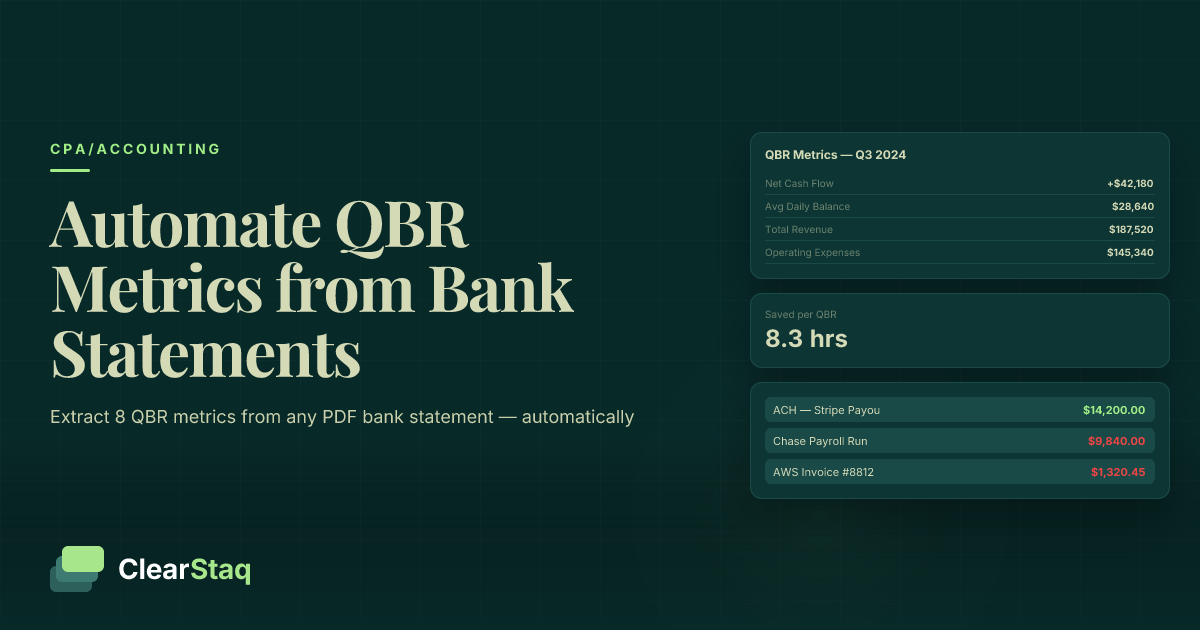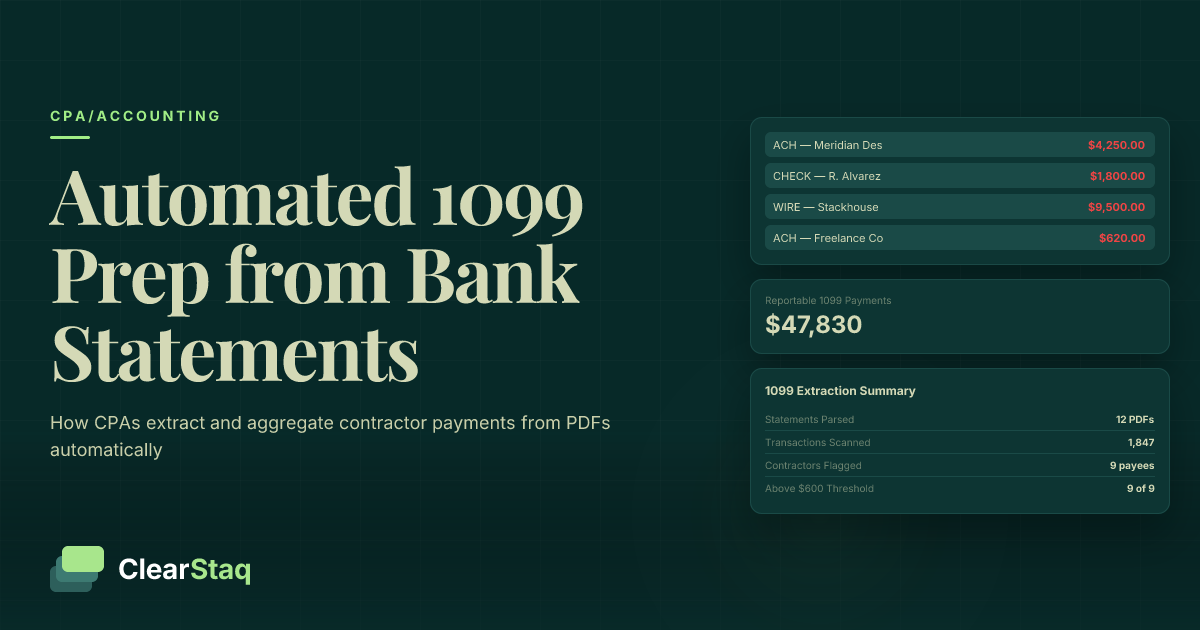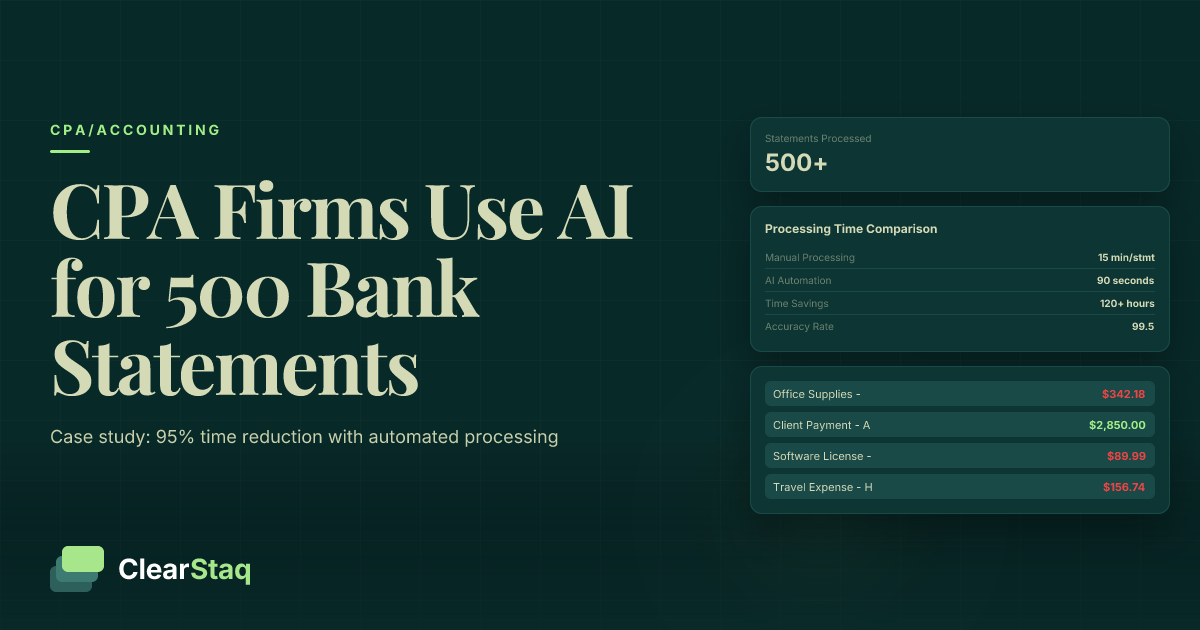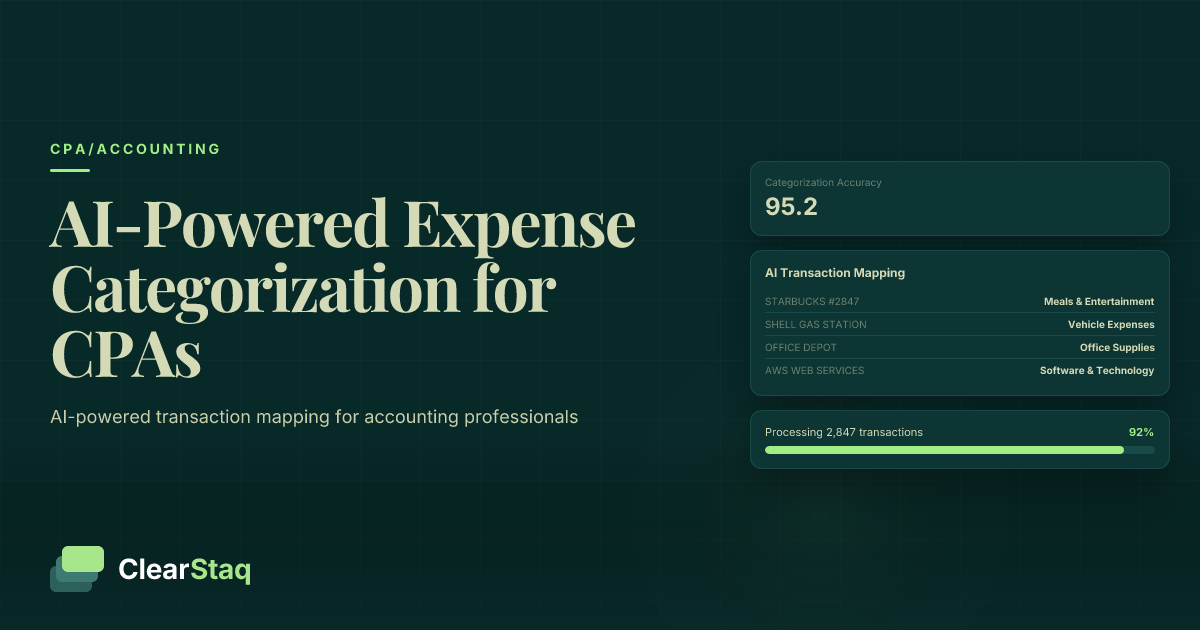
Automated expense categorization uses AI to analyze bank statement transactions and map them to appropriate chart of accounts categories based on transaction descriptions, amounts, and merchant patterns. Modern AI systems achieve 95%+ accuracy while processing thousands of transactions in seconds, eliminating manual data entry for accounting professionals.
What you'll learn
- AI-powered expense categorization achieves 95%+ accuracy while processing thousands of transactions in seconds
- Automated systems eliminate 80-90% of manual categorization time through intelligent transaction mapping
- Machine learning models continuously improve accuracy through user feedback and pattern recognition
- API integration enables real-time categorization workflows with accounting software like QuickBooks and Xero
- Custom chart of accounts mapping supports client-specific requirements and industry-specific categories
Automated expense categorization uses AI to analyze bank statement transactions and map them to appropriate chart of accounts categories based on transaction descriptions, amounts, and merchant patterns. Modern AI systems achieve 95%+ accuracy while processing thousands of transactions in seconds, eliminating manual data entry for accounting professionals.
What is Automated Expense Categorization?
Automated expense categorization represents a fundamental shift in how accounting professionals handle transaction classification. Instead of manually reviewing each bank transaction and assigning it to the appropriate chart of accounts category, AI-powered systems analyze transaction data and make these assignments automatically.
At its core, the technology combines transaction parsing, pattern recognition, and machine learning classification to transform raw bank statement data into properly categorized financial records. The system reads transaction descriptions, identifies merchants, analyzes amounts and patterns, then maps each transaction to the most appropriate expense category in your chart of accounts.
The Traditional Problem: Manual Transaction Categorization
Manual expense categorization has plagued accounting departments for decades. A typical accountant spends 2-3 hours categorizing 100 transactions, with error rates averaging 3-5% due to fatigue and inconsistent decision-making. When you multiply this across multiple clients and thousands of monthly transactions, the time cost becomes staggering.
The inconsistency problem compounds when multiple staff members handle categorization. One person might categorize "AMZN Marketplace" as Office Supplies while another codes it as Technology Equipment. These discrepancies create reporting inconsistencies and complicate year-end reconciliation. For more on the challenges of manual expense categorization, see our detailed guide.
How AI Changes the Game
AI transforms expense categorization through three key capabilities. First, pattern recognition allows the system to identify transaction types based on historical data patterns, even when descriptions vary. Second, machine learning adaptation means the system improves accuracy over time by learning from corrections. Third, AI provides unlimited scale — whether processing 100 or 10,000 transactions, the time difference is negligible.
The technology doesn't just match keywords; it understands context. When it sees "SQ *COFFEE SHOP" followed by a small dollar amount, it recognizes a meals and entertainment expense, not a square footage measurement for real estate.
How AI Maps Bank Transactions to Chart of Accounts
The journey from raw bank statement to categorized transaction involves four sophisticated steps, each leveraging different AI technologies to ensure accuracy and reliability.
Bank Statement Parsing: The Foundation
Before AI can categorize anything, it needs clean, structured data. Bank statement parsing extracts transaction data from PDFs, CSVs, and other formats into a standardized structure. Modern parsers support 900+ bank formats globally, handling everything from simple checking accounts to complex commercial statements.
The parsing process extracts essential fields: transaction date, description, amount, balance, and transaction type. Quality parsing achieves 99.5% accuracy on these core fields, providing the reliable foundation AI needs for accurate categorization. Transaction descriptions get standardized — removing extra spaces, normalizing merchant names, and extracting key identifiers.
Natural Language Processing for Descriptions
Once parsed, Natural Language Processing (NLP) analyzes transaction descriptions to extract meaning. The AI identifies merchant names even when obscured by payment processor codes. It recognizes "PAYPAL *OFFICEDEPOT" as an Office Depot purchase, not a PayPal service fee.
NLP also identifies transaction context clues: recurring patterns suggest subscriptions, round numbers often indicate transfers or loan payments, and specific merchant categories become apparent through description analysis. The system builds a semantic understanding of each transaction beyond simple keyword matching.
Machine Learning Classification Models
The classification engine represents the AI's decision-making core. Trained on millions of pre-categorized transactions, these models recognize patterns humans might miss. The system considers multiple factors simultaneously: merchant type, transaction amount, frequency, timing, and relationship to other transactions.
Here's how the AI analyzes a bank statement and extracts transaction data for categorization:
6 fields extracted automatically • 99.8% accuracy
Supervised learning drives accuracy improvements. When accountants correct miscategorizations, the system updates its model weights, becoming more accurate for similar future transactions. Most systems reach 95% accuracy within the first month and continue improving toward 98%+ with ongoing use.
Benefits of Automated Categorization for Accountants
The impact of automated expense categorization extends far beyond simple time savings. Accounting firms report transformational changes in their workflows, client relationships, and business models.
Quantified Time Savings
Manual categorization typically requires 1-2 minutes per transaction when including review time, context switching, and decision-making. Automated systems process transactions in milliseconds with 95%+ accuracy. For a firm processing 5,000 transactions monthly across all clients, this translates to 80-160 hours saved — equivalent to a full-time employee.
The time savings compound when considering reduced review cycles. Instead of reviewing every transaction, accountants focus only on edge cases flagged by the AI. This targeted review approach reduces total categorization time by 85-90% while maintaining quality standards.
Quality and Consistency Improvements
Automated categorization eliminates the inconsistency inherent in manual processes. Every transaction gets evaluated against the same criteria, regardless of who's processing the statement or what time of day it is. Error rates drop from the typical 3-5% in manual processing to under 2% with AI systems.
The audit trail improves dramatically. Each categorization includes confidence scores, decision factors, and processing timestamps. When questions arise during audit or review, the complete decision logic is available, not just the final category assignment.
Multi-Client Scalability
For CPA firms managing dozens or hundreds of clients, automated categorization enables true scalability. Batch processing allows firms to categorize statements for all clients simultaneously. Client-specific categorization rules ensure each client's unique chart of accounts gets respected without manual configuration for each processing run.
Watch how automated categorization transforms raw transaction data into actionable financial insights:
The ability to handle multi-client processing efficiently opens new service opportunities. Firms can offer more frequent financial reporting, real-time categorization services, and proactive financial analysis without proportionally increasing staff.
Setting Up AI-Powered Expense Categorization
Successful implementation of automated categorization requires thoughtful preparation and systematic execution. The setup process determines long-term accuracy and usability.
Chart of Accounts Configuration
Start by auditing your existing chart of accounts structure. AI systems work best with clear, logically organized categories. Consolidate redundant categories and ensure naming conventions are consistent. While AI can handle complex hierarchies, simpler structures often yield better results.
Most systems support both standard and custom categories. Standard categories follow common accounting frameworks and work immediately. Custom categories require mapping but allow complete flexibility for industry-specific or client-specific needs. Consider starting with standard categories and adding custom ones as needed.
Training Data Requirements
Quality training data drives categorization accuracy. Ideal training sets include 3-6 months of historical transactions with accurate categorizations. Aim for at least 20-30 examples per category, though common categories benefit from hundreds of examples.
Diversity matters more than volume. Include transactions from different merchants, varying amounts, and multiple description formats. Edge cases and unusual transactions are particularly valuable for training — they help the AI learn boundaries between similar categories.
Integration Planning
Modern categorization systems integrate through APIs, allowing seamless connection with existing workflows. Plan your integration architecture carefully: direct API connections offer real-time processing, webhook notifications enable event-driven workflows, and batch processing APIs handle high-volume scenarios efficiently.
Consider data flow in both directions. Categorized transactions should sync to your accounting software automatically, while corrections made in your accounting system should flow back to improve the AI model.
Training Data and Accuracy Optimization
Achieving and maintaining high categorization accuracy requires ongoing attention to data quality and model performance.
Building High-Quality Training Datasets
Start with your cleanest, most reliable historical data. Export 6-12 months of transactions from your most organized clients. Review the categorizations for accuracy before using them as training data — garbage in, garbage out applies strongly to AI training.
Include edge cases deliberately. Transactions that sit between two categories help the AI learn decision boundaries. For example, include various software purchases to help distinguish between "Software Subscriptions" and "Computer Equipment" categories.
Continuous Model Improvement
Implement feedback loops from day one. When users correct categorizations, capture not just the correction but the reason. Was the merchant name ambiguous? Did the amount suggest a different category? This context helps improve future accuracy.
Schedule regular retraining cycles. Monthly retraining incorporating recent corrections keeps the model current. Track accuracy metrics over time — most systems show steady improvement for the first 3-6 months before plateauing at 96-98% accuracy.
Measuring and Improving Accuracy
Accurate measurement requires consistent benchmarking. Sample 100 random transactions monthly and manually verify their categorizations. Track accuracy by category — some categories naturally achieve higher accuracy than others.
When accuracy issues arise, analyze patterns. Are certain merchants consistently miscategorized? Do transactions within specific amount ranges cause problems? Understanding parsing accuracy factors helps identify whether issues stem from data extraction or categorization logic.
Handling Edge Cases and Custom Categories
Real-world transactions don't always fit neatly into predefined categories. Successful automated systems must handle ambiguity gracefully.
Common Edge Cases in Expense Categorization
Ambiguous merchant descriptions top the list of categorization challenges. When "WALMART" appears, the purchase could be office supplies, client entertainment, or employee snacks. AI systems handle this by analyzing amount patterns — $500 at Walmart likely differs from $50 purchases.
Multi-category transactions create another challenge. A restaurant charge during travel could be categorized as "Meals & Entertainment" or "Travel Expenses." The best AI systems maintain primary and secondary category suggestions, allowing flexible handling based on client preferences.
Custom Category Implementation
Industry-specific businesses often require unique categories. Law firms might need "Client Development" separate from "Marketing," while construction companies require detailed equipment categories. Modern AI systems support unlimited custom categories with the same accuracy as standard ones.
Client-specific requirements add another layer. Some clients want granular categorization (separating "Local Meals" from "Travel Meals"), while others prefer consolidation. The key is configuring these preferences once and letting the AI handle them automatically.
Manual Review Workflows
Even 98% accuracy means 2 in 100 transactions need attention. Effective review workflows make this manageable. Set confidence thresholds — transactions categorized with less than 85% confidence get flagged for review. This typically catches 5-10% of transactions while identifying nearly all errors.
Review queues should be intuitive. Show the transaction, the AI's suggestion with confidence score, and alternative options. One-click approval or correction keeps the workflow efficient while capturing valuable training data.
API Integration for Automated Workflows
APIs transform expense categorization from a batch process into a real-time capability integrated throughout your tech stack.
Real-Time API Implementation
Modern categorization APIs process transactions in under 500ms, enabling real-time workflows. RESTful endpoints accept transaction data and return categorizations with confidence scores. Authentication via API keys or OAuth2 ensures security while allowing granular access control.
Here's how the API request and response flow works for automated expense categorization:
{
  "status": "success",
  "fraud_score": 57,
  "transactions": 47,
  "bank": "Chase",
  "processing_time_ms": 238
}Response formats typically include the primary category, confidence score, alternative suggestions, and metadata explaining the categorization logic. This transparency helps build trust and enables intelligent handling of uncertain categorizations.
Accounting Software Integration
Direct integration with QuickBooks, Xero, and similar platforms eliminates manual data entry entirely. Categorized transactions sync automatically, maintaining audit trails and ensuring consistency. Two-way sync capabilities mean corrections in your accounting software improve the AI model.
The ClearStaq API supports both push and pull models. Push bank statements for categorization, or let the system pull statements directly from connected bank accounts. Webhook notifications alert your systems when processing completes.
Webhook Automation
Event-driven architecture via webhooks enables sophisticated automation. When statements upload, parsing begins automatically. Completed categorizations trigger downstream processes: updating accounting software, notifying reviewers of flagged transactions, or generating client reports.
Error handling becomes crucial in automated workflows. Webhooks should include retry logic, timeout handling, and clear error messages. When categorization confidence falls below thresholds, webhooks can route transactions to manual review queues automatically.
Ready to Automate Your Expense Categorization Workflow?
Start a free trial and see how ClearStaq's API can categorize thousands of transactions in minutes.
How ClearStaq Automates Expense Categorization
ClearStaq combines advanced bank statement parsing with AI-powered categorization to deliver a complete automation solution for accounting professionals. The system stands apart through its comprehensive approach to the entire workflow.
Advanced Bank Statement Processing
With support for 900+ bank formats globally, ClearStaq handles virtually any statement format your clients use. The parsing engine achieves 99.5% accuracy on transaction extraction, providing the clean data foundation essential for accurate categorization.
Multi-format support means PDFs, CSVs, Excel files, and even scanned statements process through the same pipeline. Automatic format detection eliminates manual configuration — simply upload statements and let the system handle format complexities.
Integrated Fraud Detection
Unlike standalone categorization tools, ClearStaq simultaneously screens for fraud during processing. The system analyzes 27 fraud signals including altered PDFs, impossible balances, and suspicious transaction patterns.
This integrated approach provides quality assurance beyond simple categorization accuracy. Flagged statements alert you to potential issues before they impact financial reporting. For lending and risk assessment use cases, this fraud detection adds crucial verification to the categorization process.
Flexible API Architecture
ClearStaq's RESTful API design supports both simple integrations and complex workflows. Single-statement processing completes in under 2 seconds, while batch endpoints handle thousands of statements efficiently. Webhook support enables event-driven architectures without polling.
Custom integration support extends beyond basic API access. The platform supports client-specific categorization rules, custom chart of accounts mapping, and flexible output formats. Whether you need CPA solutions for multi-client management or embedded categorization in your own software, the API adapts to your requirements.
Frequently Asked Questions
How accurate is automated expense categorization?
Modern AI-powered expense categorization achieves 95%+ accuracy on standard business transactions. Accuracy improves over time through machine learning and user feedback, with most systems reaching 98%+ accuracy after processing several months of data.
Can AI categorize transactions to custom chart of accounts?
Yes. AI categorization systems can be trained on custom chart of accounts structures, including industry-specific categories and client-specific requirements. The system maps transactions to your existing categories rather than forcing standard classifications.
What happens when AI can't categorize a transaction?
Transactions below confidence thresholds are flagged for manual review. Most systems provide suggested categories with confidence scores, allowing accountants to approve or correct the categorization while training the AI for future similar transactions.
How does AI handle ambiguous transaction descriptions?
AI uses context clues including merchant names, transaction amounts, frequency patterns, and surrounding transactions to categorize ambiguous descriptions. When uncertainty remains high, the transaction is queued for manual review with suggested categories.
Can automated categorization integrate with existing accounting software?
Yes. Most AI categorization tools offer API integrations with popular accounting platforms like QuickBooks, Xero, and Sage. Integration allows categorized transactions to sync directly into your existing workflows and chart of accounts structure.
Ready to Transform Your Expense Categorization?
Stop categorizing expenses manually. ClearStaq's AI processes bank statements and maps transactions to your chart of accounts automatically — with 95%+ accuracy and fraud detection built in.
Frequently Asked Questions
How accurate is automated expense categorization?
Modern AI-powered expense categorization achieves 95%+ accuracy on standard business transactions. Accuracy improves over time through machine learning and user feedback, with most systems reaching 98%+ accuracy after processing several months of data.
Can AI categorize transactions to custom chart of accounts?
Yes. AI categorization systems can be trained on custom chart of accounts structures, including industry-specific categories and client-specific requirements. The system maps transactions to your existing categories rather than forcing standard classifications.
What happens when AI can't categorize a transaction?
Transactions below confidence thresholds are flagged for manual review. Most systems provide suggested categories with confidence scores, allowing accountants to approve or correct the categorization while training the AI for future similar transactions.
How does AI handle ambiguous transaction descriptions?
AI uses context clues including merchant names, transaction amounts, frequency patterns, and surrounding transactions to categorize ambiguous descriptions. When uncertainty remains high, the transaction is queued for manual review with suggested categories.
Can automated categorization integrate with existing accounting software?
Yes. Most AI categorization tools offer API integrations with popular accounting platforms like QuickBooks, Xero, and Sage. Integration allows categorized transactions to sync directly into your existing workflows and chart of accounts structure.
ClearStaq Team
Product Team
The ClearStaq team builds AI-powered tools for bank statement parsing, fraud detection, and income verification.