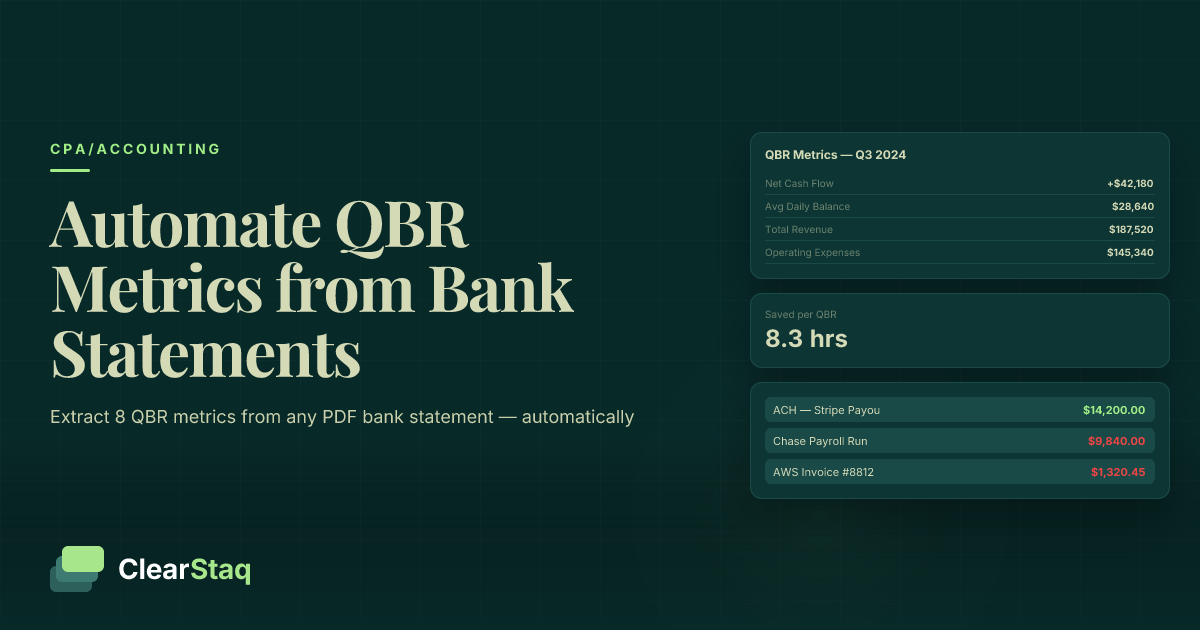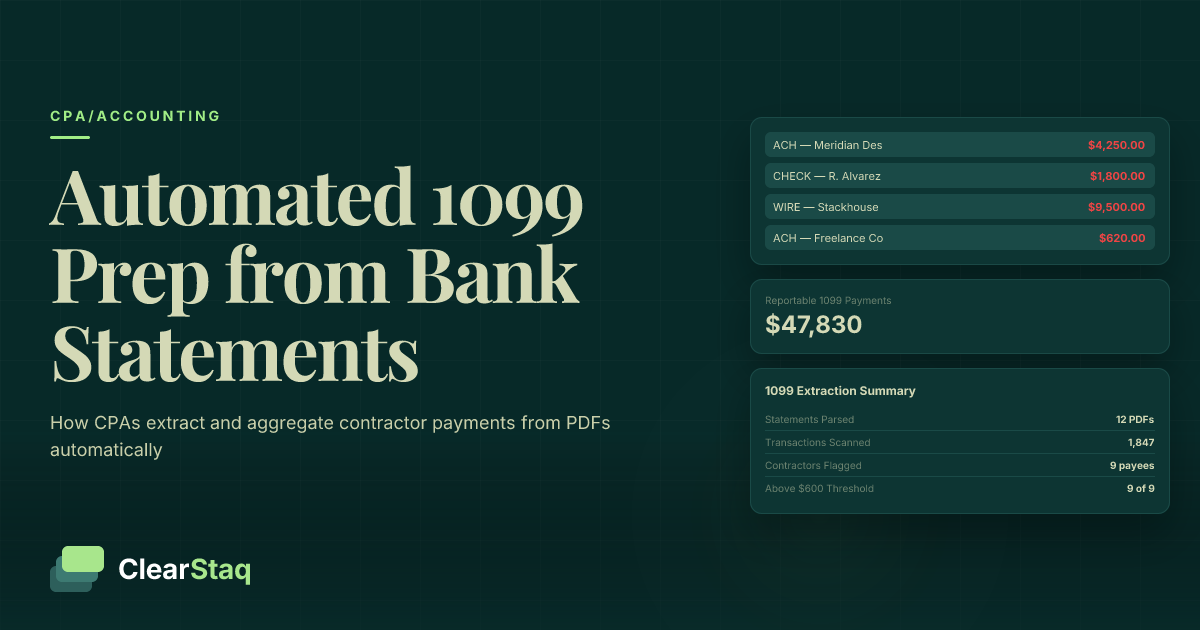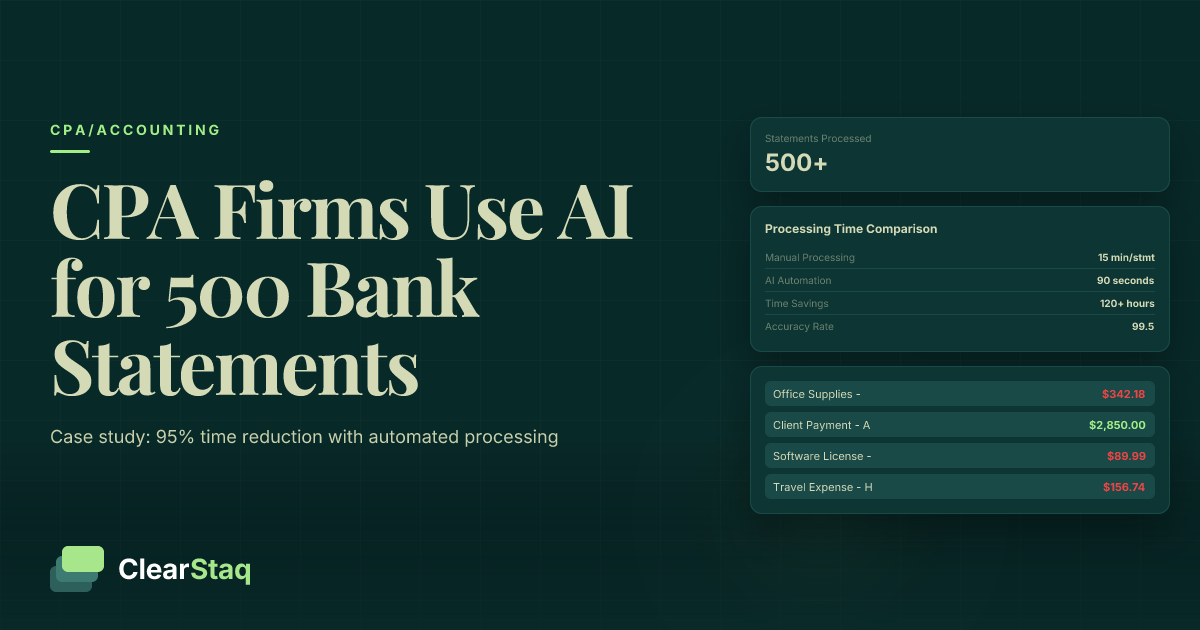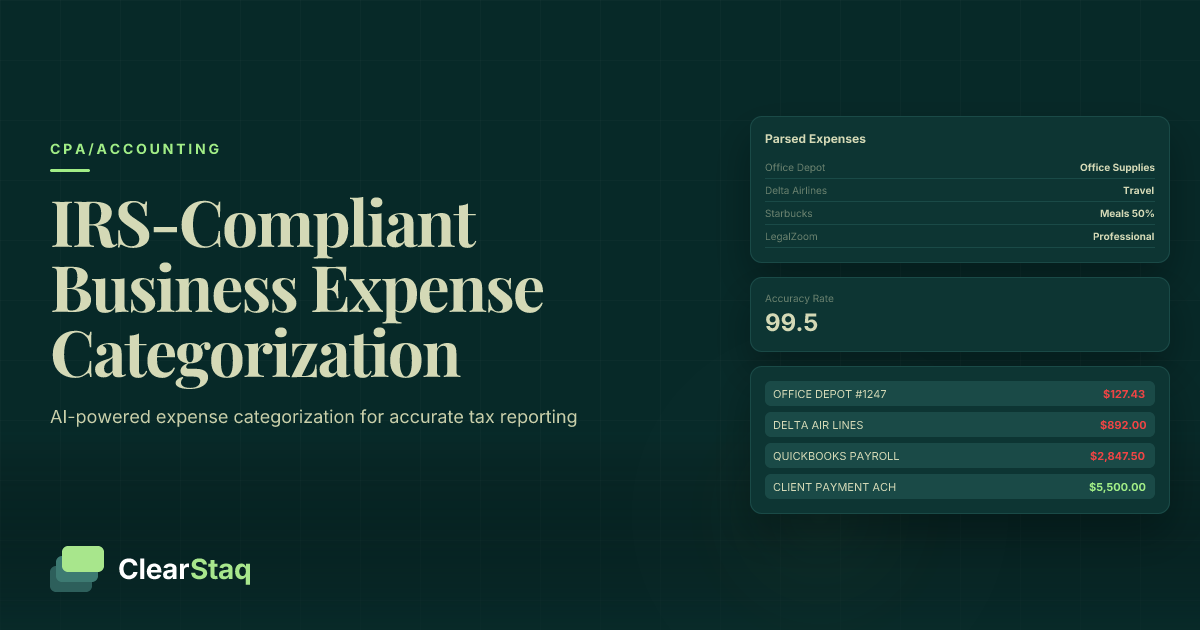
Business expenses from bank statements can be categorized into IRS-compliant categories by parsing transaction data and mapping merchant names, amounts, and descriptions to specific expense types like office supplies, travel, meals, and professional services. Automated tools achieve 99.5% accuracy by analyzing transaction patterns and merchant codes.
What you'll learn
- Manual expense categorization takes 4-6 hours monthly with 15% error rates for most businesses
- Automated AI systems achieve 99.5% categorization accuracy by analyzing merchant patterns and transaction data
- Proper categorization prevents IRS audits and can save businesses $3,500 annually in missed deductions
- The IRS requires expenses to be both 'ordinary' and 'necessary' to qualify for business deductions
- Real-time automated categorization transforms monthly batch processing into continuous financial monitoring
Business expenses from bank statements can be categorized into IRS-compliant categories by parsing transaction data and mapping merchant names, amounts, and descriptions to specific expense types like office supplies, travel, meals, and professional services. Automated tools achieve 99.5% accuracy by analyzing transaction patterns and merchant codes.
Why Proper Expense Categorization Matters
Every business transaction tells a story about your company's financial health. When you categorize expenses correctly from your bank statements, you're not just organizing numbers — you're building a foundation for tax compliance, financial insights, and business growth.
The average small business processes over 200 transactions monthly, and each one needs proper categorization for IRS compliance. Manual categorization takes 4-6 hours per month for most businesses, with error rates reaching 15% when done by hand. These mistakes don't just waste time — they cost money through missed deductions and potential audit penalties.
The Cost of Miscategorized Expenses
Incorrectly categorized expenses trigger three major problems for businesses. First, IRS audit triggers occur when expense patterns don't match industry norms or when categories show suspicious variations. The IRS uses automated systems to flag returns with unusual expense ratios, making proper categorization your first line of audit defense.
Second, businesses lose an average of $3,500 annually in missed tax deductions due to categorization errors. Common losses include home office expenses miscategorized as personal, business meals recorded as general expenses, and equipment purchases that should qualify for Section 179 deductions but get buried in operating expenses.
Third, compliance penalties can reach thousands of dollars. The IRS can disallow improperly documented deductions and impose accuracy-related penalties of 20% on understated taxes. For a business with $50,000 in miscategorized expenses, that's a potential $2,000 penalty plus interest.
Business Benefits Beyond Tax Compliance
Proper expense categorization delivers insights that transform business operations. Cash flow analysis becomes meaningful when expenses are accurately sorted — you can see exactly where money goes and identify opportunities to reduce costs. Businesses using proper categorization report 23% better cash flow visibility.
Budget planning improves dramatically with categorized historical data. You can set realistic budgets based on actual spending patterns, not guesswork. Marketing expenses might average $2,000 monthly, but without proper categorization, you'd never know if campaigns are delivering ROI.
Vendor analysis reveals hidden opportunities. When expenses are properly categorized, you can identify duplicate services, negotiate better rates with high-volume vendors, and consolidate purchases for bulk discounts. One retail client discovered they were paying for three separate inventory management systems after implementing proper categorization.
IRS Business Expense Categories (Complete List)
The IRS recognizes specific expense categories that qualify for business deductions. Each category must pass two tests: expenses must be both ordinary (common in your industry) and necessary (helpful and appropriate for your business). Understanding these categories ensures you maximize deductions while maintaining compliance.
The distinction between capital expenses and operating expenses fundamentally changes how you report costs. Operating expenses are deducted in the year incurred, while capital expenses must be depreciated over multiple years. This difference can significantly impact your current year tax liability.
Operating Expenses
Office supplies include everyday items costing less than $2,500: paper, pens, printer ink, small desk accessories, and basic software subscriptions. The key is these items are consumed within one year. A $50 box of printer paper is an office supply; a $3,000 printer is equipment.
Rent and utilities cover your physical business space costs. This includes monthly rent, electricity, water, internet, phone service, and property insurance. Home-based businesses can deduct the percentage of utilities used for business purposes — if your home office occupies 15% of your home, you can deduct 15% of utilities.
Professional services encompass fees paid to lawyers, accountants, consultants, and contractors. These must be directly related to business operations. A lawyer reviewing your lease agreement is deductible; personal estate planning with the same lawyer isn't.
Marketing and advertising includes all promotional expenses: digital ads, print materials, website development, social media campaigns, and trade show participation. The IRS allows 100% deduction for legitimate advertising expenses that promote your business.
Capital Expenses
Equipment purchases over $2,500 typically require capitalization and depreciation. This includes computers, machinery, vehicles, and specialized tools. However, Section 179 allows immediate deduction of up to $1,160,000 (2024 limit) for qualifying equipment purchases.
Property improvements that extend the useful life or adapt property for new uses must be capitalized. Replacing a roof, adding a room, or installing new HVAC systems are improvements. Fixing a broken window or patching existing flooring are repairs (operating expenses).
Technology investments like enterprise software, custom development projects, and major system upgrades often qualify as capital expenses. The determining factor is whether the technology provides benefits beyond the current tax year.
Travel and Transportation
Business travel includes flights, hotels, rental cars, and 50% of meal expenses during business trips. The trip's primary purpose must be business-related. Extending a business trip for personal vacation doesn't disqualify business expenses, but personal days aren't deductible.
Vehicle expenses offer two deduction methods: actual expenses or standard mileage rate (65.5 cents per mile for 2024). Actual expenses include gas, maintenance, insurance, and depreciation. Most businesses benefit from tracking both methods and choosing the larger deduction.
Local transportation between business locations is fully deductible, but commuting from home to your regular workplace isn't. Trips to meet clients, visit job sites, or attend business events qualify. Document the business purpose for each trip.
Employee-Related Expenses
Wages and salaries paid to employees are fully deductible, including bonuses and commissions. This category represents the largest expense for most businesses. Payments must be reasonable for services performed and properly reported on W-2 forms.
Employee benefits like health insurance, retirement contributions, and life insurance are deductible when offered to all eligible employees. The IRS scrutinizes benefits that disproportionately favor owners or highly compensated employees.
Training and education that maintains or improves employee skills for current positions is deductible. Sending your accountant to tax update seminars qualifies; paying for their MBA generally doesn't unless required for their current role.
How to Categorize Expenses from Bank Statements
Converting bank statement transactions into properly categorized business expenses requires systematic analysis of transaction data. Modern bank statement parsing technology can extract this data automatically, but understanding the manual process helps you implement better automated systems.
Bank statements contain four key data points for categorization: transaction date, merchant name, amount, and description. Each element provides clues about the proper expense category. The challenge lies in interpreting abbreviated merchant names and cryptic transaction codes that banks use.
Manual Categorization Steps
Start by downloading statements in PDF format from your bank's online portal. Most banks provide 18-24 months of historical statements. Download all available months to establish spending patterns and ensure nothing is missed during year-end tax preparation.
Review each transaction line by line, examining the merchant name and amount. Create a spreadsheet with columns for date, merchant, amount, and category. This manual review typically takes 30-45 minutes per monthly statement.
Apply category rules based on merchant type and transaction patterns. "OFFICE DEPOT" clearly maps to office supplies, while "AMAZON" requires checking receipts since it could be supplies, equipment, or inventory. Establish consistent rules for ambiguous merchants.
Document categorization decisions in a reference guide. When you determine that "SQ *COFFEE SHOP" is actually your client meeting location (50% deductible meals), record this mapping for future use. This documentation speeds future categorization and ensures consistency.
6 fields extracted automatically • 99.8% accuracy
Interpreting Transaction Descriptions
Merchant name analysis requires understanding common abbreviations and payment processor codes. "TST* RESTAURANT" indicates a Toast point-of-sale system at a restaurant. "SQ *" prefix means Square payment processing. Learning these patterns improves categorization accuracy.
Transaction codes embedded in descriptions provide category hints. "APL*APPLE.COM/BILL" suggests a recurring software subscription. "RECURRING" flags subscription services. "PMT" often indicates loan or credit payments.
Amount patterns help identify expense types. Regular monthly charges of the same amount typically indicate subscriptions or rent. Variable amounts at the same merchant might be inventory purchases or client entertainment. Round numbers often represent negotiated services or contractor payments.
Handling Multi-Category Transactions
Split transactions occur when one purchase includes multiple expense categories. A Costco run might include office supplies, employee snacks (100% deductible), and client gifts (limited to $25 per person). These require manual allocation based on receipt details.
Mixed-purpose expenses like cell phone bills used for business and personal calls need percentage allocation. Track business usage for one month to establish a reasonable business percentage, then apply consistently. The IRS accepts reasonable estimates backed by documentation.
Documentation requirements increase for split transactions. Keep detailed receipts showing individual items, note the business purpose for each category, and maintain a calculation showing how you split the expense. This documentation prevents audit issues.
Automated vs Manual Categorization Methods
The choice between manual and automated expense categorization impacts your business efficiency, accuracy, and scalability. While manual methods offer complete control, automated bank statement processing tools deliver speed and consistency that manual processes can't match.
Consider this: manually categorizing 200 monthly transactions takes 4-6 hours and yields 85% accuracy on average. Automated systems process the same volume in under 60 seconds with parsing accuracy exceeding 99.5%. The time savings alone justify automation for most businesses.
Manual Categorization Pros and Cons
Complete control represents the primary advantage of manual categorization. You review every transaction, make nuanced decisions, and handle edge cases with human judgment. This control appeals to businesses with unique expense patterns or very low transaction volumes.
However, manual processes are extremely time intensive. A business processing 500 monthly transactions spends 10-15 hours on categorization. This time doubles during tax season when historical corrections and documentation reviews are needed.
Manual categorization is inherently error prone. Fatigue, distractions, and inconsistent rule application lead to mistakes. Studies show error rates increase 40% after the first hour of manual data entry. These errors compound when different team members apply different interpretations.
Most critically, manual processes don't scale. Adding locations, increasing transaction volume, or expanding internationally multiplies categorization time linearly. A business doubling from 200 to 400 monthly transactions doubles categorization time.
Automated Categorization Benefits
Modern AI systems achieve 99.5% categorization accuracy by analyzing patterns across millions of transactions. These systems recognize merchant variations, understand industry-specific patterns, and apply consistent rules regardless of volume.
Real-time processing transforms business operations. Expenses are categorized instantly as bank statements are uploaded, enabling daily financial monitoring instead of monthly batch processing. This immediacy helps identify issues before they become problems.
Consistent rule application eliminates human interpretation variations. Once trained, the system categorizes "AMZN MKTP US*2A3B4C5D6" as office supplies every time based on historical patterns, regardless of who uploads the statement or when.
Scalable architecture handles growth effortlessly. Processing 10,000 transactions takes marginally longer than processing 100. This scalability enables businesses to maintain accurate categorization during rapid growth phases.
Machine Learning Models for Classification
Pattern recognition algorithms analyze merchant names, amounts, timing, and transaction sequences to determine categories. The AI learns that charges from "FEDEX" on Mondays are typically customer shipments (cost of goods sold) while Friday charges are office supply deliveries.
Continuous improvement occurs through feedback loops. When users correct miscategorizations, the system updates its model. After seeing "NOTION.SO" corrected from "Other" to "Software Subscriptions" across multiple businesses, the AI automatically applies this learning.
Custom rule sets allow business-specific overrides while maintaining AI intelligence. You can specify that all "STARBUCKS" transactions are client meetings (50% deductible) while the AI handles standard categorization for other merchants. This hybrid approach combines automation efficiency with business-specific needs.
Industry-Specific Categorization Rules
Different industries face unique expense patterns that require specialized categorization approaches. While IRS categories remain consistent, how expenses map to these categories varies significantly by business type. Understanding your industry's specific needs ensures accurate categorization and maximum deductions.
Restaurant Industry Expenses
Food costs represent 25-35% of restaurant revenue and require detailed categorization. Separate raw ingredients (cost of goods sold) from prepared items for staff meals (employee benefits) and owner consumption (non-deductible). Track spoilage separately for inventory management insights.
Equipment expenses in restaurants follow unique patterns. Small wares under $500 (plates, utensils, cookware) are supplies, while major equipment (ovens, refrigerators) requires capitalization. The constant replacement cycle of restaurant equipment makes Section 179 deductions particularly valuable.
Permits and licenses include health permits, liquor licenses, music licensing (ASCAP/BMI), and sidewalk cafe permits. These operating expenses recur annually but may require amortization if covering multiple years. Track renewal dates to ensure timely deduction.
Professional Services
Client entertainment for lawyers, consultants, and accountants follows strict IRS rules. Meals with clients discussing business are 50% deductible, but entertainment expenses (golf, sports events) are non-deductible since 2018. Document the business purpose and attendees for every client meal.
Professional development includes continuing education, certifications, and industry conferences. CPAs deduct CLE courses, consultants deduct certification programs, and all professionals can deduct industry publication subscriptions. Travel to conferences follows standard business travel rules.
Technology subscriptions for professional services often exceed typical businesses. Legal research platforms, accounting software, project management tools, and client portals are fully deductible. Annual subscriptions paid upfront can be deducted entirely in the payment year for cash-basis taxpayers.
Construction and Trades
Materials purchases require careful categorization between inventory (job-specific materials) and supplies (consumables like nails, caulk, tape). Job materials are cost of goods sold, deducted when the job is billed. Supplies are deducted when purchased.
Equipment rentals versus purchases present strategic decisions. Renting equipment is immediately deductible, while purchases may require depreciation. Many contractors rent specialized equipment for specific jobs while owning frequently-used tools.
Subcontractor payments must be tracked separately from employee wages. Subcontractors receiving over $600 annually require 1099 forms. Categorize these as contract labor, not wages, to avoid payroll tax confusion. Maintain W-9 forms for all subcontractors.
How ClearStaq Automates Expense Categorization
ClearStaq transforms expense categorization from a manual chore into an automated workflow. The platform's AI analyzes bank statement transactions in real-time, applying machine learning models trained on millions of business expenses to achieve 99.5% categorization accuracy.
API-Based Categorization Workflow
The process begins when you upload bank statements through the ClearStaq API or web interface. The system accepts PDFs from over 900 banks, including encrypted statements that other tools can't process. Upload happens in seconds, regardless of statement size.
Automatic parsing extracts every transaction with its date, amount, merchant name, and description. ClearStaq's parsing engine handles complex statement formats, multi-column layouts, and even handwritten annotations without confusion.
AI categorization applies immediately after parsing. The system analyzes merchant patterns, transaction amounts, and timing to assign IRS-compliant categories. Unlike rule-based systems, ClearStaq's AI understands context — it knows that "DELTA AIRLINES" is travel expense while "DELTA DENTAL" is employee benefits.
Results export seamlessly to accounting software in formats compatible with QuickBooks, Xero, and other platforms. Transactions arrive pre-categorized, eliminating hours of manual data entry. The export includes confidence scores for each categorization, flagging any transactions requiring human review.
{
  "status": "success",
  "fraud_score": 57,
  "transactions": 47,
  "bank": "Chase",
  "processing_time_ms": 238
}Integration with QuickBooks and Xero
Direct sync eliminates the traditional export-import cycle. Once connected, ClearStaq pushes categorized transactions directly into your accounting software. This real-time sync means your books stay current without manual intervention.
Category mapping aligns ClearStaq's AI categories with your existing QuickBooks or Xero chart of accounts. During setup, map each IRS category to your specific account structure. The system remembers these mappings, ensuring consistent categorization that matches your accounting preferences.
Automated reconciliation matches imported transactions with existing entries, preventing duplicates. When you've already entered some transactions manually, ClearStaq identifies matches and skips them. This intelligence allows gradual automation adoption without disrupting existing workflows. Learn more about importing bank statements into QuickBooks with proper categorization.
Custom Rules and Machine Learning
Business-specific patterns get recognized through ClearStaq's adaptive learning. If your business categorizes all coffee shop purchases as client meetings rather than meals, the system learns this preference. After a few corrections, it automatically applies your custom categorization.
Learning from corrections continuously improves accuracy. When you change a category, ClearStaq's AI analyzes why — was it the merchant, amount, or timing that led to miscategorization? This analysis updates the model for future transactions.
Continuous improvement means categorization gets more accurate over time. ClearStaq's models update weekly based on aggregated learning across all users (while maintaining complete data privacy). New merchant patterns and emerging expense types get recognized automatically.
Common Categorization Mistakes to Avoid
Even experienced business owners make categorization errors that trigger audits, reduce deductions, or violate IRS rules. Understanding these common mistakes helps you build better processes — whether manual or automated — that maintain compliance while maximizing legitimate deductions.
Personal vs Business Expense Mix-ups
Home office expenses create the most confusion. The IRS requires exclusive business use for home office deductions. Your dining room table used for evening paperwork doesn't qualify, but a dedicated room or clearly defined workspace does. Calculate the percentage of your home used exclusively for business, then apply that percentage to mortgage interest, utilities, and maintenance.
Vehicle usage mistakes cost thousands in lost deductions. Many business owners deduct all vehicle expenses without tracking business mileage. The IRS requires contemporary mileage logs showing date, destination, purpose, and miles for each trip. Personal commuting never qualifies, even if you make business calls while driving.
Meal categorization errors occur when businesses deduct 100% of restaurant expenses. Only employee meals are fully deductible — client meals and business travel meals are limited to 50%. That weekly team lunch is 100% deductible, but dinner with a prospective client is only 50% deductible.
Capital vs Operating Expense Confusion
Equipment threshold rules changed significantly with recent tax updates. Items costing less than $2,500 can be expensed immediately if you have an applicable financial statement, or $500 without one. Many businesses still capitalize $1,000 computers unnecessarily, missing immediate deductions.
Improvement versus repair distinctions affect deduction timing. Fixing a broken HVAC system is a repair (immediate deduction). Replacing the entire system is an improvement (capitalized). The key question: does the expense maintain existing function or add new capabilities?
Depreciation implications multiply the impact of miscategorization. Incorrectly expensing a $10,000 equipment purchase might trigger an audit, while improperly capitalizing office supplies delays legitimate deductions for years. When in doubt, consult your tax advisor for items near threshold amounts.
Documentation Requirements
Receipt retention rules vary by expense type and amount. The IRS requires receipts for all expenses over $75, but best practice keeps receipts for everything. Digital copies are acceptable if they show merchant, date, amount, and business purpose. Credit card statements alone don't suffice for most business deductions.
Business purpose notes transform receipts into audit-proof documentation. Write or digitally note who attended that client dinner, what you discussed, and how it relates to business. For travel, document the business reason for the trip. These contemporaneous notes carry more weight than reconstructed explanations years later.
Audit-ready records require organization beyond simple receipt keeping. Maintain expense reports linking receipts to bank statement transactions and category assignments. Digital systems excel here — they can automatically match receipts to transactions and store everything in searchable formats.
Best Practices for Ongoing Expense Management
Successful expense categorization isn't a one-time task — it requires consistent processes that evolve with your business. Implementing these best practices ensures accurate books, maximum deductions, and audit-ready documentation throughout the year.
Monthly Review Workflows
Automated alerts flag unusual expenses before they become problems. Set up notifications for transactions exceeding normal amounts, new merchant categories, or expense ratios outside your typical range. These early warnings prevent month-end surprises and catch fraud attempts.
Exception handling processes streamline reviews. Focus human attention on flagged transactions while trusting automated categorization for routine expenses. ClearStaq highlights low-confidence categorizations, split transaction candidates, and amounts requiring receipt documentation.
Correction processes should be simple and educational. When correcting a miscategorized expense, document why the change was needed. This documentation trains both human reviewers and AI systems, improving future accuracy. Batch similar corrections to identify systematic issues.
Quality Control Measures
Spot checking maintains categorization accuracy without reviewing every transaction. Randomly sample 5-10% of monthly transactions for detailed review. Compare categorization against receipts and business purpose. This sampling catches systematic errors before they affect tax filings.
Variance analysis identifies categorization drift. Compare expense category percentages month-over-month and against industry benchmarks. If office supplies jump from 2% to 8% of revenue, investigate whether expenses are miscategorized or spending is actually increasing.
Training staff on categorization rules ensures consistency across your team. Document your business-specific rules, share IRS guidelines, and review common mistakes quarterly. When multiple people handle expenses, consistent training prevents conflicting categorizations.
Year-End Tax Preparation
Category summaries compiled throughout the year simplify tax preparation. Regular categorization means year-end becomes a review process, not a reconstruction project. Export category totals monthly, allowing quick identification of unusual patterns or missing expenses.
Supporting documentation should be organized by category and date. Digital filing systems excel here — tag receipts with their expense category for instant retrieval. When your CPA requests documentation for professional services expenses, you can provide a complete package in minutes.
Deduction maximization requires proactive planning, not year-end scrambling. Review expenses quarterly to identify additional deduction opportunities. Are you tracking all business mileage? Have you documented home office expenses? Could equipment purchases benefit from Section 179 treatment? Regular reviews ensure nothing is missed.
For comprehensive expense management, consider leveraging CPA solutions that automate categorization while maintaining the control and accuracy your business requires.
Frequently Asked Questions
What are the main IRS business expense categories?
The IRS recognizes several main categories: office expenses, travel and transportation, meals and entertainment, professional services, advertising and marketing, equipment and supplies, utilities, rent, and employee-related expenses. Each must pass the 'ordinary and necessary' test for business deductibility.
How do you categorize expenses directly from bank statements?
Review each transaction's merchant name, description, and amount to determine the business purpose. Match transactions to appropriate IRS categories based on the vendor and expense type. For unclear transactions, refer to receipts or business records for proper categorization.
How can AI automate business expense categorization?
AI analyzes transaction patterns, merchant names, and historical categorization data to automatically assign expenses to appropriate categories. Machine learning models achieve 99.5% accuracy by recognizing vendor patterns and learning from user corrections.
What are the most commonly miscategorized business expenses?
Common mistakes include mixing personal and business expenses, incorrectly categorizing meals and entertainment, confusing capital versus operating expenses, and improper classification of home office expenses. These errors can trigger IRS audits and reduce available deductions.
How often should you review and update expense categories?
Review expense categorization monthly to catch errors early and maintain accuracy. Perform comprehensive reviews quarterly and annually before tax filing. Update categorization rules when business operations change or new expense types emerge.
Ready to Automate Your Expense Categorization?
Try ClearStaq's AI-powered solution free for 14 days and see how it categorizes your business expenses with 99.5% accuracy.
Stop Spending Hours Manually Categorizing Expenses
ClearStaq's automated expense categorization saves time, improves accuracy, and ensures IRS compliance from day one.
Frequently Asked Questions
What are the main IRS business expense categories?
The IRS recognizes several main categories: office expenses, travel and transportation, meals and entertainment, professional services, advertising and marketing, equipment and supplies, utilities, rent, and employee-related expenses. Each must pass the 'ordinary and necessary' test for business deductibility.
How do you categorize expenses directly from bank statements?
Review each transaction's merchant name, description, and amount to determine the business purpose. Match transactions to appropriate IRS categories based on the vendor and expense type. For unclear transactions, refer to receipts or business records for proper categorization.
How can AI automate business expense categorization?
AI analyzes transaction patterns, merchant names, and historical categorization data to automatically assign expenses to appropriate categories. Machine learning models achieve 99.5% accuracy by recognizing vendor patterns and learning from user corrections.
What are the most commonly miscategorized business expenses?
Common mistakes include mixing personal and business expenses, incorrectly categorizing meals and entertainment, confusing capital versus operating expenses, and improper classification of home office expenses. These errors can trigger IRS audits and reduce available deductions.
How often should you review and update expense categories?
Review expense categorization monthly to catch errors early and maintain accuracy. Perform comprehensive reviews quarterly and annually before tax filing. Update categorization rules when business operations change or new expense types emerge.
ClearStaq Team
Product Team
The ClearStaq team builds AI-powered tools for bank statement parsing, fraud detection, and income verification.