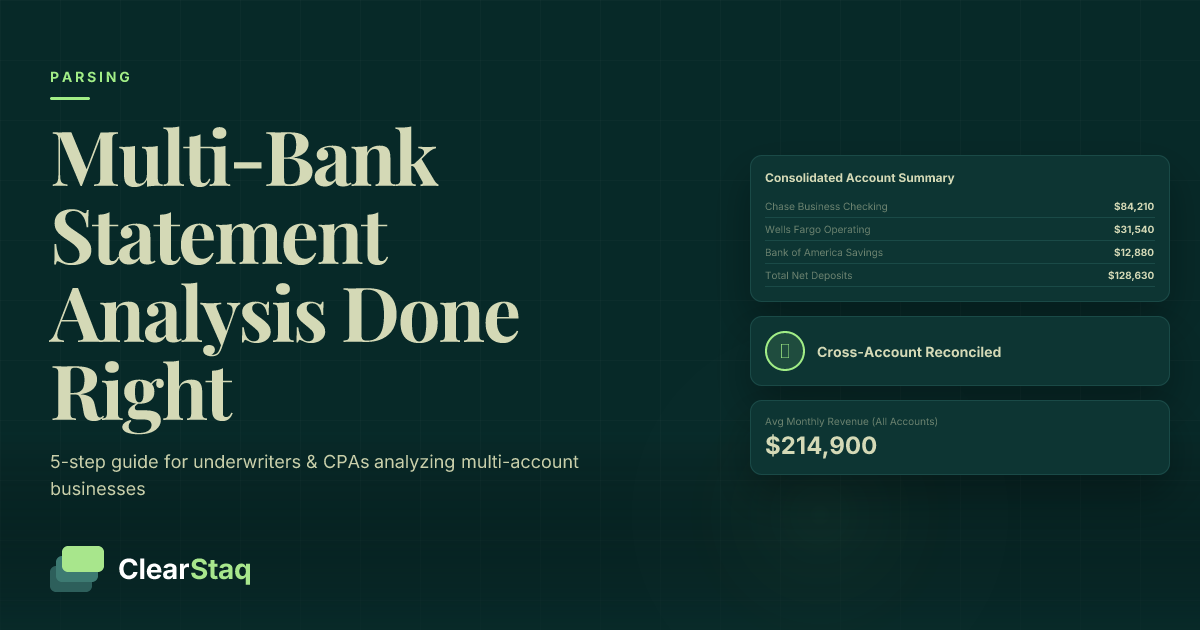
Multi-bank statement analysis is the process of collecting statements from all of a business's bank accounts, segmenting them by account purpose, eliminating inter-account transfers to prevent double-counting, and producing a single consolidated cash flow view. Accurate multi-account analysis requires date normalization across institutions, timing-mismatch handling, and cross-account fraud signal detection — steps that manual review routinely misses.
What you'll learn
- Inter-account transfer removal is the most critical step in multi-bank consolidation — failing to strip transfers inflates gross revenue figures by counting the same funds twice
- Account purpose segmentation must happen before aggregation — payroll, reserve, and merchant accounts each require different treatment in ADB and net deposit calculations
- Timing mismatches across institutions require a three-business-day matching window to correctly identify transfer pairs that span month boundaries
- Multi-account fraud signals — including circular transfer schemes, account proliferation, and loan stacking concealment — are invisible in single-account review
- Manual consolidation is viable for two to three accounts but breaks down at four or more accounts, where automated API-based tools become the only scalable path
Multi-bank statement analysis is the process of collecting statements from all of a business's bank accounts, segmenting them by account purpose, eliminating inter-account transfers to prevent double-counting, and producing a single consolidated cash flow view. Accurate multi-account analysis requires date normalization across institutions, timing-mismatch handling, and cross-account fraud signal detection — steps that manual review routinely misses.
What Is Multi-Bank Statement Analysis?
Multi-bank statement analysis is the process of aggregating, deduplicating, and consolidating financial data across two or more business bank accounts held at different institutions. The goal is a single, accurate picture of business cash flow — one that reflects all revenue, all expenses, and all liabilities, regardless of how many accounts or banks are involved.
The audience for this work is wide. MCA underwriters, SBA lenders, commercial loan officers, and CPAs preparing monthly or quarterly reports all depend on complete multi-account data. A single-account view captures only a partial picture, and partial pictures produce bad decisions.
For a companion overview of how consolidated views are structured, see our guide on building a unified cash flow view across multiple accounts.
This post walks through a five-step methodology for accurate multi-bank statement analysis, covers the fraud signals that only emerge when you look across all accounts simultaneously, and explains when automated tools are the only viable path.
Why Businesses Have Multiple Bank Accounts
Businesses don't maintain multiple accounts by accident. There are real structural reasons — and understanding them helps analysts interpret account patterns correctly.
- FDIC insurance limits: The FDIC insures deposits up to $250,000 per depositor per institution. Cash-rich SMBs spread balances across institutions to maximize federal protection.
- Operational segregation: Payroll, tax reserves, merchant processing, and day-to-day expenses are often kept in separate accounts for accounting clarity and internal controls.
- Relationship banking: Businesses maintain accounts at multiple institutions to preserve access to credit lines and negotiate better terms.
- Acquisition history: Merged or acquired entities frequently retain legacy accounts at their original institutions long after the deal closes.
Most businesses seeking MCA or SBA funding maintain three to ten or more accounts across multiple institutions. Analyzing only one of them isn't just incomplete — it's misleading.
How Multi-Account Analysis Differs by Use Case
The consolidation methodology is consistent, but the weighting priorities shift depending on who's doing the analysis.
| Use Case | Statement Period Required | Primary Focus | Account Weighting Priority |
|---|---|---|---|
| MCA Underwriting | 3 months minimum | Net deposits, NSF frequency, revenue consistency | Primary operating account weighted most heavily |
| SBA Lending | 6–12 months | DSCR calculation, full expense visibility | All accounts required; DSCR uses aggregate figures |
| CPA / Bookkeeping | 12 months (annual) | Tax prep, P&L, QBR reporting | Full expense visibility across all accounts |
Underwriters weight the primary operating account most heavily. CPAs need full expense visibility across every account. Both need the same foundational consolidation work — they just use the output differently.
Why Single-Account Analysis Creates Dangerous Blind Spots
Consider a concrete example. A business deposits $80,000 per month into its primary operating account. It also routes $40,000 per month in Stripe settlements into a separate merchant processing account. A lender who reviews only the primary account sees $80,000 in monthly revenue — and underestimates the business's true income by 33%.
The inverse error is equally costly. A lender who collects both accounts but doesn't strip out inter-account transfers will count the same funds twice — once as an outflow from the operating account and again as an inflow to the payroll account. That $20,000 monthly payroll transfer becomes $20,000 in phantom revenue.
Large SMBs with five, eight, or ten accounts are entirely misrepresented by single-account review. Most competitors design their workflows around two or three accounts. This post addresses the full range.
The Double-Counting Trap
Inter-account transfers appear in two places: as an outflow in the sending account and as an inflow in the receiving account. Without stripping these transfers, gross deposit totals are artificially inflated.
Example: a business transfers $20,000 each month from its operating account to its payroll account. A naive aggregation of both accounts shows $20,000 in additional monthly "revenue" that doesn't exist. Multiply that across five accounts and the distortion becomes severe.
This is the single most common error in manual multi-account consolidation. For a technical walkthrough of how to identify and flag these transactions, see our guide on duplicate transaction detection.
The Hidden Revenue Problem
The opposite error is just as damaging: requiring only the primary account misses legitimate revenue flowing into secondary accounts. E-commerce businesses routinely route Stripe or PayPal settlements into a separate deposit account. Restaurant groups route POS settlements into a merchant account that never touches the primary operating account.
Lenders who miss this revenue stream don't just make an analytical error — they systematically underfund qualified applicants. The business looks weaker than it is, and the underwriter makes a decision based on incomplete data.
Step 1 — Collect and Catalog All Accounts
Before any analysis begins, you need a complete account set. Require the applicant to disclose all business bank accounts — not just the primary — and document that requirement in writing.
Statement period requirements vary by use case. For MCA underwriting, a minimum of three months is standard. SBA and commercial loans typically require six months. CPA annual reporting needs twelve months. Don't start consolidation until you have the full required period for every disclosed account.
Build an account catalog before you touch a single transaction. It should include: institution name, account number (last four digits), account type, statement period covered, and the primary contact at the business responsible for that account. This catalog becomes the reference point for every subsequent step.
Verifying Account Completeness
Applicants don't always disclose every account voluntarily. Scan each submitted statement for outbound ACH or wire transfers to unrecognized routing numbers. These may indicate undisclosed accounts at other institutions.
- Compare total outbound transfers against the disclosed account list. Unexplained outflows to unnamed accounts are a disclosure red flag.
- Request business tax returns or Schedule C to cross-check the number of accounts reported to the IRS.
- Document any gaps or discrepancies before proceeding to aggregation.
An applicant who discloses three accounts but routes consistent ACH transfers to a fourth unrecognized routing number has an undisclosed account. That's worth a conversation before you finalize any consolidated figures.
What to Do When Statements Have Mismatched Date Ranges
Identify the overlapping date range across all submitted statements before you start. Analysis should only cover the common period — extrapolating from incomplete periods produces unreliable metrics.
Flag accounts where the submitted period is shorter than required and request supplemental statements. Don't annualize data from incomplete periods without explicitly noting the limitation in the final report. For automated tools, date range normalization should happen programmatically at intake — not manually after aggregation is complete.
Step 2 — Segment Accounts by Purpose Before You Aggregate
Account purpose segmentation is the step most analysts skip — and the most consequential one to get right. Aggregating all account types equally produces misleading metrics. A payroll account's large outflows are not operating expenses. A reserve account's balance shouldn't be folded into the average daily balance figure without qualification.
There are four primary account types in business banking consolidation, and each requires different treatment in the analysis.
Account Type Taxonomy and Analysis Implications
- Operating account: The source of truth for revenue, expenses, and net cash flow. This account carries full weight in all ADB and net deposit calculations.
- Payroll/disbursement account: Funded by transfers from the operating account. Include outflows in expense analysis, but exclude inbound transfers from the operating account to avoid double-counting. These funds were already counted as operating account outflows.
- Reserve/savings account: Balance is relevant for liquidity assessment, but deposit activity may not represent revenue. Report separately — don't fold into operating ADB.
- Merchant processing account: Settlement deposits are legitimate revenue. Include in net deposit calculations but tag separately for revenue source analysis.
- Loan/credit line accounts: Exclude from cash flow analysis entirely unless repayments are relevant to DSCR.
How to Identify Account Purpose From Transaction Data
You don't always get a clear label from the applicant. Transaction patterns tell the story.
Operating accounts show mixed inflows from customers, vendors, and POS systems alongside mixed outflows for rent, utilities, and supplies. Payroll accounts show large, regular outflows on consistent payroll dates, funded by periodic transfers from the operating account. Reserve accounts have minimal transaction activity — occasional large transfers in, low or no recurring outflows. Merchant accounts show deposits sourced from payment processors (Stripe, Square, PayPal) with outflows primarily moving to the operating account.
Automated tools can classify account purpose directly from transaction pattern analysis, eliminating the manual categorization step entirely.
See Multi-Account Consolidation in Action
ClearStaq automatically segments accounts by purpose, strips inter-account transfers, and returns a unified consolidated cash flow view from multiple PDFs in a single API call. Start your free trial — no credit card required.
Step 3 — Identify and Strip Out Inter-Account Transfers
Inter-account transfer removal is the most technically demanding step in multi-bank consolidation — and the one most prone to manual error. The matching criteria are straightforward in principle: same dollar amount, within a two-business-day window, originating from one disclosed account and landing in another.
In practice, it's messier. For a detailed technical walkthrough of the deduplication logic, see our guide on duplicate transaction detection.
As a practical threshold: flag any transfer pair where same-amount transactions appear across two accounts within three business days as a candidate for deduplication review. Large outflows with no corresponding inflow in a disclosed account may indicate an undisclosed account — flag those for manual review before finalizing consolidated figures.
Manual Matching Methodology
- Build a chronological ledger of all ACH and wire transactions across all accounts.
- Sort by amount; group same-amount transactions within a three-business-day window.
- For each matched pair — an outflow in Account A and an inflow in Account B of the same amount — mark both as inter-account transfers and exclude from the net deposit calculation.
- Document every matched pair in the consolidation audit trail.
- Escalate unmatched large outflows for review before finalizing consolidated figures.
Handling Timing Mismatches Across Institutions
ACH settlement typically takes one to two business days. Wire transfers settle same-day but may post end-of-day. This creates a specific problem: a transfer from Chase initiated on January 31 may appear as an inflow in Bank of America on February 1. Comparing same-date transactions across both statements leaves this pair unmatched.
Expand the matching window to three business days to capture settlement delays. For month-end transactions, extend the window across the month boundary. January and February cannot be treated as isolated buckets when matching transfers that span the turn of the month.
This timing mismatch problem is unaddressed by every major competitor in the SERP. It's a critical practical issue for any analyst working manually — and it's exactly the kind of edge case that causes consolidated figures to be wrong without the analyst knowing why.
Step 4 — Normalize Dates, Formats, and Currencies Across Institutions
Different banks format dates differently. Chase might use MM/DD/YYYY. A regional bank might use DD/MM/YYYY. Another uses YYYY-MM-DD in exported CSV. Before any cross-account analysis, all dates must be normalized to a single format.
Transaction descriptions are equally inconsistent. The same ACH payee might appear as "ACME CORP ACH 123456" in Chase and "ACM CORP PAYMT" in Wells Fargo. Accurate payee consolidation across institutions requires normalization or fuzzy matching — you can't rely on string matching alone. For a detailed breakdown of how format quirks vary by institution, see our analysis of format differences across major bank statement types.
For businesses with foreign currency accounts — less common but present in import/export businesses banking at US institutions — convert to USD at period-average exchange rates and document the methodology in the report. Then trim all accounts to the common overlapping date range identified in Step 1 before calculating any metrics.
There are 900+ bank format variations across US institutions. Manual normalization is not scalable beyond three or four accounts.
Building the Master Transaction Ledger
After normalization, combine all non-transfer transactions from all accounts into a single chronological ledger. Tag each transaction with:
- Source account identifier
- Account purpose category (operating, payroll, reserve, merchant)
- Transaction type (deposit, withdrawal, fee, transfer)
- Normalized date
The master ledger is the foundation for every subsequent metric calculation. Any error here propagates through the entire analysis. For manual workflows, a spreadsheet with one row per transaction is the minimum viable structure. For automated workflows, this is the structured JSON output that a parsing API returns.
Step 5 — Build the Consolidated Cash Flow View and Calculate Key Metrics
With inter-account transfers stripped and all transactions normalized, the consolidated cash flow view can be built. The output should include both a per-account breakdown and a consolidated total — underwriters need the aggregate view and the ability to drill into individual accounts.
Combined Average Daily Balance: The Right Calculation
The average daily balance calculation across multiple accounts requires careful account-type handling. Don't simply average all accounts together.
- Operating account ADB carries full weight in the consolidated figure.
- Merchant account ADB is included — merchant settlements are legitimate operating funds.
- Reserve account balances are reported separately as a liquidity reserve, not folded into operating ADB. Doing so overstates accessible working capital.
- Payroll account ADB is excluded from consolidated operating ADB — those funds were already captured as operating account outflows.
Sum the daily ending balances across operating and merchant accounts for each day; divide by the number of days in the period. That is the consolidated operating ADB.
What the Final Consolidated Report Should Include
A complete consolidated report contains six core components:
- Month-by-month net deposit table — rows are months, columns are accounts plus a consolidated total
- Combined ADB by month with per-account breakdown
- NSF/overdraft count and frequency across all accounts — not just the primary
- Top 10 deposit sources consolidated across all accounts (payee/counterparty analysis)
- Inter-account transfer log — full audit trail of all matched pairs excluded from net deposit calculations
- Data quality confidence score per account — flagging accounts with incomplete periods or low parsing confidence
Once consolidation is complete, the MCA underwriting checklist provides the complementary framework for translating these consolidated metrics into a credit decision.
Fraud Signals That Only Appear in Multi-Account Analysis
Some fraud patterns are invisible in single-account review. They only become visible when all accounts are analyzed together. Multi-account fraud signals fall into three categories: account proliferation, circular transfer schemes, and loan stacking concealment.
Account Proliferation: When Too Many Accounts Is a Red Flag
Legitimate reasons for multiple accounts exist — FDIC coverage limits, operational segregation, relationship banking. But six or more accounts across four or more institutions with overlapping purposes warrants scrutiny.
Specific red flags to look for:
- Multiple accounts at the same institution with similar transaction patterns — suggests accounts were opened specifically to fragment revenue appearance
- New accounts opened within 90 days of the loan application, especially with limited transaction history
- Account count that doesn't match business complexity — a sole proprietor with seven bank accounts across five institutions is anomalous
The question to ask is simple: do the account purposes justify the account count?
Circular Transfers and Revenue Inflation via Interbank Cycling
A circular transfer scheme works like this: funds move from Account A → Account B → Account C → Account A in a loop. Each leg of the loop appears as a deposit in the receiving account. Gross deposit totals across all accounts are inflated — sometimes dramatically — while true external revenue stays flat.
Detection rule: flag any transfer pair where the same dollar amount appears as an outflow in Account A and an inflow in Account B, and also appears as an outflow in Account B and an inflow in Account A within the same 30-day period.
Round-number interbank transfers are a key signal. Legitimate operational transfers are rarely round numbers. A $50,000.00 transfer cycling between two accounts every month is suspicious. A business that deposits $30,000 into Account A, transfers $25,000 to Account B, then transfers $20,000 back to Account A shows $50,000 in gross deposits across both accounts — when true external revenue is $30,000.
For the complete technical playbook on identifying these patterns, see our guide on circular transaction detection.
Multi-Account Loan Stacking Concealment
MCA repayments — daily ACH debits from a factor — are sometimes spread across multiple accounts to hide the total debt service load from new lenders reviewing only one account. An applicant may show clean cash flow in the primary account while a secondary account carries three active MCA repayments.
When consolidating, sum all recurring ACH debits matching MCA repayment patterns across all accounts. The combined debt service load is what matters for underwriting — not the load on any single account.
Cross-account NSF analysis adds another layer: NSFs occurring only in secondary accounts (never in the primary) may indicate the applicant selectively submitted the cleanest account in a previous review. For more on identifying these patterns, see our resource on loan stacking detection.
Manual vs. Automated Consolidation: When Each Approach Makes Sense
Manual consolidation is viable for two to three accounts from major institutions with overlapping date ranges and a skilled analyst. Budget three to six hours per application. Beyond that, the approach breaks down.
At $50–75 per hour in analyst time, a four-account manual consolidation costs $200–450 per application. Automated API-based tools process the same document set in under 60 seconds. For high-volume teams, the math is straightforward — for more on the full cost picture, see the hidden cost of manual bank statement review.
The Manual Consolidation Workflow at a Glance
For teams where manual consolidation is still the right fit, the workflow looks like this:
- Collect all statements and catalog accounts
- Export each statement to CSV
- Normalize dates and transaction descriptions in a spreadsheet
- Build a master transaction ledger with account tags
- Flag and remove inter-account transfers using the three-business-day matching window
- Calculate net deposits, ADB, and NSF counts from the cleaned ledger
Primary failure points: inconsistent date formats from different banks, overlooked transfers due to timing mismatches, and analyst fatigue on high-account-count applications. This workflow is best suited for analysts reviewing fewer than five applications per day with three or fewer accounts per application.
When to Move to an Automated Solution
Four triggers indicate it's time to automate:
- Volume trigger: More than ten applications per day makes manual consolidation a bottleneck.
- Complexity trigger: Applications regularly featuring four or more accounts, or accounts from regional banks with non-standard PDF formats.
- Fraud risk trigger: Any underwriting program where document authenticity can't be verified manually — automated tools add PDF metadata and pixel-level analysis that human review can't replicate.
- CPA scale trigger: Firms with 50+ business clients needing monthly multi-account reconciliation reports can't staff their way through tax season with manual processes.
How ClearStaq Handles Multi-Bank Statement Consolidation via API
ClearStaq's bank statement parsing platform accepts multiple PDF bank statements — across 900+ formats — in a single API session and returns a unified, deduplicated transaction dataset in structured JSON.
The API Request Structure for Multi-Account Submissions
A single POST request accepts an array of document objects. Each object contains the PDF file, the institution name, and an optional account label. No pre-configuration per institution is required — ClearStaq auto-detects the bank format from the document structure.
The session_id parameter links all submitted documents to a single applicant consolidation session, enabling deduplication and cross-account analysis across the full document set. Inter-account transfer detection happens automatically — the API identifies matched transfer pairs and excludes them from net deposit calculations without any manual intervention. For developers ready to implement this, see our documentation on getting started with the ClearStaq API.
Account purpose classification is built into the parsing output. Each account is tagged as operating, payroll, reserve, or merchant based on transaction pattern analysis. Cross-account fraud signals — circular transfer detection, round-number interbank cycling scoring, and account proliferation flags — are returned alongside the consolidated cash flow data.
Output: What the Consolidated JSON Response Contains
The response structure is designed for direct ingestion into loan origination systems, CRM platforms, and CPA practice management tools:
- accounts[] — Array of per-account objects with parsed transactions, ADB, net deposits, NSF count, and confidence scores in parsed bank statement data
- consolidated_metrics{} — Combined ADB, combined net monthly deposits by month, combined NSF frequency, and revenue trend
- transfer_pairs[] — Log of all identified inter-account transfers with matched account IDs, amounts, and dates
- fraud_signals{} — Account proliferation score, circular transfer detections, round-number cycling flags, and overall multi-account risk score
Analysts know exactly which accounts have clean, high-confidence data and which require manual review before the consolidated figures are finalized.
Frequently Asked Questions
How do you analyze bank statements from multiple accounts accurately?
Accurate multi-bank statement analysis requires five steps: collecting and cataloging all accounts, segmenting them by purpose, removing inter-account transfers using a three-business-day matching window, normalizing dates and formats across institutions, and calculating consolidated metrics from the cleaned ledger. Skipping the transfer removal or segmentation step produces inflated or misleading cash flow figures.
What is the biggest risk when consolidating multiple bank statements?
The biggest risk is double-counting inter-account transfers. When funds move from an operating account to a payroll account, that same amount appears as both an outflow and an inflow. Without stripping these transfers before calculating net deposits, gross revenue figures can be significantly inflated — sometimes by tens of thousands of dollars per month.
How do lenders handle businesses with multiple bank accounts?
Most lenders require disclosure of all business bank accounts, then consolidate the statements to produce a single net cash flow view. The consolidation process involves removing inter-account transfers, segmenting accounts by purpose, and calculating combined metrics like total net monthly deposits and average daily balance across operating and merchant accounts.
Can AI or API tools automatically consolidate bank statements from different banks?
Yes. Modern parsing APIs can ingest multiple PDFs from different institutions in a single session, auto-detect each bank's format, strip inter-account transfers algorithmically, and return a unified JSON dataset with consolidated metrics. This reduces a three-to-six-hour manual process to seconds and eliminates the timing-mismatch errors that manual consolidation frequently misses.
What is account proliferation, and why does it matter for underwriting?
Account proliferation is the pattern of a business maintaining an unusually high number of accounts — typically six or more across four or more institutions — relative to its size and complexity. While multiple accounts can be legitimate, proliferation can also signal intent to fragment revenue appearance or obscure existing debt service loads from new lenders. Any business with overlapping account purposes and more accounts than its operational complexity justifies warrants additional review.
Ready to Automate Multi-Bank Statement Consolidation?
Stop spending hours manually matching transfers and normalizing date formats. ClearStaq processes statements from 900+ bank formats in a single API call — returning a deduplicated, consolidated cash flow view with fraud signals included. Start your free trial today.
Frequently Asked Questions
How do you analyze bank statements from multiple accounts accurately?
Accurate multi-bank statement analysis requires five steps: collecting and cataloging all accounts, segmenting them by purpose, removing inter-account transfers using a three-business-day matching window, normalizing dates and formats across institutions, and calculating consolidated metrics from the cleaned ledger. Skipping the transfer removal or segmentation step produces inflated or misleading cash flow figures.
What is the biggest risk when consolidating multiple bank statements?
The biggest risk is double-counting inter-account transfers. When funds move from an operating account to a payroll account, that same amount appears as both an outflow and an inflow — without stripping these transfers before calculating net deposits, gross revenue figures can be significantly inflated, sometimes by tens of thousands of dollars per month.
How do lenders handle businesses with multiple bank accounts?
Most lenders require disclosure of all business bank accounts, then consolidate the statements to produce a single net cash flow view. The consolidation process involves removing inter-account transfers, segmenting accounts by purpose, and calculating combined metrics like total net monthly deposits and average daily balance across operating and merchant accounts.
Can AI or API tools automatically consolidate bank statements from different banks?
Yes. Modern parsing APIs can ingest multiple PDFs from different institutions in a single session, auto-detect each bank's format, strip inter-account transfers algorithmically, and return a unified JSON dataset with consolidated metrics. This reduces a three-to-six-hour manual process to seconds and eliminates the timing-mismatch errors that manual consolidation frequently misses.
What is account proliferation, and why does it matter for underwriting?
Account proliferation is the pattern of a business maintaining an unusually high number of accounts — typically six or more across four or more institutions — relative to its size and complexity. While multiple accounts can be legitimate, proliferation can signal intent to fragment revenue appearance or obscure existing debt service loads from new lenders, warranting additional review.
ClearStaq Team
Product Team
The ClearStaq team builds AI-powered tools for bank statement parsing, fraud detection, and income verification.