Loan stacking in MCA lending occurs when a merchant obtains multiple merchant cash advances from different funders simultaneously without disclosing existing positions. Lenders detect stacking by analyzing ACH debit descriptions for competing funder names, monitoring average daily balance deterioration, calculating effective daily debt service load, and using automated position detection tools that parse bank statements across all merchant accounts.
What you'll learn
- Loan stacking occurs when a merchant holds multiple simultaneous MCA positions without disclosing them, breaching standard no-additional-debt covenants and driving disproportionate default rates
- Seven bank statement signals — including multiple recurring ACH debits, ADB deterioration, and unusual deposit spikes — constitute strong stacking evidence when three or more appear together
- The Effective Daily Debt Service (EDDS) calculation quantifies total MCA obligations across all payees; a ratio above 35–40% of average daily gross deposits signals high default risk
- Merchants can disguise stacking by submitting short-window statements, inflating deposits artificially, or splitting ACH debits across multiple bank accounts to defeat single-account review
- Automated position detection maps truncated ACH descriptions against 500+ known MCA funder name variants in seconds, replacing 45–90 minutes of manual review per application
Loan stacking in MCA lending occurs when a merchant obtains multiple merchant cash advances from different funders simultaneously, without disclosing existing positions. Lenders detect stacking by analyzing ACH debit descriptions for competing funder names, monitoring average daily balance deterioration, calculating effective daily debt service load, and using automated position detection tools that parse bank statements across all merchant accounts.
What Is Loan Stacking in MCA Lending?
Loan stacking happens when a merchant secures multiple merchant cash advances from different funders at the same time — typically without telling each new funder about the others. It's not simply having multiple business debts. The danger is the compounding effect of several daily ACH obligations hitting the same bank account simultaneously, draining cash faster than revenue can replenish it.
Most MCA agreements include a no-additional-debt covenant that explicitly prohibits the merchant from taking on additional financing without the funder's written consent. When a merchant stacks, they breach that covenant. Depending on how the application was filled out, they may also be making a fraudulent misrepresentation about their existing obligations. For a tactical breakdown of how to spot these positions in raw statement data, see our guide on how to detect MCA stacking from bank statements.
It's worth noting the legal gray area here. Stacking isn't always a criminal offense, but it almost always constitutes a material breach of the MCA agreement. And from a portfolio perspective, the consequence is the same regardless of legal classification: default. Stacking is consistently cited as one of the leading drivers of MCA charge-offs across the industry.
How Merchants Successfully Obtain Multiple MCAs
The MCA market has a structural blind spot that makes stacking easy to execute. Unlike traditional lending, MCA funders don't report positions to consumer or commercial credit bureaus. That means each new funder is underwriting in the dark — they can't see what other funders have already committed capital to the same merchant.
Merchants exploit this gap in several ways:
- Applying to multiple funders simultaneously or in rapid succession, before ACH debits from the first advance appear consistently on bank statements
- Submitting statements from a deliberately narrow lookback window — often just the most recent 30 days — before existing debit patterns normalize
- Working with ISO brokers who submit the same application package to multiple funders at once, sometimes without the broker fully understanding the implications
ISO brokers occupy an important but complicated role here. Their commission structure rewards funded deals, not long-term portfolio performance. That incentive misalignment — even without any intent to deceive — means brokers may routinely shop applications to five or ten funders simultaneously, facilitating stacking as a byproduct of normal deal flow.
The Scale of the Stacking Problem
Stacking accounts for a disproportionate share of MCA defaults relative to its frequency in the portfolio. Industry practitioners routinely report that stacked positions default at two to four times the rate of single-position accounts, though published, independently verified statistics remain limited due to the industry's private nature.
The compounding math explains why. Each additional MCA position added to an existing obligation doesn't just increase debt service linearly — it accelerates cash depletion. A merchant whose first advance was borderline sustainable becomes immediately distressed when a second daily ACH obligation hits the same account. A third position often triggers default within weeks.
The portfolio-level impact is equally damaging. A single stacked default can wipe out the net margin on eight to twelve performing accounts, depending on advance size and factor rate. For smaller funders or concentrated portfolios, a handful of stacked defaults in a single month can meaningfully impair portfolio economics.
Why Merchants Stack: The Economics Behind the Risk
Understanding why merchants stack helps underwriters recognize the behavioral patterns that precede it. Merchants who stack aren't usually calculating a sophisticated arbitrage — they're typically in financial distress and looking for any available capital to keep operations running.
The most common driver is a cash flow crisis. Revenue has already declined, existing obligations are consuming cash faster than the business generates it, and the merchant needs more working capital than any single funder is willing to provide. Because MCA qualification is capped at a percentage of monthly revenue — typically 80–150% of one month's gross deposits — a single advance often doesn't meet the full capital need. Stacking is the merchant's workaround.
The speed of desperation also matters. A merchant facing payroll shortfall or a supplier cutoff isn't running a long-term cost-benefit analysis. They're solving a 72-hour problem. This is why stacking often emerges in clusters: when business conditions deteriorate across an industry vertical or geography, stacking rates tend to spike simultaneously across multiple funders' portfolios.
The Merchant's Calculation (and Why It Usually Fails)
The arithmetic of stacking failure is straightforward. Consider a merchant generating $50,000 per month in gross revenue. They've taken three MCAs, each with a daily ACH debit of $500. That's $1,500 per day in combined MCA debt service.
At 22 business days per month, that's $33,000 in monthly debt service obligations — leaving just $17,000 to cover rent, payroll, cost of goods, and every other operating expense. For most businesses, that's an impossible operating ratio. Default typically follows within 60 to 90 days of the second or third position being funded.
What makes MCA stacking uniquely dangerous compared to traditional term debt is the daily ACH debit structure. Term loans have monthly payments, giving the business 29 days of float between obligations. MCA debits are relentless — they hit every business day regardless of revenue performance, and there's no grace period built into the structure.
How Merchants Disguise Stacking During Underwriting
Merchants who stack aren't passive about hiding it. The most common disguise techniques underwriters encounter are:
- Short-window statement submission: Submitting only the most recent 30 days of statements, catching the period before existing ACH debits appear with sufficient frequency to be recognized
- Artificial deposit inflation: Transferring funds from personal accounts, related entities, or other business accounts into the primary operating account to inflate gross deposits and make net cash flow look healthier than it is — a pattern closely related to artificial cash flow smoothing
- Multi-account splitting: Using multiple bank accounts and submitting only the account with the cleanest-looking ACH debit history, hiding total debt service load from any single funder's view
Each of these techniques is detectable — but only if the underwriter knows what to look for, has access to all relevant accounts, and has sufficient statement history to establish patterns. That combination is rarely achievable through manual review alone.
The Real Cost of Stacking to MCA Funders
The direct financial cost of a stacked default is straightforward: the funder loses the outstanding purchased receivables balance. But the indirect costs compound that damage significantly and are often underestimated.
When a stacked merchant defaults, multiple funders have simultaneous claims on the same revenue stream. Unlike secured lending where collateral is physically discrete, MCA receivables — future credit card receipts or ACH deposits — are fungible. Every dollar that flows through the merchant's account is contested by every funder with a UCC-1 filing. Recovery rates on stacked defaults are typically lower than on single-position defaults because the same asset base is divided among more claimants.
UCC lien dilution compounds the problem. The first funder to file a UCC-1 has priority, but subsequent positions dilute the effective security interest of earlier funders. In practice, because MCA agreements often include blanket lien language on all business assets, the legal priority question can become complicated and expensive to litigate — rarely worth pursuing on a sub-$100K advance.
Why Stacking Is Harder to Catch Than Other Fraud Types
Other MCA fraud types — fabricated bank statements, forged tax returns, synthetic identities — involve altered documents. A trained reviewer looking at the right signals can often spot document manipulation. Stacking is different and more insidious because the underlying documents are entirely authentic.
The fraud in a stacking scenario is omission, not fabrication. The bank statements are real. The transactions are real. What's missing is the disclosure of positions at other funders — which, by definition, won't appear in the statement data until ACH debits have been running long enough to establish a visible pattern.
The ACH description truncation problem makes detection even harder. NACHA formatting limits ACH description fields to 10–16 characters, which means funder names appear in abbreviated, truncated, or holding-company form. "GREENBOX CAPITAL" might appear as "GRNBX CAP" or "GREENBOX C" depending on the bank. "LIBERTAS FUNDING" might appear under a parent entity name that no manual reviewer recognizes. Without a comprehensive, continuously maintained database of MCA funder name variants — including DBA names and holding company structures — manual detection will miss a significant fraction of existing positions.
7 Bank Statement Signals That Reveal Hidden MCA Positions
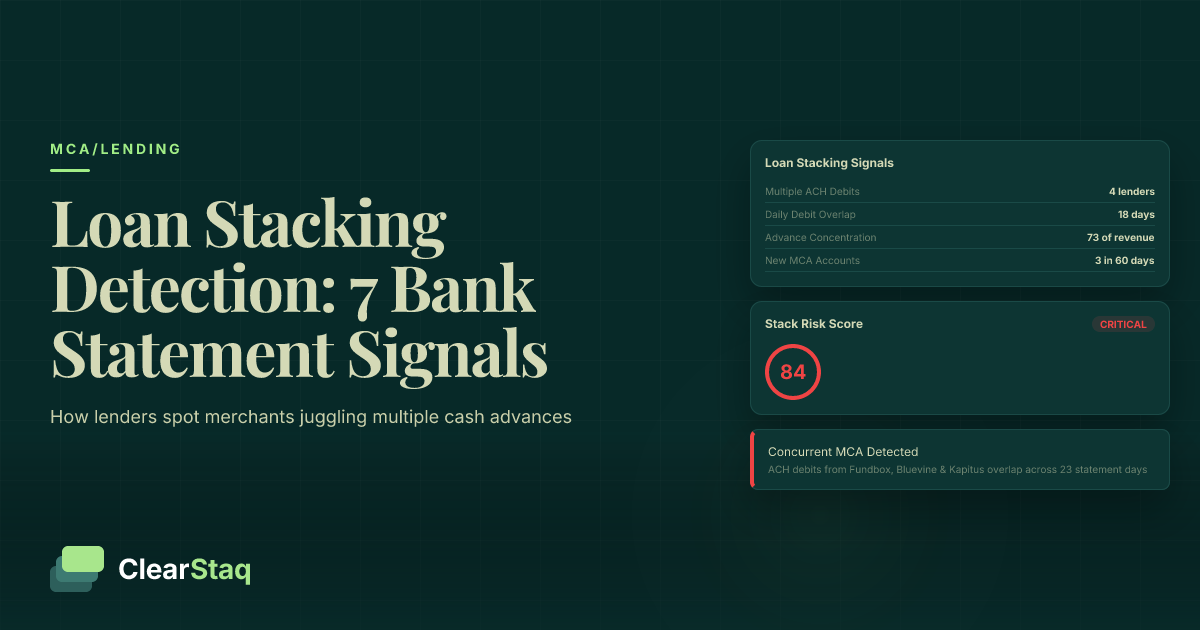
These seven signals form a practical checklist for identifying MCA stacking detection during underwriting. One signal may be explainable in isolation. Three or more together constitute strong evidence of an existing stacking scenario. Cross-reference this checklist against every application as a standard step, not an exception-triggered review.
Signal 1–3: ACH Debit Patterns
Signal 1 — Multiple recurring ACH debits to different MCA-pattern payees. Look for two or more daily or near-daily ACH debits originating from different entities whose names match known MCA funder naming conventions. Common identifiers include strings like "WCF," "CAP ADV," "MERCHANT FIN," "GREENBOX," "LIBERTAS," "BLU VINE," "CAN CAP," and dozens of similar variants. The presence of multiple distinct payees each following a daily remittance cadence is the clearest single indicator of simultaneous MCA advances.
Signal 2 — ACH debit velocity increase. Compare the number of outbound ACH debits in month one of the statement period to month three. An increasing count of outbound ACH debits — particularly daily-cadence debits — without a corresponding increase in revenue or business activity is a strong indicator that new MCA positions are being added. Transaction velocity analysis formalizes this measure and can be used to set threshold triggers.
Signal 3 — Debit timing clustering. Multiple ACH debits hitting on the same business day, every business day, at consistent amounts — each from a different payee — is characteristic of two or more automated MCA remittance schedules running in parallel. This pattern is nearly impossible to explain through legitimate business operations and is a high-confidence stacking indicator.
Signal 4–5: Balance and Cash Flow Deterioration
Signal 4 — Declining average daily balance trend. Calculate the average daily balance for each month in the statement period. A drop of 20% or more month-over-month, without a corresponding decline in gross deposit volume, indicates that debt service is consuming cash faster than revenue is replacing it. This is the balance-sheet signature of compounding daily ACH obligations.
Signal 5 — Shrinking net cash flow after debt service. Sum all gross deposits for the period, subtract all recurring MCA-pattern ACH debits, and compute the residual. If this figure leaves insufficient margin for plausible operating expenses — or trends toward zero across the three-month period — the merchant is in debt service distress. Watch for NSF frequency and overdraft patterns as a co-indicator; non-sufficient funds events typically begin appearing in the same months that ADB deterioration accelerates in stacked positions.
Signal 6–7: Deposit and Structural Anomalies
Signal 6 — Unusual deposit spikes in the most recent statement month. A large round-number deposit or an unusual transfer from a non-operating source appearing in the final 30 days of the statement window is often an attempt to inflate the apparent cash position for underwriting purposes. This is particularly suspicious when the deposit doesn't match the cadence or source profile of the merchant's normal deposit pattern. Compare the most recent month's gross deposit total to the two prior months — a spike of 30% or more without a business explanation warrants investigation.
Signal 7 — Multi-account distribution patterns. When a merchant operates across multiple bank accounts, they may deliberately concentrate MCA ACH debits in one account while directing revenue deposits into another, making each individual account look healthier than the consolidated picture. Reviewing only one account misses this entirely. Requiring statements from all accounts and applying multi-bank statement aggregation before calculating total debt service is essential for catching split-account stacking.
As the visualization above illustrates, these seven signals rarely appear in isolation in a genuine stacking scenario. The automated detection engine evaluates all signals simultaneously across the full statement period, computing a composite stacking risk score rather than treating each indicator as a standalone flag.
See MCA Stacking Detection in Action
ClearStaq's position detection engine identifies existing MCA positions from ACH debit patterns in seconds — across 900+ bank formats, all merchant accounts, and 500+ funder name variants. Start your free trial and run stacking detection on your next application today.
How to Calculate Effective Daily Debt Obligation from Bank Statements
The Effective Daily Debt Service (EDDS) calculation is the most important quantitative tool in loan stacking detection — and it's a content gap no competitor fills in useful detail. Here's the complete methodology, step by step.
Step 1: Pull all ACH debit transactions from the statement period (minimum 3 months). Group transactions by payee name, normalizing for truncation variants and abbreviations. Each distinct recurring payee that shows a daily or near-daily pattern is a candidate MCA position.
Step 2: For each identified MCA-pattern payee, calculate the average daily debit amount. Divide the total debited from that payee over the statement period by the number of business days in the period. This gives you the per-position daily obligation.
Step 3: Sum all per-payee average daily debits. This total is the merchant's Effective Daily Debt Service — the combined daily ACH obligation across all identified MCA positions.
Step 4: Calculate the merchant's Average Daily Gross Deposits (ADGD) by dividing total gross deposits over the period by the number of business days. Then divide EDDS by ADGD to produce the debt service coverage ratio. Flag as high risk if EDDS exceeds 35–40% of ADGD.
| Metric | Example Value | Risk Assessment |
|---|---|---|
| Average Daily Gross Deposits (ADGD) | $2,272 ($50K/month ÷ 22 days) | Baseline |
| Position 1 Daily ACH Debit | $500/day | — |
| Position 2 Daily ACH Debit | $500/day | — |
| Position 3 Daily ACH Debit | $500/day | — |
| Effective Daily Debt Service (EDDS) | $1,500/day | — |
| EDDS-to-ADGD Ratio | 66% | High Risk — Decline |
| Net Daily Cash Flow After Debt Service | $772/day ($17K/month) | Insufficient for most operations |
At a 66% EDDS-to-ADGD ratio, this merchant is allocating two-thirds of every day's revenue to MCA debt service before paying a single operating expense. Default probability is extremely high within 60 days.
This business demonstrates strong financial health with consistent cash flow and minimal overdraft activity. Recommended for approval with standard terms.
Setting Debt Service Thresholds for Underwriting Decisions
Most experienced MCA underwriters apply a hard stop at an EDDS-to-ADGD ratio of 35–40%. At that threshold, the merchant retains just 60–65 cents of every dollar of revenue after MCA obligations, which leaves margin for operating expenses in most business types. Above 40%, sustainability becomes business-specific and should trigger enhanced due diligence rather than automatic approval.
A single month's EDDS calculation is a snapshot, not a conclusion. The three-month trend matters more. An EDDS-to-ADGD ratio that is rising month-over-month — even if it hasn't crossed the 40% threshold yet — signals deterioration in progress and warrants heightened scrutiny.
The Multi-Account Problem in Debt Service Calculations
When a merchant deliberately splits MCA ACH debits across multiple bank accounts, EDDS calculated from any single account understates the true obligation. Each account appears to have a manageable debt service load. The consolidated picture reveals a business that is dangerously over-leveraged.
The solution is aggregating all merchant bank accounts before computing EDDS. This is straightforward in principle and practically difficult in manual review — it requires the underwriter to obtain statements from every account, reconcile ACH debits across institutions, and deduplicate payees that may debit multiple accounts. Automated aggregation tools perform this consolidation in seconds, making comprehensive EDDS calculation feasible at underwriting volume.
Stacking vs. Refinancing: How to Tell the Difference
The stacking-versus-refinancing distinction is underdeveloped across all competitor content, leaving underwriters without clear criteria to apply. The distinction matters because legitimate refinancing or consolidation — where a new advance is used to pay off an existing one — is not stacking and may be appropriate depending on the merchant's situation.
The definition is straightforward in principle:
- Refinancing: An existing MCA is retired at or before the new advance is funded. The prior funder's ACH debits stop. Net daily obligation stays the same or decreases.
- Stacking: A new MCA is added while existing positions remain active and being debited. Net daily obligation increases. The prior funder's ACH debits continue alongside the new funder's debits.
The diagnostic question is simple: does the bank statement show the prior funder's ACH debits stopping at or near the date of the new advance funding? If yes, and if the new advance amount is consistent with a payoff of the prior balance, it's likely refinancing. If both debit streams continue simultaneously, it's stacking.
Bank Statement Evidence for Legitimate Refinancing
When reviewing a claim of refinancing or consolidation, look for these specific patterns in the transaction history:
- The prior funder's regular ACH debits cease within one to three business days of the new advance funding date
- The prior funder's final debit is larger than the regular daily amount — consistent with a lump-sum payoff or settlement figure
- The new funder's ACH debits begin at approximately the same daily rate as the prior funder's debits ceased
- A payoff letter or written confirmation from the prior funder is provided as supporting documentation
If multiple funder ACH debits continue simultaneously after the new advance funding date, no amount of documentation establishes this as refinancing. The transaction record is dispositive.
The UCC Lien Cross-Reference Method
UCC-1 filings are public record and list existing MCA security interests against a merchant's receivables. Cross-referencing UCC filer names against ACH payee names in bank statements provides useful corroborating evidence of stacking positions — particularly for positions that may not yet be visible in a short statement window.
The UCC search has important limitations as a standalone tool. It shows that a funder has a security interest, but not whether that position is still active. A merchant may have fully paid off an advance while the UCC-1 remains on file. The ACH debit record — or absence of it — is the ground truth for whether a position is currently being serviced. Use UCC search as a supplementary screen to identify funders worth investigating, then confirm activity status in the bank statement transaction data.
Manual Detection Methods (and Why They Fall Short)
Most MCA underwriting teams today rely heavily on manual stacking review. The workflow looks something like this: an underwriter downloads PDF bank statements, reads through ACH debit description fields line by line, Googles unfamiliar payee names to determine if they're MCA funders, and builds a spreadsheet of identified positions with estimated daily amounts.
On a clean, simple application with a single bank account and two months of statements, this takes 15–20 minutes. On a complex application with three bank accounts, 90 days of statements, and multiple abbreviated ACH description fields — the kind of application most likely to involve stacking — it takes 45 to 90 minutes. Per application. That time cost, multiplied across 50+ applications per week, becomes the primary bottleneck in underwriting throughput.
For a view of how stacking detection fits into the full workflow, see our MCA underwriting checklist.
The ACH Description Truncation Problem
NACHA formatting limits ACH description fields to 10–16 characters. In practice, this means funder names appear in abbreviated, truncated, or unrecognizable forms depending on how each bank renders the description field.
"GREENBOX CAPITAL" might appear as "GRNBX CAP," "GREENBOX C," or simply "GBX FNDING." Funders operating under holding company structures — which is common in the MCA industry — may originate ACH debits under a parent entity name that bears no obvious relationship to the brand name an underwriter would recognize. A funder branded as "Merchant Growth Capital" might debit accounts as "MGC HOLDINGS LLC" or "SYNAPSE FIN SVC."
Manual underwriters handle this by maintaining their own informal lists of known MCA payee name variants. These lists are inevitably incomplete, inconsistently maintained across team members, and never fully current as funders restructure, rebrand, or change ACH originator configurations. No individual underwriter can maintain a comprehensive mapping of 500+ funder names and their truncation variants from memory.
Volume and Consistency Limitations
Manual review quality degrades predictably under volume pressure. When an underwriter is processing their eighth application of the day, they skim ACH descriptions rather than reading them carefully. Unusual payee names that would have caught their attention in the morning pass unexamined in the afternoon.
Consistency is also a fundamental problem. Two underwriters reviewing the same application with the same ACH descriptions may reach different conclusions about whether a particular payee is an MCA funder. There's no standardized ruleset, no shared reference database, and no systematic audit trail documenting which ACH debits were evaluated and why a particular decision was reached.
The hidden cost of a missed stacking scenario is the most compelling argument for addressing these limitations. A single funded stacked deal — where the merchant defaults within 90 days — can generate losses that exceed months of underwriting labor cost savings from skimping on stacking review.
How Automated Detection Catches What Human Review Misses
Automated bank statement analysis approaches the stacking detection problem from the other direction. Instead of relying on an underwriter to recognize MCA funder names from memory, automated tools parse every ACH debit description and match it against a continuously maintained database of 500+ known MCA funder name variants — including holding company names, truncation patterns, and DBA aliases.
Machine learning extends detection beyond the known-funder database. ACH debit patterns that follow a daily cadence, consistent amount, and specific description format characteristic of MCA remittance — even if the payee name doesn't match any known funder — can be flagged as probable MCA positions. This catches new or smaller funders that haven't yet been cataloged, as well as intentionally obfuscated originator names.
The speed advantage is significant. Automated stacking detection completes in seconds per application — not 45 to 90 minutes. At 50 applications per week, that's the equivalent of recovering two to four underwriter days per week, which can be reallocated to judgment-intensive credit decisions rather than data extraction tasks.
How MCA Position Detection Works as a Parsed Output
Position detection isn't a binary fraud flag — it's a structured data output. For each application, the system produces a list of identified MCA positions that includes:
- Funder name (mapped from ACH description to known funder identity)
- Estimated average daily debit amount
- Estimated position start date (based on first appearance of the payee in the statement history)
- Estimated outstanding balance (based on typical factor rate and remaining term inferences)
This output lets underwriters see at a glance exactly how many positions exist, who the funders are, and what the combined daily obligation looks like — without a single manual lookup. It goes directly into the credit memo as actionable intelligence. The API-first architecture means position detection results are available programmatically for integration into LOS workflows and automated decisioning engines, enabling stacking detection to run on every application without adding underwriter time.
Real-Time Portfolio Monitoring for Post-Funding Stacking
Stacking risk doesn't end at funding. A merchant who passes stacking screens at origination can take on additional MCA positions the following week, creating the same distress scenario the pre-funding screen was designed to prevent. This is a risk management gap that no competitor currently addresses in published content.
Webhook-based monitoring resolves this. When new MCA-pattern ACH debits appear in a monitored merchant's account after funding, automated alerts fire immediately — giving portfolio managers the information they need to intervene before the distress cascade reaches default. Real-time fraud alerts via webhooks allow funders to set policy-based triggers: notify when a new daily-cadence ACH debit from an unrecognized entity appears in any monitored account, and include the estimated daily amount and first appearance date.
The income chart above illustrates what post-funding stacking looks like in the cash flow data: a gradual but unmistakable deterioration in net daily cash flow as each new MCA position is added to the merchant's obligations, with the trajectory pointing directly toward default if the positions aren't identified and addressed early.
How ClearStaq Detects Loan Stacking Automatically
ClearStaq's MCA position detection engine was built specifically for the problem described in this article. Every ACH debit description in every parsed statement is matched against a database of 500+ MCA funder name variants — no manual payee lookup required, no reliance on the underwriter's memory of truncated ACH strings.
Multi-bank statement aggregation ingests statements from all of a merchant's bank accounts simultaneously, computing consolidated EDDS across all institutions before any underwriting decision is made. This eliminates the split-account stacking blind spot that defeats single-account manual review.
ClearStaq's 27 fraud signals include a dedicated cluster of stacking-specific indicators: ADB deterioration rate, ACH debit velocity trends, net-cash-flow-after-debt-service ratio, and deposit normalization anomalies consistent with artificial deposit inflation. These signals are evaluated simultaneously across the full statement period, not as isolated data points.
The platform supports 900+ bank formats — Chase, Bank of America, Wells Fargo, US Bank, and hundreds of regional and community banks — ensuring consistent detection quality regardless of where the merchant banks. Detection results are returned in the same parsed statement payload via API, making integration into existing LOS and decisioning workflows straightforward. Learn more about ClearStaq's capabilities on the MCA funding platform page.
The Position Detection Output: What Underwriters See
The position detection output is designed to be used directly in credit decisions without additional research. A typical output for a stacked application looks like this: three identified MCA positions, funder names resolved from truncated ACH descriptions, average daily debits of $450, $375, and $500 respectively, position start dates spanning the past four months, and a combined EDDS of $1,325 per day against an ADGD of $2,100 — an EDDS-to-ADGD ratio of 63%.
That single output page replaces 60 minutes of manual ACH description lookup, spreadsheet building, and ratio calculation. The underwriter sees the full stacking picture immediately and can make a documented, defensible credit decision. Integration options include API response (embedded in the parsed statement JSON), webhook payload (for monitoring alerts), and dashboard view (for human review workflows). The full output is retained in the audit log, documenting exactly which positions were identified and why the decision was reached.
Building a Stacking-Resistant Underwriting Process
Stacking detection is most effective when it's embedded systematically into the underwriting process — not triggered only when a reviewer happens to notice something suspicious. Here are the key process elements that create a genuinely stacking-resistant underwriting workflow:
- Minimum 3-month lookback: One month of statements is insufficient to establish ACH debit patterns. Three months is the minimum required to see position start dates, debit velocity trends, and ADB deterioration in context.
- All-account requirement: Require statements from every business bank account, not just the primary operating account. Document which accounts were reviewed in the credit file.
- Automated position detection on every application: Run stacking detection as a standard step, not an exception-triggered check. Manual review for applications that look clean is where stacking hides most effectively.
- UCC cross-reference: Cross-reference position detection output against UCC-1 search results. Discrepancies between UCC filers and ACH payees — a funder who filed but isn't appearing in ACH debits — warrant an investigation into whether the position was paid off or whether the statement set is incomplete.
- Hard EDDS threshold in credit policy: Document the EDDS-to-ADGD ratio threshold as a formal credit policy hard stop, not a discretionary judgment call.
- Post-funding monitoring: Implement webhook-based alerts for existing portfolio accounts to catch new MCA positions taken after funding.
Industry Data-Sharing Networks and Their Limitations
MCA industry data-sharing consortiums — including DataMerch and Factor Funder — allow participating funders to report funded deal history and query whether a merchant has received advances from other consortium members. This is a useful supplementary tool, but it has a significant structural limitation: participation is voluntary and not universal.
A merchant stacking with funders who don't participate in the consortium will not appear in consortium query results, regardless of how many positions they've accumulated. The consortium database reflects what participating members have reported, not what has actually happened. Bank statement ACH debit analysis has no such blind spot — it reflects actual transaction reality, not self-reported data from a subset of market participants.
Best practice is to use consortium databases as one check among many, not as a primary stacking detection method. A clean consortium result should lower suspicion marginally, not clear an application.
ISO Broker Accountability and Application Integrity
ISO broker relationships are the entry point for most stacking scenarios. Funders who treat broker accountability as an afterthought are accepting stacking risk through their distribution channel. Several process elements reduce this risk:
- ISO agreements should include explicit representations that the broker has disclosed all known existing MCA positions for each submitted merchant
- Application forms should require specific merchant disclosure of all existing advances, remaining balances, and daily payment obligations
- Monitor broker-level stacking rates across funded deals — a broker whose funded portfolio shows disproportionate stacking incidents warrants a relationship review and may need additional submission requirements
- Document stacking detection results in the credit file to support enforcement of the no-additional-debt covenant if the merchant later stacks and defaults
The complete framework for structuring this process is detailed in the MCA underwriting checklist, which covers stacking detection in the context of the full credit evaluation workflow.
Ready to Automate MCA Stacking Detection?
Stop relying on underwriters to recognize truncated ACH descriptions from memory. ClearStaq's position detection engine catches multiple merchant cash advances in seconds — across every bank account, every format, every application. Start your free trial today and see what manual review is missing.
Frequently Asked Questions
What is loan stacking in MCA lending?
Loan stacking in MCA lending occurs when a merchant obtains multiple merchant cash advances from different funders simultaneously without disclosing existing positions. Most MCA agreements prohibit this through no-additional-debt covenants, making stacking a breach of contract and a leading cause of MCA default. When the merchant misrepresents existing obligations on the application, it may also constitute fraudulent misrepresentation under state law.
How do lenders detect multiple merchant cash advances?
Lenders detect multiple merchant cash advances by analyzing bank statement ACH debit descriptions for recurring payments to known MCA funder entities, monitoring average daily balance deterioration across the statement period, and calculating effective daily debt service across all identified payees. Automated tools match ACH descriptions against a database of 500+ MCA funder name variants — including holding company names and truncation patterns — to identify positions that manual review would miss.
Is MCA stacking illegal?
MCA stacking is not universally a criminal offense, but it typically constitutes a breach of the merchant cash advance agreement, which usually contains a covenant prohibiting additional financing without the funder's consent. In cases where the merchant actively misrepresents their existing obligations on an application, it may rise to fraudulent misrepresentation under applicable state law. The practical consequence — default — is the same regardless of legal classification.
How do you identify stacking in bank statements?
Stacking is identified in bank statements by looking for multiple recurring ACH debits from different payees following a daily cadence consistent with MCA remittance, a declining average daily balance trend not explained by revenue decline, and a net cash flow after debt service ratio below sustainable operating levels. Unusual deposit spikes in the most recent statement month may also indicate attempts to artificially inflate the apparent cash position and mask stacking from underwriters.
Can merchants hide MCA stacking across multiple bank accounts?
Yes. Merchants can distribute MCA ACH debits across multiple bank accounts to make each individual account appear to have a manageable debt service load, a strategy that defeats single-account underwriting review entirely. Detecting this split-account stacking approach requires aggregating bank statements from all of the merchant's accounts before calculating total effective daily debt obligation — which is why multi-bank statement aggregation is a necessary component of any comprehensive loan stacking detection process.
ClearStaq Team
Product Team
The ClearStaq team builds AI-powered tools for bank statement parsing, fraud detection, and income verification.