DSCR from bank statements is calculated by dividing net operating cash flow — total monthly deposits minus inter-account transfers, refunds, and one-time items — by total recurring debt payments identified in the transaction history. A ratio above 1.25x generally indicates sufficient cash flow to service debt. Bank statements provide more current and reliable cash flow data than tax returns alone.
What you'll learn
- DSCR is calculated by dividing adjusted monthly operating revenue by total monthly debt service identified in transaction history
- Gross deposits must be normalized — removing inter-account transfers, loan proceeds, and one-time items — before use as the DSCR numerator
- SBA lenders require a minimum 1.15x global DSCR while MCA funders cap monthly payments at 15–20% of average monthly deposits
- The most common inflation error is counting inter-account transfers as revenue, which can overstate NOI by 20–40%
- Automated bank statement parsing reduces DSCR turnaround from days of manual review to minutes of structured data extraction
DSCR from bank statements is calculated by dividing net operating cash flow — total monthly deposits minus inter-account transfers, refunds, and one-time items — by total recurring debt payments identified in the transaction history. A ratio above 1.25x generally indicates sufficient cash flow to service debt. Bank statements provide more current and reliable cash flow data than tax returns alone, making them the preferred primary source for MCA and alternative lenders.
What Is DSCR and Why Bank Statements Are the Most Reliable Source
The Debt Service Coverage Ratio (DSCR) measures how much operating cash flow a business generates relative to its debt obligations. The higher the ratio, the more comfortably the business can make its loan payments. A DSCR of 1.0 means the business earns exactly enough to cover its debt — nothing more. Below 1.0, it can't.
Traditional lenders calculate DSCR from tax returns. The problem: tax returns reflect last year's income, sometimes the year before that. A business can look healthy on a 2023 return while struggling badly in late 2024. Bank statements close that gap. They show actual cash moving through the account — this month, last month, and the eleven months before that.
For lenders who need to make fast, accurate credit decisions, bank statement DSCR is simply more reliable. It reflects real-time payment behavior, captures actual loan payment debits, and can be pulled from 12 months of statements without waiting on a borrower's accountant to file.
Before beginning any DSCR analysis, make sure you've collected all required documents. The MCA underwriting checklist covers everything you'll need to gather before the first calculation.
DSCR in Traditional vs. Alternative Lending
SBA and conventional lenders use tax returns as the primary DSCR source, treating bank statements as a supplement or verification tool. This approach works reasonably well for established businesses with clean financials — but it's slow, and it relies on a document that may be 12–18 months old.
MCA and fintech lenders take the opposite approach. Bank statements are the primary — often the only — underwriting document. They're available immediately, they capture every payment the borrower has made, and they're harder to manipulate than tax returns when analyzed correctly.
This model works especially well for small businesses with complex tax situations: owner-operators who run personal and business expenses through the same account, businesses with high depreciation, or companies that show minimal taxable income despite strong cash flow. Bank-statement DSCR sees through the tax picture to the actual money moving through the business.
Can DSCR Be Calculated Without Tax Returns?
Yes — when 12 months of complete bank statements are available, DSCR can be calculated entirely from transaction data. You don't need tax returns to produce a defensible, accurate coverage ratio.
The limitation worth noting: bank statements can't capture non-cash items like depreciation or amortization. They also can't surface deductions that reduce taxable income without affecting actual cash flow. For most alternative lending decisions, this is fine — you care about cash, not accounting adjustments. But for lenders who want maximum confidence, cross-referencing bank statements with tax returns eliminates any doubt about the income picture.
The DSCR Formula: Breaking Down Each Component
The formula is straightforward:
DSCR = Net Operating Income ÷ Total Debt Service
The complexity is in building each side of that equation accurately. Done wrong, you get a number that looks like a DSCR but doesn't actually reflect the borrower's repayment capacity. Done right, it's the most powerful single metric in your underwriting toolkit.
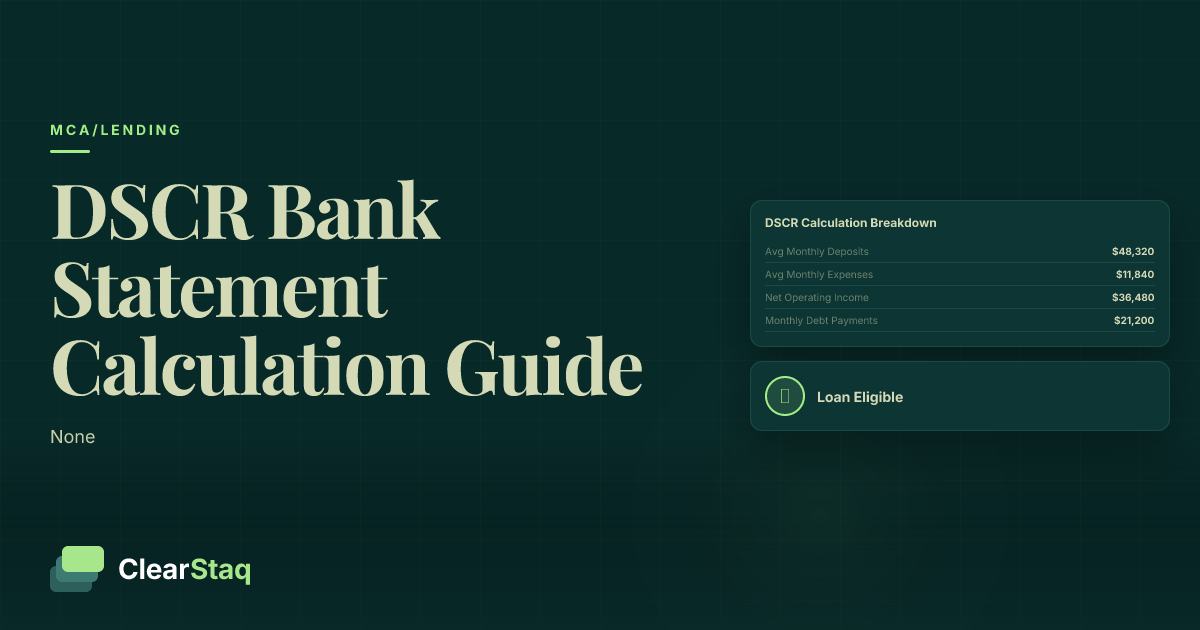
Here's a concrete example. A business shows $95,000 in gross monthly deposits. After removing $7,000 in inter-account transfers and $3,000 in loan proceeds received, adjusted operating revenue is $85,000. Monthly debt payments identified in the transaction history total $18,000. The DSCR is $85,000 ÷ $18,000 = 1.47x. The business generates $1.47 for every $1.00 of debt obligation — a comfortable margin for most lenders.
What each outcome means:
- DSCR above 1.25x: Strong coverage. Most lenders approve without significant concern about repayment capacity.
- DSCR between 1.0x and 1.25x: Adequate but thin. Lenders may require additional collateral, a shorter term, or stronger credit history.
- DSCR exactly 1.0x: The business earns exactly enough to cover debt — no buffer. Any revenue dip creates a payment problem.
- DSCR below 1.0x: Insufficient cash flow to service existing debt. Most lenders decline or require significant restructuring.
Building the Numerator: Net Operating Income from Bank Statements
Start with total credits — every deposit posted across all months in the review period. This is your gross deposit figure. But gross deposits are not net operating income. They include money that doesn't belong in the numerator at all.
You need to strip out transfers, loan proceeds, refunds, and one-time deposits to get to true operating revenue. This is the adjusted figure that actually reflects what the business earns from its customers. For a detailed breakdown of why this step matters, see our post on true revenue vs. gross deposits — skipping this adjustment is the most common reason DSCR figures are inflated at the file level.
Note that average daily balance is a separate but related metric MCA underwriters use alongside DSCR. It measures liquidity rather than income coverage. See our average daily balance calculation guide for how these two metrics work together in MCA approval decisions.
Building the Denominator: Identifying Debt Service in Transactions
The denominator is every scheduled principal and interest payment on existing financing obligations. Finding it requires scanning the full transaction history for recurring fixed debits that match loan payment patterns.
Look for these specifically:
- ACH pulls from known lender names, SBA payment servicers, or equipment finance companies
- Transactions labeled "LOAN PMT," "MCA PAYMENT," "SBA LOAN," "EQP FINANCE," or similar descriptors
- Consistent fixed amounts debited on predictable dates each month (or daily, in the case of MCA)
- Credit card minimum payments that appear as consistent recurring obligations
Do not include variable operating expenses in the denominator. Payroll, rent, utilities, and inventory purchases are not debt service — they're operating costs that belong in the income calculation, not the coverage ratio denominator. Including them is a common error that deflates DSCR and makes borrowers look less creditworthy than they actually are.
Step-by-Step: How to Calculate DSCR from Bank Statements
Here is the complete six-step workflow for producing an accurate DSCR bank statement calculation from raw documents.
Step 1–3: Gathering and Cleaning Deposit Data
Step 1: Collect 12 months of complete bank statements for all active business accounts. Not just the primary checking account — all accounts. Businesses frequently route revenue through secondary accounts, and missing even one can materially understate income or obscure debt payments. Request statements in PDF format and verify each statement shows a complete calendar month.
Step 2: Sum all credits for each month to get gross monthly deposits. Build a month-by-month deposit table. Flag any month with fewer than 20 banking days represented — incomplete statements skew the monthly average and should be excluded or noted in the file.
Step 3: Remove non-operating credits from each month's total. Items to exclude:
- Inter-account transfers (money moving between the borrower's own accounts)
- Loan proceeds received (MCA disbursements or term loan draws deposited into the account)
- Refunds and chargebacks
- Owner capital contributions
- One-time asset sale proceeds or insurance reimbursements
A 3-month snapshot can be useful for a quick read, but it's not reliable for DSCR. A business in its seasonal peak will show strong numbers that don't reflect its annual capacity. Use 12-month averages as your standard — and document every exclusion you make with a brief rationale for the credit file.
Step 4–6: Calculating the Ratio
Step 4: Calculate average monthly adjusted operating revenue. Sum the 12 normalized monthly figures and divide by 12. Before you take the average, build the full month-by-month table — this surfaces volatility that an average alone would hide. Identify the lowest three-month stretch and use it as your stress-test scenario. A borrower with an average DSCR of 1.4x but a trough-period DSCR of 0.9x is a meaningfully different risk than one who holds above 1.2x all year.
Step 5: Identify and sum all recurring debt payments. Go line by line through the transaction history across all 12 months. Add up every confirmed debt obligation. For MCA advances with daily ACH pulls, multiply the daily payment by the number of banking days in the month to get the monthly equivalent.
Step 6: Divide average monthly adjusted revenue by monthly debt service. This is your DSCR. For an annualized figure, divide annual adjusted NOI by annual total debt service — the result should be identical if your monthly figures are consistent.
This business demonstrates strong financial health with consistent cash flow and minimal overdraft activity. Recommended for approval with standard terms.
How to Normalize Cash Flow Before Calculating DSCR
Normalization is the most overlooked step in bank-statement DSCR calculation. It's where underwriters most frequently introduce error — usually by failing to remove items that inflate the numerator. The formula is simple; getting the inputs right is the actual work.
What to Exclude from Gross Deposits
The following items must be removed before gross deposits can be used as the DSCR numerator:
| Item to Exclude | Why It Doesn't Belong | How to Identify It |
|---|---|---|
| Inter-account transfers | Money moving between the borrower's own accounts — not revenue | Matching debit and credit on same date across accounts |
| Loan proceeds received | Borrowed funds, not operating income | "MCA FUNDING," "ADVANCE DEPOSIT," lender name in description |
| Refunds and chargebacks | Reversals of prior revenue, not new income | "REFUND," "CHARGEBACK," "RETURN" in transaction description |
| Owner capital contributions | Personal funds injected into the business — not earned revenue | Personal account name as originator, irregular large round-number deposits |
| Asset sale proceeds | One-time event, not sustainable operating cash flow | Large non-recurring credit with no matching pattern |
| Insurance reimbursements | Non-recurring, not reflective of business earning capacity | "INSURANCE," "CLAIM PAYMENT" in description |
How to Handle NSF Fees, Overdrafts, and Returned Items
NSF fees don't get subtracted from the deposit total — they're expense items, not revenue adjustments. But they are strong negative signals about cash flow reliability, and their frequency directly affects how much confidence you place in the DSCR figure. A borrower with an adequate 1.3x DSCR but 15 NSF events in 12 months is a materially different risk than one with zero. For a detailed framework on interpreting these patterns, see our guide on NSF fees and overdrafts in borrower risk analysis.
Returned ACH debits are a specific case worth attention. When a payment is attempted and returned, the bank may post a reversal credit that temporarily inflates the account balance. Identify these reversal credits and remove them from the deposit total — they represent failed payment collection, not revenue.
Overdraft protection draws should always be excluded from operating revenue. If the account draws on an overdraft line to cover a shortfall and that draw appears as a credit, it's borrowed funds — not income.
Handling Seasonal Revenue Variability
Never use a business's peak revenue month as the representative period for DSCR. It will overstate sustainable cash flow and produce a misleadingly strong coverage ratio. The 12-month average exists precisely to smooth out these peaks.
For highly seasonal businesses — retail, agriculture, hospitality, landscaping — go further. Calculate a trough-adjusted DSCR using only the three weakest months of the year. If the loan repayment period includes those low months, that trough figure is what actually matters for default risk. A seasonal business that looks strong on an annual average can still default if it can't service debt during its slow period.
For a full methodology on identifying and adjusting for seasonal patterns across 12 months of bank statements, see our post on seasonality analysis in bank statements.
DSCR Thresholds by Lender and Loan Type
Different lender types apply materially different DSCR thresholds, and understanding where each sits helps underwriters calibrate their analysis to the specific product being evaluated.
SBA and Conventional Bank Thresholds
SBA 7(a) and SBA 504 loans require a minimum 1.15x global DSCR per SBA guidance. This is a global figure — it incorporates both business and personal cash flows and debt obligations, not just the business in isolation.
Conventional commercial banks typically require 1.20x–1.25x depending on loan type, industry, and collateral. Community banks and credit unions may accept 1.10x for borrowers with strong collateral or established relationships. FDIC commercial lending examination guidance uses 1.20x as a standard benchmark for commercial loan quality review.
MCA and Alternative Lender Thresholds
MCA funders don't use traditional DSCR — but they apply an equivalent metric. The standard question is: what percentage of average monthly deposits does the proposed monthly MCA payment represent?
| Lender Type | Minimum DSCR / Equivalent Threshold | Primary Source |
|---|---|---|
| SBA 7(a) / SBA 504 | 1.15x global DSCR | Tax returns + bank statements |
| Conventional commercial bank | 1.20x–1.25x | Tax returns + financial statements |
| Community bank / credit union | 1.10x–1.20x (collateral-dependent) | Tax returns + bank statements |
| Fintech term lender | 1.15x–1.25x | Bank statements (primary) |
| MCA funder | Monthly payment ≤ 15–20% of avg. monthly deposits | Bank statements (only) |
| Revenue-based financing | Monthly payment ≤ 8–12% of monthly revenue | Bank statements (primary) |
Note that the debt service calculation differs for MCA vs. term loans. An MCA obligation is calculated as: factor rate × advance amount, divided by the repayment period. A term loan denominator is the amortizing principal-plus-interest payment. Using the wrong calculation method for the product type will produce an inaccurate denominator and a misleading DSCR.
Common DSCR Calculation Errors Underwriters Make
No competitor content addresses this from an underwriter workflow perspective — yet these errors happen constantly, especially at volume. Each one either inflates DSCR (creating false approval confidence) or deflates it (creating false declines) or misses real risk signals entirely.
Errors That Inflate DSCR (False Positives)
Error 1: Including inter-account transfers as revenue. This is the single most common DSCR inflation error. A business that moves $30,000 each month from its operating account to a payroll account shows that $30,000 as a credit on the payroll account's statement. Count both sides without reconciling, and you've just doubled that revenue. This error alone can overstate NOI by 20–40% depending on the business's account structure.
Error 2: Including loan disbursements received in the deposit total. When a borrower receives a $50,000 MCA advance and deposits it, that credit appears in the transaction history. It's not revenue — it's debt. Including it in the DSCR numerator treats borrowed money as income and makes a leveraged borrower look dramatically more capable than they are.
Error 3: Using gross deposits instead of adjusted operating revenue. Failing to normalize at all — simply using the total credit column — layers all of the above errors together. Without stripping refunds, transfers, proceeds, and one-time items, the numerator overstates true operating income by an amount that varies widely by borrower but is rarely trivial.
Error 4: Using only the most recent 3 months during a seasonal peak. A restaurant in November and December will show its best numbers of the year. Underwriting based on that 3-month window produces a DSCR that won't hold through February and March. Always use a 12-month average unless the loan term is explicitly short enough that only the next quarter matters.
Errors That Deflate DSCR or Miss Risk Signals
Error 5: Missing debt payments buried in ambiguous transaction descriptions. Many loan servicers post ACH debits with generic descriptors: "ACH DEBIT VENDOR 1234," "PAYMENT SVC," or just the servicer's internal code. Underwriters doing manual review frequently miss these as debt service, understating the denominator and inflating DSCR. Automated categorization eliminates this by pattern-matching against known lender identifiers.
Error 6: Failing to identify MCA stacking. A borrower with three active MCA advances may show daily ACH pulls from three different funders. Without carefully accounting for all of them, the debt service denominator is seriously understated. For a full methodology on identifying this pattern, see our guide to MCA stacking from bank statements.
Error 7: Not accounting for personal debt obligations in global DSCR. When SBA or other lenders require a global DSCR, the borrower's personal mortgage, auto loan, and other obligations must be included in the denominator. Missing these understates total debt service and produces an inflated global coverage ratio.
Error 8: Ignoring overdraft lines of credit as recurring obligations. An overdraft line that's regularly drawn and repaid functions as a revolving credit facility. If a borrower consistently draws $10,000 per month and repays it, that's a recurring financing obligation that belongs in the denominator — not an operating expense.
Global DSCR: When You Need to Look Beyond the Business Account
Global DSCR is a combined coverage ratio that incorporates both business and personal cash flows and debt obligations. Instead of evaluating the business in isolation, global DSCR treats the owner and the business as a single economic unit — because for most small businesses, that's what they are.
For SBA loan underwriting, global DSCR is required for 7(a) and 504 loans. It's also appropriate — and increasingly standard — for any owner-dependent small business, sole proprietor, or single-member LLC where the owner's personal finances directly affect the business's ability to service debt.
How to Calculate Global DSCR Step by Step
- Calculate business DSCR inputs: Adjusted operating cash flow from business statements using the six-step process described above.
- Calculate personal cash flow: Total personal deposits (wages, distributions, investment income) minus personal living expenses and personal-only debt obligations (mortgage, auto loan, student loans).
- Combine for global NOI: Adjusted business NOI + personal net income after personal expenses.
- Combine for global debt service: All business debt payments + all personal debt obligations.
- Divide: Global NOI ÷ Global Total Debt Service = Global DSCR.
Avoiding Double-Counting in Global DSCR
The most common global DSCR error is double-counting owner compensation. If the owner draws a $10,000 monthly salary from the business, it appears as an expense on the business side and a deposit on the personal side. Pick one — include it as a business expense deducted from business NOI, or include it as personal income on the personal side. Not both.
The same logic applies to owner distributions. If distributions are excluded from business NOI (as they should be — they're not operating costs), they can be counted as personal income. If they're treated as a business cash outflow, they should not appear again as personal income.
For vehicle loans or other obligations that are nominally personal but used for the business, allocate them to the business side when the business benefit is clear and documented. SBA guidance specifies how to treat owner compensation and mixed-use obligations — following it precisely prevents the audit problems that come from inconsistent allocation.
How Automated Bank Statement Parsing Accelerates DSCR Underwriting
Every step in the DSCR calculation workflow described above — gathering statements, cleaning deposit data, identifying debt payments, normalizing for seasonality, building the month-by-month table — is manual work when done from raw PDFs. At low volume, it's time-consuming. At scale, it's a source of consistent error and a bottleneck that limits how many applications an underwriting team can process.
ClearStaq automates the extraction and categorization step that precedes the DSCR calculation. Raw bank statement PDFs go in; structured, normalized data comes out — with the specific fields that feed directly into the formula already separated and labeled.
What ClearStaq Extracts for DSCR Calculation
ClearStaq's bank statement income verification engine produces the following outputs, ready for DSCR calculation:
- Total monthly deposits broken down by category: operating revenue, inter-account transfers, loan proceeds received, refunds — each labeled and separated so the clean numerator is produced automatically
- Recurring fixed ACH debit identification: the system flags transactions matching loan payment patterns and groups them as debt service candidates for underwriter review
- 12-month trend data: month-by-month adjusted NOI enabling seasonally-aware DSCR rather than snapshot calculations
- Multi-account aggregation: business and personal statements processed simultaneously for global DSCR without manual reconciliation
- 27 fraud signal checks: statement integrity is validated before DSCR is calculated, preventing garbage-in-garbage-out underwriting decisions
ClearStaq supports 900+ bank formats, which means the extraction is consistent regardless of which institution's statement you receive — no format-specific manual adjustments required.
API Integration for LOS Workflows
For high-volume lenders, the manual spreadsheet step between document receipt and underwriting decision is where time and accuracy are both lost. ClearStaq's API returns structured JSON with all DSCR-relevant fields — adjusted deposits by month, recurring debt payments, account-level summaries — ready for direct ingestion into your loan origination system.
The result: DSCR turnaround drops from days of manual review to minutes of automated extraction. Underwriters start with clean, validated numbers rather than raw PDFs. Your team can review more applications with fewer errors — and document every normalization decision automatically.
To learn more about how ClearStaq supports your workflow, visit the MCA underwriting platform page.
See ClearStaq's DSCR Extraction in Action
See how ClearStaq extracts every number you need for DSCR — adjusted deposits, recurring debt payments, 12-month trend data — directly from bank statement PDFs in minutes. Book a demo to see it with your actual statement formats.
Frequently Asked Questions
How do you calculate DSCR from bank statements?
Calculate DSCR from bank statements by dividing adjusted monthly operating revenue — total deposits minus inter-account transfers, loan proceeds, and one-time items — by total monthly debt service identified in the transaction history. Use a 12-month average for both figures to avoid distortion from seasonal peaks or troughs. Document every exclusion made to gross deposits with a brief rationale for the credit file.
What is a good DSCR ratio for a business loan?
Most conventional and SBA lenders require a minimum DSCR of 1.15x to 1.25x, meaning the business generates $1.15–$1.25 in operating cash flow for every $1.00 of debt service. MCA and alternative lenders use equivalent thresholds expressed differently — typically capping monthly payments at 15–20% of average monthly deposits. A DSCR above 1.25x is generally considered strong across all lender types.
What counts as debt service when calculating DSCR from bank statements?
Debt service includes all scheduled principal and interest payments on existing loans, lines of credit, MCA advances, equipment leases, and other financing obligations. It does not include operating expenses like payroll, rent, or utilities — only fixed financing obligations that appear as recurring debits in the transaction history. For MCA, calculate monthly debt service as the daily ACH amount multiplied by the number of banking days in the month.
Can DSCR be calculated without tax returns using only bank statements?
Yes. When 12 months of complete bank statements are available, DSCR can be calculated entirely from transaction data without tax returns. Bank statements provide more current cash flow information — tax returns may lag by 12–18 months — making them the preferred primary source for MCA and fintech lenders. For SBA loans, bank statements can supplement but typically don't fully replace tax returns. Check our pricing plans to see how ClearStaq fits your volume.
What is global DSCR and when do lenders require it?
Global DSCR combines business and personal cash flows and debt obligations into a single coverage ratio. It is required by SBA lenders for 7(a) and 504 loans, and is appropriate for any loan where the business owner's personal finances are closely intertwined with business performance — sole proprietors, single-member LLCs, and owner-dependent small businesses. The key challenge is avoiding double-counting of owner compensation, which appears as both a business expense and personal income.
Ready to Automate DSCR Underwriting?
Stop calculating DSCR in spreadsheets. ClearStaq automatically extracts, categorizes, and normalizes bank statement data so your underwriters start with clean numbers — not raw PDFs. Book a demo and run your next application through it.
Frequently Asked Questions
How do you calculate DSCR from bank statements?
Calculate DSCR from bank statements by dividing adjusted monthly operating revenue — total deposits minus inter-account transfers, loan proceeds, and one-time items — by total monthly debt service identified in the transaction history. Use a 12-month average for both figures to avoid distortion from seasonal peaks or troughs. Document every exclusion made to gross deposits with a brief rationale for the credit file.
What is a good DSCR ratio for a business loan?
Most conventional and SBA lenders require a minimum DSCR of 1.15x to 1.25x, meaning the business generates $1.15–$1.25 in operating cash flow for every $1.00 of debt service. MCA and alternative lenders use equivalent thresholds expressed differently — typically capping monthly payments at 15–20% of average monthly deposits. A DSCR above 1.25x is generally considered strong across all lender types.
What counts as debt service when calculating DSCR from bank statements?
Debt service includes all scheduled principal and interest payments on existing loans, lines of credit, MCA advances, equipment leases, and other financing obligations. It does not include operating expenses like payroll, rent, or utilities — only fixed financing obligations that appear as recurring debits in the transaction history. For MCA, calculate monthly debt service as the daily ACH amount multiplied by the number of banking days in the month.
Can DSCR be calculated without tax returns using only bank statements?
Yes. When 12 months of complete bank statements are available, DSCR can be calculated entirely from transaction data without tax returns. Bank statements provide more current cash flow information — tax returns may lag by 12–18 months — making them the preferred primary source for MCA and fintech lenders. For SBA loans, bank statements can supplement but typically do not fully replace tax returns.
What is global DSCR and when do lenders require it?
Global DSCR combines business and personal cash flows and debt obligations into a single coverage ratio. It is required by SBA lenders for 7(a) and 504 loans, and is appropriate for any loan where the business owner's personal finances are closely intertwined with business performance — sole proprietors, single-member LLCs, and owner-dependent small businesses. The key challenge is avoiding double-counting of owner compensation, which appears as both a business expense and personal income.
ClearStaq Team
Product Team
The ClearStaq team builds AI-powered tools for bank statement parsing, fraud detection, and income verification.