MCA underwriting automation reduces bank statement review time from four hours to under 15 minutes by replacing manual data entry, calculation, and fraud checks with a single automated pipeline. ClearStaq parses statements from 900+ bank formats, runs 27 fraud signals in parallel, and returns a complete cash flow and risk report in seconds — enabling MCA brokers to close more deals without adding headcount.
What you'll learn
- Automating MCA underwriting can reduce per-deal review time by 95%, from four hours to under 12 minutes
- Automated fraud detection checks 27 signals in parallel, catching subtle patterns manual reviewers miss
- The same analyst headcount can process three to four times more deals after automation is implemented
- ClearStaq onboarding takes one business day, with ROI beginning on the first automated deal
- Recovering even one lost deal per week at a $2,000 commission returns $8,000 per month — typically exceeding tool cost many times over
MCA underwriting automation can reduce bank statement review time from four hours to under 15 minutes by replacing manual data entry, calculation, and fraud checks with a single automated pipeline. ClearStaq's platform parses statements from 900+ bank formats, runs 27 fraud signals in parallel, and returns a complete cash flow and risk report in seconds — enabling MCA brokers to close more deals without adding headcount.
The Problem: 4-Hour Underwriting Cycles Were Killing Deals
In merchant cash advance, speed isn't just a nice-to-have. It's the deciding factor in who gets the deal. Merchants don't wait for the thorough broker — they sign with the fast one. When one mid-size MCA brokerage examined its pipeline last year, the numbers were uncomfortable: average underwriting time was four hours per deal, and the firm was losing fundable merchants to competitors who moved faster.
Understanding the full scope of that problem — and what it actually cost — is where the case for MCA underwriting automation becomes impossible to ignore.
When Speed Determines Who Gets the Deal
Most merchants don't apply to a single MCA provider and wait. They apply to three, four, sometimes five brokers simultaneously. They're looking for capital quickly, and they'll sign with whichever broker returns a term sheet first. Industry data consistently shows that the first broker to present a viable offer wins the deal in the majority of cases.
A four-hour review cycle makes winning that race nearly impossible. Competitors with 30-to-60-minute turnarounds aren't just faster — they're structurally advantaged. They're delivering term sheets while the slower broker is still transcribing transaction data into a spreadsheet. Staff capacity was the ceiling, not deal quality or merchant demand.
The Real Cost of Slow Underwriting
Slow underwriting isn't just an operational inconvenience — it has a direct and measurable revenue impact. Every deal that closes with a faster competitor is commission the slower broker never earned. Every merchant who abandons mid-process because they haven't heard back is a relationship that won't come back.
Beyond lost deals, there's the staffing dimension. Underwriters working evenings to process a backed-up queue aren't sustainable as a business model. The hidden cost of manual bank statement review extends well beyond the hours on the clock — it includes overtime, errors from fatigue, and the compounding opportunity cost of deals that never even got submitted because the pipeline was full. These costs are real, and most brokers haven't quantified them until a breaking point forces the conversation.
Inside the Manual Process: Where Time Was Really Going
Before implementing any automation, this broker's underwriting workflow looked like what you'd find at most mid-size MCA shops: a combination of PDF reading, manual spreadsheet work, and experienced judgment applied one deal at a time. The process worked — until volume grew to the point where it didn't.
Mapping the old workflow in detail revealed that bank statement review alone consumed 60 to 70 percent of total underwriting time. Everything else — application intake, memo writing, communication — was secondary.
Step-by-Step: The Old Underwriting Workflow
Here's what a typical deal looked like before automation:
- Receive the merchant application and PDF bank statements — often scanned, not digitally generated
- Open each statement PDF and manually read and transcribe transaction data into a spreadsheet row by row
- Calculate average daily balance, monthly deposits, and NSF frequency by hand across 60 to 90 days of history
- Cross-reference three months of statements to check for consistency and flag irregularities
- Write a deal summary memo documenting findings — another 30 to 45 minutes per file
The full MCA underwriting checklist the team was working through manually included more than a dozen data points per statement. Across three months of statements, that's a significant volume of manual data handling before a single decision gets made.
The Metrics That Were Hardest to Calculate Manually
Not all parts of the manual process were equally difficult, but some were particularly error-prone. Average daily balance — one of the most important metrics in MCA underwriting — requires summing end-of-day balances across 60 to 90 individual days. Done manually in a spreadsheet, it's slow and easy to get wrong. A detailed look at average daily balance calculation methodology shows just how many steps the manual version involves.
NSF frequency analysis was similarly painful. Spotting every non-sufficient funds event required scrolling through hundreds of transactions line by line without any automated filtering. Seasonal revenue patterns were essentially invisible without manually aggregating multiple months of deposits into a comparable format — a task that took significant time even for experienced analysts.
The Breaking Point: Why the Broker Decided to Automate
For most businesses, the decision to invest in automation doesn't come from a gradual realization — it comes from a specific, painful moment. For this broker, that moment arrived during a single week where the team lost three fundable deals to faster competitors. Three merchants who had submitted complete documentation, were qualified, and were ready to sign. Gone, because the review queue couldn't move fast enough.
Staff were already working evenings to keep up with the volume. Then one analyst resigned, citing review fatigue. Losing an experienced underwriter to burnout crystallized the problem in human terms that the pipeline metrics hadn't fully captured.
Quantifying the Cost of Doing Nothing
Leadership sat down and did the math for a single quarter. Three lost deals in one week at an average MCA commission between $1,500 and $3,000 each is between $4,500 and $9,000 gone in seven days. Multiply that across a quarter, add overtime costs during peak periods, and factor in the opportunity cost of deals that never even got submitted because the queue was full — the number becomes significant quickly.
The harder realization was structural: the problem would get worse with growth, not better. More deal flow meant more manual work meant more bottleneck. Hiring another analyst would help for a few months before the same ceiling returned. The firm wasn't facing a staffing problem — it was facing a process problem, and the only sustainable fix was automation.
Choosing ClearStaq: What the Evaluation Process Looked Like
The broker evaluated two to three tools before selecting ClearStaq. The evaluation wasn't primarily about price — it was about whether any tool could actually solve the specific problem the team faced without creating new ones.
The criteria that mattered most: parsing accuracy across the diverse mix of regional and national banks their merchant base used, fraud detection depth integrated into the same workflow, onboarding friction, and pricing structured for a mid-size brokerage's deal volume. A review of available MCA underwriting software options made clear that most tools were built for generic accounting or document management — not MCA-specific cash flow analysis.
What the Broker Needed That Generic Tools Couldn't Deliver
Generic document processing tools could extract numbers from PDFs. What they couldn't do was deliver MCA-specific cash flow metrics out of the box. The broker needed average daily balance, monthly deposit volume, NSF frequency, and deposit consistency — not generic accounting line items that required a second round of manual calculation to make useful.
The other non-negotiable: fraud scoring alongside cash flow analysis, in one tool. The team didn't want to run a separate fraud review step after getting the cash flow report. They needed both outputs simultaneously. SOC2 compliance was also on the checklist — the broker handles sensitive merchant financial data and needed assurance that the tool met institutional security standards.
The 60-Second Proof of Concept
ClearStaq's self-serve trial removed most of the evaluation friction immediately. The broker uploaded a real merchant statement during the trial and had results back in seconds. The team then compared ClearStaq's output against their own previously completed manual calculation on the same file.
The accuracy matched and, in several places, exceeded what the manual process had caught. The decision was made within the week. No lengthy sales process, no implementation scoping project, no waiting for a technical team to validate feasibility. The tool proved itself on a real file before any commitment was made.
Implementation: From Onboarding to First Automated Deal
One of the broker's biggest concerns before adopting any automation tool was implementation friction. Adding a new system to a live pipeline — one where deals are moving daily — carries real risk. The concern was valid. The reality was simpler than expected.
The team was operational within one business day. No IT project, no dedicated technical resource, no lengthy configuration. The first live deal was processed through ClearStaq on day two of onboarding.
Upload
0.1sDrop any bank statement format
Parse
1.2sOCR + AI extraction
Detect
0.8sFraud & stacking analysis
Verify
0.3sIncome verification
Deliver
0.1sStructured JSON response
Day One to First Automated Deal: The Timeline
- Day 1: Account setup, API key generated, documentation reviewed by the team
- Day 2: First real merchant statement uploaded — results returned in under 30 seconds
- Week 1: All new deals processed through ClearStaq; manual review reserved for edge cases only
- Week 2: Webhook connected to the broker's existing CRM; deal data flowing automatically into the pipeline tool — completed by a non-technical team member using ClearStaq's documentation
- Week 3: Parallel manual review discontinued — the team had full confidence in the automated output
Addressing the Team's Accuracy Concerns
Underwriters were skeptical at first — which is the right instinct. Experienced analysts who have spent years reading bank statements manually don't abandon that process easily. The concern wasn't about the tool's speed; it was whether it would miss things they'd normally catch.
The two-week parallel review period answered that question directly. Running ClearStaq alongside manual review on the same files gave the team concrete, side-by-side evidence. ClearStaq matched manual review on every metric and flagged fraud signals on historical deals that the manual process had missed. That last point built trust faster than any documentation could.
The team's role shifted from data extraction to decision-making. Analysts were no longer spending most of their day transcribing numbers — they were reviewing a structured output report and making credit judgments. That's a meaningful improvement to the work itself, and the team noticed.
The Results: 4 Hours to 12 Minutes
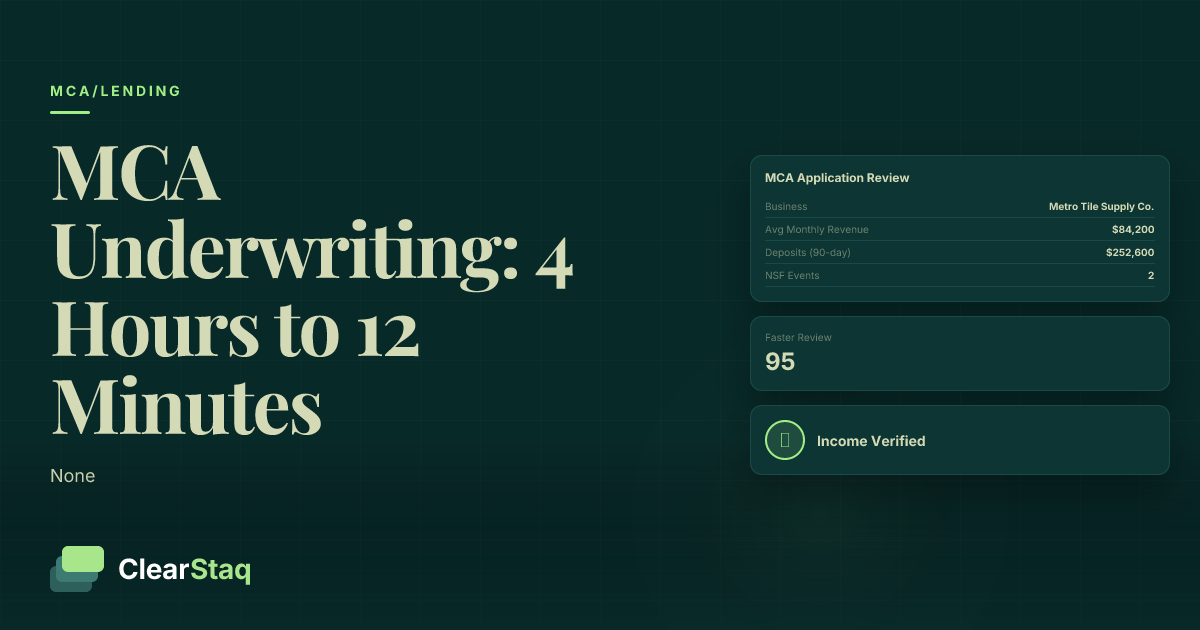
The headline metric is straightforward: average underwriting time reduction from four hours to 12 minutes per deal. That's a 95% reduction in time per file, with no loss in output quality and significant improvement in fraud detection coverage.
Breaking down those 12 minutes: parsing and data extraction now takes under 30 seconds. Fraud review runs simultaneously — not as a separate sequential step. The analyst's active time is spent reviewing the output report, asking clarifying questions if needed, and making a decision. That review takes 10 to 11 minutes. The rest is done.
This business demonstrates strong financial health with consistent cash flow and minimal overdraft activity. Recommended for approval with standard terms.
Before and After: The Numbers Side by Side
| Metric | Before ClearStaq | After ClearStaq |
|---|---|---|
| Average underwriting time per deal | 4 hours | 12 minutes |
| Deals processed per analyst per day | 2–3 | 8–10 |
| Manual data entry errors | Frequent | Eliminated |
| Fraud signals checked per deal | 5–8 (informal) | 27 (automated) |
| Same-day term sheet delivery | Rare | Standard |
| Balance calculation discrepancies | Occasional | Zero |
The automated output surfaces NSF patterns and overdraft risk signals alongside deposit volume, average daily balance, and monthly revenue — all in a structured report that takes minutes to review rather than hours to produce. For a deeper look at how transaction velocity analysis adds another layer to the cash flow picture, the automated report includes that data point as well.
See What a 12-Minute Underwriting Workflow Looks Like
Book a live demo and we'll run a real bank statement through ClearStaq while you watch — average daily balance, fraud signals, cash flow report, all in under 60 seconds.
What the Freed-Up Time Actually Gets Used For
The 95% time reduction isn't just an efficiency metric — it's a reallocation of human capacity. Underwriters who were spending their days doing data entry are now spending their days on merchant calls, relationship building, and deal structuring. Those activities directly generate revenue and don't scale with headcount the same way manual review does.
More deals submitted per analyst means higher individual commissions. Leadership time that used to go toward managing backlog and firefighting is now available for business development. Team morale improved when the tedious, error-prone work was removed from the daily routine — a benefit that doesn't show up in a time metric but matters significantly for retention.
Beyond Speed: Fraud Detection and Decision Quality
The concern every experienced MCA broker raises about automation is legitimate: does moving faster mean catching less? It's a fair question, and the honest answer in this case is the opposite of what most people expect.
ClearStaq runs 27 fraud signals simultaneously during the same parse that extracts cash flow data. There's no separate fraud review step, no toggle between cash flow mode and fraud mode. The fraud analysis happens in parallel, in the same 30 seconds, and the output report surfaces both cash flow metrics and fraud risk flags together.
Why Automated Fraud Detection Is More Thorough Than Manual Review
Manual reviewers, even experienced ones, typically check five to eight obvious fraud indicators during a bank statement review. They're looking for round-number deposits, high NSF counts, sudden revenue spikes. Those checks are valuable, but they represent a fraction of the signal surface area available in the data.
ClearStaq checks 27 signals in parallel — every time, on every deal, regardless of how many files have been reviewed that day. Human reviewers experience accuracy degradation on the eighth statement of the day. Automated accuracy doesn't. Subtle patterns like revenue smoothing across months, circular transaction indicators, and structured deposit sequences are invisible to tired eyes but immediately visible to an algorithm that's explicitly looking for them.
Specific Fraud Signals the Broker Now Catches Automatically
In practice, the fraud detection improvement showed up quickly after implementation. MCA stacking detection — identifying whether a merchant has active advances from other funders — is now caught automatically through deposit pattern analysis that would have required specific knowledge and time to spot manually. NSF clustering patterns that predict default risk are flagged in the report. Round-number deposit anomalies that suggest potential income manipulation are highlighted automatically, even when they occur infrequently enough that a manual reviewer scanning a statement might not notice the pattern.
The broker found instances in their historical files where manual review had missed stacking indicators on deals that later defaulted. That discovery, more than any benchmark comparison, validated the switch.
What This Means for MCA Brokers Still Reviewing Manually
If the broker in this case study was losing deals at a four-hour review cycle, the question worth asking is: what are you losing at your current speed? The math doesn't require a four-hour baseline to be painful. A two-hour cycle against a competitor running at 45 minutes still loses the deal most of the time.
The competitive landscape is shifting. MCA industry trends in 2026 point clearly toward automation adoption accelerating among brokers of all sizes. The brokers automating now are building a structural advantage that compounds over time — more deals processed, faster turnarounds, better fraud detection, same headcount. Brokers still running manual workflows aren't just slower today; they're falling further behind with each month that passes.
Calculating Your Own ROI on Underwriting Automation
The ROI calculation is straightforward. Start with this formula:
(Deals lost per week × average commission) − monthly tool cost = net monthly gain
Conservative numbers: one recovered deal per week at a $2,000 commission returns $8,000 per month. Most MCA brokers losing deals to faster competitors are losing more than one per week. Beyond recovered deals, the same headcount handling three times the deal volume means revenue growth without proportional cost growth — the kind of scaling that's impossible to achieve by hiring alone.
Time-to-value is also worth noting: ClearStaq's onboarding takes one day, and ROI begins on the first automated deal, not after a multi-month implementation project.
How to Start Without Disrupting Your Live Pipeline
The transition doesn't require a system overhaul. Start with new deals only — there's no need to reprocess existing files. Run ClearStaq in parallel with manual review for your first five deals to build confidence in the output. The browser-based upload interface works immediately; API integration with your CRM can come later once you've validated the accuracy on live files.
ClearStaq's 900+ bank format support means virtually no deal will be turned away for an unsupported statement format. Regional banks, national institutions, digital-only banks — the format library covers the full range of what MCA merchants actually submit, which matters more than it might sound when your merchant base is geographically diverse.
Frequently Asked Questions
How long does manual MCA bank statement underwriting typically take?
Manual MCA underwriting typically takes two to four hours per deal when reviewing three months of bank statements. The biggest time sinks are transcribing transaction data, calculating average daily balance by hand, and checking for fraud indicators line by line across hundreds of transactions. Analysts reviewing high volumes experience accuracy degradation as the day progresses.
What is MCA underwriting automation?
MCA underwriting automation uses software to parse bank statement PDFs, extract cash flow metrics, and run fraud detection checks automatically — replacing manual data entry and calculation. Modern platforms like ClearStaq return a complete underwriting report in under 60 seconds, reducing total review time from hours to minutes without sacrificing accuracy or fraud detection coverage.
Is automated bank statement review as accurate as manual underwriting?
Automated bank statement review is typically more accurate than manual review because it eliminates data entry errors and applies consistent logic to every transaction, every time. ClearStaq's parsing accuracy exceeds 99.5%, and its 27-signal fraud detection catches subtle patterns that human reviewers miss — particularly on high-volume days when fatigue affects manual accuracy. For a broader look at MCA underwriting software options, the accuracy comparison across tools is worth reviewing before committing.
What is the ROI of automating MCA underwriting?
ROI depends on deal volume and average commission, but conservative estimates are significant. Recovering even one lost deal per week at a $2,000 commission returns $8,000 per month. Beyond recovered deals, the same headcount can process three times the volume after automation — compounding revenue without adding staff costs. Most brokers see positive ROI within the first week of deployment.
How long does it take to implement MCA underwriting automation?
With ClearStaq, MCA brokers can parse their first statement within 60 seconds of signing up — no IT project or integration required to start. Full webhook integration with an existing CRM typically takes less than one week, and brokers are processing live deals through the automated workflow within the first few days. The browser-based interface requires no technical setup at all.
Every Hour Spent on Manual Review Is an Hour a Faster Broker Is Winning Your Deals
Stop losing fundable merchants to competitors with faster workflows. Book a demo and watch ClearStaq process a real bank statement in real time — cash flow report, 27 fraud signals, and a complete underwriting output in under 60 seconds.
Frequently Asked Questions
How long does manual MCA bank statement underwriting typically take?
Manual MCA underwriting typically takes two to four hours per deal when reviewing three months of bank statements. The biggest time sinks are transcribing transaction data, calculating average daily balance by hand, and checking for fraud indicators line by line across hundreds of transactions. Accuracy also degrades as analysts review more files in a single day.
What is MCA underwriting automation?
MCA underwriting automation uses software to parse bank statement PDFs, extract cash flow metrics, and run fraud detection checks automatically — replacing manual data entry and calculation. Platforms like ClearStaq return a complete underwriting report in under 60 seconds, reducing total review time from hours to minutes without sacrificing accuracy.
Is automated bank statement review as accurate as manual underwriting?
Automated bank statement review is typically more accurate than manual review because it eliminates data entry errors and applies consistent logic to every transaction. ClearStaq's parsing accuracy exceeds 99.5%, and its 27-signal fraud detection catches subtle patterns that human reviewers miss, particularly on high-volume days when fatigue affects manual accuracy.
What is the ROI of automating MCA underwriting?
ROI depends on deal volume and average commission, but conservative estimates are significant. Recovering even one lost deal per week at a $2,000 commission returns $8,000 per month. Beyond recovered deals, the same headcount can process three times the volume after automation, compounding revenue without adding staff costs.
How long does it take to implement MCA underwriting automation?
With ClearStaq, MCA brokers can parse their first statement within 60 seconds of signing up — no IT project or integration required to start. Full webhook integration with an existing CRM typically takes less than one week, and brokers are processing live deals through the automated workflow within the first few days.
ClearStaq Team
Product Team
The ClearStaq team builds AI-powered tools for bank statement parsing, fraud detection, and income verification.