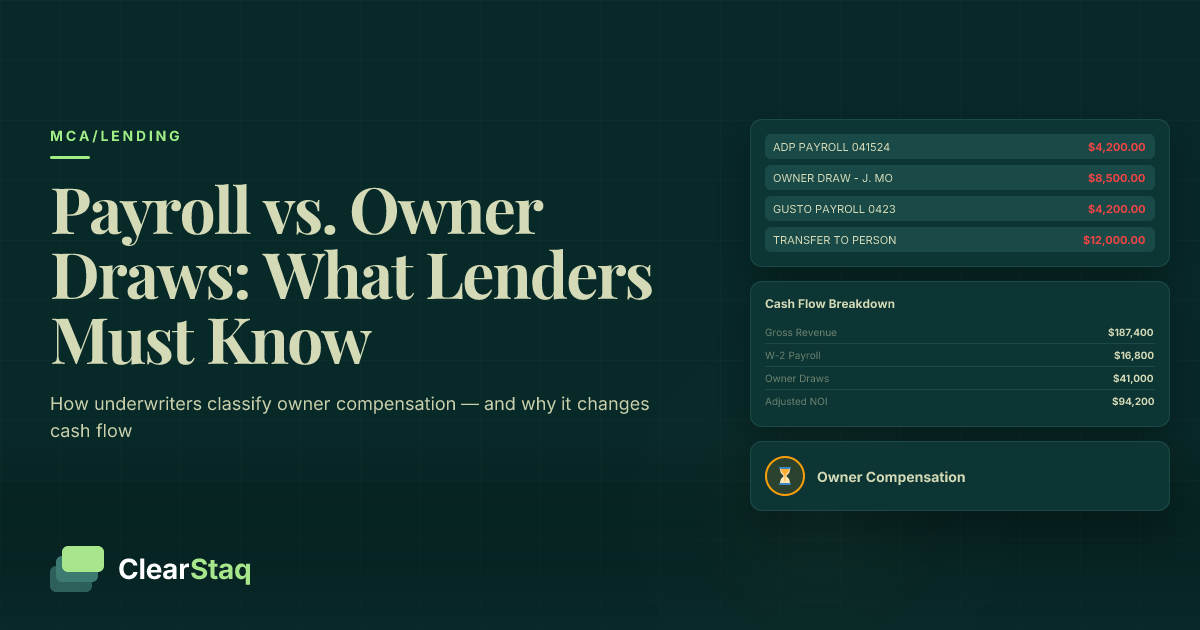
Identifying payroll transactions in bank statements requires distinguishing between four compensation types — owner draws, guaranteed payments, W-2 wages, and S-corp distributions — each appearing differently in transaction data and requiring different treatment in cash flow analysis. Automated parsing tools classify these outflows by ACH description patterns, payee names, and transaction frequency to calculate true net operating cash flow available for debt service.
What you'll learn
- Owner draws appear as irregular round-dollar debits with the owner's personal name, while employee payroll carries a biweekly cadence and a payroll processor ACH fingerprint such as ADP, Gusto, or Paychex
- Entity type determines how much owner compensation is adjustable in underwriting — sole proprietor draws are fully discretionary, while S-corp W-2 wages represent a fixed labor cost that cannot be added back
- True distributable cash flow equals gross deposits minus identified operating expenses minus existing debt service minus normalized owner compensation — gross deposit volume alone overstates debt capacity
- The absence of regular payroll ACH from a business claiming S-corp status is a red flag indicating potential IRS compliance issues and requiring underwriter scrutiny
- Automated parsing tools apply rule-based and machine learning classification across 900-plus bank formats to tag transactions as OWNER_DRAW, EMPLOYEE_PAYROLL, PARTNER_DISTRIBUTION, or OWNER_WAGE — enabling programmatic cash flow analysis at scale
Identifying payroll transactions in bank statements requires distinguishing between four compensation types — owner draws, guaranteed payments, W-2 wages, and S-corp distributions — each of which appears differently in transaction data and requires different treatment in cash flow analysis. Automated parsing tools classify these outflows by ACH description patterns, payee names, and transaction frequency to calculate true net operating cash flow available for debt service.
Why Owner Compensation Is the Most Misunderstood Line Item in Business Underwriting
Ask ten underwriters how they handle owner compensation in a bank statement review, and you'll get ten different answers. That inconsistency costs lenders money — either by approving businesses with less debt capacity than the numbers suggest, or by declining healthy businesses because owner draws inflated the apparent expense base.
The problem starts with a fundamental mismatch. Accounting treats owner draws as equity reductions. Underwriting treats every cash outflow as a potential operating expense. Neither framework, on its own, produces an accurate picture of how much cash a business actually has available for debt service.
This post bridges that gap. It covers transaction-level identification of owner compensation, underwriting treatment by entity type, add-back methodology, and red flag signals — in one place, written for lenders, not accountants.
The Gap Between Accounting Definitions and Underwriting Reality
In a balance sheet, an owner's draw reduces the equity account — it doesn't touch the income statement at all. That means it doesn't appear as an expense in accounting terms. But in a bank statement, cash still leaves the account. The outflow is real, the balance declines, and the business has less money to service debt.
Underwriters analyzing bank statements see debits without bookkeeping context. A $10,000 debit to "John Smith" could be an owner draw, a vendor payment, a loan repayment, or a personal expense run through the business account. Without classification, it's just a number.
The same business can appear cash-flow positive or negative depending entirely on how owner compensation is treated. That's not a theoretical concern — it changes approval decisions.
Why Gross Deposit Volume Is an Incomplete Metric
Gross deposit volume is a starting point, not a conclusion. Understanding the difference between true revenue versus gross revenue is essential before owner compensation even enters the picture — because deposits can include returned funds, inter-account transfers, and non-revenue inflows that overstate the business's earning power.
Layer owner compensation on top of that, and the distortion compounds. A business showing $50,000 in monthly deposits but taking $15,000 in owner draws has a very different risk profile than raw deposit volume implies. Net operating cash flow — not gross deposits — is the number that determines debt service capacity.
What Is Owner Compensation? The Four Ways Business Owners Pay Themselves
Before you can identify owner compensation in a bank statement, you need to know what you're looking for. There are four distinct compensation structures, each associated with specific entity types and each leaving a different footprint in transaction data.
The SBA's overview of owner compensation by entity type provides a useful baseline, but it stops at the accounting layer. Here's how each structure translates to what lenders actually see in statements.
| Compensation Type | Entity Type | Accounting Treatment | Underwriting Treatment |
|---|---|---|---|
| Owner's Draw | Sole prop, single-member LLC | Equity reduction (not an expense) | Discretionary — potentially excludable from expense base |
| Guaranteed Payment | Partnership, multi-member LLC | Deductible expense at entity level | Semi-fixed — partially adjustable depending on partnership terms |
| W-2 Wages | S-corp, C-corp owner-employee | Operating expense (payroll) | Fixed operating cost — generally not addable back |
| S-Corp Distribution | S-corp shareholder | Equity distribution (not an expense) | Discretionary portion — partially excludable above reasonable comp |
Owner's Draw vs. Salary: The Tax Context Lenders Should Understand
Owner draws carry no payroll tax withholding. There's no FICA signature in the transaction — no consistent net-pay amount that reflects federal and state withholding deductions. Draws happen when the owner decides they need cash, which means irregular timing and often round dollar amounts.
Salaries processed through payroll carry a different fingerprint. ACH descriptions typically include the payroll processor name: Gusto, ADP, Paychex, Ceridian, Heartland Pay. The net pay amount reflects withholding, so it's rarely a round number. The cadence is biweekly or semi-monthly — consistent enough to identify on a calendar grid.
For S-corp owners, the IRS requires that owner-employees take reasonable W-2 compensation before taking distributions. This means a properly structured S-corp should show both payroll ACH and periodic distributions. If it shows only distributions, that's a compliance red flag — and an underwriting one.
Guaranteed Payments and Partnership Distributions: The Overlooked Category
Guaranteed payments are the partnership equivalent of a salary — fixed payments to partners regardless of whether the business is profitable. Unlike draws, they're deductible at the entity level, which means they reduce reported partnership income. In a bank statement, they typically appear as recurring ACH transfers to a partner's personal account or as scheduled wire transfers.
Multi-member LLCs frequently show inter-account transfers that are easy to misclassify. A payment to "Michael Torres" might be a guaranteed payment to a managing partner, a loan repayment, or a vendor payment — the description alone may not disambiguate. Frequency and consistency are the key signals: guaranteed payments tend to be the same amount on the same schedule every month.
How to Identify Payroll Transactions in a Bank Statement: Patterns and Signals
This is where lender training and automated tooling diverge most sharply from general accounting guidance. No competitor content covers what transaction data actually looks like when you're distinguishing employee payroll from owner draws. Here's the practical guide.
For payroll identification in bank statements, the primary signals are ACH description content, payment cadence, and amount characteristics. Each compensation type has a distinct combination of these three factors.
ACH Description Patterns That Signal Employee Payroll vs. Owner Pay
Employee payroll ACH batches almost always contain a payroll processor identifier in the description field. Common patterns include:
- ADP — "ADP PAYROLL", "ADP TX", "ADP WAGE"
- Gusto — "GUSTO PAYROLL", "GUSTO PAY"
- Paychex — "PAYCHEX PAYROLL", "PAYCHEX FOCS"
- Intuit/QuickBooks Payroll — "INTUIT PAYROLL", "QBO PAYROLL"
- Ceridian — "CERIDIAN", "CERIDIAN HCM"
- Heartland — "HEARTLAND PAY", "HEARTLAND PYRL"
- Generic — "PAYROLL" followed by company name or batch reference
Owner W-2 payroll from an S-corp follows the same pattern — the same ACH processor, the same description format. What distinguishes it from a full employee payroll batch is the amount: a single-owner S-corp may show a payroll debit matching exactly one employee's net pay. The individual payee may be identified in supplemental transaction data depending on the bank's format.
Owner draws, by contrast, look like this: "ACH DEBIT — SARAH CHEN", "CHECK — PAYABLE TO OWNER", or simply "ONLINE TRANSFER TO PERSONAL SAVINGS." No payroll processor, no batch reference, no consistent biweekly cadence. For a guide to extracting payroll data from bank statements in a tax context, the same identification logic applies — the distinction matters whether you're reconciling books or underwriting a loan.
Round Numbers, Irregular Timing, and Other Draw Signatures
Owner draws are discretionary. Because they're not payroll-calculated — no formula involving hours, rates, and withholding — they tend to land on round numbers. $5,000. $10,000. $7,500. This is one of the clearest signals separating draws from genuine payroll, where net pay amounts are almost never round.
Timing irregularity is equally telling. Draws happen when cash is available or when the owner needs funds — not on a fixed schedule. A statement showing payroll debits on the 1st and 15th of every month alongside irregular $8,000 debits in the owner's name on the 7th, 19th, and 28th is displaying both patterns simultaneously. They represent different things in the cash flow calculation.
Check-based draws are another category: paper checks payable to the owner appearing as "CHECK" debits. When the bank statement includes payee data — not all do — these are straightforward to identify. When the statement shows only "CHECK #1047" without a payee, cross-referencing with the check register or requesting additional documentation may be necessary.
How Bank Format Differences Affect Payroll Identification
Chase, Bank of America, Wells Fargo, and regional banks present ACH description fields differently. Chase tends to preserve the full originator name. Bank of America truncates descriptions more aggressively. Regional banks may not standardize description formatting at all — the same Gusto payroll transaction can appear as "GUSTO" at one bank and "GUSTO PAY 123456" at another.
This means payroll identification rules written for one bank format may produce false negatives at another. Normalization — stripping formatting artifacts, standardizing capitalization, mapping known processor name variants to canonical identifiers — must happen before classification rules are applied. Multi-format parsing capability isn't a convenience feature; it's a prerequisite for consistent payroll identification across a real loan portfolio.
Owner Draws vs. Employee Payroll: Why the Distinction Matters for Cash Flow Analysis
Employee payroll is a fixed operating expense. It must be paid regardless of revenue fluctuations, owner preferences, or business circumstances. In cash flow analysis, it belongs in the expense column without adjustment — it reduces the cash available for debt service just as surely as rent or insurance.
Owner draws are different. They're discretionary. The owner can reduce them, defer them, or eliminate them if the business needs cash for debt service. That discretionary nature makes them a different category in the underwriting calculation — not necessarily excludable, but treatable differently than a contractually fixed operating cost.
The practical implication: a business paying $20,000 per month in combined payroll, where $16,000 goes to employees and $4,000 goes to the owner as W-2 wages, has a very different cash flow profile than a business where the same $20,000 is split $10,000 to employees and $10,000 as owner draws. The second business has more adjustable capacity — but only if the underwriter separates the two.
The Commingling Problem: When Personal and Business Expenses Share One Account
Many sole proprietors and single-member LLCs run personal expenses through the business account. This is the personal vs. business expense commingling problem, and it inflates the apparent expense base in ways that can make a viable business look unfinanceable.
An owner drawing $8,000 per month might have $3,000 of that flowing to personal grocery, utility, and subscription charges — not discretionary draws in any meaningful business sense, but also not genuine operating expenses. Automated categorization tools can flag personal-category merchants appearing in a business account: grocery chains, personal care retailers, streaming services, consumer electronics stores. These are signals that the expense base needs to be cleaned before cash flow analysis proceeds.
The downstream risk of missing commingling: overstating the expense base reduces apparent net operating cash flow, which can lead to declining a creditworthy applicant. Understating it — by treating personal expenses as business operating costs — can lead to approving a business whose actual margins are thinner than they appear.
Irregular or Lumpy Owner Pay: What It Signals to Underwriters
A large owner draw in month three of a three-month statement window distorts the monthly average. That one month looks cash-lean; the business looks inconsistent; the underwriter may flag volatility that isn't real — it's just the owner's draw timing. Normalizing or annualizing lumpy owner compensation, rather than reading it month-by-month, produces a more accurate picture.
Lump-sum draws also create a second-order problem. Large cash extractions in any given month can deplete the account balance enough to trigger NSF events in the days that follow. Understanding overdraft patterns and borrower risk requires separating draw-induced cash depletion from structural liquidity problems — they have different implications for credit quality.
The Add-Back Question: When Can Underwriters Adjust for Owner Compensation?
The add-back concept is straightforward: remove identified owner compensation from the expense calculation to arrive at a cleaner measure of distributable cash flow. The implementation is more nuanced.
An add-back is appropriate when owner compensation is above market rate and genuinely discretionary. It's not appropriate when the compensation represents labor the business would have to replace at similar cost — if the owner is performing the core revenue-generating work and would need to hire a replacement at market salary, that compensation is a real operating cost regardless of how it's structured.
The AICPA's framework for normalizing owner compensation in business valuation applies the same logic: establish a reasonable market-rate replacement salary for the owner's role, then normalize total owner compensation to that rate. Underwriting add-backs follow the same methodology.
True Distributable Cash Flow: The Metric Lenders Should Be Calculating
True distributable cash flow is the most conservative and accurate basis for assessing MCA repayment capacity. The formula:
True Distributable Cash Flow = Gross Deposits − Identified Operating Expenses − Existing Debt Service − Normalized Owner Compensation
Gross deposits minus operating expenses alone overstates cash available for new debt service if owner draws haven't been isolated. And EBITDA-based analysis — the standard for larger business lending — doesn't translate cleanly to bank statement underwriting, which has no depreciation or amortization to add back. Owner compensation normalization serves the same function in bank statement analysis that D&A add-backs serve in EBITDA analysis: it brings the cash flow figure closer to what the business actually generates independent of owner-specific decisions.
How Entity Type Changes the Add-Back Calculation
Entity type determines how much of the owner comp is genuinely adjustable:
- Sole proprietor: All draws are discretionary equity withdrawals. The full draw amount is available for add-back consideration, subject to market-rate replacement analysis.
- S-corp: The W-2 portion represents a genuine labor cost. Only distributions above reasonable market compensation can be normalized. The IRS requirement for reasonable compensation means the W-2 floor is not fully adjustable.
- Partnership/LLC: Guaranteed payments are semi-fixed obligations; profit distributions are discretionary. Only the distribution component is cleanly addable back.
- C-corp: Owner salary is a deductible business expense. Without strong justification — e.g., compensation clearly above market — it generally cannot be added back.
Validating these figures against tax documents is essential. Cross-referencing bank statements with tax returns closes the loop between what the statement shows and what the entity's filings confirm: Schedule C for sole props, K-1 for partnerships, W-2 and 1120S for S-corps.
Entity Type Matters: How Sole Props, LLCs, S-Corps, and C-Corps Differ in the Statement
Each entity type leaves a different pattern in the bank statement. Knowing what to expect — and flagging when expectations aren't met — is a core underwriting skill for business cash flow analysis involving owner compensation.
What Underwriters Should Expect to See by Entity Type
Sole proprietor / single-member LLC: No payroll processor ACH. Draws appear as irregular debits with the owner's personal name in the payee field, or as transfers to a personal account. Round dollar amounts. No FICA withholding signature. The bank account may be registered under the owner's personal SSN.
S-corp: Regular biweekly payroll ACH from ADP, Gusto, Paychex, or similar. The amount reflects net pay after withholding — not a round number. Additionally, periodic (often quarterly or as-needed) lump-sum ACH or wire to the owner's personal account representing distributions. The absence of regular payroll ACH from a business claiming S-corp status is a red flag — it may indicate the owner is bypassing required reasonable compensation, which has both IRS and underwriting implications.
Partnership / multi-member LLC: Recurring ACH or wire transfers to partner names or partner personal accounts. Amounts tend to be consistent if they represent guaranteed payments; variable if they represent profit distributions. The transaction description may include the partner's name or a reference to the partnership agreement's payment schedule.
C-corp: Structured W-2 payroll only. Dividends or shareholder distributions are uncommon in closely-held C-corps seeking working-capital financing — their presence warrants explanation.
Multi-Entity Structures: When Draws Flow Between Accounts
In holding company / operating company structures, owner compensation may never appear directly in the operating entity's bank statement. The operating company transfers funds to "XYZ Holdings LLC," which then pays the owner personally. The operating statement shows only the inter-entity transfer — which looks like a vendor payment or management fee rather than owner compensation.
These structures are legitimate, but they require additional due diligence. Underwriters should request statements for all related entities when inter-entity transfers represent significant recurring outflows. Automated tools can flag recurring ACH or wire transfers to entities with similar registered names or addresses as potential inter-entity compensation flows for human review.
Red Flags: When Owner Compensation Signals Risk Rather Than Stability
Owner compensation isn't always a neutral line item. Certain patterns are active risk signals — indicators of cash extraction, revenue manipulation, or imminent financial distress.
The Over-Compensation Signal: When Owner Pay Exceeds Business Capacity
Calculate owner compensation as a percentage of monthly net deposits. While benchmarks vary by industry, extreme ratios warrant immediate scrutiny. An owner drawing $20,000 per month from a business generating $30,000 in net deposits has roughly $10,000 left to cover rent, payroll, cost of goods, and any new debt service. That math often doesn't work.
Cross-referencing with tax return data adds another dimension. If Schedule C shows minimal net income while bank statements show heavy draws, the business may be drawing down cash reserves — not generating income. That's a fundamentally different risk profile than a profitable business distributing earnings to its owner.
Pre-Application Cash Extraction Patterns
A sudden increase in draw size or frequency in the 60 days before application is a yellow flag. It can indicate the owner is extracting equity in anticipation of business closure or default — reducing the collateral base before a lender takes a position. This pattern should be evaluated alongside NSF frequency, declining deposit trends, and existing debt obligations visible in the statement.
Other owner comp red flags to add to your MCA underwriting checklist:
- Draws that occur immediately after large deposits — suggesting cash isn't being retained for operations
- Round-number draws that precisely match round-number deposits — a potential circular transaction signal
- Complete absence of owner compensation in a profitable business — income may be routed through a different account or entity
- Draw amounts that escalate month-over-month while deposit volumes decline
This business demonstrates strong financial health with consistent cash flow and minimal overdraft activity. Recommended for approval with standard terms.
How Automated Parsing Classifies Owner Compensation at Scale
Manual identification of owner compensation is slow, inconsistent, and error-prone. A single underwriter reviewing a 90-day statement from a multi-owner S-corp with mixed payroll and distributions can spend 30-45 minutes just on the compensation classification — before any cash flow calculation begins. Multiply that across a pipeline of 50 applications and the economics break down.
Automated payroll identification in bank statements applies rule-based and machine learning classification to every transaction at ingestion. ClearStaq's transaction categorization engine distinguishes payroll ACH batches from owner draw transactions using description patterns, payee names, and frequency analysis — across the 900+ bank formats in its parsing library. The same Gusto payroll transaction gets correctly classified whether it comes from a Chase statement or a regional credit union export.
The output is structured JSON with transaction category tags: OWNER_DRAW, EMPLOYEE_PAYROLL, PARTNER_DISTRIBUTION, OWNER_WAGE. Underwriting teams can programmatically sum each category, compute ratios, and apply their own decisioning logic — without rebuilding the classification layer from scratch. ClearStaq's MCA lending platform delivers this structured output directly into underwriting workflows, reducing time-to-decision without sacrificing analytical depth.
From Raw Transaction Data to Categorized Owner Comp Output
The pipeline from raw statement to classified owner compensation data follows five stages:
- Parse: Extract raw transaction records from PDF or OFX/QFX statement formats, preserving description fields, amounts, dates, and payee data where available
- Normalize: Standardize ACH description fields across bank format variants — strip truncation artifacts, map processor name variants to canonical identifiers
- Classify: Run the classification model against normalized descriptions, transaction amounts, and frequency patterns to assign category labels
- Score: Attach a confidence score to each classification, flagging low-confidence transactions for human review rather than auto-accepting
- Aggregate: Sum tagged transactions to produce total owner compensation, total employee payroll, and net operating cash flow metrics
Why Confidence Scores Matter When Classifying Ambiguous Transactions
Not every owner compensation transaction announces itself clearly. "ACH DEBIT — M PATEL" with no payroll processor reference could be an owner draw, a vendor payment, or a personal loan repayment. A binary classification system will guess; a confidence-scored system will flag it for review.
Confidence scoring reduces both error types: false positives (misclassifying employee payroll as owner draws, inflating apparent adjustable capacity) and false negatives (missing draws labeled ambiguously, understating owner compensation). High-confidence classifications process automatically; medium and low-confidence ones route to the underwriter's queue with context. That's the right division of labor between machine and human judgment. The same logic applies when extracting payroll data from bank statements for tax reconciliation — ambiguous transactions require human resolution regardless of the use case.
See How ClearStaq Classifies Owner Compensation Automatically
See how ClearStaq automatically tags owner draws, employee payroll, and partner distributions across any bank format — and delivers structured cash flow output your underwriting team can act on immediately.
Practical Framework: A Step-by-Step Approach to Owner Comp Analysis for Lenders
Here's the complete workflow — from statement collection to validated cash flow figure — that underwriting teams can apply to any business loan or MCA application.
- Collect statements: Request 3-6 months of bank statements for all business accounts. If the application mentions a holding company or multiple entities, request those statements too.
- Parse and normalize: Extract transaction records from raw PDFs or electronic formats. Standardize description fields across formats before applying any classification rules.
- Identify and tag owner comp: Apply the ACH description patterns, payee name signals, cadence analysis, and amount characteristics covered above. Tag transactions by compensation type: draw, W-2 wage, distribution, guaranteed payment.
- Separate employee payroll: Identify and isolate employee payroll as a fixed operating cost. Do not mix it with owner compensation in the adjustment calculation.
- Calculate monthly average owner comp: Sum tagged owner compensation transactions across the statement period. Divide by the number of months to get a normalized monthly figure. Don't let a single large draw skew the average.
- Apply entity-type add-back logic: Based on entity type, determine which portion of owner comp is adjustable. Sole prop draws are fully adjustable subject to market-rate analysis; S-corp W-2 wages are not; distributions above reasonable comp are partially adjustable.
- Compute true distributable cash flow: Net deposits minus operating expenses minus existing debt service minus normalized owner compensation.
- Cross-reference with tax documents: Validate the bank statement owner comp figure against Schedule C, K-1, or W-2 as appropriate for the entity type.
- Flag anomalies: Document any red flags identified — over-compensation ratios, pre-application extraction patterns, missing payroll from an S-corp, inter-entity transfers — for underwriter review.
Common Mistakes Underwriters Make When Analyzing Owner Compensation
These errors appear consistently across manual underwriting reviews:
- Treating all payroll ACH as employee payroll without checking whether the owner is the sole payee — a single-owner S-corp shows payroll ACH that represents owner W-2, not staff wages
- Adding back full owner comp without market-rate analysis — the add-back is only valid for the portion above what a replacement would cost
- Ignoring inter-entity transfers that represent hidden owner compensation flowing to a holding company before reaching the owner personally
- Accepting stated owner salary at face value without verifying it matches what the bank statement actually shows in payroll debits
Validating Bank Statement Owner Comp Against Tax Documents
Tax documents provide an independent check on what the bank statement shows. Discrepancies are information, not noise — they point to second accounts, unreported income, or document manipulation.
- Sole proprietor: Schedule C net profit should approximate monthly net deposits minus business operating expenses. Large draws not reflected in Schedule C may indicate unreported business income converted to personal use.
- S-corp: Box 1 of the W-2 should match the sum of payroll ACH amounts visible in the bank statement for the owner's wage payments.
- Partnership: Schedule K-1 guaranteed payment figures should align with the recurring ACH transfer amounts to partner accounts in the statement.
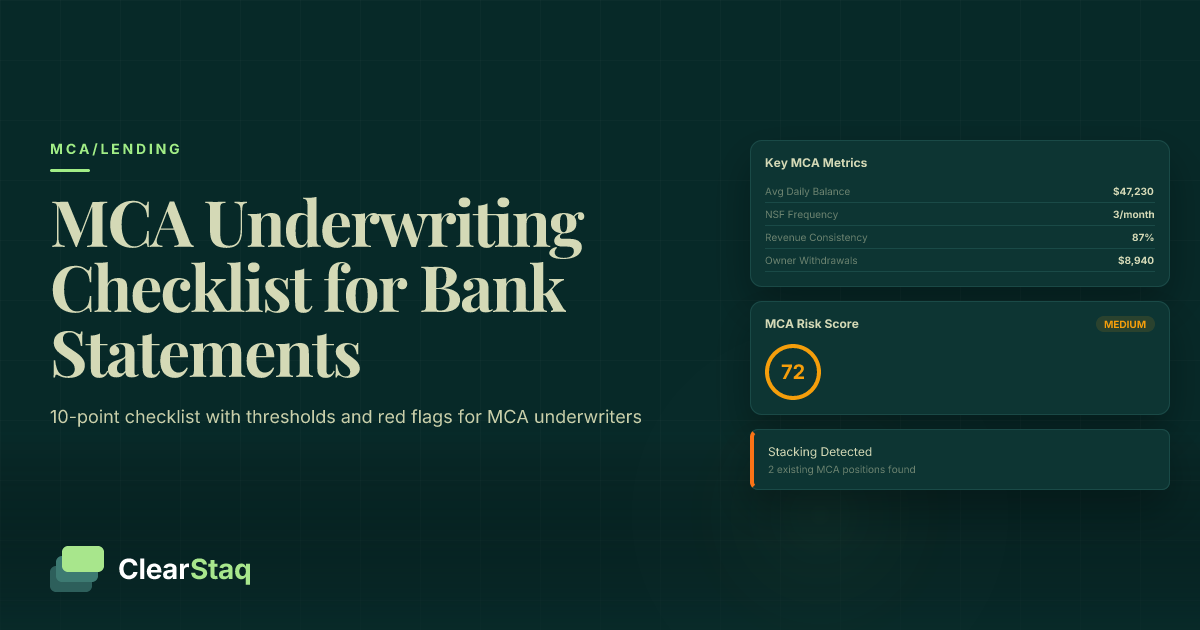
Material discrepancies between statement cash flows and tax figures require explanation before proceeding. For a detailed methodology on reconciling these documents, see the full guide to cross-referencing bank statements with tax returns in underwriting. For the complete set of underwriting criteria beyond owner compensation, the MCA underwriting checklist covers the full review process.
Frequently Asked Questions
How do lenders identify payroll transactions in bank statements?
Lenders identify payroll transactions by scanning ACH description fields for payroll processor names — ADP, Gusto, Paychex, Ceridian, Intuit Payroll — alongside biweekly payment cadence and non-round net pay amounts that reflect withholding deductions. Owner draws, by contrast, typically appear as ACH or check debits with the owner's personal name, irregular timing, and round dollar amounts. Automated parsing tools apply these pattern rules at scale across 900+ bank formats.
What is the difference between an owner draw and a salary for underwriting purposes?
An owner draw is a discretionary equity withdrawal with no payroll tax obligation — the owner takes cash from the business as needed, in any amount, at any time. A salary is processed through payroll, appears as a recurring ACH with a payroll processor fingerprint, and represents a fixed operating expense with consistent biweekly timing. For underwriting, draws may be partially adjustable in cash flow analysis, while W-2 salaries are treated as fixed costs that reduce debt service capacity regardless of owner decisions.
Can owner draws be added back to cash flow when underwriting a business loan?
Owner draws can be partially added back when they exceed a reasonable market-rate replacement salary for the owner's role. The methodology involves identifying total owner compensation outflows, establishing what a replacement employee would cost for the same function, and adding back only the excess above that market rate. For MCA underwriting, stripping draws from the expense base before calculating net operating cash flow is a common adjustment that better reflects true debt service capacity.
How do MCA lenders treat owner compensation in cash flow analysis?
MCA lenders typically calculate net operating cash flow by subtracting identified operating expenses and existing debt service from gross deposits. Owner compensation is isolated as a separate category — employee payroll is treated as a fixed operating expense, while owner draws or distributions may be excluded from the expense base to assess true repayment capacity. The entity type determines how much of the identified owner comp is adjustable, with sole proprietor draws being the most flexible and S-corp W-2 wages the least.
How does entity type affect how underwriters analyze owner compensation in bank statements?
Sole proprietors show irregular draw debits with no payroll processor involvement — all draws are fully discretionary. S-corp owners should show both biweekly W-2 payroll ACH and periodic distributions; the absence of regular payroll ACH from an S-corp is itself a red flag indicating potential IRS compliance issues. Partnerships show recurring ACH transfers to partner accounts representing guaranteed payments. C-corp owners appear only as W-2 payroll recipients, with no shareholder distributions expected in most working-capital lending contexts.
Stop Guessing Which Transactions Are Owner Draws
Stop guessing which transactions are owner draws and which are operating expenses. ClearStaq's automated classification engine separates them instantly — so your underwriters spend time making decisions, not hunting through transaction descriptions.
Frequently Asked Questions
How do lenders identify payroll transactions in bank statements?
Lenders identify payroll transactions by scanning ACH description fields for payroll processor names — ADP, Gusto, Paychex, Ceridian, Intuit Payroll — alongside biweekly payment cadence and non-round net pay amounts that reflect withholding deductions. Owner draws, by contrast, typically appear as ACH or check debits with the owner's personal name, irregular timing, and round dollar amounts. Automated parsing tools apply these pattern rules at scale across 900-plus bank formats.
What is the difference between an owner draw and a salary for underwriting purposes?
An owner draw is a discretionary equity withdrawal with no payroll tax obligation — the owner takes cash from the business as needed, in any amount, at any time. A salary is processed through payroll, appears as a recurring ACH with a payroll processor fingerprint, and represents a fixed operating expense with consistent biweekly timing. For underwriting, draws may be partially adjustable in cash flow analysis while W-2 salaries are treated as fixed costs that reduce debt service capacity.
Can owner draws be added back to cash flow when underwriting a business loan?
Owner draws can be partially added back when they exceed a reasonable market-rate replacement salary for the owner's role. The methodology involves identifying total owner compensation outflows, establishing what a replacement employee would cost for the same function, and adding back only the excess above that market rate. For MCA underwriting, stripping draws from the expense base before calculating net operating cash flow is a common adjustment that better reflects true debt service capacity.
How do MCA lenders treat owner compensation in cash flow analysis?
MCA lenders typically calculate net operating cash flow by subtracting identified operating expenses and existing debt service from gross deposits. Owner compensation is isolated as a separate category — employee payroll is treated as a fixed operating expense, while owner draws or distributions may be excluded from the expense base to assess true repayment capacity. The entity type determines how much of the identified owner compensation is adjustable, with sole proprietor draws being most flexible and S-corp W-2 wages the least.
How does entity type affect how underwriters analyze owner compensation in bank statements?
Sole proprietors show irregular draw debits with no payroll processor involvement — all draws are fully discretionary. S-corp owners should show both biweekly W-2 payroll ACH and periodic distributions; the absence of regular payroll ACH from an S-corp is a red flag indicating potential IRS compliance issues. Partnerships show recurring ACH transfers to partner accounts representing guaranteed payments. C-corp owners appear only as W-2 payroll recipients, with no shareholder distributions expected in most working-capital lending contexts.
ClearStaq Team
Product Team
The ClearStaq team builds AI-powered tools for bank statement parsing, fraud detection, and income verification.