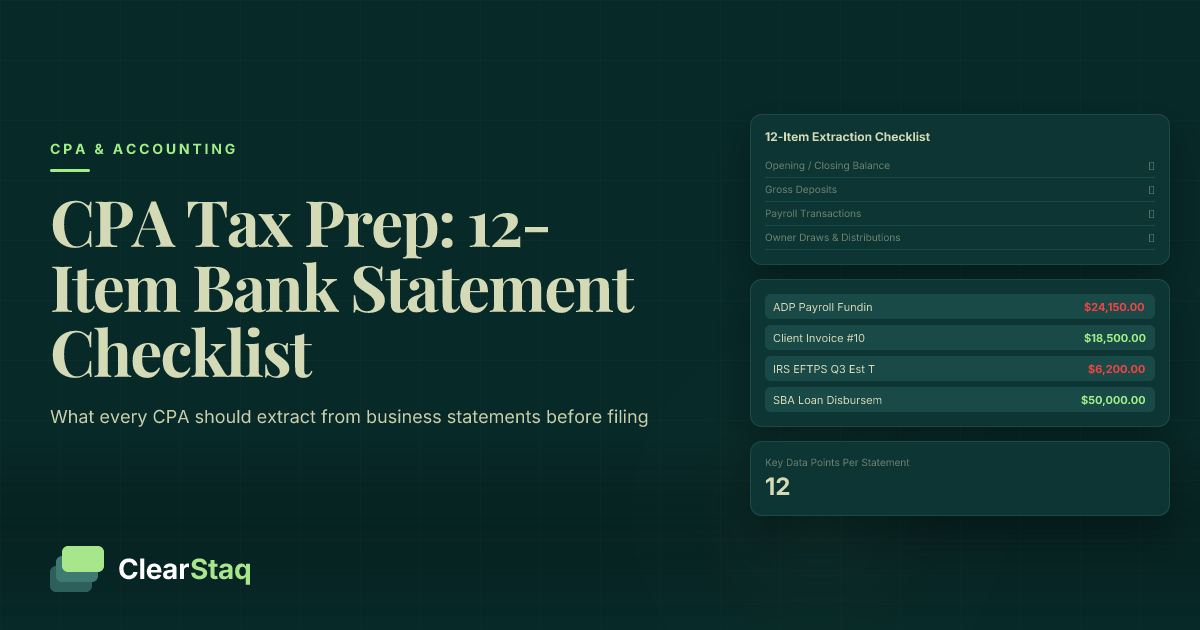
Before filing, CPAs should extract 12 categories from business bank statements: gross revenue deposits, owner draws, payroll transactions, 1099 contractor payments, estimated quarterly tax payments, loan proceeds, IRS Schedule C expenses, NSF fees, recurring subscriptions, crypto exchange transactions, vehicle and fuel purchases, and statement anomalies. Automated extraction tools can surface all 12 in a single pass.
What you'll learn
- CPAs should extract 12 distinct categories from business bank statements before filing, spanning income classification, expense capture, and anomaly detection
- Owner draws are one of the most commonly misclassified items — they are equity withdrawals, not deductible business expenses for sole proprietors
- Loan proceeds and MCA advances appear as deposits but are not taxable income and must be explicitly excluded from gross revenue
- Crypto exchange ACH transfers in business bank statements trigger additional reporting obligations including Form 8949 and Schedule D
- Automated bank statement parsing APIs can extract and categorize all 12 checklist items in a single pass, replacing hours of manual line-by-line review per client
Before filing, CPAs should extract 12 categories from business bank statements: gross revenue deposits, owner draws, payroll transactions, 1099 contractor payments, estimated quarterly tax payments, loan proceeds, IRS Schedule C expenses, NSF fees, recurring subscriptions, crypto exchange transactions, vehicle and fuel purchases, and statement anomalies. Automated extraction tools can surface all 12 in a single pass — eliminating the manual review burden during your busiest season.
Why Bank Statement Review Is a Critical Pre-Filing Step
Bank statements are primary source documents. The IRS requires businesses to maintain records that support income and deductions reported on a return — and bank statements are often the most complete, unedited record of what actually moved through a business account. They corroborate gross receipts, substantiate deductions, and expose discrepancies before they become audit problems.
CPAs face professional liability when filed returns don't align with source documents. Bank statements are the reconciliation checkpoint that sits between what a client reports and what actually happened. The gap between those two things is where errors — and sometimes fraud — live.
The challenge is scale. A CPA firm handling 50 business clients during tax season may be looking at 600 or more statement-months of transactions. Without a systematic extraction process, critical items get missed. A systematic bank statement review checklist isn't just good practice — it's a risk management tool.
How Many Months of Statements Do CPAs Need?
The standard is 12 full months for an annual return — January through December for calendar-year businesses. Fiscal-year entities require the 12 months matching their tax year. Native PDF statements downloaded directly from the bank are always preferable to scanned copies; native PDFs preserve metadata, embedded fonts, and transaction structure that automated parsing tools rely on.
Request more than 12 months when onboarding a new client, when months are missing, or when there are signs of underreporting. Reviewing deposit patterns across a full year also supports revenue seasonality mapping, which helps CPAs identify whether a business's income profile is consistent with its industry and benchmark expectations.
The Cost of an Incomplete Review
Missed deductions leave client money on the table. A single overlooked SaaS subscription at $200/month is $2,400 in unclaimed deductions. Across dozens of clients, these gaps compound into significant underreported deductible expenses.
Unreported income is the more serious risk. If a client omits revenue that appears clearly in the bank statement, that discrepancy creates direct audit exposure — and it implicates the CPA who signed the return. A thorough, documented bank statement review is the primary defense. Manual line-by-line review is error-prone at volume. That's the case for a structured, repeatable extraction process.
The 12-Item Bank Statement Extraction Checklist for CPAs
This checklist is structured around IRS Schedule C filing categories — not generic bookkeeping categories. Each item maps to a specific tax treatment, filing obligation, or risk flag. CPAs should verify each item against client-provided records (QuickBooks exports, invoices, payroll reports, 1099 filings) before the return is finalized.
Items 1–6 are income and classification items — they determine what counts as taxable gross revenue and what doesn't. Items 7–12 are expense and anomaly items — they capture deductible costs and flag irregularities worth investigating. Two distinct passes through the statement.
AICPA professional standards require CPAs to exercise due diligence in reviewing client-provided documentation. A documented, reproducible extraction checklist is evidence of that diligence — and protection when questions arise post-filing.
1. Gross Revenue Deposits (Separated from Transfers and Loans)
Start by extracting all credit entries. Then remove everything that isn't operating revenue: inter-account transfers, loan proceeds, owner capital contributions, insurance reimbursements, and tax refunds. What remains is the candidate gross revenue figure — the number that must reconcile with reported gross receipts on Schedule C.
The most common misclassification error here is counting a line-of-credit draw as revenue. A $50,000 credit appearing in January looks like income if you're not verifying the counterparty. It's a loan. Flag all large lump-sum credits from financial institution ACH originators for explicit exclusion documentation.
Round-number deposits at regular intervals — exactly $10,000, exactly $25,000 — warrant additional scrutiny. They may be loan draws, capital contributions, or in unusual cases, structuring patterns. Document the basis for including or excluding each material deposit in your workpaper.
Identifying Non-Taxable Deposits
Four categories of credits are non-taxable and must be explicitly excluded from gross revenue: loan proceeds, insurance reimbursements, tax refunds, and owner capital injections. Each has identifiable characteristics in the statement data.
Loan proceeds typically originate from a bank or fintech lender ACH, with the originator name visible in the transaction descriptor. Insurance reimbursements often include a claim number in the memo field. Tax refunds from the IRS appear as "IRS TREAS 310" credits. Owner capital injections show as transfers from a personal account, often with the owner's name in the memo.
Document each excluded deposit with a brief note in the workpaper: the date, amount, counterparty, and basis for exclusion. This protects the CPA if the exclusion is ever questioned.
2. Owner Draws and Distributions
Owner draws are one of the most commonly misclassified items in business bank statement reviews. For sole proprietors and partnerships, owner draws are not a deductible business expense — they're equity withdrawals. Yet they appear in statements as debits, and clients frequently categorize them alongside legitimate business expenses in their bookkeeping.
Identify owner draws by looking for: transfers to personal bank accounts (often with the owner's name), checks made payable to the owner, and Zelle or Venmo payments sent to the owner's personal profile. These transactions need to be pulled out of the expense pool entirely and documented separately.
For S-corporations, the distinction gets more complex. Owner draws and W-2 salary both appear in statements, but they have different tax treatment. W-2 salary is a deductible business expense; distributions are not. A CPA needs to confirm both are correctly classified.
S-Corp Reasonable Compensation Check
The IRS requires S-corp owner-employees to pay themselves reasonable compensation via W-2 payroll before taking distributions. Underpaying W-2 salary while taking large shareholder distributions is a well-documented audit trigger — the IRS views it as an attempt to avoid payroll taxes.
During the bank statement review, compare total W-2 payroll debits (payroll processor transactions) against total owner distribution debits. If distributions significantly exceed salary for an owner actively working in the business, flag it for client discussion before filing. Reasonable compensation determinations should be documented in the workpaper.
3. Payroll Transactions and W-2 Reconciliation
Extract all payroll processor debits from the statement: ADP, Gusto, Paychex, and direct ACH payroll batches. Total them by quarter, then reconcile against the client's Form 941 quarterly payroll tax returns and year-end W-2 totals. The numbers should agree within rounding tolerances.
Discrepancies matter. Payroll debits on the statement that exceed W-2 totals may indicate unreported compensation, payroll processing errors, or in some cases, payroll fraud. Payroll debits that fall short of W-2 totals may indicate manual payroll payments not routed through the processor. Both warrant investigation before the return is filed.
Payroll tax deposit payments appear separately — look for IRS EFTPS debits, typically labeled "IRS USATAXPYMT." These should be extracted and reconciled against the tax deposit obligations shown on Form 941. For more detail on this process, see our guide on how to extract payroll data from bank statements for W-2 and payroll tax filing.
Separating Payroll from Owner Compensation
Payroll processor debits and direct owner compensation transfers have different tax treatment and must be categorized separately. Employee wages paid through a payroll processor are a fully deductible Schedule C expense. Direct transfers to an owner's personal account are draws — not deductible for sole proprietors.
For sole proprietors, no payroll deduction exists for the owner's own compensation. Only wages paid to bona fide employees are deductible. Confirm payroll tax deposit amounts match the liability figures on Form 941 — shortfalls may indicate unpaid payroll tax obligations, which carry significant penalties.
4. 1099 Contractor and Vendor Payments
Any payment of $600 or more to an unincorporated contractor in a calendar year triggers a 1099-NEC filing obligation. Bank statements often contain the clearest record of these payments — and they're frequently more complete than a client's QuickBooks data, which may not include payments made by check or Zelle.
Identify probable contractor payments by looking for: payments to individuals or unregistered DBAs, memo fields referencing services rendered, and recurring payments to the same payee. Payments via Zelle, Venmo, or check to the same individual across multiple months are a common pattern to flag.
For guidance on building a systematic contractor identification workflow, see our post on automated 1099 prep from bank statements. Reconcile every contractor identified in the statement against 1099-NECs already filed — gaps create direct liability.
The $600 Threshold and Common Misses
The most common miss: payments split across months that individually fall below $600 but aggregate above it over the calendar year. A contractor paid $400 in March and $500 in September has received $900 total — 1099 required. Statement-level extraction catches this aggregation when individual payment review would not.
| Payment Type | 1099-NEC Required? | How It Appears in Statement |
|---|---|---|
| Individual contractor (sole proprietor) | Yes, if $600+ aggregate | Check payable to person, Zelle/Venmo to individual |
| Payment to incorporated vendor (e.g., ABC Corp) | Generally no | ACH/wire to business entity name |
| Payment via PayPal/Venmo Business | Platform issues 1099-K; cross-reference | PayPal ACH debit in statement |
| Attorney fees (any structure) | Yes, if $600+ regardless of entity type | Check or ACH to law firm |
5. Estimated Quarterly Tax Payments
Self-employed clients and pass-through entity owners are required to make quarterly estimated tax payments via Form 1040-ES. These appear in business bank statements as IRS EFTPS debits — typically labeled "IRS USATAXPYMT" — and they must be extracted and totaled before filing.
Reconcile the extracted quarterly payments against what was owed based on prior-year tax liability or current-year estimates. Underpayment creates Form 2210 penalty exposure — a fee that applies even when the full balance is paid by the April filing deadline. The IRS self-employed tax center outlines the payment schedule and safe harbor thresholds.
Also extract state estimated tax payments — they appear as ACH debits to state tax agency descriptors (e.g., "CA FTB," "NY DTF," "TX COMPTROLLER") and are separately deductible on Schedule A for itemizers.
Underpayment Penalty Red Flags
If a client's annual tax liability exceeds $1,000 and their combined withholding and estimated payments don't meet the IRS safe harbor threshold, Form 2210 applies. The safe harbor is 100% of prior-year tax liability (110% for clients with AGI above $150,000).
Extract the four quarterly payment dates and amounts from the full-year statement. If Q1 or Q2 payments are missing entirely, flag them now — the underpayment penalty is calculated per quarter, so a missed Q1 payment creates a penalty even if large Q3 and Q4 payments cover the annual amount. NSF fees around estimated payment due dates may explain why payments were missed.
6. Loan Proceeds and Debt Repayments
Loan proceeds are not taxable income. But they appear in business bank statements as large credit entries, and they will be counted as revenue if not explicitly identified and excluded. An SBA loan draw of $150,000 that gets included in gross receipts inflates reported income and creates an overpayment — or triggers questions when the return doesn't reconcile with other data.
Identify loan proceeds by their source: ACH credits from bank names, SBA-identified originators, fintech lenders (Kabbage, OnDeck, Bluevine), or MCA providers. Confirm with the client's loan documentation. On the debit side, loan repayments are partially deductible — the interest component is deductible, but principal repayment is not. The split isn't visible in the bank statement alone; request the loan amortization schedule.
MCA Advances: A Special Classification Case
Merchant cash advances (MCAs) present a classification challenge that trips up many CPA bank statement reviews. MCA advances appear as deposits — sometimes daily or weekly — but they're financing transactions, not revenue. The daily or weekly ACH debits that follow are MCA repayments, not operating expenses.
The factor fee embedded in an MCA (the cost of the advance above the principal amount) is deductible as a financing expense. To extract it, subtract the total principal advanced from the total repayments made in the tax year. That difference is the deductible financing cost. Document the MCA agreement to support the calculation in your workpaper.
7. Business Expense Categories (IRS Schedule C Aligned)
Expense extraction is where most CPA bank statement reviews do their heaviest lifting. The goal is to classify every debit transaction into an IRS Schedule C line item, separate personal expenses commingled in the account, and flag mixed-use items that require client input on allocation percentage.
The primary Schedule C expense categories to map against bank statement debits are: advertising, car and truck expenses, commissions and fees, insurance, legal and professional services, meals (50% limit), office expenses, rent or lease payments, utilities, and wages. To build a systematic approach, see our detailed guide on how to categorize business expenses from bank statements using IRS-aligned workflows.
Commonly missed categories include bank service charges, wire transfer fees, merchant processing fees (Stripe, Square debits), and professional association dues. These are fully deductible but often overlooked because they appear as small, recurring debits that blend into the statement background.
Most Commonly Miscategorized Expenses
Meals present an immediate issue: they're subject to a 50% deductibility limit. Extract all restaurant and food merchant transactions and flag them separately — they can't be lumped into general office expenses. The statement will show the merchant name; the CPA needs to confirm the business purpose with the client.
Personal purchases on Amazon mixed with business supply orders are a recurring headache. The statement shows "AMAZON.COM" as a single debit — the CPA can't know the split without the order detail. Flag all Amazon debits for client verification before categorizing. Health insurance premiums for self-employed individuals follow a separate above-the-line deduction path — extract and note separately from general insurance expenses.
8. NSF Fees and Overdraft Patterns
NSF and overdraft fees are deductible bank charges under Schedule C — typically labeled "NSF FEE," "OVERDRAFT FEE," or "RETURNED ITEM FEE" by financial institutions. They're easy to miss because they're small relative to other debits, but they should be captured in the expense extraction.
Beyond the deduction, NSF fees are a diagnostic signal. High frequency of returned items indicates cash flow problems that may affect other filing obligations. A client with NSF clusters in April and June may explain why Q1 and Q2 estimated tax payments are missing — there wasn't enough cash to fund them.
What NSF Patterns Tell CPAs Beyond the Fee Amount
NSF clusters in specific months often correlate with other problems: missed payroll tax deposits, deferred vendor payments, or gaps in estimated tax filings. If the statement shows four NSF fees in the same week that an estimated tax payment was due, that's a data point worth noting — and discussing with the client before filing.
Chronic overdrafts across multiple months also raise a softer concern: if the client's internal bookkeeping were accurate, they would have anticipated the shortfalls. Repeated overdraft patterns suggest the client's records may not be reliable, which means the CPA should request corroborating documentation rather than relying on client-provided numbers. Document NSF frequency as a workpaper note for the audit trail.
9. Recurring Subscriptions and SaaS Expenses
Recurring SaaS subscriptions are fully deductible business expenses — and they're consistently undercounted in manual bank statement reviews because they're small, predictable, and easy to overlook. A systematic extraction across 12 months catches what spot-checking misses.
Common business SaaS subscriptions to look for: QuickBooks, Xero, Adobe Creative Cloud, Microsoft 365, Zoom, Slack, Salesforce, HubSpot, Shopify, and any industry-specific software tools. Identify them by fixed-amount recurring debits from the same merchant on a monthly or annual cadence. A $99/month project management tool represents $1,188 in annual deductions — material, and easily missed if only reviewing recent months.
Annual vs. Monthly Billing: Don't Miss the Lump-Sum Deductions
Annual SaaS renewals appear as one-time large debits and are frequently miscategorized as equipment purchases or one-time professional service fees. A $1,200 annual Adobe subscription renewal in February shouldn't be categorized as an equipment expense — it's a software subscription expense, Schedule C line 22 (other expenses).
Build a recurring subscription register from the 12-month statement view: list the vendor, monthly or annual amount, and annualized cost. This register serves two purposes — it captures the full deduction and gives the client a useful audit of what recurring charges are active in their account, some of which they may not even recognize.
10. Crypto Exchange Transactions
Business bank statements increasingly show ACH transfers to and from cryptocurrency exchanges — Coinbase, Kraken, Binance US, Gemini, Crypto.com. These transactions require specific action: they don't resolve themselves, and ignoring them creates filing risk.
A transfer from the business bank account to an exchange is not itself a taxable event. But it indicates crypto activity that must be tracked and reported. A transfer from an exchange back to the business bank account may represent proceeds from a sale — potentially taxable as capital gains or ordinary income depending on the asset's holding period and how it was used. For a detailed breakdown of how to handle these transactions at filing, see our guide on crypto exchange transactions in business bank statements.
How to Flag Crypto Activity in Business Statements
Train your review process to recognize these ACH descriptors: "COINBASE," "KRAKEN," "GEMINI," "BINANCE US," "CRYPTO.COM," and "BLOCKCHAIN.COM." Both inbound and outbound transfers should be flagged — inbound transfers from exchanges may represent liquidated asset proceeds that are taxable.
When crypto exchange activity appears in a business statement, request the full exchange transaction history before filing. The bank statement alone doesn't tell you what was bought, sold, or the cost basis. Form 1099-DA (being phased in for broker reporting) or a CSV export from the exchange is required to calculate gains and losses for Form 8949 and Schedule D.
11. Vehicle, Mileage, and Fuel Purchases
Gas station purchases and fleet fuel card charges visible in business bank statements are indicators of potential vehicle deduction claims — but the deduction method determines how much the statement data actually tells you.
Under the actual expense method, extract all vehicle-related costs from the statement: fuel purchases, auto insurance payments, repair and maintenance debits, and loan or lease payments on the vehicle. These documented costs form the basis for the vehicle deduction, subject to the business-use percentage the client provides. For a step-by-step approach, see our guide on extracting mileage deductions from bank statement gas purchases.
Under the standard mileage rate, the statement's fuel purchases are supporting context — the deduction is calculated from a mileage log, not from actual costs. The bank statement can't substitute for the mileage log, but it can corroborate that vehicle use occurred.
Identifying Fleet and Commercial Vehicle Costs
Commercial fuel card programs — WEX, Fleetcor, Fuelman — appear as lump ACH debits rather than individual gas station charges. A single $2,400 WEX debit may represent fuel purchases across an entire fleet for the month. Extract these separately and request the fuel card detail report to break down usage by vehicle or driver.
If the statement shows multiple fuel card programs or multiple auto lease payments, it indicates a fleet situation requiring per-vehicle cost allocation. Each vehicle used for business needs its own deduction calculation — and if any vehicles are used for both personal and business purposes, the client needs to provide the business-use percentage backed by mileage log data.
12. Anomalies and Missing Months
The final step before closing the review is auditing the statement set itself. Are all 12 months present? Are there gaps in page numbering or date sequences within a given statement? Missing months are never acceptable — request replacements directly from the bank if the client can't provide them. See our guide on reconciling bank statements for a new bookkeeping client for a structured approach to handling incomplete records.
Beyond completeness, look for transactional anomalies that warrant follow-up: round-number deposits at regular intervals, circular transfers between related accounts, sudden revenue spikes unaccompanied by corresponding expense increases, and payments to LLCs with generic or opaque names. Document every anomaly in the workpaper — this protects the CPA if questions arise after filing.
Fraud Signals CPAs Should Recognize During Tax Review
A CPA's bank statement review isn't an audit, but it's often the last point at which obvious irregularities can be caught before a return is filed. Several patterns are worth flagging:
- Round-number deposits at regular intervals (exactly $5,000 or $10,000 monthly) may indicate structuring, inflated revenue, or fabricated transactions
- Circular transfers — money leaving and returning within short cycles — can artificially inflate revenue figures
- Statement formatting inconsistencies — font changes mid-document, altered totals, inconsistent spacing — may indicate document tampering; request bank-certified copies when suspected
- Transactions inconsistent with the business type — a landscaping company with regular wire transfers to offshore entities, for example — warrant further inquiry
When fraud is suspected, Circular 230 professional obligations apply. CPAs should not prepare or file a return they believe contains false information. Document the concern, discuss it with the client, and if necessary, consult professional liability counsel before proceeding.
How to Automate Bank Statement Extraction at Tax Season Scale
Manual line-by-line review of 12-month business bank statements is not sustainable at volume. A CPA firm with 50 business clients faces 600 statement-months to process — and that's before accounting for clients who provide multiple accounts. Understanding how CPA firms process hundreds of bank statements during tax season with AI makes the case for automation clearly.
Modern bank statement parsing APIs extract structured transaction data from PDFs automatically. Every transaction is parsed — date, description, amount, running balance, counterparty — and returned as structured data without manual entry. AI-powered categorization then maps each transaction to an IRS Schedule C line item without human assignment. The 12-item checklist above becomes a single API call rather than hours of review per client.
Batch processing capability allows CPA firms to upload all client statements simultaneously at the start of tax season rather than processing them sequentially. Output formats — CSV, QFX, JSON — integrate directly with QuickBooks, Drake, UltraTax, and other tax prep platforms. The extracted data flows into existing workflows without manual re-entry.
See ClearStaq's Extraction Engine on a Real Client Statement
See how ClearStaq extracts all 12 checklist items from a business bank statement in a single API call — including Schedule C categorization, contractor payment flags, and anomaly alerts. Book a demo to see it on a real client statement.
What ClearStaq Extracts Automatically for CPA Tax Prep
ClearStaq's bank statement extraction platform for CPA firms handles every item on this checklist in a single processing pass. The extraction pipeline supports 900+ bank statement formats, so no client bank creates a compatibility problem. Revenue deposits are separated from transfers and loan proceeds automatically. Owner draws, payroll processor debits, and contractor payments are tagged by category. Crypto exchange transactions are identified by exchange name. NSF fees are extracted and labeled.
A confidence scoring layer flags which extracted line items are high-confidence and which need CPA verification — so review time is focused on the items that actually need human judgment, not on transcribing data from PDFs. A parallel fraud signal layer runs 27 detection signals against the statement data and surfaces anomalies before they reach the return.
Building a Repeatable Tax Season Intake Workflow
Standardize your client statement collection process: request native PDF bank statements downloaded directly from the bank's portal, not scanned photos or printouts. Native PDFs yield significantly more reliable extraction output.
At the start of tax season, batch upload all client statements simultaneously. Review confidence-scored output and anomaly alerts before the client meeting — you arrive prepared with specific questions rather than discovering issues in real time. For firms that want to extend this discipline beyond tax season, see our guide on automating quarterly business reviews using bank statement metrics as the data foundation.
Frequently Asked Questions
What do CPAs look for in bank statements during tax prep?
CPAs use bank statement tax prep to extract 12 categories before filing: gross revenue deposits, owner draws, payroll transactions, 1099 contractor payments, estimated quarterly tax payments, loan proceeds, Schedule C business expenses, NSF fees, recurring subscriptions, crypto exchange activity, vehicle costs, and statement anomalies. Each item maps to a specific tax treatment or IRS filing requirement.
How many months of bank statements do CPAs need to review for taxes?
CPAs typically need a full 12 months of business bank statements for an annual return — January through December for calendar-year businesses. Fiscal-year entities require the 12 months matching their tax year. New clients or those with suspected underreporting may require prior-year statements in addition to the current year.
Can a CPA use bank statements to file taxes without other records?
Bank statements are strong source documents but are rarely sufficient alone. CPAs use them to verify income and identify expense categories, but deductions typically require supporting documentation such as receipts, invoices, payroll reports, and mileage logs. The IRS accepts bank statements as corroborating evidence, not as standalone proof for all deductions.
What expenses can be deducted from business bank statements?
Business bank statements can surface deductible expenses across IRS Schedule C categories: advertising, wages, rent, utilities, professional services, insurance, bank fees, merchant processing fees, and business software subscriptions. Expenses must be ordinary and necessary for the business and properly separated from any personal spending in the same account.
How can CPAs automate bank statement extraction during tax season?
Bank statement parsing APIs extract structured transaction data from PDFs automatically, categorizing each transaction to IRS Schedule C lines without manual review. Batch processing allows CPA firms to handle hundreds of client statements simultaneously, with outputs in CSV, QFX, or JSON formats that integrate directly into accounting and tax preparation software platforms.
Do accountants need original bank statements or can they use PDFs?
Native PDFs downloaded directly from the bank's portal are strongly preferred over scanned copies or printed statements. Native PDFs preserve embedded metadata, font data, and transaction structure that automated parsing tools rely on for accurate extraction. When document tampering is suspected, bank-certified copies provide an additional layer of verification.
Ready to Stop Reviewing Bank Statements Line by Line?
Stop reviewing bank statements line by line during your busiest season. ClearStaq extracts, categorizes, and flags everything on this checklist automatically — so you can focus on filing, not finding data.
Frequently Asked Questions
What do CPAs look for in bank statements during tax prep?
CPAs use bank statement tax prep to extract 12 categories before filing: gross revenue deposits, owner draws, payroll transactions, 1099 contractor payments, estimated quarterly tax payments, loan proceeds, Schedule C business expenses, NSF fees, recurring subscriptions, crypto exchange activity, vehicle costs, and statement anomalies. Each item maps to a specific tax treatment or IRS filing requirement.
How many months of bank statements do CPAs need to review for taxes?
CPAs typically need a full 12 months of business bank statements for an annual return — January through December for calendar-year businesses. Fiscal-year entities require the 12 months matching their tax year. New clients or those with suspected underreporting may require prior-year statements in addition to the current year.
Can a CPA use bank statements to file taxes without other records?
Bank statements are strong source documents but are rarely sufficient alone. CPAs use them to verify income and identify expense categories, but deductions typically require supporting documentation such as receipts, invoices, payroll reports, and mileage logs. The IRS accepts bank statements as corroborating evidence, not as standalone proof for all deductions.
What expenses can be deducted from business bank statements?
Business bank statements can surface deductible expenses across IRS Schedule C categories: advertising, wages, rent, utilities, professional services, insurance, bank fees, merchant processing fees, and business software subscriptions. Expenses must be ordinary and necessary for the business and properly separated from any personal spending in the account.
How can CPAs automate bank statement extraction during tax season?
Bank statement parsing APIs extract structured transaction data from PDFs automatically, categorizing each transaction to IRS Schedule C lines without manual review. Batch processing allows CPA firms to handle hundreds of client statements simultaneously, with outputs in CSV, QFX, or JSON formats that integrate directly into accounting and tax preparation software platforms.
Do accountants need original bank statements or can they use PDFs?
Native PDFs downloaded directly from the bank's portal are strongly preferred over scanned copies or printed statements. Native PDFs preserve embedded metadata, font data, and transaction structure that automated parsing tools rely on for accurate extraction. When document tampering is suspected, bank-certified copies provide an additional layer of verification.
ClearStaq Team
Product Team
The ClearStaq team builds AI-powered tools for bank statement parsing, fraud detection, and income verification.