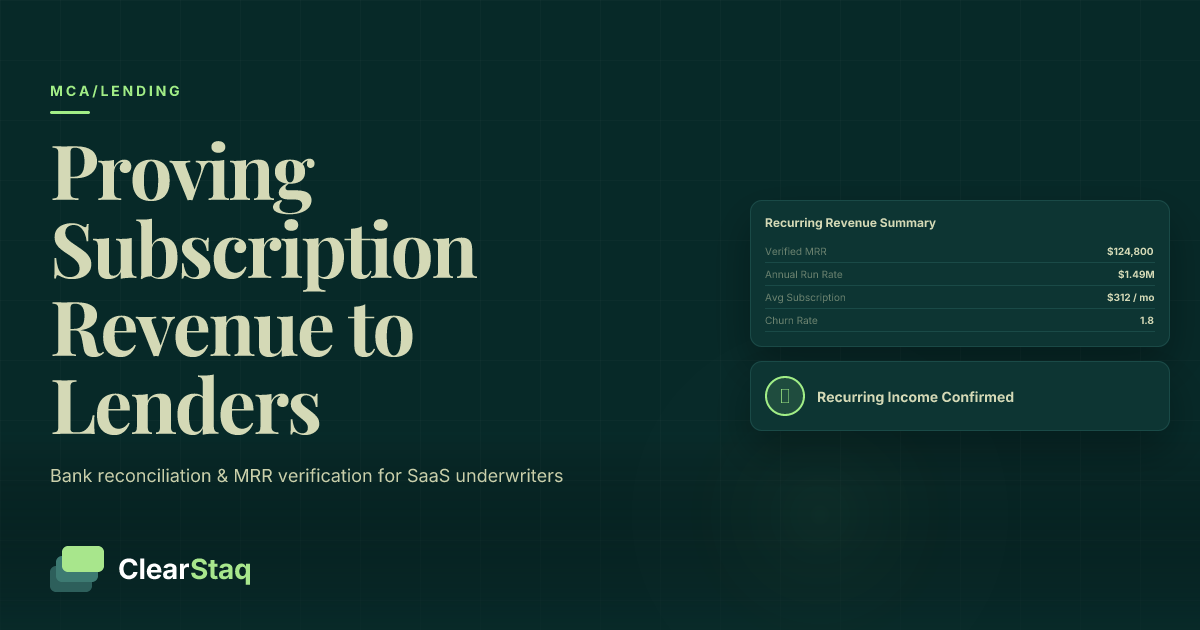
Subscription revenue validation requires lenders to cross-reference three sources: bank statement deposit patterns, payment processor exports (Stripe, Recurly, Chargebee), and MRR/ARR schedules provided by the SaaS company. Recurring deposit consistency, billing cycle identification, and churn signal analysis are the primary verification methods underwriters use to confirm recurring income claims.
What you'll learn
- Bank statements are the only independently verifiable income source for SaaS companies — ARR schedules and dashboard exports cannot substitute for actual deposit records
- Lenders should normalize trailing 3-month average cash deposits as the MRR proxy, not company-reported ARR figures
- Annual billing creates lumpy deposit patterns that require a full 12-month statement history to interpret correctly
- Net Revenue Retention below 85% is a serious repayment risk signal — even when headline MRR appears stable
- Round-dollar processor deposits appearing across three or more consecutive months are a statistically rare fraud signal that warrants immediate reconciliation
Subscription revenue validation requires lenders to cross-reference three sources: bank statement deposit patterns, payment processor exports (Stripe, Recurly, Chargebee), and MRR/ARR schedules provided by the SaaS company. Recurring deposit consistency, billing cycle identification, and churn signal analysis in bank statements are the primary verification methods underwriters rely on to confirm recurring income claims.
Why SaaS Revenue Is Hard to Verify (and Why Lenders Struggle With It)
Traditional lending is built on two pillars: tangible assets and earnings. Neither maps cleanly to a SaaS business. There's no inventory to seize, no equipment to lien, and reported earnings often bear little resemblance to actual cash flow. Underwriters trained on retail P&Ls or manufacturing balance sheets frequently misread SaaS financials entirely.
The post-pandemic SaaS boom made this worse. Between 2020 and 2023, many SaaS companies reported explosive MRR growth — growth that masked rising churn, trial-inflated subscriber counts, and deferred revenue that would never convert to sustainable cash. Lenders who approved financing based on headline ARR figures found themselves holding paper on companies whose actual deposit activity had been declining for six months before the credit decision. In 2026, that history is driving far more scrutiny across the SaaS lending market.
Good bank statement income verification practice starts with understanding why SaaS bank statements look different from every other business type — and why that difference matters for underwriting.
The Three Versions of SaaS Revenue
A SaaS company presents lenders with three simultaneous versions of its revenue, and they rarely match each other.
Contracted ARR is what the company has signed but not yet collected. A five-year enterprise contract worth $500,000 per year might appear in ARR figures the day it's signed — even though the cash won't arrive for months, or may never arrive if the customer churns or disputes the contract.
GAAP recognized revenue is what accounting rules allow the company to book each period under ASC 606. For a $12,000 annual contract, the company can recognize only $1,000 per month — even if the customer paid the full $12,000 upfront in January.
Cash deposits are what actually hits the bank account. This is the only figure lenders can independently verify. For an annual billing company, January shows a $12,000 deposit and February through December show nothing from that customer. For a monthly billing company, $1,000 arrives every month. Both represent the same contract, but they look completely different in the bank.
Smart underwriters anchor to cash. ARR schedules are provided by the applicant and are unverified until reconciled to actual bank deposits. Cash deposits come from the financial institution and can't be self-reported.
Why Traditional Banks Reject SaaS Loan Applications
Most traditional bank loan officers aren't equipped to evaluate a SaaS business model. Their underwriting frameworks require collateral, predictable earnings history, and tangible repayment sources. SaaS companies offer none of the above in a familiar form.
Deferred revenue creates a specific problem. A company with $2 million in deferred revenue has already collected cash — but that cash is a liability, not equity. The bank statement may look healthy while the balance sheet shows a growing obligation to deliver services not yet provided. Loan officers who focus on cash balances without understanding deferred revenue will systematically overestimate the financial health of annual billing SaaS companies.
Fintech lenders that use bank statements to build risk scores are better positioned to underwrite SaaS companies accurately — because their models are built on actual deposit behavior rather than accounting categories that don't translate across business types.
The Core Metrics Lenders Use to Evaluate Subscription Businesses
SaaS underwriting has its own metric vocabulary. Lenders who don't speak this language make systematic errors — either approving companies with deteriorating retention or rejecting stable businesses with lumpy billing cycles. These are the metrics that matter.
MRR vs. ARR vs. Recognized Revenue: Which Number Do Lenders Actually Use?
MRR (Monthly Recurring Revenue) is the foundational SaaS metric — the normalized monthly value of all active subscriptions. A company with 100 customers each paying $500 per month has $50,000 MRR. It excludes one-time fees, setup charges, and non-recurring revenue.
ARR (Annual Recurring Revenue) is simply MRR multiplied by 12. It's a projection, not a verified figure. A company claiming $1.2M ARR is asserting that its current MRR run-rate will persist for 12 months. Churn, expansion, and contraction will all affect whether that projection holds.
Recognized revenue under GAAP follows ASC 606 rules, which require revenue to be recognized as services are delivered, not when cash is received. For annual prepayments, this creates a significant timing gap between cash deposits and recognized revenue.
For underwriting purposes, the most defensible figure is the trailing 3-month average of actual cash deposits attributable to subscription payment processors. This normalizes seasonal variation, accounts for billing cycle differences, and relies entirely on independently verifiable data — not company-reported schedules.
Understanding the difference between true revenue vs. gross revenue is essential here: gross deposits from a payment processor include refunds, chargebacks, and one-time fees that must be stripped out before the figure can be treated as recurring income.
Net Revenue Retention: The Metric That Predicts Loan Repayment
Net Revenue Retention (NRR) measures how much revenue a company retains from its existing customer base over time, including expansions, contractions, and cancellations. An NRR above 100% means existing customers are spending more over time — a strong signal that the revenue base is growing without requiring new customer acquisition.
An NRR below 85% is a serious warning sign. It means existing customers are downgrading or canceling faster than the company can expand accounts. A company in this position may show flat or growing total MRR — funded by constant new customer acquisition — while its underlying cohort economics are deteriorating. That's a churn treadmill, and it's a terrible repayment profile for a lender.
Gross Revenue Retention (GRR) is NRR without expansion revenue factored in. It measures the pure retention floor — what percentage of last month's revenue the company kept, assuming no upsells. GRR is the conservative floor lenders should model against when stress-testing repayment scenarios.
Customer Concentration Risk in SaaS Underwriting
When a single customer represents 40% or more of a company's MRR, that company's revenue is not as stable as the headline number suggests. If that customer churns, the business immediately loses nearly half its income. For a lender, that's a credit event.
Industry practice among experienced SaaS lenders is to cap single-customer exposure at 25-30% of MRR for full credit approval. When concentration exceeds that threshold, most lenders either apply a revenue haircut — using only 70-75% of stated MRR in the underwriting calculation — or require covenant protections that trigger a review if that customer churns.
Customer concentration can be identified directly from bank statement deposit patterns. A recurring large ACH credit from a single originator, appearing monthly or annually, that represents a disproportionate share of total deposit volume is a detectable signal — especially with automated transaction-level analysis.
What Documents SaaS Companies Need to Prove Recurring Income
The minimum viable document package for SaaS loan applications includes six components. Each plays a different verification role, and none can substitute for another.
| Document | What It Shows | Verification Level |
|---|---|---|
| Bank statements (12 months) | Actual cash received, deposit patterns, payment processor credits | Independently verifiable |
| Payment processor export (Stripe, Recurly, Chargebee) | Gross charges, refunds, net payouts, subscription counts | Verifiable against bank deposits |
| ARR schedule (by customer, billing frequency, contract date) | "What the company claims its recurring revenue is"Unverified until reconciled | |
| P&L statement (12 months) | Revenue recognition, cost structure, operating margins | Self-reported / accountant-prepared |
| Customer churn report | Logo churn and dollar churn rates by cohort | Self-reported / cross-checkable vs. deposits |
| Tax returns (2 years) | IRS-filed revenue figures, operating history | Independently verifiable |
Dashboard screenshots are not acceptable as revenue documentation. Stripe dashboards, Baremetrics exports, and ChartMogul reports are all generated from the company's own data feeds and can be manipulated. They are neither independently sourced nor tamper-evident.
Understanding 12 months of bank statement patterns is why lenders require a full year — not 3 or 6 months. Annual billing creates lumpy deposit patterns that only become interpretable over a complete billing cycle. A company with 50% annual billing will show enormous deposit months when renewals hit and near-zero months in between. Without 12 months of history, an underwriter can't distinguish a healthy annual billing company from a business in serious decline.
Bank Statements: The Only Independently Verifiable Source
Bank statements occupy a unique position in the document stack: they can't be self-reported. They originate from a financial institution and reflect actual transactions, not projected or accrued revenue. Crucially, they show cash actually collected — not contractual commitments that have yet to be invoiced, or revenue that has been accrued under GAAP but not yet received.
For high-risk applications, lenders should request statements directly from the bank or through a secure upload portal rather than accepting applicant-downloaded PDFs. PDF metadata analysis — checking creation date, software used, and modification history — can confirm whether a document has been altered after generation. Any statement showing evidence of post-creation modification is an immediate escalation signal.
When preparing their application, SaaS borrowers should reference the full underwriting checklist to ensure their document package is complete before submission — incomplete packages slow approval and often signal disorganization to underwriters.
Payment Processor Reports: Stripe and Recurly Exports Explained
Stripe MRR reports show gross charge volume, total refunds, and net payouts. The net payout figure — after Stripe deducts processing fees and refunds — is the number that should appear in the bank statement. Stripe payouts typically arrive 2-7 business days after the charge date, so underwriters must account for timing differences when performing deposit matching.
Recurly and Chargebee exports add subscription status fields that Stripe doesn't surface directly: active, paused, canceled, and dunning statuses. These fields are valuable for churn verification — a high count of "dunning" statuses (failed payment retries) in a Recurly export is a forward-looking churn signal that may not yet be visible in the bank statement deposit trends.
The key reconciliation check: sum of net payouts from the processor export over any 30-day rolling period should match bank deposit inflows attributable to that processor within 1-2% variance. Larger discrepancies require explanation.
How Underwriters Read Bank Statements for Subscription Revenue
Subscription revenue has a distinct deposit signature that experienced underwriters recognize immediately. Unlike retail businesses with dozens of small, irregular deposits from card processing, or service businesses with large invoiced payments from individual clients, SaaS deposit patterns are characterized by consistent amounts, consistent timing, and consistent originator names.
The most common pattern: recurring ACH credits from Stripe, PayPal, Braintree, or Recurly appearing on a predictable weekly or monthly schedule, with moderate amounts that vary slightly due to refunds and churn adjustments. This pattern is meaningfully different from verifying platform payouts for working capital loans in marketplace or gig economy businesses, where deposit timing and amounts vary with transaction volume rather than contract schedules.
To calculate a clean MRR proxy from bank statements: isolate all credits from recognized payment processors, exclude one-time deposits (wire transfers, SBA disbursements, inter-account transfers), and average the remaining monthly totals over a 3-to-6-month trailing period. This figure is the independently verifiable MRR baseline. Any significant divergence from the company's stated MRR requires a documented explanation before credit approval.
The visualization above illustrates what healthy subscription deposit patterns look like over a 12-month period — a relatively stable monthly deposit band with minor variance — versus a declining trend that signals net churn even when the company's ARR schedule shows flat or growing figures.
Identifying Recurring Deposit Patterns vs. One-Time Revenue
The functional distinction for underwriting purposes: recurring deposits share an originator, appear at a consistent interval, and show similar amounts month over month. One-time revenue deposits have a unique originator, appear once, and carry no interval pattern.
Professional services fees, setup charges, and implementation revenue frequently mix with recurring SaaS deposits in bank statements — especially for companies that sell both a subscription product and professional services to enterprise customers. These must be categorized separately, because they are not recurring and cannot be included in the MRR calculation. A company that generates $20,000 per month in recurring subscriptions and $15,000 per month in one-time professional services is not a $35,000 MRR business — it's a $20,000 MRR business with volatile services revenue on top.
Automated transaction categorization handles this at scale by applying originator matching, amount variance analysis, and interval detection across all transactions simultaneously — eliminating the manual review burden that makes this step error-prone at volume.
Spotting Churn in Deposit Patterns Before the Company Reports It
Bank statement deposit analysis provides an early churn signal that often precedes what the company reports. The mechanism: declining monthly deposit totals from a stable payment processor source indicate that fewer or smaller subscriptions are being billed — even if the company's ARR schedule shows flat or growing figures.
A more sophisticated concealment pattern: a sudden spike in new processor payouts that masks an equal drop in established customer payments. Total monthly deposits look flat, but the underlying composition has shifted — existing customers are churning and being replaced by new ones. This "churn treadmill" pattern is visible in deposit-level analysis but invisible in headline MRR figures.
To map deposit trends: build a month-by-month deposit band chart across the full 12-month statement period and plot the total, the maximum single-month total, and the minimum. A narrowing band or consistent downward drift in the monthly total, even a gradual one, is a churn signal worth investigating before approving credit.
Annual vs. Monthly Billing: How Contract Structure Changes the Analysis
Billing cycle structure is one of the most commonly misread aspects of SaaS bank statements. An underwriter who doesn't account for billing cycle differences will either overestimate an annual billing company's monthly cash flow or underestimate it entirely — depending on which month of the cycle they happen to be reviewing.
A monthly billing SaaS company with $50,000 MRR produces a consistent, readable deposit stream: roughly $50,000 in processor credits every month, with minor variance for churn and expansion. The MRR calculation is straightforward and requires minimal normalization.
An annual billing SaaS company with the same $50,000 MRR might show $200,000 in deposits in January (when renewals cluster), $150,000 in March, $80,000 in June, and near-zero months in between from those same customers. The business is equally healthy — but the bank statement looks nothing like what a monthly billing company produces.
Deferred Revenue and What It Means for Bank Statement Analysis
Deferred revenue is a liability on the balance sheet — cash received for services not yet delivered. When a SaaS company collects $24,000 for a two-year enterprise contract in January, the bank statement shows a $24,000 deposit. GAAP allows the company to recognize only $1,000 per month. The remaining $23,000 sits on the balance sheet as deferred revenue — cash the company holds but has not yet "earned" under accounting rules.
For lenders evaluating repayment capacity, this distinction matters enormously. That $24,000 is not free cash flow. It's obligated to deliver the contracted service for 24 months. If the customer churns in month 3, the company may owe a prorated refund. A lender who reads that $24,000 January deposit as evidence of strong monthly cash generation is making a $21,000 per month analytical error.
The practical normalization approach for annual billing companies: divide large single deposits from a payment processor by 12 to get the monthly revenue equivalent before calculating the MRR proxy. For a company with a 60/40 annual-to-monthly billing split, this requires processing the two streams separately before blending them into a composite monthly figure.
The tracker above shows how monthly versus annual billing structures create dramatically different balance and deposit trajectories over a 12-month period — making the normalization step visually intuitive for underwriting teams working through these calculations.
Identifying Annual vs. Monthly Billing Cycles in Bank Statements
Monthly billing has a recognizable signature: 20 to 50 small-to-medium recurring credits per month from a payment processor, arriving on a rolling schedule with consistent amounts and minor variance. Annual billing looks completely different: 1 to 5 large recurring credits per month, with some months showing near-zero inflows from that processor source as the billing anniversaries are spread across different calendar months.
Most SaaS companies run a mixed billing model — some customers on monthly plans, others on annual. This creates a blended pattern that requires transaction-level categorization to separate correctly. The right approach is to request an ARR schedule broken out by billing frequency alongside the bank statements, then cross-validate the deposit patterns observed in the statements against the expected structure from the ARR schedule. Discrepancies between the two are an investigation trigger.
Red Flags That Signal Inflated or Misrepresented SaaS Revenue
SaaS revenue misrepresentation is more sophisticated than simple document forgery. The most common patterns involve metric manipulation rather than outright fabrication — and they're specifically designed to pass a cursory review. These are the signals that separate a careful lender from one that gets burned.
Round-dollar MRR figures are a primary red flag. Real subscription revenue almost never produces perfectly round monthly deposit totals. Processing fees, partial-month proration, refunds, and churn adjustments introduce natural variance. A SaaS company whose payment processor deposits land at exactly $50,000 three months in a row should trigger immediate scrutiny.
Artificially smoothed deposits are the next signal. Legitimate SaaS revenue has minor month-to-month variance — typically 3-8% — driven by natural churn and expansion. Suspiciously flat deposit totals across 6 or more months, with variance below 2-3%, may indicate manual adjustment of deposit figures to create an appearance of stable, growing revenue.
Churn concealment is the most operationally sophisticated pattern. The total monthly deposit figure stays flat, but the underlying set of depositing originators changes — existing customers are churning and being replaced by new ones at the same rate. The company may legitimately believe its MRR is stable. The risk to the lender is that new customer acquisition is subsidizing the revenue figure, and the unit economics may not support that indefinitely. Learn how artificial cash flow smoothing is detected in automated analysis systems.
Trial-to-paid conversion inflation occurs when a company reports MRR that includes trial accounts or freemium users who haven't yet converted to paid plans. The bank deposits are consistently lower than the stated MRR — because the revenue being reported hasn't been charged yet, or may never be charged. If the trailing 3-month average of bank deposits is more than 15% below the stated MRR, that gap requires an explanation.
Channel-mixed deposits involve commingling one-time professional services revenue with recurring subscription deposits. This inflates apparent MRR without any fabrication — the deposits are real, but they're not recurring. Automated duplicate transaction detection and categorization tools can separate these income streams; manual review frequently can't.
Round-Dollar Deposit Fabrication: A SaaS-Specific Fraud Signal
Real Stripe or Recurly payouts reflect net amounts after processing fees, refund deductions, and churn adjustments. A net payout of exactly $100,000 from Stripe is extraordinarily unlikely to occur naturally — Stripe's fee structure, combined with the randomness of refund timing and amounts, makes round-number net payouts statistically rare.
When round-dollar deposit patterns appear across three or more consecutive months from a payment processor, the appropriate response is to request the raw Stripe payout report and reconcile it to the bank deposit line-by-line. The net payout amount in the Stripe export should match the bank deposit within a few dollars. If the bank deposit is round and the Stripe export shows a different figure, one of the two documents has been altered.
Automated systems can flag this pattern immediately by calculating deposit variance across the statement period and alerting when variance falls below statistically normal thresholds for subscription businesses — a check that takes seconds in software and hours in manual review.
Churn Concealment and Trial Conversion Inflation
The churn concealment pattern is detectable at the originator level. Month over month, the set of ACH originators contributing to payment processor payouts changes, while total deposit volume stays flat. This indicates churned customers being replaced by new ones — not organic growth from a stable customer base. Ask for a cohort retention report alongside the deposit data: if MRR looks healthy but cohort retention curves are declining at 12 and 18 months, the business is running a churn treadmill that will eventually collapse.
Trial conversion inflation is detectable by comparing stated MRR to actual bank deposits. The trailing 3-month average of bank deposits should fall within 10-15% of stated MRR for a healthy subscription business. A persistent gap larger than 15% — where the company claims higher MRR than actual deposits support — indicates that either trials, freemium users, or committed-but-uncharged contracts are being counted in the MRR figure.
ClearStaq's fraud scoring engine applies all of these signals simultaneously — round-dollar detection, variance suppression flagging, churn concealment patterns, concentration risk, and more — producing a composite risk score that surfaces the highest-priority issues for underwriter review.
How Automated Bank Statement Analysis Validates Subscription Income at Scale
Manual bank statement review for SaaS applications doesn't scale. An underwriter working through 12 months of statements plus payment processor exports for a single application is committing 2-4 hours of focused analytical work — and even then, the results depend on their familiarity with SaaS-specific patterns. Multiply that by 50 applications per month and the bottleneck becomes a fundamental constraint on origination volume.
Automated parsing changes the economics entirely. Systems that recognize recurring deposit patterns across 900+ bank formats can extract, categorize, and analyze 12 months of SaaS transaction data in seconds — with consistent methodology that doesn't vary based on who reviewed the file.
The workflow above illustrates the end-to-end automated process: statement upload triggers transaction extraction, recurring deposits are identified and separated from one-time credits, fraud signals are scored simultaneously, and the system outputs a reconciliation report ready for underwriting review — all without a manual categorization step.
Cross-Referencing Payment Processor Exports Against Bank Deposits
The payment processor reconciliation workflow has four steps: import the Stripe or Recurly CSV export, identify each payout date and net payout amount, locate the corresponding bank deposit within a 7-business-day window, and compare the two amounts for variance.
Acceptable variance is 1-2% — attributable to processing fee rounding differences. Variance above 2% for a specific payout requires explanation. An unmatched payout in the processor export that doesn't appear in the bank statement at all is a potential missing transaction signal. A bank deposit attributed to a payment processor that doesn't appear in the processor export is a potential fabricated deposit signal.
Manual reconciliation across 12 months of data requires building a matching spreadsheet by hand — typically 3-4 hours of work. Automated reconciliation performs the same match in seconds and outputs a structured report showing matched transactions, unmatched items, and variance-flagged deposits. The underwriter reviews the exception list rather than the raw data, cutting review time from hours to minutes.
This is precisely how fintech lenders use bank statements to build risk scores more accurately than traditional banks — not by reviewing more data, but by processing it systematically and surfacing only the anomalies that require human judgment.
Using AI to Detect Subscription Deposit Anomalies
ML models trained on subscription business bank statements can distinguish between seasonality and genuine revenue decline — a distinction that matters enormously for SaaS companies with annual billing cycles or Q4-heavy renewal schedules. A consumer SaaS business may show reduced deposits in Q3 and a surge in Q4 due to promotional pricing — a pattern that looks like churn to an untrained reviewer but is actually normal seasonal behavior.
Customer concentration flagging is another high-value automated capability. When a single ACH originator consistently accounts for 30% or more of monthly deposit volume, the system flags it for underwriter attention without requiring manual analysis of each transaction line. The same logic applies to identifying when a previously dominant originator suddenly disappears from the deposit stream — a signal that a large customer has churned, regardless of what the ARR schedule reports.
For lenders processing significant SaaS application volume, real-time API integration enables automated income verification at the point of application — no manual handoff, no queue, and no inconsistency in analytical methodology across the portfolio.
A Step-by-Step Validation Workflow for SaaS Underwriters
No competitor resource provides a practical, sequential workflow written from the underwriter's operational perspective. This is the process — covering document collection through final MRR determination — that a lender can implement whether doing manual review or using an automated tool.
Step 1: Collect and Authenticate the Document Package
Request 12 months of bank statements — not 3 or 6. Annual billing requires a full cycle to interpret correctly. Request payment processor exports for the same 12-month period in CSV format, not PDF dashboard screenshots. Request an ARR schedule broken out by customer name, billing frequency (monthly vs. annual), and contract start date.
Authenticate all bank statement PDFs before beginning analysis: check PDF metadata for creation date, software used, and modification history. Any statement showing evidence of post-creation modification is an immediate escalation. Confirm that statements span a continuous 12-month period with no month gaps — missing months in the middle of the range are a red flag, not an oversight.
Step 2: Extract and Normalize the MRR Baseline
Isolate all credits attributable to recognized payment processors (Stripe, PayPal, Braintree, Recurly, Chargebee) from the full transaction history. Sum these deposits by month. Identify any months with unusually large deposits relative to the monthly average — these are likely annual billing prepayments and require normalization.
For each identified large deposit, determine whether it represents an annual billing payment and divide by 12 to get the monthly equivalent. Calculate both the trailing 3-month and trailing 12-month average monthly deposit totals to establish the MRR proxy range. Compare the calculated MRR proxy to the company's stated MRR. Variance greater than 15% requires a documented explanation before proceeding.
Step 3: Reconcile Against Payment Processor Export
Match each net payout in the processor CSV export to a corresponding bank deposit. The matching window is 7 business days from the payout date — Stripe and Recurly both have settlement delays that must be accounted for.
Flag any processor payout that doesn't appear in the bank statement within the 7-day window. Flag any bank deposit attributed to a payment processor that doesn't appear in the processor export. Document the overall reconciliation rate: 95% or higher match is acceptable for full credit consideration; below 90% requires investigation before proceeding. Unmatched deposits that cannot be explained by documented timing differences are a potential fabrication signal and should trigger escalation.
The broader underwriting checklist covers how processor reconciliation fits into the full credit file documentation requirements.
Step 4: Apply Fraud Signal Checks and Final Determination
Run four checks in sequence:
- Round-dollar check: Flag if 3 or more consecutive months show processor deposits within $100 of a round number (e.g., exactly $50,000, $75,000, $100,000).
- Variance suppression check: Calculate month-to-month deposit variance as a percentage. Flag if variance falls below 3% across 6 or more consecutive months — natural subscription revenue does not behave this uniformly.
- Churn signal check: Compare trailing 3-month average deposits to trailing 12-month average. A decline greater than 10% indicates net churn in progress — even if the company's reported churn rate looks acceptable.
- Concentration check: Identify any single ACH originator representing more than 25% of total monthly deposits. Document the finding and apply the appropriate revenue haircut or covenant requirement.
Document the final validated MRR, your confidence level (high / medium / low), any active fraud flags, and the concentration assessment. Submit the complete finding to the credit decision with a brief narrative explaining any gaps between stated and verified MRR.
How ClearStaq Automates Subscription Revenue Validation for Lenders
ClearStaq's bank statement parsing engine identifies recurring deposit patterns consistent with subscription billing cycles — monthly, annual, and mixed — across 900+ supported bank formats. The system doesn't require a human to recognize that a SaaS company banks with an institution in a non-standard format; the parsing layer handles that automatically.
Automated payment processor reconciliation cross-references Stripe, Recurly, and Chargebee exports against bank deposit records to validate MRR figures in seconds. The same reconciliation that takes an underwriter 3-4 hours of manual spreadsheet work is completed before the next application enters the queue. The output is a structured reconciliation report — matched deposits, unmatched items, variance flags — ready for file documentation.
The 27 fraud signals include SaaS-specific detection logic: round-dollar deposit sequences, artificially suppressed deposit variance, sudden originator composition changes that indicate churn concealment, and trial-to-paid conversion inflation signals. Each signal is applied to every statement simultaneously, producing a composite fraud score that surfaces the highest-risk applications for priority review.
Customer concentration flagging automatically identifies when a disproportionate share of deposits originates from a single ACH source — without requiring the underwriter to manually tally originator frequencies across 12 months of transactions. The real-time API integrates directly into origination workflows, enabling automated bank statement income verification at the point of application with no manual handoff required.
From Manual Review to Automated Decision in Under 60 Seconds
Traditional manual SaaS statement review takes 2-4 hours per application — and that's for an experienced underwriter who knows what to look for. For lenders processing 30-50 SaaS applications per month, that's 60-200 hours of underwriter time dedicated to a single document review task.
ClearStaq's automated workflow: the lender uploads the bank statement and payment processor export. The API extracts all transactions, identifies recurring deposits, performs processor reconciliation, scores all 27 fraud signals, flags customer concentration, and outputs a validated MRR report with a confidence score and a month-by-month deposit trend. The underwriter reviews the exception report — not the raw statements. Review time drops from hours to minutes.
For lenders building out their SaaS underwriting practice, ClearStaq's recurring revenue lending platform provides the infrastructure to scale origination volume without proportionally scaling underwriter headcount.
See Subscription Revenue Validation in Action
Upload a SaaS bank statement and watch ClearStaq identify recurring deposit patterns, reconcile processor exports, and score 27 fraud signals — producing a validated MRR report in under 60 seconds. Start your free trial, no credit card required.
Frequently Asked Questions
How do SaaS companies prove recurring revenue to lenders?
SaaS companies prove recurring revenue by providing 12 months of bank statements, payment processor exports (Stripe, Recurly, or Chargebee), and an ARR schedule broken out by customer and billing frequency. Lenders cross-reference deposit patterns in bank statements against processor payout records to independently verify MRR figures rather than relying on self-reported dashboards or revenue projections.
What is the difference between MRR, ARR, and recognized revenue — and which do lenders use?
MRR (Monthly Recurring Revenue) is the monthly subscription run-rate; ARR (Annual Recurring Revenue) is MRR multiplied by 12. Recognized revenue follows GAAP accounting rules under ASC 606 and is often lower than cash deposits for annual billing contracts. Lenders primarily rely on trailing average cash deposits from bank statements as the most independently verifiable proxy for true MRR — not company-reported ARR figures.
How is recurring revenue verified for a loan?
Lenders verify recurring revenue by comparing bank deposit patterns to payment processor exports — net payouts from Stripe or Recurly should match bank deposits within a 7-business-day window and 1-2% variance. Automated bank statement analysis tools can perform this reconciliation across 12 months of data in seconds, flagging discrepancies that indicate inflated or fabricated revenue figures.
What red flags indicate misrepresented SaaS revenue in bank statements?
Key red flags include round-dollar processor deposits appearing in 3 or more consecutive months, deposit variance below 3% across 6+ months (artificially smoothed), trailing 3-month deposit averages more than 15% below stated MRR, and sudden shifts in ACH originator composition while total deposit volume stays flat — a churn concealment signal. Any of these warrant reconciliation with raw processor exports before approving credit.
Why do traditional banks reject SaaS loan applications?
Traditional banks are structured around collateral and EBITDA — neither applies cleanly to SaaS. Loan officers typically lack training to interpret subscription deposit patterns, deferred revenue accounting, or churn-adjusted MRR figures. Fintech lenders and MCA providers with automated bank statement analysis capabilities are better equipped to underwrite SaaS businesses because their risk models are built on actual deposit behavior rather than accounting categories that don't translate across business types.
Ready to Automate SaaS Revenue Validation?
Stop spending hours reconciling Stripe exports against bank statements by hand. ClearStaq's subscription revenue validation engine catches fraud signals, normalizes billing cycles, and produces verified MRR reports in under 60 seconds — for every application, at scale. Start your free trial today.
Frequently Asked Questions
How do SaaS companies prove recurring revenue to lenders?
SaaS companies prove recurring revenue by providing 12 months of bank statements, payment processor exports (Stripe, Recurly, or Chargebee), and an ARR schedule broken out by customer and billing frequency. Lenders cross-reference deposit patterns in bank statements against processor payout records to independently verify MRR figures rather than relying on self-reported dashboards or revenue projections.
What is the difference between MRR, ARR, and recognized revenue — and which do lenders use?
MRR (Monthly Recurring Revenue) is the monthly subscription run-rate; ARR (Annual Recurring Revenue) is MRR multiplied by 12. Recognized revenue follows GAAP accounting rules under ASC 606 and is often lower than cash deposits for annual billing contracts. Lenders primarily rely on trailing average cash deposits from bank statements as the most independently verifiable proxy for true MRR — not company-reported ARR figures.
How is recurring revenue verified for a loan?
Lenders verify recurring revenue by comparing bank deposit patterns to payment processor exports — net payouts from Stripe or Recurly should match bank deposits within a 7-business-day window and 1-2% variance. Automated bank statement analysis tools can perform this reconciliation across 12 months of data in seconds, flagging discrepancies that indicate inflated or fabricated revenue figures.
What red flags indicate misrepresented SaaS revenue in bank statements?
Key red flags include round-dollar processor deposits appearing in three or more consecutive months, deposit variance below 3% across six or more months (artificially smoothed), trailing 3-month deposit averages more than 15% below stated MRR, and sudden shifts in ACH originator composition while total deposit volume stays flat — a churn concealment signal. Any of these warrant reconciliation with raw processor exports before approving credit.
Why do traditional banks reject SaaS loan applications?
Traditional banks are structured around collateral and EBITDA — neither applies cleanly to SaaS. Loan officers typically lack training to interpret subscription deposit patterns, deferred revenue accounting, or churn-adjusted MRR figures. Fintech lenders with automated bank statement analysis capabilities are better equipped to underwrite SaaS businesses because their risk models are built on actual deposit behavior rather than accounting categories that don't translate across business types.
ClearStaq Team
Product Team
The ClearStaq team builds AI-powered tools for bank statement parsing, fraud detection, and income verification.