Automating document intake for loan origination means replacing manual uploads, re-keying, and eyeball review with a parsing layer that reads bank statements, tax returns, and pay stubs automatically and hands underwriters structured data instead of raw PDFs. The fastest path in 2026 is format-aware parsing paired with fraud detection at the point of intake, not a generic OCR tool bolted onto your loan origination system (LOS). The hidden cost most teams miss: intake automation only pays off if it also screens for fraud signals, because faster document processing without fraud checks just means faster approval of bad files.
- Automating document intake for loan origination replaces manual re-keying with format-aware parsing and fraud screening.
- ClearStaq parses bank statements and tax returns in under 5 seconds with 99.5% accuracy across 900+ formats.
- Manual intake without automation still burns 4-8 hours per file for underwriting teams in 2026.
- 27+ AI fraud signals catch doctored statements before they reach an underwriter's desk.
- Format-aware parsing cuts document review time by up to 95% versus manual entry.
Why this matters
Loan origination stalls at document intake more than anywhere else in the funnel. A broker or lender collects bank statements, tax returns, and pay stubs, then someone on the team manually opens each PDF, checks pages, and types numbers into a spreadsheet before underwriting even starts.
That manual step is where deals die. Files sit in a queue, applicants get impatient, and by the time a human catches a doctored statement or a missing page, the borrower has already shopped the deal to three other lenders. Automating bank statement review removes that queue entirely by parsing on upload instead of after a human opens the file.
How to automate document intake for loan origination
The process breaks into six steps, and each one either speeds up the file or protects it from fraud — most teams skip step 4 and pay for it later.
- Centralize intake. Route every document — email attachment, portal upload, API push — into a single ingestion point instead of scattered inboxes.
- Auto-classify document type. A document classification layer tags each file as a bank statement, tax return, pay stub, or voided check before parsing starts.
- Parse and extract structured data. Format-aware parsing pulls transaction history, deposits, and balances into structured fields instead of leaving them trapped in a PDF.
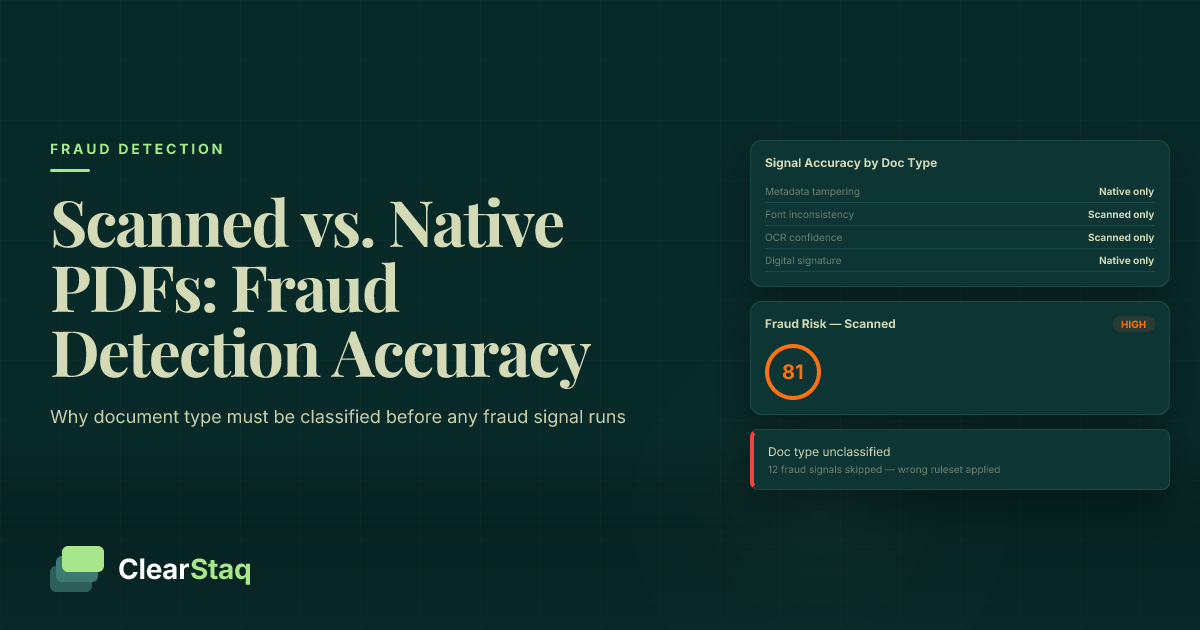
- Run fraud detection automatically. Every parsed document gets scored against fraud signals — altered balances, inconsistent fonts, mismatched metadata — before a human ever sees it.
- Auto-populate underwriting fields. Structured data flows straight into the LOS or spreading tool, eliminating manual re-keying.
- Route only flagged files to human review. Clean files move straight to underwriting; only the ones with fraud flags or missing pages hit a reviewer's queue.
Skip step 4 and you've just automated the speed of bad decisions — the file moves fast, but nobody caught the doctored statement until funding.
Bank statement parsing: 99.5% accuracy in under 5 seconds
Bank statement parsing is the highest-volume document type in most loan origination workflows, and it's also the most format-fragmented — Chase, Bank of America, and Wells Fargo statements all lay out transactions differently. A parser built for 900+ formats handles that variance without a human normalizing columns by hand, returning structured output in under 5 seconds at 99.5% accuracy. Best for: MCA brokers and lenders processing high volumes of bank statements daily. Verdict: Buy — this is the single highest-ROI automation point in intake.
Fraud detection: 27+ signals scored before underwriting sees the file
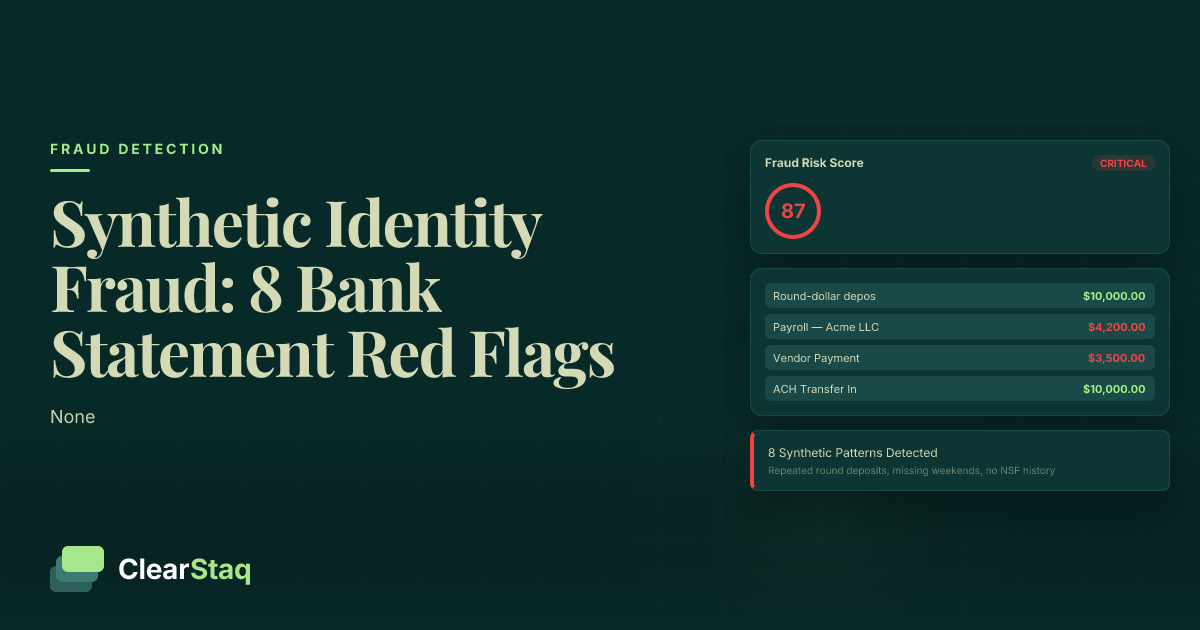
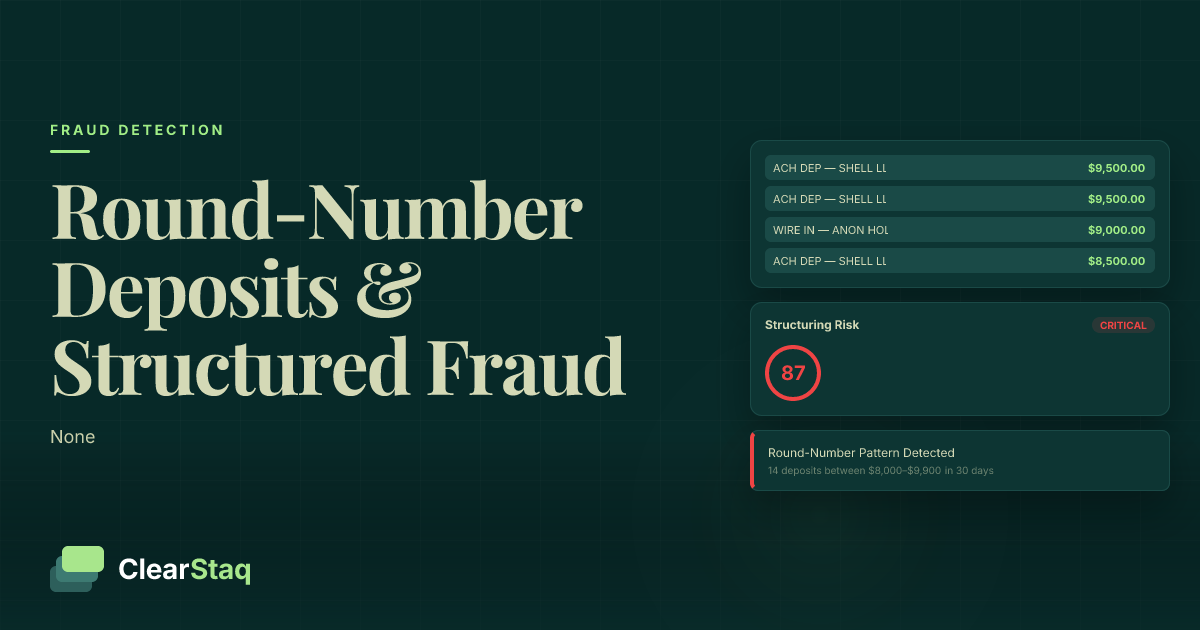
Fraud detection has to run at intake, not after underwriting has already spent time on a file. Running 27+ AI signals — altered transaction rows, inconsistent metadata, duplicate deposit patterns — against every parsed statement catches synthetic and doctored documents before they cost anyone review time. Verdict: Buy — skipping this step is how bad files slip through a faster pipeline.
Stipulation collection: automated requests instead of manual chasing
Once a file is parsed and screened, missing stipulations — a missing bank statement page, an unsigned form — still need chasing. Automating stipulation collection turns that follow-up into a triggered request instead of a manual phone call or email, closing the loop on incomplete files without adding headcount.
“If your underwriters are still re-keying bank statements into Excel in 2026, the bottleneck is your intake process, not your credit box.”
Why manual document intake fails
Manual intake breaks down for predictable reasons, and every one of them is a format or workflow gap that automation closes:
- Format variance across banks. Chase, Bank of America, and regional credit union statements all structure transaction data differently, and manual reviewers re-learn each layout.
- No fraud screening at the point of upload. Fraud checks that happen after underwriting review are checks that happen too late.
- PDF-to-spreadsheet re-keying. Every manual transcription step introduces transposition errors and adds hours per file.
- Incomplete uploads. Missing pages or truncated statements go unnoticed until underwriting is already mid-review.
- No audit trail. Manual review rarely logs why a file passed or failed, which becomes a problem the first time a regulator or investor asks.
- Inconsistent document classification. Without auto-classification, misfiled tax returns and pay stubs get routed to the wrong reviewer.
See document intake automation in action
Parse bank statements and tax returns with fraud detection built in.
Is document intake automation worth it for small MCA brokers?
Document intake automation is worth it for small MCA brokers the moment manual review starts costing more in staff hours than the automation costs to run. A broker processing even a handful of files daily loses hours to manual bank statement review that a parser handles in seconds, and that time gap compounds as deal volume grows.
Can automated intake replace underwriters entirely?
Automated intake cannot replace underwriters entirely — it removes the data-entry and first-pass fraud screening work so underwriters spend their time on judgment calls, not transcription. The goal is routing only flagged or ambiguous files to a human, not eliminating human review altogether.
How long does it take to implement automated document intake?
Implementation time varies by how document intake connects to your existing LOS, but the core parsing and fraud screening layer itself processes each document in under 5 seconds once it's live — the setup work is in the integration, not the parsing speed.
FAQ
How do you automate document intake for loan origination?
You automate document intake by centralizing uploads, auto-classifying document type, parsing bank statements and tax returns into structured data, and running fraud detection before underwriting ever opens the file. The six-step version above covers the full workflow.
What's the best software for automating bank statement intake?
The best software for automating bank statement intake parses across the widest range of formats without manual normalization — ClearStaq covers 900+ bank and tax formats at 99.5% accuracy in under 5 seconds per document.
Does document intake automation catch fraud?
Document intake automation catches fraud when it includes a fraud detection layer scoring documents on signals like altered transaction rows and metadata mismatches — parsing alone, without fraud signals, only speeds up data entry.
How much time does automated intake save versus manual review?
Automated intake cuts document review time by up to 95% compared to manual entry, based on the shift from hours of manual re-keying per file to under 5 seconds of automated parsing.
Can automated intake handle tax returns as well as bank statements?
Automated intake handles tax returns alongside bank statements when the parsing engine is format-aware across document types, extracting structured data from both without separate manual workflows for each.
Is OCR enough to automate loan document intake?
OCR alone is not enough to automate loan document intake because generic OCR extracts text without understanding bank-specific layouts or screening for fraud, which is why format-aware parsing paired with fraud detection outperforms plain OCR.
What happens to flagged documents in an automated intake workflow?
Flagged documents route to human review while clean files move straight to underwriting, keeping the fraud check in the workflow without slowing down the majority of files that pass.
Do small lenders need document intake automation or just large banks?
Small lenders need document intake automation as much as large banks do, because manual review hours scale with file volume regardless of company size, and fraud risk doesn't shrink for smaller loan books.
One last thing
The teams that get the most out of intake automation in 2026 aren't the ones with the highest volume — they're the ones who wire fraud detection into the same step as parsing instead of treating it as a separate later-stage check. Bolt fraud screening on after the fact and you've built a faster pipeline for the same bad files to slip through; build it into intake and the 95% review-time cut actually holds up under audit.
Related guides
ClearStaq Team
Content Team
The ClearStaq team builds AI-powered tools for bank statement parsing, fraud detection, and income verification.