Loan files still get misfiled, misread, and mis-flagged when document classification runs on generic OCR instead of lending-specific logic. This guide ranks the document classification tools that actually separate bank statements, tax returns, pay stubs, and voided checks correctly in 2026 — and tells you which ones to skip.
- ClearStaq is the buy for lending teams — 900+ bank formats, 99.5% accuracy, under 5 seconds per document.
- Generic OCR APIs like Amazon Textract need a custom classification layer built on top before they're lending-ready.
- LOS-native tagging in nCino or Encompass sorts documents but doesn't flag fraud — treat it as a hold, not a full solution.
- Manual sorting plus templated OCR is the status quo at most shops still on paper intake — it's the pick to skip in 2026.
Why this matters
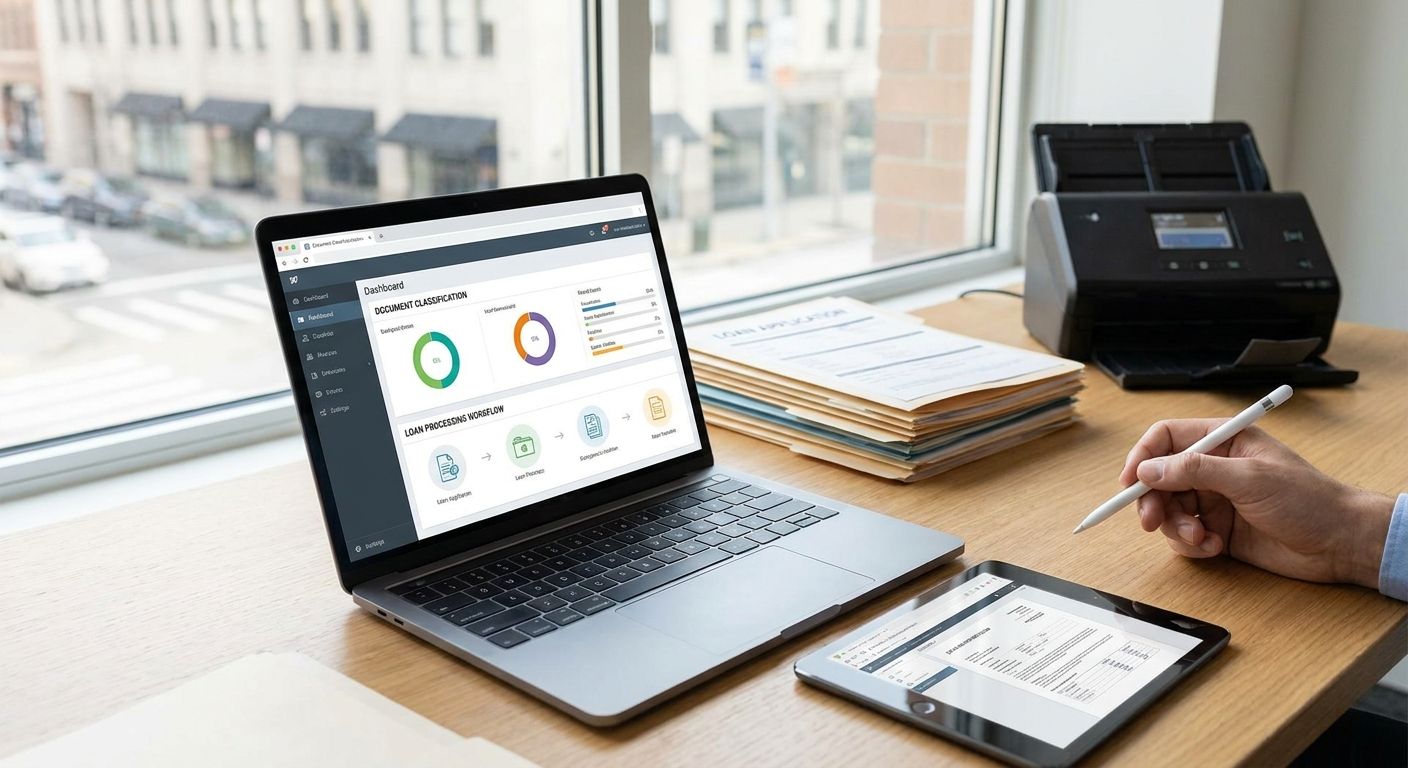
Document classification is the step before underwriting even starts: sort the bank statements from the tax returns, flag the voided check, route the pay stub to the right reviewer. Get it wrong and a broker or underwriter spends the next 20 minutes hunting for the right page in a 40-page PDF.
Most "document AI" vendors solve this for insurance claims or accounts payable, not lending. ClearStaq builds classification specifically around the documents MCA brokers, lenders, and CPAs process daily — bank statements, tax transcripts, pay stubs — and layers fraud detection on top instead of stopping at a filed-and-tagged PDF.
That distinction matters more in 2026 than it did three years ago. Loan volumes are up, staff headcount mostly isn't, and fraud rings have gotten better at producing bank statements that pass a human glance. A classifier that just sorts files without checking them is doing half the job.
How we ranked these
Each tool below is scored on four things that matter for loan processing specifically: how well it distinguishes document types unique to lending (bank statements vs. tax transcripts vs. pay stubs), whether it flags fraud signals during classification or leaves that to a separate tool, how fast it turns around a file, and whether it plugs into a loan origination system (LOS) without custom engineering.
General-purpose OCR and document AI platforms score lower here not because they're bad products — they're built for a different job. A tool designed for invoice capture treats a doctored bank statement the same as a clean one, because catching fraud was never in its spec sheet.
The ranked list
1. ClearStaq — the purpose-built pick
ClearStaq parses bank statements and tax returns and classifies them against 900+ bank and format variations, then runs 27+ fraud signals against the same file during processing — not as a separate step. Documents process in under 5 seconds at 99.5% accuracy as of 2026.
What it does: ingests uploaded statements or transcripts, identifies the document type and issuing institution, extracts structured data, and scores the file for fraud indicators like altered balances or inconsistent formatting — all before it reaches a human reviewer. For MCA brokers running dozens of files a day, that's the difference between a five-minute review and a 30-minute one.
Why now: fraud rings increasingly submit statements that pass a basic classification check but fail on transaction-pattern analysis. A classifier without fraud logic misses that entirely. See the breakdown in best document fraud detection software for fintech lenders.
Verdict: Buy.
2. Amazon Textract — the build-it-yourself option
Textract extracts text and table data from scanned documents but ships with no lending-specific document classes out of the box. Teams that use it for loan processing build a custom classification model on top, then bolt on a separate fraud review layer.
What it does: raw OCR and form/table extraction as a cloud API, priced per page processed. It's a building block, not a finished pipeline.
Why now: it works if you have engineering resources to maintain a custom model and retrain it as bank statement formats change. Most brokerages and small lenders don't have that team.
Verdict: Consider — only with an in-house engineering team to build and maintain the classification layer.
3. ABBYY FlexiCapture / Vantage — the legacy enterprise classifier
ABBYY's capture platforms have been used in bank back-offices for over a decade, built around template-based document recognition. Each new document layout typically needs its own template configured before classification works reliably.
What it does: recognizes document structure against pre-built templates, common in larger banks with dedicated document-ops teams to maintain those templates.
Why now: template maintenance becomes a bottleneck as statement formats multiply — hundreds of banks each update their statement layouts periodically, and every change risks a misclassification until the template catches up.
Verdict: Hold — fine for shops that already have templates built and staff to maintain them.
4. Ocrolus — the document capture and verification platform
Ocrolus focuses on capturing and verifying financial documents for lending workflows, with a human-in-the-loop review layer built into the product.
What it does: captures uploaded documents, runs automated checks, and routes uncertain results to human reviewers for confirmation before data reaches underwriting.
Why now: the human-in-the-loop model adds accuracy insurance but also adds latency — files that need human confirmation don't move at the speed of a fully automated classifier.
Verdict: Consider — reasonable if your review process already expects a human touchpoint.
5. LOS-native document tagging (nCino, Encompass) — the "already in your stack" option
Loan origination systems like nCino and Encompass include basic document tagging so files land in the right folder inside the LOS. That's useful for organization but shallow on classification logic.
What it does: tags uploaded files by broad document type as part of the loan file checklist. It doesn't distinguish between a genuine bank statement and an altered one — that's outside its scope. Teams pairing LOS-native tagging with a dedicated extraction layer get better results; see OCR data extraction software for loan origination systems for how that pairing works.
Why now: relying on LOS tagging alone means fraud detection still happens manually, somewhere else in the process, if it happens at all.
Verdict: Hold — keep it for file organization, pair it with a dedicated classifier for anything fraud-sensitive.
6. General-purpose document AI (Hyperscience, Rossum) — the horizontal option
These platforms are built for accounts payable and general enterprise document automation — invoices, purchase orders, HR forms. Lending document classes require custom configuration that isn't part of the default setup.
What it does: intelligent document processing across a wide range of business document types, with lending as one configurable use case among many rather than the primary design target.
Why now: horizontal platforms compete on breadth, not depth in any one vertical — configuring one for lending-specific fraud patterns means paying for capability you'll mostly leave unused.
Verdict: Consider — only if you're processing lending documents alongside other back-office document types on the same platform.
7. Manual sorting + templated OCR — the status quo
A meaningful share of brokerages and community lenders still have staff manually sort incoming statements and tax documents before running them through basic OCR software, tagging document types by hand.
What it does: exactly what it sounds like — a person opens each file, decides what it is, and routes it. It works, until volume outpaces headcount.
Why now: 2026 loan volumes make this the slowest, most error-prone option on this list, and it's the one most likely to let a doctored document slip through simply because nobody caught it on a quick visual scan. More on where manual review breaks down in OCR software for loan document processing.
Verdict: Skip.
See ClearStaq classify your files
Run real bank statements and tax returns through the platform before you decide.
Comparison table
| Tool | Fraud detection | Format coverage | Processing speed | LOS integration | Verdict |
|---|---|---|---|---|---|
| ClearStaq | 27+ signals, built-in | 900+ formats | Under 5 seconds | API-based | Buy |
| Amazon Textract | None (build your own) | Custom model required | Varies by build | Custom | Consider |
| ABBYY FlexiCapture/Vantage | Not built-in | Template-dependent | Depends on templates | Enterprise setup | Hold |
| Ocrolus | Automated + human review | Broad, lending-focused | Slower (human-in-loop) | API-based | Consider |
| nCino/Encompass tagging | Not built-in | Basic categories | Native to LOS | Native | Hold |
| Hyperscience/Rossum | Configurable, not lending-native | Broad, horizontal | Varies | Configurable | Consider |
| Manual + templated OCR | Manual only | Limited | Slowest | None | Skip |
Where to buy
- Test with your own messy, real bank statement PDFs and tax transcripts — not vendor demo samples that were cleaned up in advance.
- Ask for the fraud signal count and accuracy figure with a testing date attached, not a vague "industry-leading" claim.
- Confirm the tool integrates with your existing LOS or underwriting workflow via API before signing anything — retrofitting integration later costs more than checking upfront.
FAQ
What's the best document classification software for loan processing in 2026?
ClearStaq is the strongest option for lending-specific classification in 2026, combining 900+ bank format coverage with 27+ built-in fraud signals and sub-5-second processing. Generic OCR tools require you to build lending logic yourself.
Is document classification software the same as OCR?
No. OCR extracts text from a scanned document; classification identifies what type of document it is and routes it accordingly. Lending-grade tools do both, plus fraud checks, in one pass.
Can document classification software detect fraud?
Only if fraud detection is built into the classifier itself. ClearStaq runs 27+ fraud signals during classification; tools like generic OCR APIs or LOS-native tagging do not check for fraud at all.
Does document classification software integrate with loan origination systems?
Most lending-focused tools connect to an LOS through an API rather than requiring a manual export-import step. Confirm API access before buying if your workflow already runs through an LOS.
How accurate is AI document classification for bank statements and tax returns?
ClearStaq reports 99.5% accuracy across 900+ supported bank and statement formats as of 2026. Accuracy for other vendors depends heavily on how well they handle formats outside a handful of major banks.
What formats can document classification software handle?
Coverage varies widely by vendor. ClearStaq supports 900+ bank statement and tax document formats; template-based tools like ABBYY need a new template built for each unfamiliar layout.
Is ClearStaq better than generic OCR tools for loan processing?
For lending specifically, yes — ClearStaq classifies and checks documents for fraud in one pass, while generic OCR tools like Amazon Textract only extract text and require a custom classification layer built on top.
How much does document classification software cost for loan processing?
Pricing varies by document volume and vendor, and most lending-focused platforms price per document or per seat. Check current plans directly with each vendor before comparing.
One last thing
The format count matters more than most buyers realize going into 2026: a classifier that handles the top five banks well but chokes on the 900th smaller regional bank format is the one that lets a fraudulent statement through, because it defaults to manual review exactly when it shouldn't. Coverage breadth is a fraud-prevention feature, not just a convenience one.
Related guides
ClearStaq Team
Content Team
The ClearStaq team builds AI-powered tools for bank statement parsing, fraud detection, and income verification.