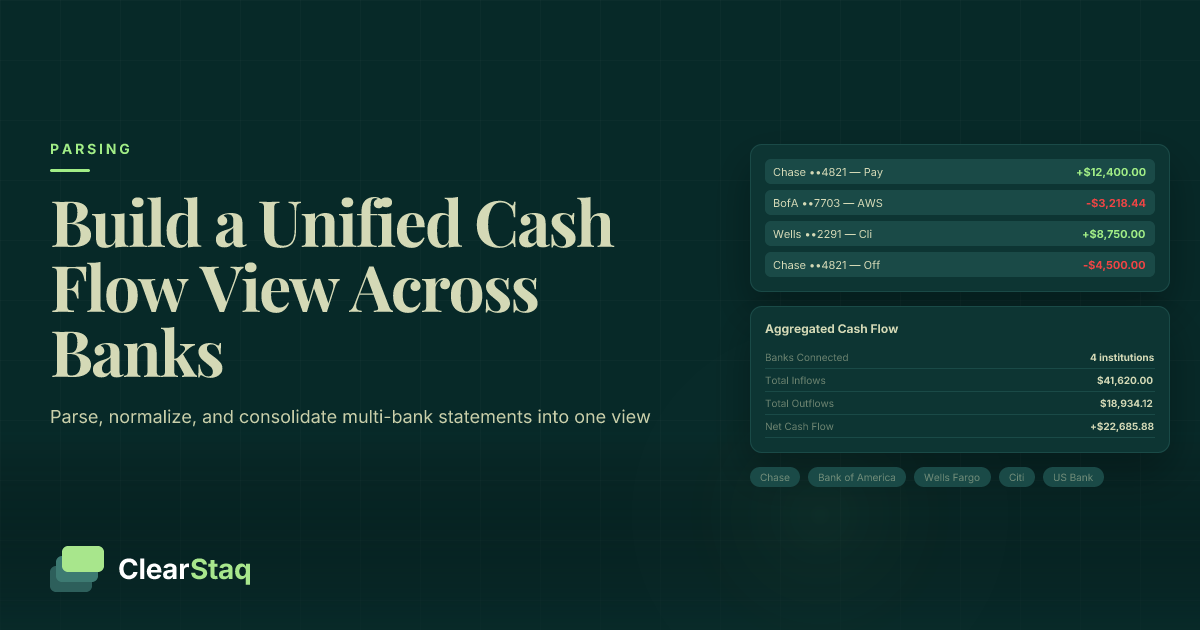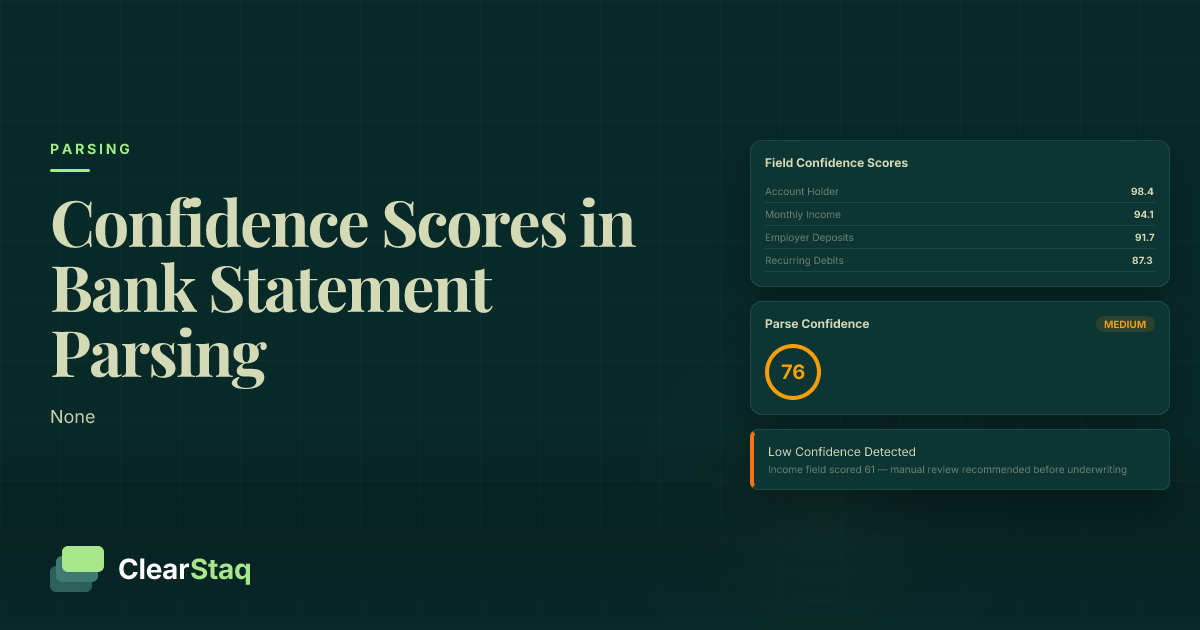
A bank statement parsing API for loan origination systems takes raw PDFs and images from applicants, converts them into structured transaction data, and hands your LOS a clean feed it can underwrite against — no manual review queue required.
- ClearStaq's bank statement parsing API for loan origination systems processes statements in under 5 seconds at 99.5% accuracy — Buy for teams building or rebuilding an LOS integration in 2026.
- 27+ fraud signals catch doctored PDFs and edited balances before they hit an underwriter's desk.
- 900+ format coverage means Chase, Bank of America, Wells Fargo, and regional bank layouts all parse without custom mapping.
- Document storage tools like LoanPro store files but don't parse them — Skip those if you need structured data, not just uploads.
Why this matters
Every LOS vendor claims "document automation" now, but most of them mean OCR that dumps text into a field, not structured parsing that an underwriting engine can run rules against. That gap is why underwriters still open PDFs manually in 2026, even inside systems marketed as automated.
The fix is an API layer that sits between document intake and your decision engine — parsing bank statements into normalized transaction data, flagging fraud signals, and returning results fast enough that the applicant isn't waiting on a human. ClearStaq is built for exactly that handoff, and the difference shows up in review time: teams that plug parsing directly into underwriting workflows cut manual review substantially, a shift covered in detail in how lenders automate commercial loan underwriting with bank statement data instead of spreadsheets.
Who this is for
This guide is for engineering leads and product managers at lenders, CDFIs, credit unions, and non-bank finance companies who are building or replacing the document intake layer inside their loan origination system. You're evaluating a bank statement parsing API for loan origination systems because your current setup either can't parse enough formats, can't detect fraud, or can't return results fast enough to keep applicant drop-off low. If you're comparing vendors on a spec sheet instead of a sales deck, this is written for you.
What to look for in a bank statement parsing API for loan origination systems
Format coverage across banks
Your applicants don't all bank at the same three institutions, so a parser that only handles Chase and Bank of America cleanly will choke on regional and credit union statement layouts. Look for coverage in the 900+ format range — anything less means your team is manually mapping new layouts every quarter.
Processing speed under load
An LOS integration lives or dies on latency. If parsing takes 30 seconds per statement and an applicant uploads six months of history across two accounts, that's minutes of dead air in your funnel. Sub-5-second processing per statement keeps the applicant experience inside the LOS instead of bouncing them to "we'll email you."
Fraud signal depth, not just OCR accuracy
Accuracy tells you the numbers were read correctly. It says nothing about whether the numbers were faked. A parsing API with 27+ fraud signals — altered balances, inconsistent fonts, structuring patterns, commingled funds — catches what a plain OCR tool passes straight through to your underwriter. That distinction matters more every year synthetic documents get better; 2026 fraud attempts don't look like 2020 fraud attempts.
API design and developer experience
RESTful endpoints, webhook callbacks for async processing, and sandbox environments for testing before go-live are non-negotiable for an LOS integration. If the vendor's "API" is really a manual export button with a technical name on it, that's a red flag worth catching in the sales call, not after signing.
Accuracy under real-world document quality
Applicants upload screenshots, scans of scans, and cropped PDFs. A parser that hits 99.5% accuracy on clean statements but drops to 80% on a phone photo of a printed statement will generate support tickets, not confidence. Ask for accuracy numbers across document quality tiers, not just the best-case demo file.
Integration effort against your existing stack
If your LOS already talks to Encompass, LoanPro, or a Salesforce-based origination layer, the parsing API needs to slot in without a rebuild. Check for existing SDKs or documented integration patterns before you assume a six-week build turns into six months.
Top picks by LOS type
The compliance-heavy pick: community and regional banks
Community banks carry examiner scrutiny that fintech lenders don't, so fraud signal depth matters as much as speed. 27+ fraud signals covering structuring and commingled funds detection give compliance teams an audit trail, not just a parsed PDF. See the breakdown in commercial loan underwriting software for community banks. Buy if your exam cycle already flags manual review gaps.
The member-experience pick: credit unions
Credit unions run leaner underwriting teams and can't absorb a slow parsing layer without member complaints piling up. 900+ format coverage means member statements from smaller regional banks parse the first time, not the third. Full detail is in commercial loan underwriting software for credit unions. Buy for teams under 10 underwriters who need throughput without headcount.
The speed-first pick: non-bank and alternative lenders
Non-bank lenders compete on approval speed above almost everything else, so a parsing API that adds latency defeats the business model. Sub-5-second processing per statement keeps same-day funding promises intact even at volume. The full comparison sits in best commercial loan underwriting software for non-bank lenders. Buy if your average approval-to-fund time is already under 24 hours and you don't want to slow it down.
What to avoid
- Document storage tools mislabeled as parsers. Some LOS add-ons store the uploaded PDF and let a human read it — that's file management, not a bank statement parsing API. If there's no structured JSON output, it's not parsing.
- OCR-only tools with no fraud layer. Reading text correctly and detecting a doctored balance are two different problems. A tool that nails accuracy but has zero fraud signals will still pass fabricated statements to your underwriters.
- Batch-only processing with no webhooks. If the API can't notify your LOS the moment a statement finishes processing, you're building polling logic instead of a real integration — extra engineering time for a worse applicant experience.
Verdict comparison
| Criteria | Document Storage Tools | OCR-Only Parsers | Bank Statement Parsing API (ClearStaq-class) |
|---|---|---|---|
| Format coverage | N/A — stores files as-is | Limited, breaks on new layouts | 900+ formats |
| Processing speed | Instant upload, manual review after | 10-30s typical | Under 5 seconds |
| Fraud signals | None | None or basic | 27+ signals |
| Integration effort | Low, but low value | Medium | Low with REST/webhooks |
| Verdict | Skip | Skip | Buy |
FAQ
What is a bank statement parsing API for loan origination systems?
It's an API that converts uploaded bank statement PDFs or images into structured transaction data your LOS can underwrite against directly. Instead of an underwriter reading a PDF, the API returns transaction-level JSON with fraud flags in seconds.
How fast should a bank statement parsing API process a document in 2026?
Under 5 seconds per statement is the current benchmark for LOS-grade parsing APIs in 2026. Anything slower creates queue backups during high-volume application periods.
Does a parsing API replace manual underwriting review entirely?
No, but it removes the document-reading step so underwriters review flagged exceptions instead of every statement line by line. Teams typically see manual review time drop sharply once fraud signals are pre-flagged.
How many bank statement formats does a good parsing API cover?
Look for coverage above 900 format variations across major banks, credit unions, and regional institutions. Lower coverage means your team manually maps new layouts every time a new bank shows up in applications.
Can a bank statement parsing API detect fake or doctored statements?
Yes, if it includes dedicated fraud signals beyond basic OCR — altered balances, font inconsistencies, and structuring patterns are common detection points. A parser with 27+ fraud signals catches far more than one built for accuracy alone.
Is ClearStaq's API better than a document storage add-on in an LOS?
Document storage tools save the file for a human to read later, while ClearStaq parses it into structured, underwritable data on upload. If your LOS needs automated decisioning, storage alone doesn't get you there.
What integration effort does a bank statement parsing API require?
With REST endpoints and webhook callbacks, most LOS teams integrate in weeks, not months, assuming the vendor documents existing patterns for systems like Encompass or LoanPro. Ask for sandbox access before committing engineering time.
How much manual review time does bank statement parsing API integration save?
Teams that move from manual PDF review to an automated parsing layer commonly cut review time by a wide margin, since flagged fraud signals replace line-by-line reads. Actual savings depend on application volume and how many statements previously required full manual review.
One last thing
Most teams evaluating a bank statement parsing API for loan origination systems compare accuracy numbers and stop there — but accuracy without fraud signals just means you're reading fabricated numbers correctly and fast. The real filter in 2026 is whether the API flags the document as suspicious before a human ever opens it, not just whether it transcribes the balance right.
“An API that reads a doctored statement at 99.5% accuracy just parsed fraud faster.”
ClearStaq Team
Content Team
The ClearStaq team builds AI-powered tools for bank statement parsing, fraud detection, and income verification.