Stipulation collection is the slowest part of loan underwriting that has nothing to do with credit risk — it's paperwork logistics, and most shops still run it by email. Automating stipulation collection in loan underwriting means the checklist, the borrower request, the document parsing, and the fraud check all happen without a processor manually chasing a PDF.
- Automate stipulation collection in loan underwriting by pairing a standardized stip checklist with parsing that classifies documents on upload.
- ClearStaq processes bank statements and tax returns in under 5 seconds at 99.5% accuracy across 900+ formats.
- Manual stip chasing adds days to funding cycles; automated tracking and borrower reminders close that gap in 2026.
- 27+ fraud signals catch doctored or mismatched stips before they reach an underwriter's desk. Verdict: automate now.
Why this matters
Every day a stip sits unfiled is a day the file doesn't move toward a decision. Processors spend hours a week emailing borrowers for bank statements, tax returns, and voided checks, then more hours re-reading what comes back to check it's even the right document.
That delay isn't a training problem — it's a workflow problem. Manual underwriting review time drops sharply once document intake, classification, and verification stop depending on a person opening every attachment by hand. ClearStaq's parsing layer is built to cut that review time by 95%, which is the difference between a three-day stip cycle and a same-day one.
In 2026, borrowers expect a text link and an upload button, not a follow-up email chain. Lenders and MCA brokers who still run stips manually are losing deals to competitors who fund faster, not because their credit box is looser.
What you'll need
- A defined stipulation list per loan product (working capital, SBA, equipment, real estate all differ)
- A borrower-facing upload portal or secure link, not an email inbox
- A document parsing engine that classifies bank statements, tax returns, and pay stubs automatically
- A fraud detection layer that flags altered PDFs, mismatched account numbers, and doctored voided checks
- An automated reminder cadence (SMS or email) tied to stip status, not manual follow-up
- A rule set for what counts as "complete" per document type (page count, date range, account holder match)
The steps
1. Standardize your stipulation checklist by loan type
A generic "send your docs" request produces incomplete submissions. Build a checklist per product: 3 months of business bank statements for MCA, 2 years of tax returns for SBA, a voided check and driver's license for most consumer products. Attach the checklist to the loan application at submission, not after the file is already stalled.
Common mistake: using one universal stip list across every product line. A construction draw loan and a working capital advance need entirely different documents, and a one-size list either over-asks or under-asks.
2. Automate the borrower request and reminder cadence
Send the stip request the moment the application is submitted, with a direct upload link, not a PDF attachment to print and scan. Set automatic reminders at 24, 48, and 72 hours of inactivity rather than relying on a processor to remember.
This single step removes the largest source of delay: borrowers who intend to comply but simply forget without a nudge.
3. Parse and classify every document on upload
Once a document lands, it needs to be identified and read immediately, not queued for a human to open later. Automated bank statement review tags the statement by bank, extracts transaction history, and flags whether the file matches the requested date range — all before an underwriter sees it.
ClearStaq's parsing engine handles this across 900+ document formats in under 5 seconds per file, so classification stops being a bottleneck even at volume.
Expected outcome: a stip that arrives at 2 a.m. is classified, extracted, and status-updated before the underwriting team logs in.
4. Verify income and flag missing or mismatched documents
Bank statements and tax returns need to actually support the income the borrower claimed on the application. Cross-check the extracted revenue figures against the loan application in real time, and flag gaps — missing months, mismatched business names, personal statements submitted for a business loan — automatically instead of during a manual second review.
Common mistake: accepting a stip as "received" without checking it's the right document type. A personal checking statement satisfies a checkbox but not the actual underwriting requirement.
5. Screen for fraud signals before the file reaches underwriting
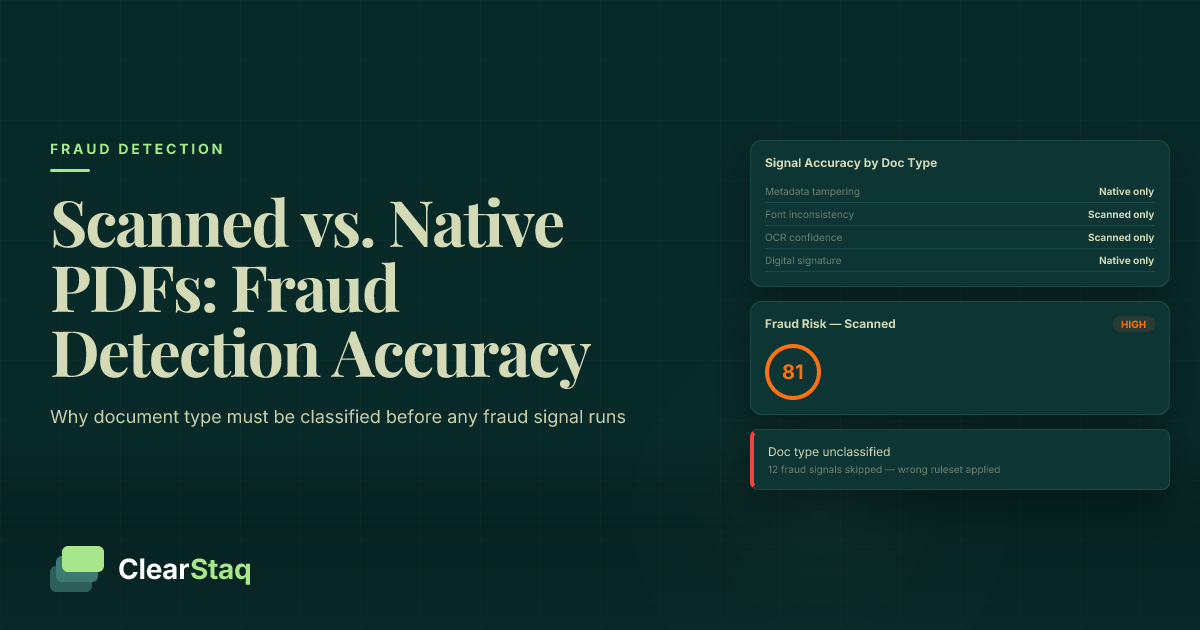
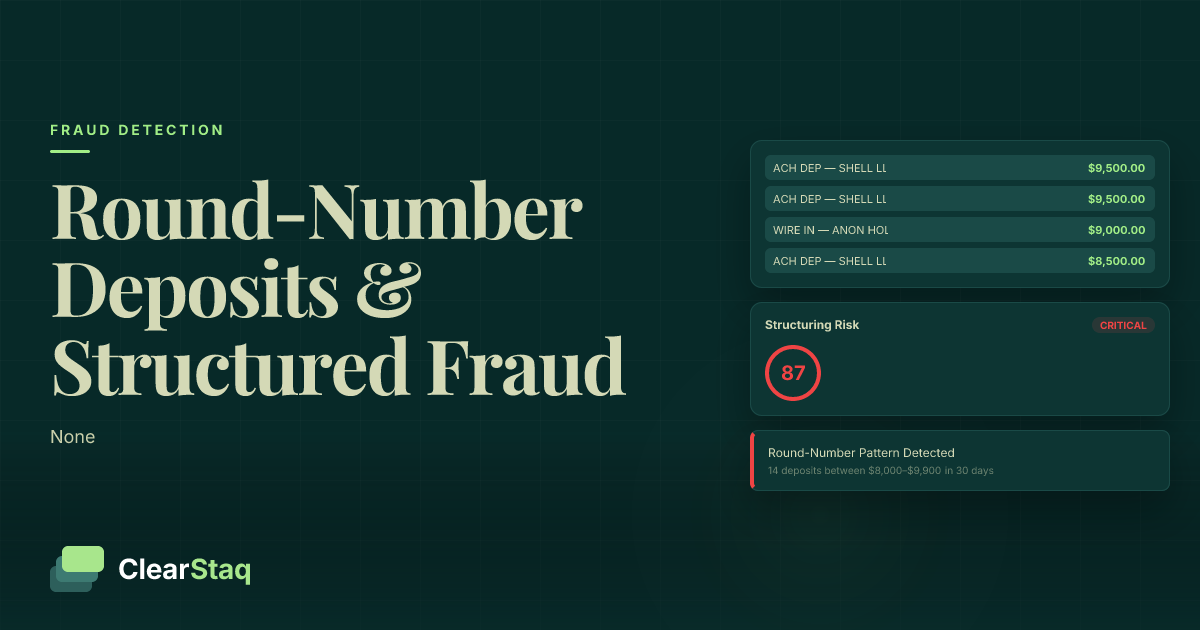
Doctored statements, altered balances, and fabricated voided checks are common enough in high-volume lending that manual review misses a meaningful share of them. A layer running 27+ fraud signals against every uploaded document catches inconsistent fonts, edited metadata, and transaction patterns that don't match the stated business type.
This step belongs before the file lands in an underwriter's queue, not after funding, when the cost of catching fraud is far higher.
6. Track stip status in real time and auto-escalate stalled files
Build a dashboard view — not a spreadsheet — that shows every open file, which stips are outstanding, and how long each has been pending. Auto-escalate anything stuck past 72 hours to a processor for direct outreach instead of letting it age silently.
Expected outcome: no file sits untouched for more than three business days without someone actively working it.
7. Route complete files straight to the underwriter queue
Once every stip is received, verified, and cleared of fraud flags, the file should move to underwriting automatically — no manual handoff, no processor deciding when a file is "ready." This is the step that actually compresses the time-to-decision number lenders report to their own management.
See stip automation in action
Parse bank statements and tax returns in under 5 seconds at 99.5% accuracy.
Troubleshooting
- Borrower uploads a personal statement instead of a business one. Flag account holder name mismatches at parsing time and auto-request the correct document instead of waiting for a manual reviewer to catch it days later.
- Password-protected PDFs stall processing. Build a step in the upload flow that prompts for the password immediately, rather than letting the file sit in a failed-parse queue.
- Partial statements with missing pages. Check page count and running balance continuity automatically; a statement missing page 2 of 4 should trigger an instant re-request.
- Duplicate uploads clog the queue. Deduplicate by file hash and account number on ingestion so the same statement doesn't get processed three times.
- Poor-quality scans or phone photos. Route low-confidence OCR results to a re-upload request rather than forcing an underwriter to manually transcribe numbers.
- Self-employed borrowers submit 1099s instead of full tax transcripts. Set document-type validation rules per stip category so the system rejects the wrong file type on upload, not three days into review.
Tools and resources
- A parsing engine that reads bank statements, tax returns, and pay stubs without manual data entry
- A fraud detection layer scoring documents against dozens of signals, not just a manual eyeball check
- A credit memo workflow that pulls verified stip data straight into underwriting write-ups — see automated credit memo generation for how that step connects to stip data downstream
- A borrower communication tool with automated reminder scheduling
- A real-time status dashboard visible to processors, underwriters, and brokers alike
What to do next
Once stip collection is automated, the next bottleneck is usually the underwriting write-up itself — spreading financials, calculating DSCR, and building the credit memo by hand. That's a separate workflow worth automating right after this one, and it depends entirely on having clean, verified stip data flowing in first.
FAQ
What does it mean to automate stipulation collection in loan underwriting?
It means the checklist, borrower requests, document classification, and verification all run without a processor manually emailing for files and reading them one by one. In 2026, this typically pairs a document parsing engine with automated borrower reminders and status tracking.
How much time does automated stip collection save?
Automated document parsing and classification can cut manual underwriting review time by up to 95% compared to a fully manual process. The bulk of savings comes from eliminating manual re-keying and back-and-forth borrower emails.
What stipulations are most commonly required in loan underwriting?
Bank statements, tax returns, voided checks, driver's licenses, and business licenses are the most common across MCA, SBA, and commercial lending. The exact list varies by loan product and lender risk policy.
Can automated systems catch fraudulent stipulation documents?
Yes. Systems running dozens of fraud signals against uploaded documents can flag altered balances, inconsistent fonts, and edited metadata that manual review often misses. ClearStaq runs 27+ such signals on every parsed document.
Is stip automation only for high-volume lenders?
No. Even lower-volume lenders benefit because the time cost per file is the same whether you process 50 loans a month or 5,000 — a single stalled stip still delays one borrower's funding by days.
How fast can documents be processed once uploaded?
Modern parsing engines process bank statements and tax returns in under 5 seconds per document at accuracy rates around 99.5%, compared to minutes of manual reading and data entry per file.
What's the biggest mistake lenders make with stip collection?
Accepting a document as "received" without validating it's the correct type and date range. A personal bank statement submitted for a business loan checks a box but doesn't satisfy the actual underwriting requirement.
Does automating stips replace the underwriter?
No. It removes the document-chasing and manual-reading work so underwriters spend their time on credit decisions instead of paperwork logistics.
One last thing
The stips that kill a file's timeline aren't usually the missing ones — they're the wrong ones. A personal statement submitted for a business loan, a 1099 instead of a full tax transcript, a voided check from a closed account: these look complete to a borrower checking a box, and they're the single biggest source of rework in 2026 underwriting queues. Flag document type mismatches at the moment of upload, not three days into manual review, and the rest of the stip cycle compresses on its own.
Related guides
ClearStaq Team
Content Team
The ClearStaq team builds AI-powered tools for bank statement parsing, fraud detection, and income verification.