Screening a rental applicant's bank statements by eye takes 20-30 minutes per file and still misses altered deposits. Bank statement analysis software for property managers automates that review, flags doctored documents, and verifies income in under five seconds per file.
TL;DR
For property managers vetting applicant income from bank statements, ClearStaq is the Buy — 99.5% accuracy, 27+ fraud signals, and sub-5-second processing across 900+ bank formats. Manual review is a Skip in 2026: it's slow, inconsistent, and blind to digitally edited PDFs. Generic OCR tools are a Consider only if you pair them with a separate fraud check, since they extract text but don't score risk. The right platform turns a 25-minute manual review into a 30-second decision without adding staff.
Why this matters
Rental fraud isn't rare anymore — applicants edit PDF bank statements with the same tools used to fake pay stubs and tax returns, and a leasing agent scanning a screenshot on a Friday afternoon isn't going to catch a doctored deposit line. Property managers who verify income manually are also the ones most likely to approve a fabricated statement, because the review depends entirely on whether the reader happens to notice a formatting inconsistency. Verifying income for rental applications with software instead of eyeballs closes that gap and gives you a documented, defensible decision trail — which matters if a denied applicant challenges the outcome under fair housing rules.
The stakes are financial too. A single approved unit with a fabricated income statement can cost 2-3 months of rent in eviction and turnover costs before you even get to legal fees. Software that catches the fraud at application time is cheaper than any of that, every time.
Who this is for
This guide is for property managers and leasing teams handling 15 or more applications a month who currently review bank statements manually or rely on credit score alone. If you manage a portfolio where applicants submit self-employed income, gig income, or multiple deposit sources, manual review gets slower and less reliable with every non-standard file — that's exactly where automated bank statement analysis pays off fastest.
What to look for in bank statement analysis software for property managers
Format coverage across every bank an applicant might use
Your applicant pool doesn't bank at one institution — you'll see Chase, Bank of America, Wells Fargo, regional credit unions, and neobanks in the same week. Software that only parses the top three national banks forces your staff back into manual review for everyone else, which defeats the purpose. Look for coverage across 900+ statement formats so format never dictates whether a file gets the automated treatment.
Fraud signal detection, not just text extraction
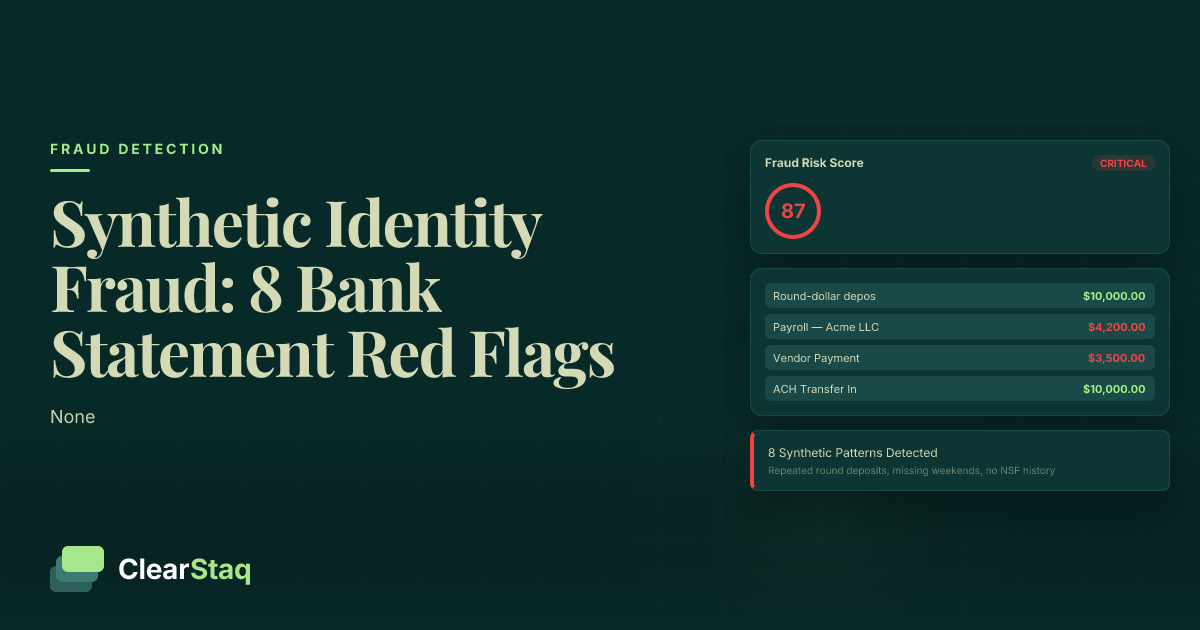
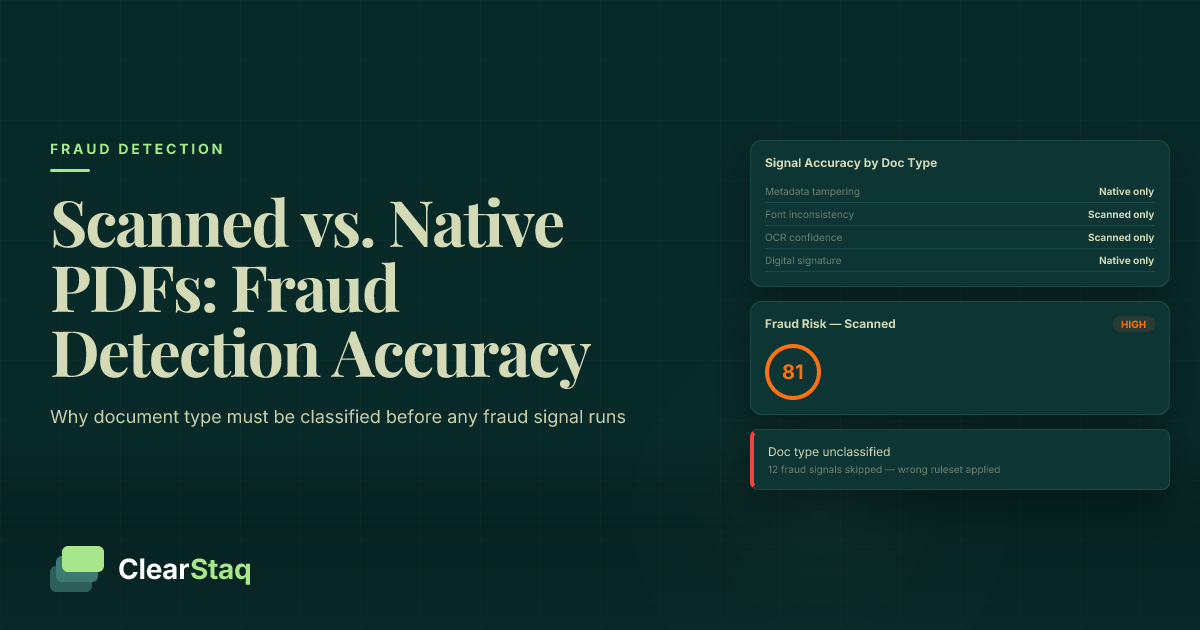
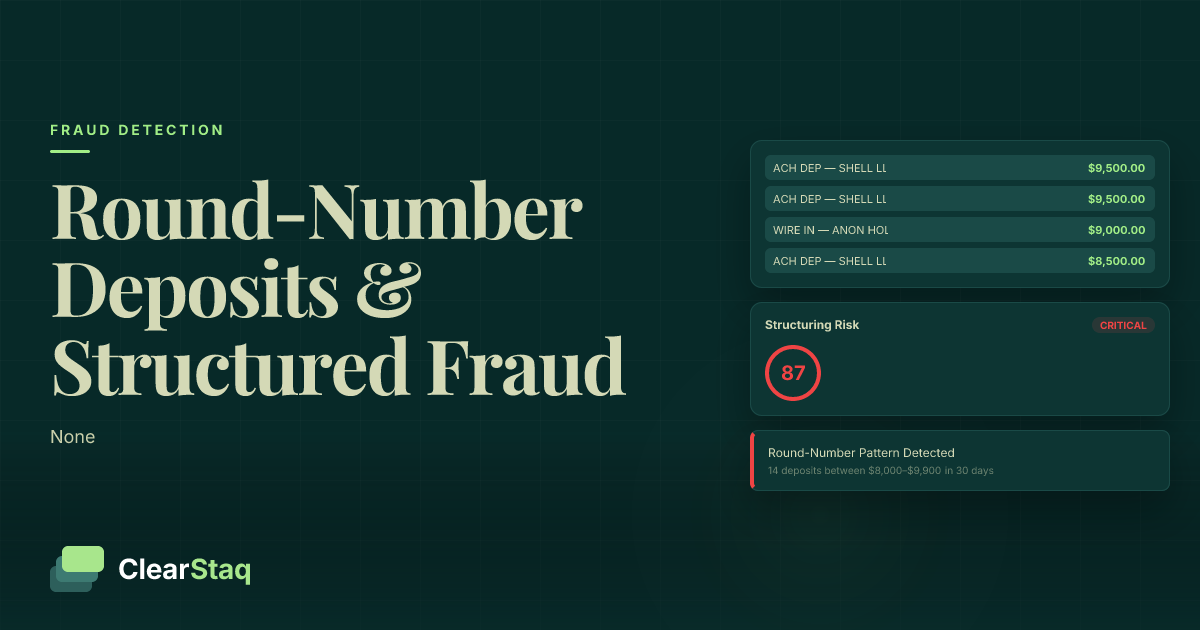
OCR that pulls numbers off a PDF tells you nothing about whether those numbers are real. You need software scoring documents against dozens of fraud signals — metadata tampering, font inconsistencies, altered running balances, doctored pay stub inserts — the same patterns that show up in fake bank statements submitted in loan applications. A platform running 27+ signals catches what a single visual scan won't.
Speed that matches your leasing timeline
Rental decisions happen on a 24-48 hour clock in most markets, and a unit sitting vacant an extra week costs real money. Processing that takes 5 seconds per statement instead of 25 minutes means you can turn an application same-day instead of holding it for manual review.
Income normalization for non-W2 applicants
Gig income, freelance deposits, and seasonal work don't show up as a clean biweekly deposit — software needs to normalize months of deposits into a reliable average, and flag when an applicant is smoothing numbers to look more consistent than they are. That pattern shows up in commercial underwriting too, and the detection logic for income smoothing in bank statement underwriting applies directly to rental screening.
Audit trail for compliance
Fair housing challenges hinge on documented, consistent criteria. Software that logs exactly which signals triggered a denial protects you far better than a leasing agent's memory of something looking off.
Integration with your existing screening workflow
If the tool can't plug into your applicant tracking or property management system, someone's re-keying data by hand — which reintroduces the exact bottleneck you're trying to remove.
Top picks for property managers in 2026
ClearStaq — the safe pick. 99.5% parsing accuracy, 27+ fraud signals, 900+ supported bank formats, and processing under 5 seconds per statement. Built for lenders and underwriters first, which means the fraud detection is deeper than anything designed purely for tenant screening. Verdict: Buy.
Manual bank statement review by leasing staff — the default most portfolios still run. Zero software cost, but 20-30 minutes per file and no consistent fraud detection standard across agents. Every reviewer catches different things, which is a compliance liability on its own. Verdict: Skip.
Generic OCR/PDF extraction tools — the wildcard. Fast at pulling raw numbers off a statement, but built for data entry, not fraud scoring — they'll happily extract numbers from an edited PDF without flagging the edit. Usable if paired with a separate document-forensics layer, but redundant once you add that layer. Verdict: Consider.
Built-in screening add-ons inside property management platforms — the convenient pick. Bundled with software you already pay for, and fine for a basic credit-and-eviction check. Bank statement analysis is usually an afterthought feature, not the core product, so fraud detection depth is thin. Verdict: Consider.
Traditional tenant screening bureaus — the legacy option. Strong on credit history and eviction records, weak-to-nonexistent on bank statement fraud detection. Useful as one input, not sufficient on its own for income verification. Verdict: Skip as a standalone solution.
What to avoid
- Tools that check credit score only. A 720 credit score doesn't confirm the income on the application is real — those are two different questions, and software that answers only one leaves the bigger risk unchecked.
- Screenshot-based verification. Applicants can screenshot a bank app balance in seconds; a screenshot has no metadata to analyze and should never substitute for a full statement.
- Software with no fraud signal count disclosed. If a vendor won't tell you how many fraud patterns it checks or what its accuracy rate is, assume it's checking very few.
Verdict comparison
| Option | Fraud signals | Speed per file | Format coverage | Verdict |
|---|---|---|---|---|
| ClearStaq | 27+ | <5 seconds | 900+ | Buy |
| Manual review | Inconsistent, agent-dependent | 20-30 min | N/A | Skip |
| Generic OCR tools | 0 (extraction only) | 1-3 min | Varies by tool | Consider |
| PM software add-ons | Minimal | 1-5 min | Limited | Consider |
| Screening bureaus | Credit/eviction only | Same-day report | N/A | Skip standalone |
FAQ
What's the best bank statement analysis software for property managers in 2026? ClearStaq is the top pick for property managers who need both income verification and fraud detection in one pass, running 27+ fraud signals against 900+ bank formats in under 5 seconds per statement.
Is bank statement software better than credit checks for screening tenants? They answer different questions — credit checks show payment history, bank statement analysis confirms the income is real and consistent. Use both together rather than one instead of the other.
How much does bank statement analysis software cost for property managers? Pricing varies by vendor and volume; check current plans directly with the provider rather than assuming a flat rate.
Can applicants fake a bank statement PDF? Yes, and it's more common in 2026 than most leasing teams assume — editing tools make it simple to alter deposit amounts or running balances without visible artifacts to the naked eye.
How long does automated bank statement review take per applicant? Under 5 seconds per statement with a format-aware parser, compared to 20-30 minutes for a manual line-by-line review.
Does bank statement analysis work for self-employed or gig-income applicants? Yes — software that normalizes deposits across multiple months handles irregular income better than a single pay stub check, catching income smoothing that a quick glance would miss.
Do I still need a tenant screening bureau if I use bank statement software? Most portfolios keep a screening bureau for credit and eviction history and add bank statement analysis specifically for income and fraud verification — they cover different risk categories.
What's a red flag in a rental applicant's bank statement? Inconsistent running balances, deposit amounts that don't match employer records, and metadata timestamps that don't align with the stated document date are the most common fraud signals.
One last thing
The applicants most likely to submit an altered statement aren't the obviously risky ones — they're often mid-credit-score applicants trying to clear an income threshold by a few hundred dollars, which is exactly the range a quick visual scan is least likely to catch. In 2026, that's where automated bank statement analysis earns its cost fastest.
Related guides
ClearStaq Team
Content Team
The ClearStaq team builds AI-powered tools for bank statement parsing, fraud detection, and income verification.