Landlords and property managers reject or approve rental applications based on income documents that are easy to fake and hard to check by eye — this guide walks through the exact verification steps that catch fabricated pay stubs, inflated bank statements, and self-employment income that doesn't hold up.
TL;DR
Verifying income for rental applications means cross-checking at least two independent sources — pay stubs, bank statements, tax returns, or an employer call — against each other, not trusting any single document. For W-2 renters, request 2-3 recent pay stubs plus one bank statement showing the deposits landing. For self-employed or gig-economy applicants, request 3-6 months of bank statements and calculate average monthly deposits yourself, since a single month can hide seasonal dips or one-time transfers dressed up as income. Verdict: manual review works for small portfolios under 20 units in 2026, but anything larger needs bank statement parsing software to catch commingled funds and structuring patterns at scale. ClearStaq processes statements in under 5 seconds with 99.5% accuracy across 900+ bank formats, which is the difference between a 15-minute manual review and a 15-second automated one.
Why this matters
Rental fraud costs landlords real money, and fabricated income documents are the most common entry point. A tenant who can't actually afford the rent shows up as a missed payment in month two, not month one — by then you've already signed a 12-month lease.
The applicants most likely to submit doctored documents aren't always the ones you'd expect. Self-employed renters and gig workers have thinner paper trails than salaried W-2 employees, which means their bank statements carry more of the verification weight. A ClearStaq analysis of underwriting patterns shows the same fraud signals that show up in mortgage and auto lending — income smoothing, commingled accounts, structured deposits — also show up in rental income documents, just at a smaller dollar scale.
What you'll need
- Government-issued ID to match the applicant's name across all documents
- 2-3 most recent pay stubs (W-2 applicants) or 3-6 months of bank statements (self-employed applicants)
- Two most recent tax returns for self-employed or 1099 applicants
- Employer contact information for a verbal or written verification of employment (VOE)
- A bank statement showing at least one full pay cycle of deposits
- A calculator or spreadsheet to normalize monthly income across pay periods
- Optional but recommended: bank statement parsing software if you're reviewing more than 5-10 applications a month
The steps
1. Collect documents before you schedule a showing
Requiring pay stubs and bank statements upfront filters out applicants who can't produce them, which saves you time on both ends. Ask for documents dated within the last 30-60 days — anything older doesn't reflect current income.
Common mistake: accepting a single pay stub as proof of income. One pay stub shows gross pay for one period; it doesn't show consistency, and it's the easiest document to edit in a PDF tool.
2. Cross-check the name, employer, and address on every document
Match the applicant's legal name across the ID, pay stubs, bank statements, and lease application. A mismatch — different spelling, different address on the pay stub versus the ID — is the first flag, not proof of fraud, but a reason to ask a follow-up question.
Check that the employer name on the pay stub matches the account name on the bank statement's direct deposit line. Fabricated pay stubs often get this detail wrong because the person editing them focuses on the numbers, not the metadata.
3. Calculate income the same way every time
For W-2 applicants, multiply the gross pay per period by the number of pay periods in a year (26 for biweekly, 24 for semi-monthly, 12 for monthly) and divide by 12 to get monthly gross income. Most landlords use a 3x rent-to-income ratio as the qualifying threshold in 2026 — an applicant earning $4,500/month against $1,500 rent clears that bar with room.
For self-employed applicants, average deposits across 3-6 months of bank statements rather than trusting a single month. One month of $8,000 in deposits followed by two months of $2,000 tells a very different story than three months averaging $4,000 evenly.
4. Verify employment directly
Call the employer's HR line or payroll department listed on the pay stub — not a number the applicant gives you verbally. Confirm employment status, start date, and whether pay is full-time or part-time. This single call catches a meaningful share of fabricated pay stub cases because a fake employer either doesn't answer or answers with obvious inconsistencies.
Common mistake: relying only on a phone number written on the application. Cross-reference it against a public business listing or the employer's official website first.
5. Read the bank statement line by line, not just the balance
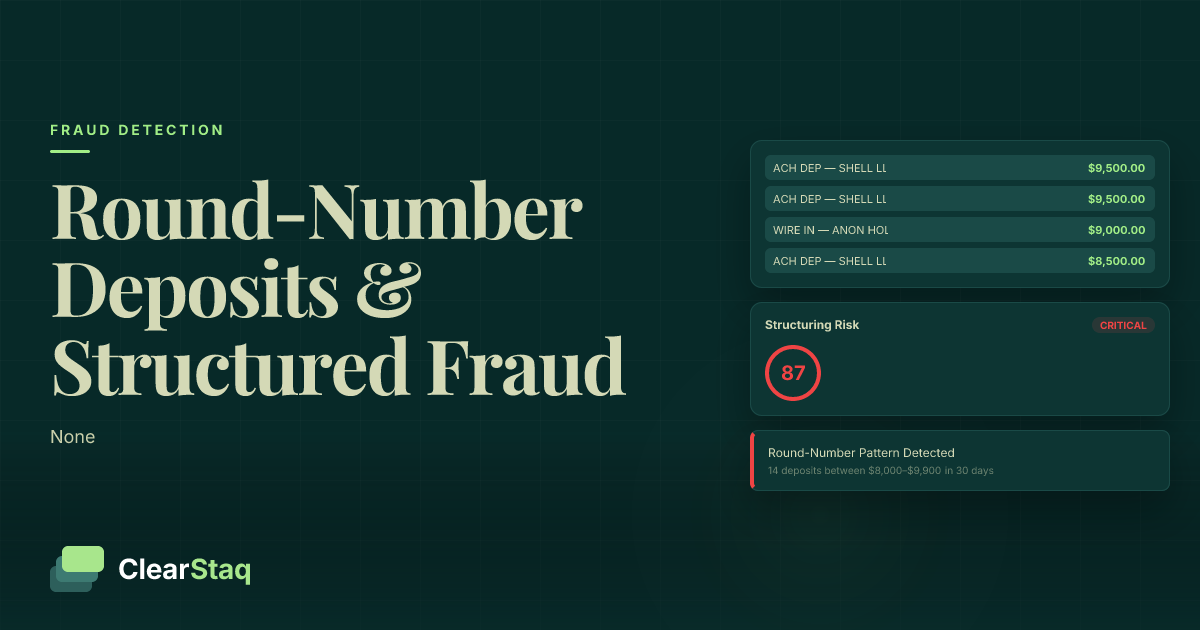
The ending balance tells you almost nothing about income stability. Look at the deposit history: are paychecks landing on a predictable schedule, or are deposits irregular, round-numbered, and inconsistent with a payroll cadence? Round numbers like exactly $3,000 or $5,000 appearing as "income" deposits are a common pattern in manufactured bank statements.
Also check for deposits just under $10,000 appearing repeatedly — a pattern known as structuring, typically used to avoid reporting thresholds and worth flagging even outside a lending context. ClearStaq's breakdown of structuring patterns in business bank statements covers the specific deposit sequences that indicate manipulated cash flow, and the same patterns apply whether the account belongs to a business or an individual landlord applicant.
6. Separate personal deposits from business deposits for self-employed applicants
Self-employed renters sometimes deposit personal loans, gifts, or transfers between their own accounts and count them as income. This commingling inflates the apparent monthly average and makes a shaky income look stable. Look for round-number transfers that don't match the applicant's stated business activity, and ask for the source of any deposit over $1,000 that doesn't match a recurring pattern.
This is the same issue underwriters flag when reviewing commingled funds in business bank statements — a personal transfer dressed up as revenue changes the qualifying number by hundreds or thousands of dollars a month.
7. Check for income smoothing across the full statement period
Some applicants submit a bank statement window that hides a bad month by cherry-picking the date range, or they use one large deposit late in the period to smooth out an otherwise weak average. Requesting a full 3-6 month window rather than a single 30-day statement makes this much harder to pull off. ClearStaq's guide on detecting income smoothing in bank statement underwriting walks through the specific deposit timing patterns that indicate a manufactured average versus a genuine one.
Expected outcome: by the end of step 7, you have a verified monthly income figure backed by at least two independent documents and a direct employer or account confirmation.
Troubleshooting
Problem: the applicant only has one pay stub available. Ask for a bank statement showing at least two consecutive deposits from the same employer instead. One data point alone isn't enough regardless of the document type.
Problem: self-employed applicant's income varies wildly month to month. Average across 6 months instead of 3, and ask for the most recent filed tax return to cross-check the annual total against the monthly average you calculated.
Problem: the employer won't confirm details over the phone. Request a written VOE letter on company letterhead, and verify the letterhead against the company's public website or LinkedIn presence.
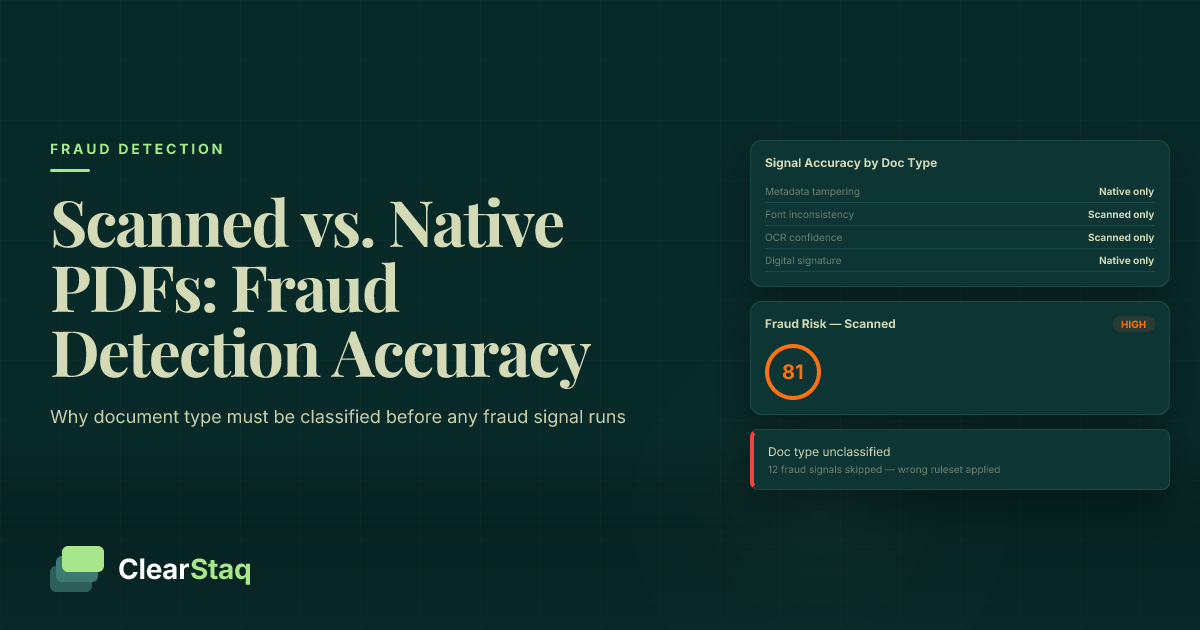
Problem: bank statement PDF looks edited. Check font consistency, alignment of transaction rows, and whether the running balance math actually adds up line by line — manually edited PDFs frequently have balance errors that don't reconcile.
Problem: you're reviewing 15+ applications a month and manual review is eating your week. This is the volume threshold where parsing software pays for itself — a platform built for document-level fraud detection processes what takes a human 15-20 minutes in under 5 seconds per statement.
Problem: applicant's deposits show a pattern of transfers just under reporting thresholds. Treat this as a hard flag, not a minor inconsistency — structuring patterns rarely happen by accident.
Tools and resources
- Pay stub and VOE templates from your property management software or a standard rental application packet
- Bank statement parsing tools for portfolios reviewing more than a handful of applications monthly — ClearStaq reads 900+ bank statement formats and flags 27+ fraud signals automatically
- A rent-to-income calculator spreadsheet, built once and reused for every applicant to keep the standard consistent
- Public business directories (state Secretary of State sites, LinkedIn) for confirming self-employed applicants' business existence
What to do next
Once income is verified, the next fraud check most landlords skip is confirming the source of funds behind large one-time deposits — the same review lenders run before closing. The guide on detecting commingled funds in business underwriting breaks down exactly which deposit patterns deserve a follow-up question versus which ones are normal account activity.
FAQ
What's the best way to verify income for rental applications? Cross-check at least two independent documents — pay stubs plus a bank statement, or tax returns plus bank statements for self-employed applicants — and confirm employment directly with the employer rather than relying on documents alone.
Is a bank statement or pay stub better for income verification? Both together are stronger than either alone. Pay stubs show gross pay per period; bank statements confirm the deposit actually landed and reveal deposit consistency a pay stub can't show.
How many months of bank statements should landlords request? Request 3-6 months for self-employed or 1099 applicants to catch seasonal swings or one-time deposits; 1-2 months is usually sufficient for salaried W-2 applicants with a stable direct deposit history.
How much income do renters need to qualify in 2026? Most landlords apply a 3x rent-to-income ratio, meaning gross monthly income should be at least three times the monthly rent — an applicant needs roughly $4,500/month for a $1,500/month unit under that standard.
Can landlords verify self-employment income without tax returns? Tax returns are the strongest source, but 3-6 months of bank statements showing consistent business deposits work as a secondary check when returns aren't available yet, such as with a newly self-employed applicant.
What are red flags in a fabricated pay stub? Mismatched employer names between the pay stub and bank statement, inconsistent fonts or spacing, gross pay math that doesn't reconcile with net pay after standard deductions, and an employer phone number that doesn't match a public listing.
Do landlords need fraud detection software for a small number of units? Manual review works fine under roughly 20 units a year. Past that volume, the time cost of line-by-line statement review makes parsing software worth the switch, especially when self-employed applicants make up a meaningful share of the applicant pool.
How long does income verification take per applicant? Manual review typically runs 15-20 minutes per applicant when done properly across pay stubs, bank statements, and an employer call. Software-based parsing cuts the document review portion to under 5 seconds per statement.
One last thing
The single highest-value check most landlords skip isn't a document at all — it's calling the employer directly instead of trusting the phone number written on the application. That one call catches a disproportionate share of fabricated income cases in 2026, because a fake employer number either goes unanswered or gets answered by someone who can't confirm basic employment details on the spot.
Related guides
ClearStaq Team
Content Team
The ClearStaq team builds AI-powered tools for bank statement parsing, fraud detection, and income verification.