AML transaction monitoring software for digital wallets is a detection layer that watches P2P transfers, top-ups, and cash-outs inside e-wallet and neobank apps to catch structuring, mule activity, and sanctioned counterparties before funds move on. Digital wallets differ from bank accounts on one point that changes everything: money moves in seconds, across dozens of linked funding sources, often before a human ever reviews the account.
- AML transaction monitoring software for digital wallets must catch structuring across P2P transfers, not just deposits, because wallets move funds in seconds.
- ClearStaq screens wallet transactions against 27+ fraud signals with sub-5-second processing per statement or transaction file.
- The $10,000 CTR threshold under the Bank Secrecy Act still applies to wallet cash-outs, and structuring below it is the most common wallet-specific typology in 2026.
- Manual review works below roughly 500 monthly active wallets; past that, rule-based or AI monitoring becomes mandatory, not optional.
Why AML transaction monitoring matters for digital wallets
Wallet providers hold a money transmitter license, a bank partnership, or both — and both come with Bank Secrecy Act obligations that don't care how young the app is. Regulators treat a wallet moving $50 million a month the same as a bank branch doing the same volume: file CTRs at $10,000, file SARs on suspicious patterns, keep a documented monitoring program.
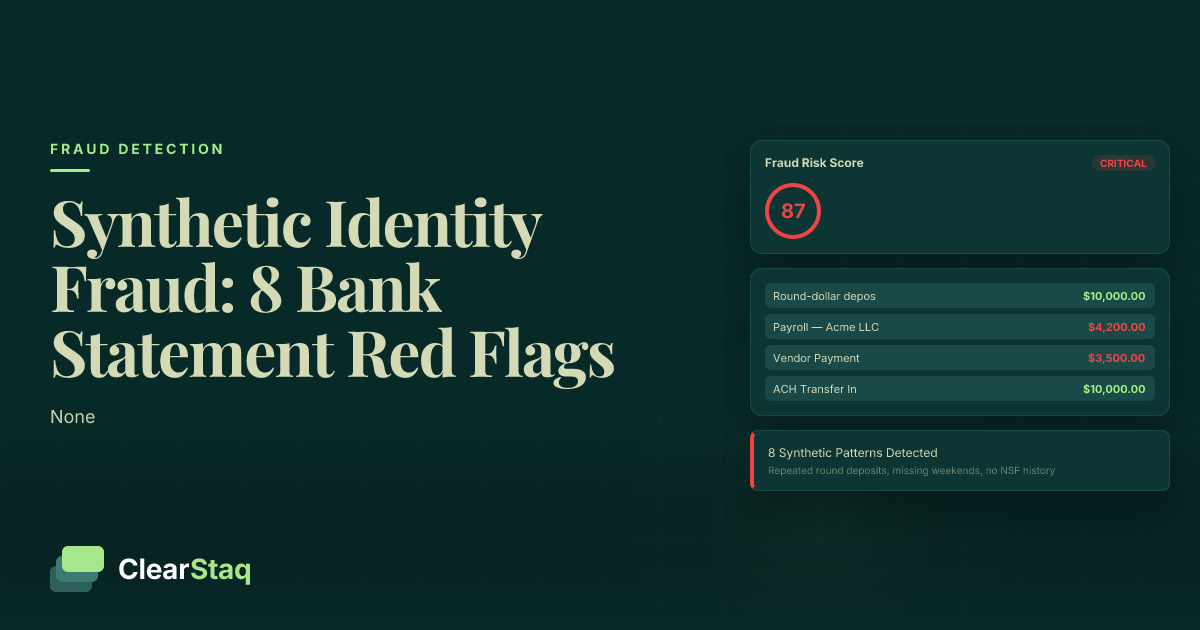
The wallet-specific risk is velocity, not size. A single wallet can receive twenty small P2P transfers from twenty different sending wallets in a day, none of them individually suspicious, all of them adding up to a structuring pattern a rules engine tuned for bank statements will miss. That's the gap ClearStaq built its layering and structuring detection to close — it reads the pattern across accounts, not just the single transaction.
Build the monitoring program
Map your wallet transaction typologies
Before any tool touches your data, write down how money actually moves through your wallet product. A generic AML rule set built for checking accounts misses wallet-specific paths entirely.
- List every funding source: card top-up, ACH pull, P2P receive, merchant refund, cash-in at retail partner
- List every outbound path: P2P send, bill pay, cash-out to bank, card load, cross-border remittance
- Flag which paths allow instant availability vs. hold periods
- Note which paths are anonymous or pseudonymous at the sending end
- Document average transaction size and velocity per typology so anomalies stand out later
Set risk-based thresholds by wallet tier
A flat dollar threshold across all wallets either buries your team in false positives or misses your highest-risk users. Tier wallets by verification level and set thresholds accordingly.
- Unverified or low-KYC wallets get the tightest velocity and dollar caps
- Fully verified wallets with transaction history get wider bands before triggering review
- Business wallets get separate thresholds from consumer wallets — commercial P2P volume looks different
- Cross-border-enabled wallets get lower thresholds regardless of verification tier
- Review thresholds quarterly against actual SAR outcomes, not just alert volume
This is where a platform like ClearStaq's AML transaction monitoring for neobanks earns its place — tiered thresholds require constant recalibration against real outcomes, and doing that by spreadsheet at scale falls apart past a few thousand active wallets.
Verify wallet holders before you monitor them
Monitoring quality is capped by onboarding quality. A wallet opened with a synthetic identity generates alerts that never resolve to a real person.
- Run document-based identity verification at signup, not just email confirmation
- Cross-check name, address, and date of birth against the funding instrument used
- Screen every new wallet holder against sanctions and PEP lists before first funding
- Re-verify when a wallet's usage pattern changes sharply from its stated purpose
- Log verification results so later SAR narratives have a paper trail
KYC verification software for payment platforms covers this step in more depth if your onboarding flow still relies on manual document review.
Watch for structuring across linked wallets
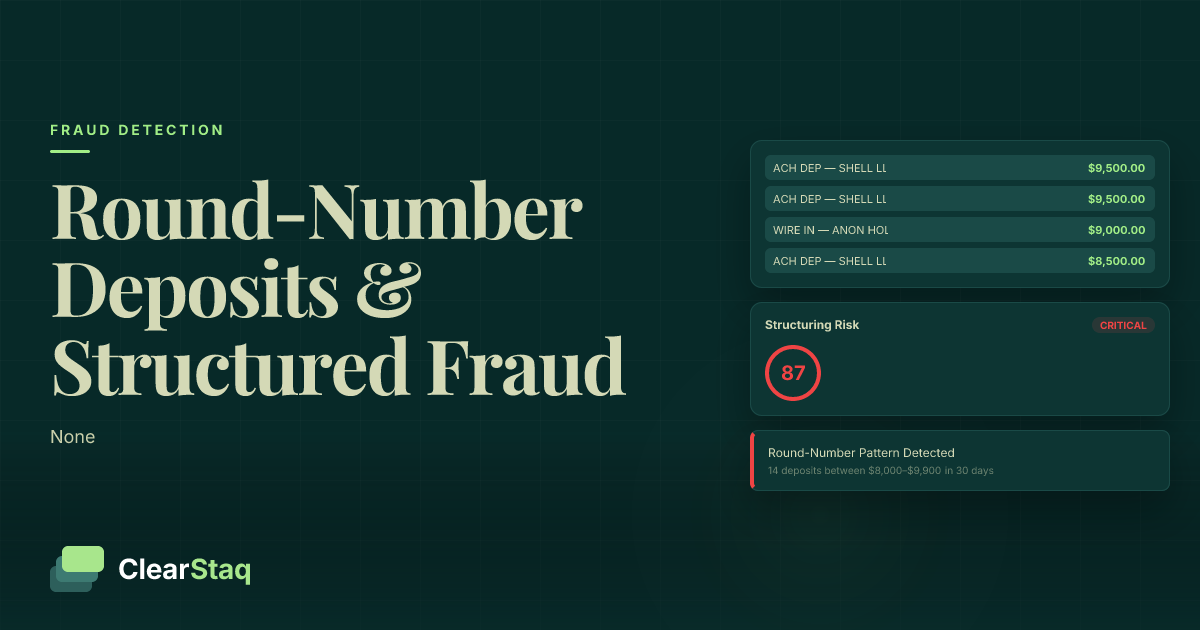
Structuring is the single most common wallet-specific typology examiners cite in 2026 — dozens of transfers just under a reporting threshold, spread across linked or related wallets to avoid detection.
- Flag multiple sub-$10,000 transfers between the same wallet cluster within a rolling 24-hour window
- Track shared device IDs, IP ranges, or funding cards across wallets that appear unrelated on paper
- Watch for round-number transfers repeated on a schedule — a common mule signature
- Correlate outbound cash-out timing with inbound P2P receipt timing; near-instant pass-through is a red flag
- Escalate any wallet cluster showing three or more of the above in a single week
How to detect layered cash deposits in money laundering schemes walks through the layering side of this same pattern in traditional cash accounts, and the underlying logic transfers directly to wallet clusters.
Flag velocity and rapid movement anomalies
A wallet that sits at a low balance for months and then processes ten times its normal volume in a week needs a human look, regardless of whether any single transaction trips a threshold.
- Baseline each wallet's typical transaction count and dollar volume over 90 days
- Alert on any week that exceeds 3x the baseline in count or volume
- Weight alerts higher when the spike coincides with a new funding source or new device
- Deprioritize spikes tied to known seasonal patterns, such as tax refund season or holiday remittance volume
Screen against sanctions and PEP lists continuously, not just at onboarding
OFAC lists update on no fixed schedule, and a wallet holder can become a sanctioned or politically exposed person after account opening. Screening once at signup and never again is the most common gap examiners flag.
- Re-screen the full wallet base against updated sanctions lists on every list refresh
- Screen counterparties in P2P transfers, not just the wallet holder
- Route any match, including fuzzy name matches, to manual review before releasing funds
- Keep a documented resolution log for every match, cleared or escalated
Automate case management and SAR filing
An alert that sits in a shared inbox for two weeks defeats the purpose of real-time monitoring. Case management needs to move at the same speed as the transactions.
- Route alerts automatically to the analyst with the least open caseload
- Attach the full transaction history and prior alerts to every new case
- Set an internal SLA for case resolution, typically 5-10 business days for standard alerts
- Pre-fill SAR narratives with transaction data pulled directly from the monitoring system
- Track time-to-file as a compliance metric, not just alert volume
Test and tune detection rules on a fixed schedule
A rule set tuned in 2024 misses the typologies wallet fraud rings are using in 2026. Rules decay as bad actors adapt.
- Backtest every rule against known SARs filed in the prior quarter
- Retire or tighten rules generating more than 90% false positives
- Add new rules based on typologies flagged by FinCEN advisories or industry ISAC alerts
- Document every rule change with the reason and the date for examiner review
Comparing your monitoring options
| Option | Best for | Key limitation |
|---|---|---|
| Manual spreadsheet review | Wallets under roughly 500 active users | Doesn't scale past a few thousand transactions a month; misses cross-wallet patterns |
| Generic bank AML rules engine | Traditional deposit accounts bolted onto a wallet product | Not built for P2P velocity or wallet-to-wallet structuring |
| ClearStaq | Wallet providers, neobanks, and payment platforms needing document- and transaction-level fraud signals fast | Requires transaction and document data feeds to reach full accuracy; not a case-management system on its own |
| In-house custom build | Large wallet providers with dedicated compliance engineering teams | High ongoing maintenance cost and slow to adapt to new typologies |
Verdict: for wallet providers past the manual-review stage, purpose-built AML transaction monitoring software for digital wallets — like ClearStaq — beats a retrofitted bank rules engine because it's built around P2P velocity and cross-wallet structuring from the start.
See ClearStaq on your wallet data
Run a real transaction file through 27+ fraud signals in under 5 seconds.
Common mistakes digital wallet providers make
- Treating P2P transfers as low-risk by default. P2P is exactly where structuring and mule activity concentrate because it moves faster than deposits and feels informal to users.
- Screening sanctions lists once at onboarding. A wallet holder's status can change months after signup; single-point screening misses it every time.
- Setting one threshold for every wallet. Verified business wallets and unverified consumer wallets need different bands, or you'll bury analysts in noise or miss the real risk.
- Ignoring device and funding-source overlap across wallets. Mule rings reuse cards and devices across dozens of wallets that look unrelated by name alone.
- Letting alert backlogs grow past the internal SLA. A structuring pattern caught three weeks late is a pattern that already moved the money out.
FAQ
What is AML transaction monitoring software for digital wallets?
It's software that screens wallet transactions — P2P transfers, top-ups, cash-outs — for structuring, sanctions matches, and unusual velocity in real time. For wallet providers, it has to track patterns across linked accounts, not just single transactions, because that's where structuring hides.
Is manual AML review enough for a digital wallet startup?
Manual review holds up under roughly 500 active wallets but breaks down past that volume, since it can't catch cross-wallet structuring in real time. Most wallet providers move to rule-based or AI monitoring well before they hit regulatory exam thresholds.
Does the $10,000 CTR threshold apply to digital wallets?
Yes — any wallet provider operating under a money transmitter license or bank partnership is subject to the same Bank Secrecy Act Currency Transaction Report threshold as a traditional bank. Structuring transfers to stay under that line is the most common wallet-specific typology.
How is wallet AML monitoring different from bank AML monitoring?
Wallet monitoring has to handle P2P velocity, instant availability, and cross-wallet linkage that traditional bank rules engines aren't built for. A rules set tuned for checking-account deposits will miss wallet-to-wallet structuring almost entirely.
How often should sanctions screening run for wallet holders?
Screen at onboarding and again on every sanctions list update, not just once. A wallet holder can become sanctioned or politically exposed after the account is already open.
What counts as suspicious velocity in a digital wallet?
A wallet processing three times its 90-day baseline transaction count or dollar volume in a single week is the standard flag point most compliance teams use. Spikes tied to a new funding source or device raise the alert priority further.
Can AML monitoring software integrate with an existing wallet platform?
Most modern AML tools, including ClearStaq, connect through an API that ingests transaction and document data directly from the wallet platform rather than requiring a data migration. Integration effort depends mainly on how structured the existing transaction feed already is.
What triggers a SAR filing for a digital wallet?
A SAR gets filed when a pattern — structuring, rapid pass-through, sanctions proximity, or unexplained velocity — can't be resolved through normal review within the compliance team's documented process. The filing deadline is generally 30 days from initial detection under BSA requirements.
One last thing
Most wallet providers build their AML program around single-transaction thresholds and miss the pattern that actually gets flagged in exams: money moving through a cluster of linked wallets, none crossing $10,000 alone. Fix the cross-wallet correlation gap before you fix anything else in 2026 — it's the one typology that generic bank rules engines consistently miss and examiners consistently ask about.
Related guides
ClearStaq Team
Content Team
The ClearStaq team builds AI-powered tools for bank statement parsing, fraud detection, and income verification.