KYC verification software for payment platforms confirms a merchant or user is who they claim to be, and that their money moves the way their application says it does, before a processor approves onboarding, underwriting, or a funding limit increase in 2026.
- KYC verification software for payment platforms pairs identity checks with bank statement and fraud analysis before approval.
- ClearStaq parses bank statements across 900+ formats and flags 27+ fraud signals in under 5 seconds.
- Identity vendors handle ID scans and liveness; ClearStaq handles the financial data those checks can't see.
- Payment platforms that skip ongoing monitoring after onboarding miss merchant risk drift - re-screen at least quarterly.
Why KYC verification matters for payment platforms
Payment platforms carry KYC obligations most SaaS companies never touch. Every merchant or user onboarded onto a payment rail is a potential vector for synthetic identities, shell companies, or structured cash flow, and a processor that approves a bad actor inherits the chargeback, the regulatory exposure, and the reputational hit.
Identity checks alone don't catch that risk. A stolen or synthetic identity can pass a document scan and a liveness check while the bank statements behind it show layered deposits or a business that doesn't operate the way the application claims. Complete merchant underwriting software for payment processors treats identity and financial verification as two separate checkpoints, not one bundled pass/fail.
By 2026, payment platforms that only verify identity at signup and never touch the applicant's actual bank data are approving merchants they can't explain later - not a compliance gap you want to discover during an audit.
Building KYC verification for payment platforms, step by step
Map every KYC checkpoint across the merchant lifecycle
A KYC program that only fires at signup misses risk that shows up after approval. Payment platforms need checkpoints at every stage where money or ownership can change.
- Onboarding: identity, business registration, beneficial ownership
- Underwriting: bank statement review, income and cash flow verification
- Funding: proof of funds and source of funds check
- Ongoing: transaction monitoring and periodic re-screening
- Offboarding: review for activity that triggers a suspicious activity report
Verify identity documents and run liveness checks first
The manual version of this step is a staff reviewer comparing a government ID photo against a selfie by eye - slow, and it misses spoofed photos and stolen credentials that pass a casual glance. Most payment platforms now route this to a dedicated identity vendor before financial data ever enters the file, and tools covered in video KYC software for digital lenders apply directly to payment onboarding.
- Government ID capture and OCR match against the application
- Selfie-to-ID biometric match
- Liveness detection to catch photo-of-a-photo and deepfake spoofing
- Device and IP fingerprinting to flag repeat-fraud rings
- Manual secondary review for any match score below threshold
Parse bank statements and tax documents to verify real financial activity
An analyst opening three months of PDF statements by hand to calculate average balance and flag NSFs takes 2-4 hours per file - and most reviewers stop at balance and miss deposit timing patterns entirely. Automated parsing does the same read in seconds and catches patterns a human skim misses.
- Average daily balance and cash flow trend across 3-12 months
- NSF and overdraft frequency
- Deposit source concentration - single payer versus diversified revenue
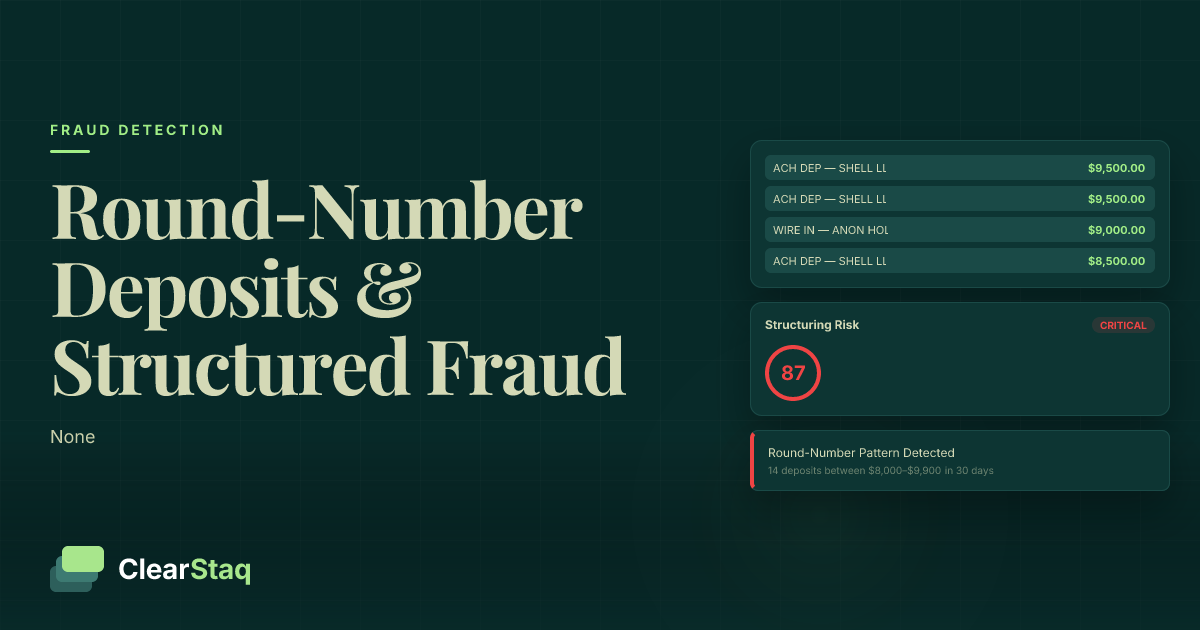
- Structuring or layering patterns in deposit timing and amounts
- Format coverage across major and regional banks without manual reformatting
ClearStaq parses statements across 900+ bank formats, returns results in under 5 seconds, and flags 27+ fraud signals per file at 99.5% accuracy on the documents it processes. It does not run ID document checks or biometric liveness on its own - pair it with an identity vendor rather than expecting it to replace one.
Screen against sanctions, PEP and adverse media lists
Sanctions and PEP screening is a separate legal obligation from fraud detection, and skipping it is a compliance failure, not a risk tolerance decision.
- OFAC SDN and consolidated sanctions list match
- Politically exposed person (PEP) screening on beneficial owners
- Adverse media search on the entity and its principals
- Match scoring to cut false positives on common names
- A documented audit trail for every screening decision
Pair identity checks with PEP screening software for fintech onboarding and a documented process for screening loan applicants against sanctions lists, adapted to a merchant or user population instead of a loan book.
Score fraud signals before you approve
Approval is the last point where you have full leverage over a bad account - after funding, your only options are chargebacks, clawbacks, and reporting.
- Chargeback ratio and dispute pattern by merchant category
- Velocity checks on transaction size and count immediately post-approval
- Cross-reference bank statement fraud signals against stated application data
- A manual review trigger for any signal above your set risk threshold
Run every application through fraud scoring similar to what's described in chargeback fraud detection software for payment processors before funds move on the account.
Automate ongoing monitoring, not just onboarding
Merchant risk drifts. A clean file at onboarding in January 2026 can look completely different by the third quarter once transaction volume and deposit patterns shift.
- Quarterly re-screening against sanctions and PEP lists
- Transaction monitoring for velocity or pattern changes
- Periodic bank statement refresh before any funding limit increase
- Alert routing to compliance for anomalies, not a silent auto-approve
Set escalation rules for manual review
Automation without an escalation path just moves the bottleneck - borderline cases still need a human decision, just a faster one.
- Score thresholds that route to a human reviewer instead of an auto-reject
- A defined SLA for compliance review of flagged applications
- A documented rationale for every override decision
- Regular calibration of thresholds against actual fraud outcomes
“If your KYC stack can verify a face but not a bank balance, you're only covering half the merchant risk.”
KYC verification options for payment platforms
| Option | Best for | Key strength | Key limitation |
|---|---|---|---|
| Manual KYC review (in-house) | Very low onboarding volume | Full control over edge cases | 2-4 hours per file; doesn't scale past a few hundred merchants a month - Wait unless volume stays tiny |
| Document/ID verification vendors | Verifying government ID and selfie liveness | Fast identity match, biometric checks | Doesn't touch bank data - blind to income, cash flow, or deposit fraud - Buy as one piece, not the whole stack |
| Full-stack KYC/AML platforms | Payment platforms needing sanctions, PEP and adverse media screening in one console | Single workflow for identity plus watchlist screening | Bolt-on bank statement parsing is often weak, still needs manual financial review - Hold and evaluate the parsing module separately |
| ClearStaq (bank statement + fraud layer) | Payment platforms verifying a merchant's or user's actual financial activity | Parses 900+ statement formats, flags 27+ fraud signals in under 5 seconds | Does not run ID document or biometric checks - pairs with an identity vendor - Buy for the financial verification layer |
See ClearStaq on your onboarding stack
Parse bank statements and flag fraud signals before you approve a merchant.
Common mistakes payment platforms make
- Treating identity verification as the whole program. A passed ID scan says nothing about whether the business behind it has real revenue or a shell account.
- No re-screening after onboarding. Sanctions and PEP status change; a clean check in 2026 doesn't stay clean forever.
- Manual bank statement review that backs up underwriting. Hours per file turns into a multi-day approval queue during volume spikes.
- No escalation matrix. Borderline cases get rubber-stamped or blanket-rejected instead of routed to a reviewer with the actual signals in front of them.
- Ignoring deposit timing patterns. Structuring and layering show up in the timing and sizing of deposits, not the balance total most reviewers check first.
FAQ
What is KYC verification software for payment platforms?
It's software that confirms a merchant or user's identity and verifies their underlying financial activity before a payment platform approves onboarding or a funding increase. A complete setup combines identity/document checks, bank statement analysis, and sanctions or PEP screening.
Is identity verification enough for payment platform KYC?
No. Identity verification confirms who someone claims to be but says nothing about their actual cash flow, deposit patterns, or business legitimacy - a stolen or synthetic identity can pass an ID scan while the bank statements behind it show fraud.
Does ClearStaq do identity document verification?
No. ClearStaq parses bank statements and tax documents and detects fraud signals in the financial data - it doesn't run ID document scans or biometric liveness checks, so it pairs with a dedicated identity vendor.
How fast can bank statements be verified during onboarding?
ClearStaq processes bank statements across 900+ formats in under 5 seconds per file and flags 27+ fraud signals, compared to 2-4 hours for a manual review of three months of statements.
How often should payment platforms re-screen merchants for sanctions and PEP status?
At minimum quarterly, and immediately before any funding limit increase. Sanctions lists and PEP status change continuously, and onboarding-only screening misses status changes that happen after approval.
What's the difference between KYC and KYB for payment platforms?
KYC verifies an individual's identity; KYB (know your business) verifies the legal entity, its registration, and its beneficial owners. Payment platforms onboarding businesses need both, since a verified individual can still front a shell company.
What causes false positives in sanctions screening?
Common names matching partial entries on watchlists cause most false positives. Match scoring and a documented review process reduce the manual burden without missing genuine hits.
Can bank statement fraud signals catch synthetic identities?
Bank statement analysis catches the financial footprint synthetic identities leave behind - thin transaction history, deposit patterns inconsistent with the stated business, or accounts opened just before an application. It works alongside, not instead of, identity verification.
One last thing
Most payment platforms build their KYC stack backwards: they buy an identity vendor first because it's the visible front door, then bolt on bank statement review later once chargebacks or a regulator forces the issue. Build the financial verification layer alongside identity from day one in 2026 - it's cheaper to design the escalation rules once than to retrofit them after a fraud loss.
Related guides
ClearStaq Team
Content Team
The ClearStaq team builds AI-powered tools for bank statement parsing, fraud detection, and income verification.