For bank statement processing, webhooks outperform polling in production environments by delivering parsed results instantly as events rather than requiring repeated status checks. Polling suits simple MVP integrations, but at scale — processing 100+ statements simultaneously — webhooks reduce infrastructure cost, eliminate latency, and enable real-time underwriting decisions that polling architectures cannot match.
What you'll learn
- Webhooks deliver bank statement parsing results the moment processing completes, eliminating the interval delay that polling adds on top of processing time
- Polling generates O(n × poll_attempts) wasted requests per batch; webhooks generate exactly one outbound callback per document regardless of volume
- The hybrid pattern — webhooks as primary delivery with polling as fallback — is the production-grade architecture for resilient bank statement pipelines
- Webhook event logs produce cleaner SOC2 audit trails than polling logs, which contain large volumes of empty status responses that obscure meaningful events
- HMAC signature verification, HTTPS enforcement, IP allowlisting, and idempotency handling are required security controls for webhook endpoints receiving parsed financial PII
For bank statement processing, webhooks outperform polling in production environments by delivering parsed results instantly as events rather than requiring repeated status checks. Polling suits simple MVP integrations, but at scale — processing 100+ statements simultaneously — webhooks reduce infrastructure cost, eliminate latency, and enable real-time underwriting decisions that polling architectures cannot match.
Why Integration Pattern Choice Matters for Bank Statement Processing
Bank statement processing is not like querying a weather API. You're submitting sensitive, PII-laden financial documents that take anywhere from 2 to 30 seconds to parse, depending on format complexity. A scanned multi-page statement from a regional credit union takes far longer than a clean native PDF from Chase. That variability is the core reason your integration pattern matters.
The pattern you choose at the MVP stage often becomes the pattern you're stuck with at scale. Re-architecting a polling-based document pipeline after you've built underwriting workflows around it is expensive — in engineering time, in missed SLAs, and in re-testing compliance controls.
The business stakes are concrete. A delayed fraud result means a funded bad actor. A delayed underwriting result means a lost deal to a competitor who replied first. Neither outcome is acceptable in a competitive lending market.
The Async Nature of Document Processing
Bank statement parsing can't be synchronous at scale. You can't hold an HTTP connection open for 30 seconds while a 40-page scanned PDF is OCR'd, structured, and run through 27 fraud detection signals. That approach collapses under any real load.
Instead, you submit a document and get back a job ID. What happens next — how you learn that the job is done — is entirely determined by your integration pattern. As noted in our guide on how processing time varies significantly between scanned and native PDFs, format-driven latency is real and unpredictable. Your integration needs to handle that gracefully.
The ripple effects reach further than developers expect. Slow result delivery creates analyst bottlenecks, delays credit decisions, and ultimately affects customer experience. The integration pattern is an engineering decision with a direct line to revenue.
Two Patterns, Very Different Outcomes
The core distinction is simple: with polling, your system asks the API repeatedly whether a job is done. With webhooks, ClearStaq tells you the moment it is.
That inversion sounds minor. At low volume, it is. At scale, it's the difference between a system that works and one that constantly fights rate limits, wastes compute, and keeps underwriters waiting. The rest of this article breaks down exactly when each pattern is appropriate — and how to combine them safely in production.
How Polling Works (And Why It Struggles at Scale)
Polling is the pattern where your client repeatedly calls a status endpoint at fixed intervals until a job transitions from pending to complete. It's intuitive and easy to implement. It's also fundamentally inefficient for document processing workloads.
The math exposes the problem quickly. If you're processing 100 statements simultaneously with a 10-second poll interval and a 30-second average processing time, you generate roughly 300 wasted requests per batch — requests that return nothing useful before the job completes. That cost compounds as volume grows.
The polling interval creates its own trap. Poll too aggressively and you risk triggering rate limits during peak loan origination periods. Poll too conservatively and you add unnecessary delay on top of the processing time your underwriters are already waiting through.
Short Polling vs Long Polling
Short polling is the simplest variant: call the status endpoint every N seconds, check the response, repeat. It's stateless and easy to debug. It's also the most wasteful — every request before the final one is infrastructure overhead with zero business value.
Long polling improves on this by holding the HTTP connection open until either the result is ready or a timeout occurs. The server responds only when there's something to say. This reduces wasted round-trips but introduces server-side connection overhead. For a provider handling thousands of concurrent document jobs, holding open connections is its own scaling problem.
Neither variant solves the fundamental issue for high-volume batch workloads. Both require your system to do the work of tracking which jobs are still pending and managing when to retry. That's complexity you're building and maintaining, not business logic.
The Rate Limit Problem in Fintech Integrations
MCA brokers submitting batch applications face the sharpest version of this problem. A Monday-morning batch of 150 statements — common in merchant cash advance lending — means 150 parallel polling loops, all hammering the status endpoint simultaneously.
Even with reasonable per-loop intervals, the aggregate request rate can exceed API thresholds, resulting in 429 responses that delay processing results further and require exponential backoff logic — complexity you've now had to build twice. For a deeper look at managing throughput under these conditions, see our guide on API rate optimization during peak processing loads.
How Webhooks Work for Document Processing
With webhooks, you flip the communication model. Instead of your system asking ClearStaq whether a job is done, ClearStaq sends an HTTP POST to your registered endpoint the moment processing completes. One submission, one callback. No repeated requests, no polling loops.
ClearStaq's webhook model is event-driven: different processing outcomes fire different event types. document.parsed fires on successful completion. document.fraud_flagged fires when the fraud analysis returns one or more signals. document.failed fires when processing cannot be completed — for example, a corrupted file or an unsupported format variant.
Your responsibility as the integrator is to expose a public HTTPS endpoint, verify the HMAC signature on each inbound request, and process the payload. That's the entire surface area of the integration.
For teams building real-time fraud alerts via webhooks, this model enables a direct pipeline from document submission to analyst notification with no intermediate polling overhead.
Anatomy of a ClearStaq Webhook Payload
The payload ClearStaq delivers is not just a status flag. It's a structured JSON object containing everything your downstream system needs to make a decision without issuing additional API calls:
- document_id — Unique identifier for idempotency and record matching
- event_type — The specific event that triggered delivery (
document.parsed,document.fraud_flagged,document.failed) - status — Processing outcome
- parsed_data — Full structured transaction data, categorized and normalized
- fraud_signals — Array of detected fraud indicators with severity ratings
- confidence_score — Parsing confidence percentage, used to route borderline documents to human review
- processing_time_ms — Actual processing duration in milliseconds
- bank_detected — Identified bank and statement format
Compare this to a typical polling response, which returns a single status: complete field and requires a separate GET request to fetch the parsed data. The webhook payload eliminates that second call entirely.
{
  "status": "success",
  "fraud_score": 57,
  "transactions": 47,
  "bank": "Chase",
  "processing_time_ms": 238
}As the demo above shows, a single document submission triggers one async processing cycle, which culminates in a single structured callback to your registered endpoint — with full results inline.
How Webhooks Enable Real-Time Underwriting
When a webhook fires, it fires immediately on processing completion — typically within milliseconds of the final analysis step. An underwriter refreshing their dashboard doesn't wait for a polling interval to expire. They see the result as soon as it exists.
Fraud flags are especially time-sensitive. A document.fraud_flagged event can trigger an immediate priority queue assignment in the analyst workflow, ensuring that high-risk applications are reviewed before lower-risk ones — regardless of submission order. That's an operational benefit polling cannot replicate.
Webhook vs Polling: Head-to-Head Comparison
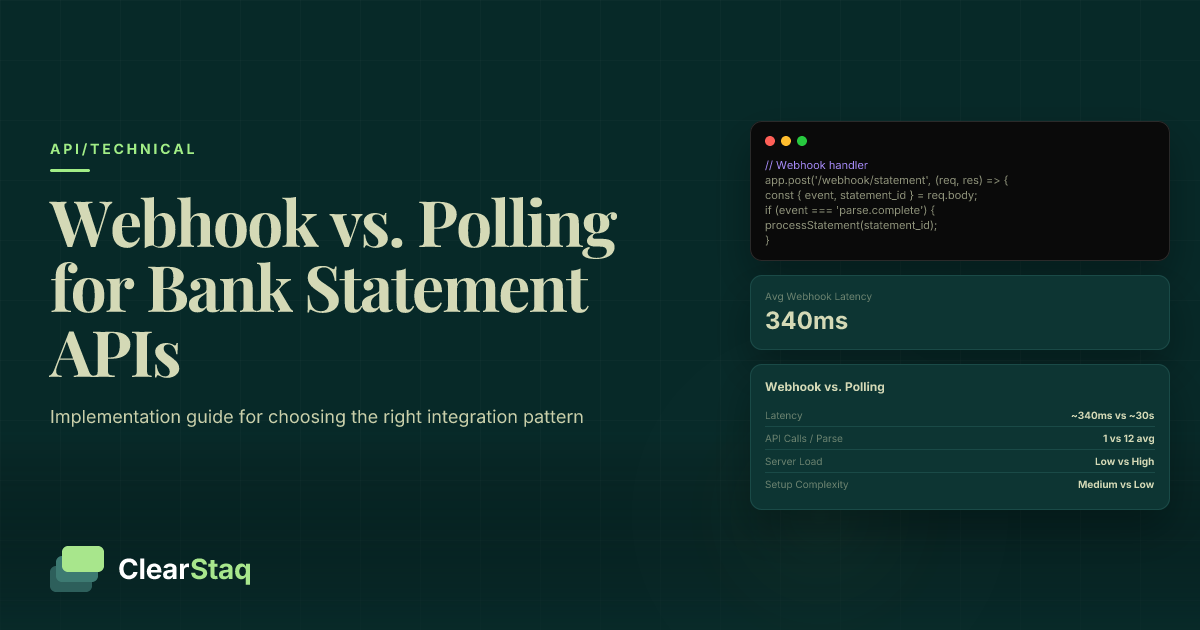
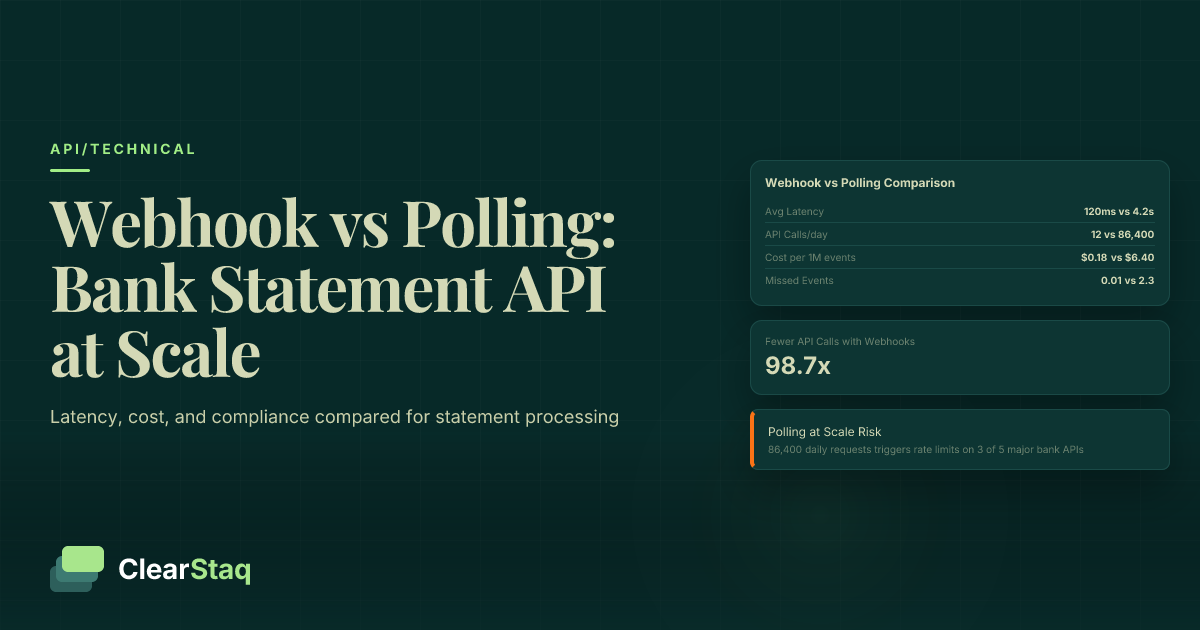
The tradeoffs between polling and webhooks cover six dimensions that matter for production bank statement processing pipelines. Here's how they compare directly:
| Dimension | Polling | Webhooks |
|---|---|---|
| Latency | Processing time + poll interval (avoidable delay) | Processing time only (milliseconds after completion) |
| Infrastructure Cost | O(n × poll_attempts) requests per batch | Exactly 1 outbound request per document |
| Implementation Complexity | Low — no endpoint to expose or secure | Medium — requires endpoint, signature verification, idempotency |
| Reliability | Client controls retry logic | Provider retry logic + client fallback needed |
| Audit Trail Quality | Noisy — hundreds of empty 200 OK responses | Clean — discrete timestamped events per processing outcome |
| Batch Suitability | Degrades exponentially with document count | Scales linearly — each document fires independently |
| Firewall Compatibility | Works behind enterprise firewalls | Requires inbound HTTP access to your endpoint |
Upload
0.1sDrop any bank statement format
Parse
1.2sOCR + AI extraction
Detect
0.8sFraud & stacking analysis
Verify
0.3sIncome verification
Deliver
0.1sStructured JSON response
Latency and Underwriting SLA Implications
MCA lenders frequently commit to same-day decisioning — sometimes within hours of application receipt. The integration pattern directly determines whether that SLA is achievable.
Consider a statement that takes 45 seconds to process. With a 30-second polling interval, you catch the result at the 60-second mark — 15 seconds after it was ready. That delay is avoidable and entirely attributable to the polling pattern. At 100 documents per day, that 15-second avoidable delay per document accumulates into analyst overtime or outright SLA breaches during peak periods.
Webhooks eliminate this entirely. The result is delivered the moment it exists, regardless of processing time variability across different bank formats.
Compliance and Audit Trail Differences
For SOC2 compliance for bank statement processing, audit trail quality is not a secondary concern. Auditors reviewing a polling-based integration see thousands of identical 200 OK responses to a status endpoint — a log that obscures the handful of meaningful processing events within it.
Webhook event logs, by contrast, contain only discrete, timestamped records of actual processing outcomes. Each event is immutable and corresponds to a specific document processing result. That's exactly the kind of audit evidence SOC2 reviewers want to see. The pattern choice has a direct impact on audit readiness.
When to Use Polling for Bank Statement Workflows
Polling isn't wrong. It's a deliberate tradeoff that makes sense in specific contexts. Choosing polling at the right time is good engineering — not a compromise.
The most straightforward case for polling is MVP development. When you're integrating ClearStaq for the first time and need to validate that parsing works before building production infrastructure, polling lets you get to a working prototype without exposing a public endpoint or implementing signature verification. Speed of iteration matters more than optimization at this stage.
Polling is also the right choice for low-volume workflows — fewer than 20 to 30 documents per day. At that volume, the overhead is negligible. The infrastructure cost of polling a handful of jobs is not worth the complexity of a webhook pipeline.
The MVP Case for Polling
For local development and testing, polling has a meaningful advantage: it works without any inbound network configuration. No ngrok tunnel, no cloud-hosted endpoint, no TLS certificate. You call the status endpoint in a loop, see results, and move on.
When you're ready to prototype webhooks before pointing at a production endpoint, webhook.site provides a free public endpoint that captures and displays all inbound requests — useful for verifying your payload structure before writing a handler.
Enterprise Firewall Constraints
Many enterprise lending platforms operate behind firewalls that block inbound HTTP traffic on custom application endpoints. In these environments, polling or queue-based consumption (such as AWS SQS) is the only viable pattern — there's no way to receive webhook callbacks.
ClearStaq supports both patterns explicitly. Polling is not a second-class integration mode for constrained environments. If your infrastructure can't receive inbound traffic, you can poll the results endpoint without any loss of parsed data quality or fraud signal coverage.
When to Use Webhooks for Bank Statement Workflows
Webhooks are the right choice for any production system processing more than 30 bank statements per day. Beyond that threshold, the cumulative overhead of polling starts affecting system performance and analyst productivity in measurable ways.
They're essential when real-time fraud alert delivery is part of your product promise. If your underwriting platform commits to flagging suspicious applications before they proceed, polling cannot reliably deliver that — there's always an interval delay between when fraud signals are detected and when your system learns about them.
Webhooks are also required when SOC2 compliance depends on clean, auditable event logging of document processing outcomes — a common requirement for lenders handling regulated financial data.
High-Volume Batch Processing
The clearest case for webhooks is the MCA broker submitting 150 statements on Monday morning. With polling, you need 150 parallel polling loops, each generating requests at fixed intervals, all potentially competing for the same rate limit budget. The analyst queue fills slowly as results trickle in after each poll interval expires.
With webhooks, each of those 150 documents fires a callback independently the moment it completes processing. Results fan out to the analyst queue in real time, ordered by completion rather than by poll interval. The queue fills in minutes rather than accumulating over a polling cycle. For a detailed look at structuring these workloads, see our guide on batch processing 100+ statements.
Real-Time Fraud Alert Pipelines
The fraud_signals array in the webhook payload is delivered inline with the parsed data. No second API call is needed to fetch fraud analysis results separately. From the moment ClearStaq completes processing to the moment a fraud alert appears in the analyst dashboard, the latency is sub-second.
For platforms where fraud detection is a core product feature, this latency difference is meaningful. Our guide on real-time bank statement fraud alerts covers the full pipeline architecture for delivering these results to underwriting teams at production scale.
The Hybrid Pattern: Polling as a Webhook Fallback
Production-grade integrations don't choose between webhooks and polling — they use both. Webhooks are the primary delivery mechanism; polling is the recovery path when webhook delivery fails.
Webhook delivery can fail for reasons outside your control: your endpoint is temporarily down, a deployment causes a brief outage, a network error causes a timeout. Without a fallback, those events are lost. A failed webhook on a fraud-flagged document isn't just a technical error — it's a meaningful business event that can result in a bad actor proceeding through underwriting undetected.
The hybrid pattern works as follows: ClearStaq attempts webhook delivery. If your endpoint returns a non-2xx response or times out, ClearStaq retries with exponential backoff. After the retry budget is exhausted, the processing result remains accessible via the polling status endpoint, so your system can recover without data loss. For a detailed architecture walkthrough, see our guide on building a bank statement processing pipeline with this hybrid approach.
Exponential Backoff and Retry Strategies
Flat-interval retries — retrying every 30 seconds regardless of endpoint status — create a thundering herd problem when your endpoint recovers from downtime. Every pending retry fires simultaneously, potentially overwhelming a just-recovered service.
Exponential backoff staggers retry attempts so that subsequent failures create progressively longer delays. A reasonable cadence for document processing latency windows looks like this:
- First retry: 30 seconds after initial failure
- Second retry: 2 minutes after first retry failure
- Third retry: 10 minutes after second retry failure
- Final attempt: 30 minutes before the event is sent to the dead-letter queue
ClearStaq's webhook infrastructure includes configurable retry logic with exponential backoff built in. Integrators don't need to build this from scratch — they configure their preferred retry behavior in the dashboard.
Dead-Letter Queues for Document Events
When a webhook event exhausts its entire retry budget without successful delivery, it needs somewhere to land that isn't silent discard. That's the role of a dead-letter queue (DLQ).
Failed events parked in a DLQ can be replayed manually or programmatically once the endpoint is restored. AWS SQS is a well-supported option for this pattern — events that ClearStaq can't deliver via webhook can be routed through an SQS queue that your system drains independently.
For financial document workflows, the DLQ isn't optional. Missing a fraud-flagged document event because webhook delivery failed twice is exactly the kind of operational gap that leads to funded losses.
Securing Webhook Endpoints for Sensitive Financial Data
A bank statement webhook payload contains parsed PII — account numbers, transaction histories, balances, income figures. Treating this data as sensitive in transit is not optional. For a comprehensive treatment of endpoint security requirements, see our guide on webhook security for financial APIs.
The four required controls for any production webhook endpoint receiving financial document data are:
- HMAC signature verification — Verify every inbound payload before processing it
- HTTPS only — Reject any webhook delivery to a non-TLS endpoint
- IP allowlisting — Restrict inbound webhook traffic to ClearStaq's published IP ranges
- Idempotency handling — Prevent double-processing from network-level redelivery
HMAC Signature Verification in Practice
ClearStaq includes an X-ClearStaq-Signature header with every webhook delivery. This header contains an HMAC-SHA256 signature of the raw request body, computed using your webhook secret.
To verify: compute HMAC-SHA256 of the raw request body using your stored secret, then compare the result to the value in the header. If the signatures don't match, return a 401 and do not process the payload — discard it entirely.
One critical implementation note: verify the signature against the raw request body, not a parsed or deserialized version. Parsing the JSON before verification can subtly alter whitespace or key ordering in ways that break the signature comparison.
Never trust payload content before signature verification is complete. The event type, document ID, and fraud signals in the payload should all be treated as untrusted input until the signature check passes.
Idempotency for Financial Document Events
Webhooks can be delivered more than once. Network retries, ClearStaq retry logic, and infrastructure hiccups can all result in the same event arriving at your endpoint twice. In most domains this is an inconvenience. In financial document processing, it can create duplicate underwriting records or double-trigger fraud workflows — both of which have real operational consequences.
The solution is to store a composite idempotency key — document_id + event_type — before processing each event. On any subsequent delivery with the same composite key, return a 200 to acknowledge receipt but skip processing. The 200 response tells ClearStaq delivery succeeded; the skip prevents duplicate effects.
Implement idempotency key storage in a durable data store, not in application memory. In-memory deduplication doesn't survive process restarts or multi-instance deployments.
How ClearStaq Implements Webhook-First Processing
ClearStaq is designed as a webhook-first API. Webhooks aren't an optional add-on bolted onto a polling-based system — they're the primary delivery mechanism the entire processing pipeline is built around.
Support for 900+ bank formats means processing time can vary substantially. A native digital PDF from a major bank might complete in 3 seconds. A scanned multi-bank consolidated statement might take 28 seconds. ClearStaq's webhook architecture abstracts this variability completely — integrators don't need format-specific polling intervals because they never poll at all. The callback arrives when the result is ready, regardless of how long it took.
The pipeline above shows the full flow: document submitted, async processing begins across parsing and fraud analysis stages, processing completes, and a single structured webhook fires to your registered endpoint. The integrator sees none of the internal complexity — just the result, delivered instantly.
Webhook Configuration in ClearStaq
Configuring webhook delivery in ClearStaq takes four steps:
- Register your HTTPS endpoint URL in the ClearStaq dashboard under Webhooks
- Select the event types you want to receive:
document.parsed,document.fraud_flagged,document.failed— subscribe to each independently - Copy your webhook secret for HMAC verification in your endpoint handler
- Configure retry attempts and backoff multiplier to match your endpoint's expected recovery time
For a step-by-step implementation walkthrough, see the guide on getting started with the ClearStaq API, which covers endpoint registration, signature verification, and your first test delivery. Full reference documentation is available in the ClearStaq API documentation.
What the Payload Contains
ClearStaq's webhook payload is designed to be the single source of truth for a processing event. Everything your underwriting system needs to make a decision is included in one callback:
- document_id — For idempotency and record linking
- event_type — The specific outcome event
- parsed_data — Full normalized transaction data with categories and running balances
- fraud_signals — Inline array of detected fraud indicators — no second API call required
- confidence_score — Parsing confidence percentage for routing to auto-approve or human review
- processing_time_ms — Actual processing duration
- bank_detected — Identified bank and format variant
This payload design reduces the total API calls per document from N (polling) to exactly 1. For a platform processing 500 documents per day, that's a significant reduction in API surface area, request volume, and latency per decision.
Ready to Implement Webhook-Based Bank Statement Processing?
Explore the ClearStaq API docs to register your first endpoint and start receiving real-time parsing results — including fraud signals and confidence scores — the moment each document is processed.
Frequently Asked Questions
What is the difference between webhooks and polling for bank statement processing?
Polling requires your system to repeatedly call a status endpoint at fixed intervals until a document finishes processing, generating wasted requests on every check before the result is ready. Webhooks invert this model — ClearStaq pushes a structured JSON payload to your registered endpoint the moment processing completes, delivering results instantly with no wasted requests and no interval delay added on top of processing time.
When should a fintech platform use webhooks instead of polling?
Use webhooks in any production environment processing more than 30 bank statements per day, when real-time fraud alerts are required, or when underwriting SLAs demand sub-minute turnaround from document submission to analyst review. Polling is appropriate for MVP builds and for environments behind enterprise firewalls where exposing a public webhook endpoint isn't possible.
How do you handle webhook failures and retries in a bank statement pipeline?
Implement a hybrid pattern where webhooks are the primary delivery mechanism and polling serves as a fallback after delivery failures. ClearStaq's built-in retry logic uses exponential backoff to reattempt delivery; integrators should also implement dead-letter queues to capture events that exhaust all retry attempts, ensuring no processing result is silently lost — especially for fraud-flagged documents.
How do you implement idempotency for bank statement webhook events?
Store the combination of document_id and event_type from each webhook payload before processing, and reject any subsequent delivery with the same composite key by returning a 200 without reprocessing. This prevents duplicate underwriting records or double-triggered fraud alerts that can result from network-level webhook redelivery. Store idempotency keys in a durable data store, not application memory.
How does the choice of integration pattern affect SOC2 compliance and audit trails?
Webhooks produce cleaner audit trails because each event is a discrete, timestamped, immutable record of a specific processing outcome. Polling logs contain large volumes of empty status responses that obscure meaningful events and complicate audit reviews. For SOC2-regulated bank statement processing pipelines, webhooks are the preferred pattern — and ClearStaq's webhook infrastructure logs all deliveries with payload hashes and delivery status for auditors.
Is polling or webhooks better for real-time document processing?
Webhooks are unambiguously better for real-time processing. Polling adds an unavoidable interval delay on top of processing time — if a document finishes at second 45 and you poll every 30 seconds, you don't learn about it until second 60. Webhooks eliminate this gap entirely, delivering results within milliseconds of processing completion regardless of document format or processing duration.
Stop Polling for Results
ClearStaq's webhook-first API delivers parsed bank statement data — including fraud signals and confidence scores — the moment processing completes. Get started with the API and process your first statement in under 60 seconds.
Frequently Asked Questions
What is the difference between webhooks and polling for bank statement processing?
Polling requires your system to repeatedly call a status endpoint at fixed intervals until a document finishes processing, generating wasted requests on every check before the result is ready. Webhooks invert this model — ClearStaq pushes a structured JSON payload to your registered endpoint the moment processing completes, delivering results instantly with no wasted requests and no interval delay added on top of processing time.
When should a fintech platform use webhooks instead of polling?
Use webhooks in any production environment processing more than 30 bank statements per day, when real-time fraud alerts are required, or when underwriting SLAs demand sub-minute turnaround from document submission to analyst review. Polling is appropriate for MVP builds and for environments behind enterprise firewalls where exposing a public webhook endpoint is not possible.
How do you handle webhook failures and retries in a bank statement pipeline?
Implement a hybrid pattern where webhooks are the primary delivery mechanism and polling serves as a fallback after delivery failures. ClearStaq's built-in retry logic uses exponential backoff to reattempt delivery; integrators should also implement dead-letter queues to capture events that exhaust all retry attempts, ensuring no processing result is silently lost.
How do you implement idempotency for bank statement webhook events?
Store the combination of document_id and event_type from each webhook payload before processing, and reject any subsequent delivery with the same composite key by returning a 200 without reprocessing. This prevents duplicate underwriting records or double-triggered fraud alerts that can result from network-level webhook redelivery. Store idempotency keys in a durable data store, not application memory.
How does the choice of integration pattern affect SOC2 compliance and audit trails?
Webhooks produce cleaner audit trails because each event is a discrete, timestamped, immutable record of a specific processing outcome. Polling logs contain large volumes of empty status responses that obscure meaningful events and complicate audit reviews, making webhooks the preferred pattern for SOC2-regulated bank statement processing pipelines.
Is polling or webhooks better for real-time document processing?
Webhooks are unambiguously better for real-time processing. Polling adds an unavoidable interval delay on top of processing time — if a document finishes at second 45 and you poll every 30 seconds, you don't learn about it until second 60. Webhooks eliminate this gap entirely, delivering results within milliseconds of processing completion regardless of document format or processing duration.
ClearStaq Team
Engineering Team
The ClearStaq team builds AI-powered tools for bank statement parsing, fraud detection, and income verification.