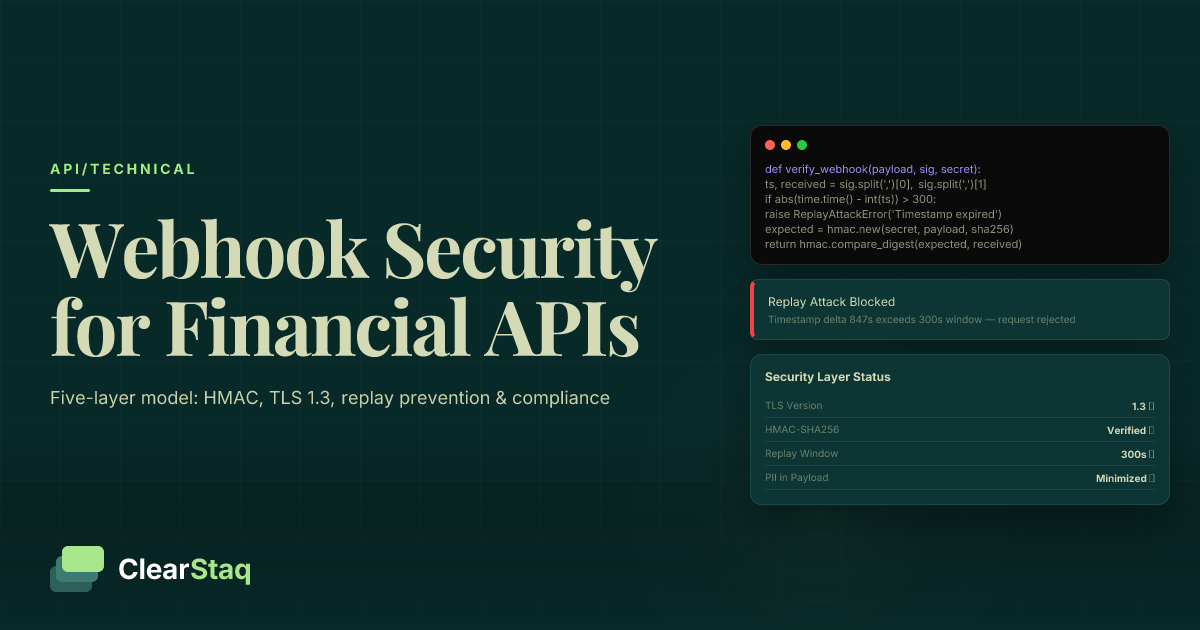
Webhook security for financial APIs requires a five-layer approach: enforcing TLS 1.2+ on all connections, verifying HMAC-SHA256 signatures on every payload, rejecting requests outside a 5-minute timestamp window to prevent replay attacks, minimizing PII in payloads using the event-driven fetch pattern, and rotating signing secrets without downtime using overlapping validity windows. Financial webhook infrastructure must also satisfy GLBA, PCI-DSS, and SOC2 requirements.
What you'll learn
- HMAC-SHA256 signature verification with constant-time comparison is the minimum authentication standard for financial webhook endpoints
- Replay attacks are the most overlooked webhook threat — timestamp validation within a 5-minute window is required alongside signature verification
- Webhook payloads should carry derived metrics and opaque reference tokens, never raw bank statement content, account numbers, or customer PII
- Per-tenant isolated signing secrets prevent a single compromised secret from exposing all integrations on a multi-lender platform
- SOC2, GLBA, and PCI-DSS compliance requires documented evidence of TLS enforcement, HMAC verification, secret rotation records, and delivery monitoring
Webhook security for financial APIs requires a layered approach: enforcing TLS 1.2+ on all connections, verifying HMAC signatures on every payload, rejecting requests outside a 5-minute timestamp window to prevent replay attacks, minimizing PII in payloads, and rotating signing secrets without downtime. Financial APIs transmitting bank statement data must also satisfy GLBA, PCI-DSS, and SOC2 requirements.
Why Webhook Security Is Non-Negotiable for Financial APIs
Webhooks are the connective tissue of modern financial APIs. When ClearStaq finishes parsing a bank statement, detects a fraud signal, or updates a processing status, it doesn't wait for your application to ask — it pushes the result directly to your endpoint. These event-driven HTTP callbacks are fast and efficient, but they introduce a security model that most developers underestimate.
Financial webhook payloads are high-value targets. A single event might carry a fraud score, parsed income metrics, account balance trends, and a reference to the underlying bank statement. Structured financial data at this level of detail is exactly what attackers want — and exactly what regulators require you to protect.
This guide covers a five-layer security model for financial webhook infrastructure: transport security, authentication, replay prevention, payload minimization, and secret management. It also addresses compliance requirements under GLBA, PCI-DSS, and SOC2, and goes deeper than any generic webhook guide on the topics that matter most to lending platforms and fintech engineers. The OWASP API Security Top 10 provides the underlying threat taxonomy for the attack vectors addressed here.
How Webhooks Differ from REST API Calls in a Security Context
With a standard REST API call, your application initiates the connection and authenticates itself to the server. The trust model is straightforward — you prove who you are, then get data back. Webhooks invert this entirely.
With webhooks, the server pushes data to your endpoint. That means your receiver must authenticate the sender — not the other way around. Your webhook endpoint is a publicly reachable URL on the open internet. Anyone can send an HTTP POST to it. Without proper controls, you have no way of knowing whether an incoming request is a legitimate event from ClearStaq or a forged payload from an attacker.
There's also no universal signing standard. Each provider implements its own scheme. That inconsistency means developers must actively implement verification rather than relying on a protocol-level guarantee.
The Stakes: What Happens When Financial Webhooks Are Compromised
The consequences of an unsecured financial webhook endpoint are severe. Payload interception exposes account balances, transaction histories, and fraud scores. A spoofed webhook event — one that mimics a legitimate signal — can trigger a fraudulent loan approval or suppress a fraud alert that should have blocked a bad actor.
Consider what real-time fraud alerts via webhooks actually carry: triggered signal lists, confidence levels, account references, and risk scores. If an attacker can forge a payload that sets fraud_score: 0 on a high-risk applicant, the downstream consequences are a direct financial loss.
Regulatory exposure compounds the operational risk. The GLBA Safeguards Rule requires covered financial institutions to protect nonpublic personal financial information in transit. A compromised webhook endpoint that leaks bank statement parsing results isn't just a security incident — it's a compliance failure with potential FTC enforcement implications.
The Threat Landscape: What Can Go Wrong with Unsecured Webhooks
Understanding the attack surface is the first step to defending it. Financial webhook endpoints face five primary threat categories: payload interception, replay attacks, spoofed events, server-side request forgery (SSRF) via malicious callback URLs, and enumeration attacks probing endpoint behavior.
Each of these threats has a distinct mechanism and a distinct countermeasure. Addressing only one or two leaves meaningful gaps. The five-layer model in this guide is designed to close all of them simultaneously.
Replay Attacks: The Most Overlooked Webhook Threat
A replay attack is deceptively simple: an attacker intercepts a valid, properly signed webhook payload and re-sends it later. Because the signature is legitimate, a receiver that only checks signatures will accept it as authentic.
The financial consequences are significant. Double-sending a bank_statement.parsed event could trigger a second loan approval workflow on the same application. Double-firing a fraud.cleared event could suppress a fraud flag that was subsequently re-raised. In high-volume lending pipelines, even a small percentage of replayed events represents material operational risk.
Replay attacks are common precisely because many implementations verify signatures but don't validate timestamps. Signature verification alone is not enough.
Payload Interception and Data Exposure
Raw bank statement data — PDFs, full account numbers, complete transaction histories — should never travel in a webhook payload. Even with TLS protecting the connection, a compromised logging pipeline, intermediary proxy, or misconfigured SIEM can expose payload content that was captured before it reached your application logic.
The principle of payload minimization applies here: send structured derived data, not source documents. ClearStaq webhooks deliver structured bank statement data as parsed JSON metrics — fraud scores, average daily balances, NSF counts — rather than raw document content. This limits the blast radius of any payload exposure to metadata rather than full financial records.
Layer 1 — Transport Security: Enforcing HTTPS and TLS 1.2+
Transport Layer Security is the foundation of webhook security. Every financial webhook connection must use HTTPS. HTTP delivery must be rejected at the provider level — not redirected, rejected. Redirecting HTTP to HTTPS still exposes the initial request, including any headers, before the redirect occurs.
TLS version requirements: TLS 1.3 is the preferred protocol. TLS 1.2 is an acceptable minimum. TLS 1.0 and 1.1 must be explicitly disabled — they are deprecated and contain known vulnerabilities. NIST SP 800-52 Rev 2 provides federal guidance on TLS implementation applicable to financial systems. PCI-DSS Requirement 4.2.1 mandates strong cryptography for all cardholder data in transit — if your webhook payloads touch payment account data, this requirement applies directly.
Certificate validation is mandatory. Your webhook receiver must validate the sender's certificate chain against trusted CAs. Self-signed certificates are prohibited in production financial integrations — they defeat the purpose of certificate-based trust.
Configuring Your Endpoint to Reject Insecure Connections
Server-side TLS hardening for a financial webhook endpoint means: enabling HTTP Strict Transport Security (HSTS) headers, restricting cipher suites to those on the NIST-approved list, and explicitly disabling SSLv3, TLS 1.0, and TLS 1.1 in your server configuration.
Return HTTP 400 or close the connection immediately on any non-TLS request. Don't return helpful error messages that describe what went wrong — that information is useful to an attacker mapping your endpoint's behavior.
Before going live, run your endpoint through SSL Labs or an equivalent TLS scanning tool. An A+ rating on SSL Labs means your cipher suite selection, protocol support, and certificate configuration meet current best practices. Automate this check in your CI/CD pipeline so regressions are caught before deployment.
Certificate Pinning for High-Security Financial Endpoints
Certificate pinning takes TLS trust one step further. Rather than trusting any certificate signed by a recognized CA, a pinned endpoint will only accept connections from a sender whose certificate — or public key — matches a pre-configured expected value. Even a legitimately CA-signed certificate from the wrong entity is rejected.
This is particularly valuable for lender-to-fintech integrations where the webhook source is a known, static system. If ClearStaq is the only entity that should ever send webhooks to your endpoint, pinning ClearStaq's certificate eliminates an entire class of spoofing attacks, including those that exploit compromised CAs.
The trade-off is operational: pinned certificates must be rotated before they expire, and the rotation must be coordinated between both parties. For enterprise lenders with dedicated security engineering capacity, pinning is a meaningful hardening measure. For smaller teams, it may introduce more operational risk than it mitigates.
Layer 2 — Authentication: HMAC Signature Verification Step by Step
TLS protects the connection. HMAC signature verification proves that the payload came from a specific sender who knows a shared secret. These are complementary controls — you need both.
HMAC-SHA256 works as follows: the webhook sender computes a cryptographic hash of the raw payload body using a shared secret key. That hash is included in a request header — typically formatted as X-ClearStaq-Signature: sha256=<hex_digest>. The receiver independently computes the same hash from the raw body using the same secret. If the two values match, the payload is authentic and unmodified. If they don't, something is wrong — reject the request.
HMAC verifies both authenticity (the sender knows the secret) and integrity (the payload wasn't modified in transit) in a single operation. It does not expose the secret itself — an attacker who intercepts a webhook delivery learns the signature but cannot reverse it to recover the key.
One critical implementation requirement: use constant-time string comparison when checking signatures. Standard string equality functions short-circuit on the first mismatched character, creating a timing side-channel that can leak information about how close a forged signature is to the valid one. Use hmac.compare_digest in Python or crypto.timingSafeEqual in Node.js — these functions always run in constant time regardless of where the mismatch occurs.
Implementing HMAC Verification in Node.js
The critical detail in Node.js HMAC verification is using the raw request body bytes, not a parsed JSON object. JSON parsers may normalize whitespace, reorder keys, or modify the payload in ways that break the signature. Buffer the raw body before any parsing middleware touches it.
The verification flow:
- Buffer the raw request body before Express or any other middleware parses it
- Extract the
X-ClearStaq-Signatureheader and strip thesha256=prefix - Compute
crypto.createHmac('sha256', secret).update(rawBody).digest('hex') - Compare using
crypto.timingSafeEqual(Buffer.from(computed), Buffer.from(received)) - Return HTTP 401 on mismatch — with no detail in the response body about why the request was rejected
Return 401 silently. Revealing whether the signature was malformed, expired, or simply incorrect gives an attacker useful signal for refining forged requests.
Implementing HMAC Verification in Python
In Python, use hmac.new(secret.encode('utf-8'), raw_body, hashlib.sha256).hexdigest() to compute the expected signature. Compare with hmac.compare_digest(computed, received) — never with ==.
For Flask, access request.get_data() before any JSON parsing to preserve the raw body. For Django, use request.body directly. Structure this as middleware that runs before your view logic — if the signature check fails, the request never reaches your business logic layer.
Log failed verifications with the source IP address. A burst of signature failures from a single IP is an indicator of an active probing or spoofing attempt and should trigger an alert.
HMAC vs API Key vs Shared Token: Choosing the Right Scheme
| Scheme | Payload Integrity | Secret Exposure Risk | Replay Risk | Recommended for Financial APIs |
|---|---|---|---|---|
| API Key in header | None | High — visible in logs | High | No |
| Bearer Token | None | High — token theft = full access | High | No |
| HMAC-SHA256 | Yes | Low — secret never transmitted | Medium (add timestamps) | Yes — minimum standard |
| mTLS | Yes (transport layer) | Very Low | Low | Yes — for high-security integrations |
API keys and Bearer tokens in headers are logged by virtually every proxy, load balancer, and APM tool in the chain. A stolen token grants full access to everything that token authorizes. HMAC signatures are payload-specific — a captured signature cannot be reused for a different payload, and the secret itself is never transmitted.
{
  "status": "success",
  "fraud_score": 57,
  "transactions": 47,
  "bank": "Chase",
  "processing_time_ms": 238
}The visualization above shows a webhook event arriving with the X-ClearStaq-Signature header, the local HMAC computation, and the constant-time comparison that produces an authenticated acknowledgment — or a silent 401 rejection.
Layer 3 — Replay Attack Prevention: Timestamp and Nonce Validation
Signature verification proves a payload is authentic. Timestamp validation proves it's current. Together, they close the replay attack window entirely.
The standard approach is a 5-minute timestamp window: reject any webhook where the event timestamp in the payload or header is more than 300 seconds old. This window isn't arbitrary — it mirrors the time-based validation logic in the RFC 6238 TOTP standard and balances clock skew tolerance against replay exposure. A 5-minute window accommodates reasonable drift between sender and receiver system clocks while keeping the replay attack window short enough to be operationally irrelevant.
For higher-security implementations, combine timestamp windows with nonce validation: each event carries a unique nonce value, and the receiver stores seen nonces in Redis with a TTL equal to the timestamp window. Any event whose nonce has already been processed is rejected as a duplicate, even if its timestamp is within the valid window and its signature is correct.
Implementing Timestamp Validation with Clock Skew Tolerance
Extract the timestamp from the X-Timestamp header (or from within the signed payload — signing the timestamp prevents an attacker from modifying it). Compare it against your server's current UTC time. Accept the request only if the difference is within ±300 seconds.
Return HTTP 409 Conflict on timestamp rejection — not 401. A 409 signals that the request was structurally valid but cannot be processed due to a state conflict (in this case, the time window). This avoids revealing whether the failure was a signature problem or a timing problem, which would help an attacker distinguish between two different attack strategies.
Log the attempted timestamp alongside the source IP for every rejection. Patterns of requests with very old timestamps are forensic evidence of replay attempts and should feed into your anomaly detection pipeline.
Idempotency: Preventing Double-Processing of Bank Statement Events
Idempotency and replay prevention are related but distinct. Replay prevention is a security control — it blocks malicious re-submission of signed events. Idempotency is an operational control — it ensures that legitimate retry deliveries (caused by network failures, timeouts, or delivery retries) don't cause your system to process the same event twice.
In a bank statement processing pipeline with webhooks, processing the same bank_statement.parsed event twice could double-trigger a loan approval workflow or double-flag a fraud case. The consequences are the same as a replay attack — only the cause differs.
The idempotency key pattern: each event carries a unique event_id. Your receiver stores processed event IDs in a cache or database with a TTL of at least 24 hours. On every incoming event, check whether the event_id has already been processed. If it has, return HTTP 200 — acknowledge receipt without reprocessing. If it hasn't, process and store the ID atomically before responding.
Return 200, not 500, for duplicate events. A 500 response to a duplicate will trigger the sender's retry logic and compound the duplication problem.
See ClearStaq's Webhook Security in Action
ClearStaq's webhook delivery includes per-client HMAC signing, per-event idempotency keys, and payload-minimized JSON — all the controls described in this guide, built in by default. Start your free trial and integrate secure bank statement webhooks in minutes.
Layer 4 — Payload Security: What to Include (and What to Leave Out)
Transport security and authentication protect the channel. Payload minimization limits what's at risk if something goes wrong anyway. These are independent controls — both are necessary for a complete financial API security posture.
The guiding principle: transmit derived data, not source documents. A webhook payload should tell the receiver what happened and give it enough information to take action — not hand over the raw financial records that generated the event.
Designing a PII-Minimal Webhook Payload Schema
What belongs in a bank statement webhook payload:
event_id— unique identifier for idempotency and audit loggingevent_type— e.g.,bank_statement.parsed,fraud.detected,processing.failedpayload_version— schema version for backward compatibilityaccount_reference— an opaque token, not an account numberfraud_score,avg_daily_balance,nsf_count,revenue_3m— aggregated metricsstatusandconfidence_level— operational flags
What does not belong in a webhook payload:
- Raw PDF content or base64-encoded document data
- Full account numbers or routing numbers
- Social Security Numbers or Employer Identification Numbers
- Full transaction histories with merchant names and amounts
- Customer PII: names, addresses, dates of birth
Use the event-driven fetch pattern for full record access: the webhook notifies your system that a result is ready, and your system retrieves the full record via an authenticated GET request. This keeps PII out of the webhook pipeline entirely and concentrates sensitive data access in a controlled, authenticated channel.
The GLBA Safeguards Rule requires covered financial institutions to minimize the exposure of nonpublic personal financial information. A PII-minimal payload schema is not just good engineering practice — it's a documented compliance control.
Geographic Routing and Data Residency Considerations
State-level financial data regulations add geographic complexity to webhook delivery. CCPA applies to California residents' financial data. NYDFS Part 500 imposes specific cybersecurity requirements on covered financial services companies operating in New York. If your webhook payloads contain data subject to these frameworks, delivery infrastructure must route within compliant geographic boundaries.
Before production deployment, confirm your webhook provider's data center locations and routing policies. Verify that payloads are not transiting through regions where your data residency obligations prohibit them. This is infrastructure-level compliance work — it can't be addressed at the application layer after the fact.
Layer 5 — Secret Management: Rotation, Storage, and Key Hygiene
A perfectly implemented HMAC verification scheme is worthless if the signing secret is stored in a GitHub repository, a committed .env file, or an application log. Secret management is where many otherwise well-designed webhook implementations fail in practice.
Where secrets must not be stored: source code, version-controlled configuration files, application logs, CI/CD build artifacts, or unencrypted environment variable files.
Where secrets must be stored: a dedicated secrets manager — AWS Secrets Manager, HashiCorp Vault, or GCP Secret Manager — with IAM-scoped access controls that grant read access only to the specific service identities that need it. No broad role grants. No shared credentials.
Rotation schedule: minimum every 90 days, and immediately upon any suspected compromise, personnel departure from a role with secret access, or security incident. For API rate optimization for peak processing loads, coordinate secret rotation during off-peak windows to minimize the impact of any brief verification mismatches during the transition period.
Zero-Downtime Secret Rotation for Production Financial Systems
Secret rotation in a production lending pipeline cannot afford dropped webhook events. The zero-downtime rotation pattern uses overlapping validity windows to ensure continuity:
- Generate the new secret and store it alongside the old secret in your secrets manager
- Update the webhook provider with the new secret (the provider may begin dual-signing, or you update your receiver to accept both)
- Transition window (24-48 hours): your receiver verifies incoming signatures against both the old and new secret — accept if either matches
- Revoke the old secret after the transition window closes and all in-flight deliveries have been re-signed with the new key
- Log the rotation event with timestamp, actor identity, and affected integration IDs
This pattern ensures no dropped events during key rotation. Every secret rotation event should produce an audit log entry — rotation timestamps and actor identities are evidence that SOC2 and GLBA auditors will request.
Multi-Tenant Secret Architecture for Lending Platforms
A single shared HMAC secret across all lender integrations is a critical security anti-pattern. If that secret is compromised, every tenant's webhooks are exposed simultaneously.
The correct architecture: each lender tenant receives a unique HMAC signing secret at onboarding, stored in the secrets manager under a key path that includes the tenant identifier (e.g., /clearstaq/webhooks/tenant/{tenant_id}/hmac_secret). Compromise of one tenant's secret is contained to that tenant. Rotation can be performed tenant-by-tenant without affecting platform-wide operations.
This isolation is also operationally important: if a lender's security team requests an emergency rotation following a suspected breach on their side, you can rotate their secret independently without touching any other integration.
Compliance Requirements for Financial Webhook Infrastructure (SOC2, GLBA, PCI-DSS)
Webhook security in a financial context isn't just an engineering concern — it's a compliance obligation. Three frameworks are directly relevant to how webhook infrastructure must be designed, operated, and documented.
GLBA Safeguards Rule and Webhook Data Transmission
The GLBA Safeguards Rule requires covered financial institutions to maintain a written information security plan that covers all systems accessing or transmitting customer financial information. Webhook endpoints that receive bank statement parsing results qualify as systems accessing nonpublic financial data under this definition.
Required controls under GLBA for webhook infrastructure:
- Encryption in transit (TLS 1.2+ on all webhook connections)
- Access controls on the receiving endpoint
- Vendor assessment of your webhook provider's security practices
- Incident response procedures covering unauthorized webhook payload disclosure
- Documentation of all controls for regulatory review
The key practical implication: your GLBA information security plan must explicitly describe your webhook security controls. A verbal assurance that "we use TLS" is not sufficient for a regulatory examination. Document TLS configuration, HMAC verification implementation, secret storage architecture, and rotation procedures.
What SOC2 Auditors Look for in Webhook Security
SOC2 Trust Service Criteria relevant to webhook security include CC6 (logical access controls), CC7 (system operations monitoring), and A1 (availability). Auditors will look for evidence — not assertions — that each control is in place and operating effectively.
Evidence package for webhook security under SOC2:
- TLS enforcement: server configuration exports and SSL scan results showing TLS 1.2+ with approved cipher suites
- Signature verification: code review artifacts or automated test results demonstrating HMAC verification on all incoming events
- Secret rotation records: audit log showing rotation events with timestamps and actor identities
- Monitoring evidence: alerting configuration for signature verification failures and anomalous delivery patterns
- Incident response documentation: written playbook for webhook security breach scenarios
For deeper coverage of audit preparation for financial data workflows, see our guide to SOC2 compliance for bank statement processing.
PCI-DSS Requirement 4.2.1 applies when webhook payloads carry cardholder data — account numbers, card numbers, or related payment data. The requirement mandates strong cryptography for all such data in transit. TLS satisfies transport encryption; HMAC satisfies authentication and integrity. Both are required for full compliance — neither alone is sufficient.
Advanced Techniques: mTLS, Certificate Pinning, and IP Allowlisting
The five-layer model covers the security baseline for financial webhook implementations. For the highest-sensitivity integrations — direct lender-to-core-banking connections, enterprise financial platforms, or any integration processing large loan volumes — additional hardening measures are appropriate.
Implementing mTLS for Lender-to-Fintech API Communication
Mutual TLS (mTLS) requires both the sender and receiver to present certificates during the TLS handshake. Standard TLS only authenticates the server. mTLS authenticates both parties at the transport layer — before any application-level logic runs.
In a ClearStaq integration context: ClearStaq as the webhook sender presents a client certificate issued by a trusted CA. The lender's endpoint validates that certificate against the expected CA or pinned public key. A webhook connection from any sender that cannot present the correct certificate is rejected at the network layer — it never reaches your application.
mTLS eliminates the risk of spoofed events from non-certified senders entirely. An attacker cannot forge a webhook payload to your mTLS-enabled endpoint without possessing ClearStaq's private key — which never leaves ClearStaq's infrastructure.
The operational cost is real: both parties must provision certificates from a shared or mutually trusted CA, and certificate renewal must be automated to prevent expiration-caused outages. mTLS is best suited for enterprise lenders with dedicated security engineering teams who can manage certificate lifecycle operations. For smaller integrations, HMAC with the full five-layer model is the appropriate baseline.
IP Allowlisting: Defense-in-Depth, Not a Standalone Control
IP allowlisting restricts webhook endpoint access to a known set of sender IP ranges — for example, ClearStaq's published egress IP addresses. This blocks opportunistic spoofing from arbitrary internet sources and significantly reduces the exposed attack surface.
It is not, however, a substitute for HMAC verification. IP spoofing is a known technique. Cloud provider IP ranges change when infrastructure is updated. CDN and proxy architectures can make source IP unreliable. An attacker who finds a way to originate a request from an allowlisted IP — through a compromised cloud instance in the same IP range, for example — bypasses IP filtering entirely.
Implement IP allowlisting at the firewall or cloud security group level, not in application code. Combine it with HMAC verification: allowlisting reduces the attack surface; HMAC provides cryptographic proof of authenticity that holds even if IP-based controls are bypassed.
{
  "status": "success",
  "fraud_score": 57,
  "transactions": 47,
  "bank": "Chase",
  "processing_time_ms": 238
}This visualization illustrates the mTLS handshake flow and how mutual certificate validation at the transport layer differs from standard TLS — both parties authenticate before any payload is exchanged.
Monitoring, Alerting, and Incident Response for Webhook Failures
Security controls that aren't monitored aren't really controls — they're assumptions. Every webhook delivery and acknowledgment must be logged, and anomalous patterns must trigger alerts that reach an on-call engineer before they escalate into incidents.
What to Log for Webhook Security Auditing
Minimum required log fields for every webhook event:
event_id— links delivery log to event payload for forensic correlationevent_type— categorizes the event for pattern analysisdelivery_timestamp— UTC timestamp for timeline reconstructionsource_ip— for anomaly detection and allowlist validationendpoint_url— masked to remove any credential componentsresponse_code— distinguishes successful delivery from rejectionssignature_valid— boolean; enables alerting on verification failure spikesretry_count— distinguishes fresh deliveries from retry attempts
Do not log: the full payload body, signing secrets, raw account data, or any PII. Logs are a frequent target in post-breach forensics, and log data that contains financial payload content extends the blast radius of a logging system compromise.
Retain webhook security logs for a minimum of 12 months. Both SOC2 and GLBA audits may require log evidence covering periods going back to the previous audit cycle. Centralize logs in a SIEM with alerting rules configured for: signature verification failure rate above threshold, delivery volume spikes outside normal patterns, 5xx response bursts from receiver endpoints, and deliveries from IPs outside the allowlist.
Incident Response for Webhook Security Breaches in Regulated Financial Contexts
A documented incident response playbook is not optional in a regulated financial environment. Regulators will ask to see it — and if an incident occurs, you'll be grateful it exists.
The five-step playbook for a webhook security breach:
- Detect — signature verification failure spikes or unauthorized payload triggers fire an alert to the on-call engineer
- Contain — rotate the compromised signing secret immediately using the zero-downtime rotation procedure; update IP allowlists if the source IP is identifiable
- Investigate — audit webhook delivery logs for the full exposure window; identify which event payloads were delivered, to which endpoints, and whether any triggered downstream actions
- Notify — GLBA requires notification to affected customers if nonpublic financial information was compromised; engage legal counsel before communicating externally
- Remediate — review secret storage architecture, update monitoring thresholds based on what the incident revealed, conduct a post-incident review, and document findings for the next audit cycle
The real-time alert feed above demonstrates what anomaly detection looks like in practice — signature verification failures, unexpected source IPs, and delivery volume spikes all surface as discrete, actionable alerts rather than being buried in raw log output.
How ClearStaq Secures Bank Statement Webhook Delivery
ClearStaq's webhook infrastructure is designed around the five-layer security model described in this guide. Each control is built into the platform by default — not an optional add-on that needs to be configured after the fact.
At onboarding, each integration receives a unique HMAC signing secret isolated to that client. Compromise of one integration's secret doesn't affect any other. TLS 1.2+ is enforced on all webhook deliveries with full certificate chain validation and no fallback to legacy protocols.
Every webhook payload uses the PII-minimal event-driven fetch pattern: the payload carries the event_id, event_type, account_reference token, and parsed metrics. Raw bank statement content never appears in a webhook payload. Full record details are available only via an authenticated API request from the receiving system.
Zero-downtime secret rotation is supported out of the box: overlapping validity windows allow lenders to rotate secrets without dropping events during the transition. Exponential backoff retry with dead-letter queue notification ensures no silent event loss during receiver endpoint outages.
Real-Time Fraud Alert Webhooks: Security Architecture
ClearStaq's real-time fraud alerts via webhooks fire within seconds of detecting anomalies across 27 fraud signals. Each alert payload is deliberately minimal: event_id, fraud_score, triggered_signals (list of signal identifiers), account_reference, and confidence_level.
No raw transaction data or account numbers appear in the fraud alert payload. If your downstream system needs full transaction-level detail to act on an alert, it fetches that via an authenticated GET request using the account_reference token. The webhook fires fast; the full data stays behind an authenticated endpoint.
Signature verification on fraud alert webhooks is particularly important: a spoofed fraud.cleared event could suppress a legitimate fraud finding. HMAC verification ensures fraud alerts cannot be fabricated or modified by a third party.
Getting Started with Secure ClearStaq Webhook Integration
Setting up a secure ClearStaq webhook integration takes four steps:
- Register your webhook endpoint URL in the ClearStaq dashboard — HTTPS required, HTTP rejected
- Retrieve your per-client HMAC signing secret from the credentials section of the dashboard
- Implement signature verification middleware in your receiving application before any business logic runs — using the constant-time comparison pattern described in this guide
- Enable idempotency key tracking in your event processor to handle retry deliveries safely
For a complete implementation walkthrough, see the ClearStaq API integration getting started guide. It covers endpoint registration, secret retrieval, signature verification code samples in multiple languages, and idempotency key handling patterns.
The pipeline visualization above shows the complete flow: bank statement ingested, parsed through ClearStaq's extraction engine, fraud signals evaluated, and the signed webhook dispatched to your endpoint — all five security layers active at every stage of transit.
Frequently Asked Questions
How do you secure a webhook endpoint for financial APIs?
Securing a financial webhook endpoint requires five layers: enforcing TLS 1.2+ on all connections, verifying HMAC-SHA256 signatures on every incoming payload using a per-client signing secret, rejecting payloads with timestamps older than 5 minutes to prevent replay attacks, minimizing PII in the payload schema using the event-driven fetch pattern, and storing signing secrets in a dedicated secrets manager — never in source code or committed configuration files.
What is HMAC signature verification for webhooks?
HMAC (Hash-based Message Authentication Code) signature verification is a method where the webhook sender computes a cryptographic hash of the raw payload body using a shared secret key, then includes that hash in a request header. The receiver independently computes the same hash using the same secret and compares the two values using constant-time comparison. A match confirms the payload is authentic and unmodified in transit. It does not expose the secret — an intercepted signature cannot be reversed to recover the key.
How do you prevent webhook replay attacks when handling bank statement data?
Replay attack prevention combines two controls: timestamp validation and idempotency key tracking. Reject any webhook payload where the event timestamp is more than 300 seconds (5 minutes) old — this closes the replay window for captured valid payloads. Additionally, store processed event IDs with a TTL and reject any event whose ID has already been processed. Return HTTP 409 on timestamp rejection rather than 401, to avoid revealing which specific check failed.
What compliance requirements apply to webhooks processing bank statement data?
Three frameworks apply directly. The GLBA Safeguards Rule requires encryption in transit, access controls, and documented security procedures for any system transmitting nonpublic personal financial information — webhook endpoints receiving bank statement parsing results qualify. PCI-DSS Requirement 4.2.1 mandates strong cryptography for cardholder data in transit if webhooks carry payment account data. SOC2 Trust Service Criteria CC6, CC7, and A1 require documented and evidenced controls for logical access, monitoring, and availability.
What's the difference between IP allowlisting and HMAC verification for webhooks?
IP allowlisting restricts webhook endpoint access to a known set of sender IP ranges, blocking opportunistic spoofing from arbitrary internet sources. It's a network-layer control. HMAC verification is a cryptographic control that proves a specific payload was signed by an entity who holds a specific secret key. IP allowlisting reduces attack surface but can be bypassed through IP spoofing or routing changes. HMAC provides cryptographic proof that holds even if network-layer controls are circumvented. Use both — they are complementary, not interchangeable.
Ready to Implement Secure Financial Webhooks?
ClearStaq's webhook delivery includes per-client HMAC signing secrets, TLS 1.2+ enforcement, PII-minimal payloads, per-event idempotency keys, and zero-downtime secret rotation — all the controls in this guide, available out of the box. Start your free trial today and connect secure bank statement webhooks to your lending platform in minutes.
Frequently Asked Questions
How do you secure a webhook endpoint for financial APIs?
Securing a financial webhook endpoint requires five layers: enforcing TLS 1.2+ on all connections, verifying HMAC-SHA256 signatures on every incoming payload using a per-client signing secret, rejecting payloads with timestamps older than 5 minutes to prevent replay attacks, minimizing PII in the payload schema using the event-driven fetch pattern, and storing signing secrets in a dedicated secrets manager — never in source code or committed configuration files.
What is HMAC signature verification for webhooks?
HMAC signature verification is a method where the webhook sender computes a cryptographic hash of the raw payload body using a shared secret key, then includes that hash in a request header. The receiver independently computes the same hash and compares it using constant-time comparison. A match confirms the payload is authentic and unmodified in transit — without exposing the secret itself.
How do you prevent webhook replay attacks when handling bank statement data?
Replay attack prevention combines timestamp validation and idempotency key tracking. Reject any webhook payload where the event timestamp is more than 300 seconds old — this closes the replay window for captured valid payloads. Additionally, store processed event IDs with a TTL and reject any event whose ID has already been processed. Return HTTP 409 on timestamp rejection rather than 401 to avoid revealing which specific check failed.
What compliance requirements apply to webhooks processing bank statement data?
Three frameworks apply directly. The GLBA Safeguards Rule requires encryption in transit, access controls, and documented security procedures for systems transmitting nonpublic personal financial information. PCI-DSS Requirement 4.2.1 mandates strong cryptography for cardholder data in transit if webhooks carry payment account data. SOC2 Trust Service Criteria CC6, CC7, and A1 require documented and evidenced controls for logical access, monitoring, and availability.
What is the difference between IP allowlisting and HMAC verification for webhooks?
IP allowlisting restricts webhook endpoint access to a known set of sender IP ranges, blocking opportunistic spoofing from arbitrary internet sources — it is a network-layer control. HMAC verification is a cryptographic control that proves a specific payload was signed by an entity holding a specific secret key. IP allowlisting can be bypassed through IP spoofing or routing changes; HMAC provides cryptographic proof that holds even if network-layer controls are circumvented. Both should be used together as complementary controls.
ClearStaq Team
Engineering Team
The ClearStaq team builds AI-powered tools for bank statement parsing, fraud detection, and income verification.