Variable income borrowers — gig drivers, 1099 contractors, seasonal retailers, self-employed operators — don't fit a two-pay-stub underwriting model. Bank statements are the only document that shows what actually landed in the account, month over month, and this guide walks through the process to underwrite variable income borrowers from bank statements without overstating capacity or missing volatility that sinks a loan six months in.
- Underwrite variable income borrowers from bank statements using 12-month averages, not 2-month snapshots — seasonal swings distort real capacity.
- Treat deposits with gaps over 45 days as one-time, not recurring, for gig and 1099 borrowers.
- ClearStaq parses 12 months of statements in under 5 seconds and flags volatility across 27+ fraud signals.
- Verdict: manual averaging misses seasonal dips — automate the variance calculation or approvals run hot.
Why this matters
A borrower who nets $8,200 one month and $2,100 the next isn't unqualified — they're volatile, and volatility needs a different math than a flat W-2 salary. Underwriters who average two or three months of deposits and call it "average monthly revenue" routinely overstate capacity for seasonal and gig-based borrowers, then get surprised when a slow month triggers a missed payment in 2026.
The fix isn't rejecting variable income outright. It's pulling enough history to see the pattern, not the peak. Twelve months of statements, categorized correctly, tells you whether $2,100 is a slow month or the new normal.
What you'll need
- 12 consecutive months of bank statements — PDF or CSV, all accounts the borrower uses for income
- A way to categorize deposits by source (payroll, marketplace payout, client transfer, personal transfer, loan proceeds)
- Tax transcripts or 1099s for cross-verification when the file allows it
- A volatility threshold your credit policy already defines — or one you're about to set
- Parsing software that handles bank-specific formats without manual re-keying; hand-typing 12 months of transactions from three different banks is where review time disappears
The steps
1. Pull 12 months of statements, not 2
Two or three months hides seasonality. A landscaping contractor's March statement looks nothing like their August statement, and a lender who only sees August approves capacity the borrower doesn't have in February. Twelve months captures at least one full seasonal cycle for most small business and gig income patterns.
Common mistake: accepting whatever the borrower uploads first, usually the most recent and often the strongest month.
2. Categorize every deposit by source
Sort deposits into payroll, marketplace payouts (Uber, DoorDash, Etsy, Upwork), client ACH transfers, personal transfers, and loan or grant proceeds. Only the first three count toward qualifying income for most variable-income files. This step is where manual review burns hours — a 12-month statement set can carry 300-plus line items across three accounts.
Expected outcome: a clean deposit ledger with source tags, ready for averaging.
3. Strip out transfers, loans, and refunds
Internal transfers between the borrower's own accounts and one-time loan disbursements inflate the deposit total without reflecting earning capacity. A $15,000 wire from a personal savings account into the business checking account is not income — it's the borrower moving their own money, and counting it as revenue is the single most common inflation error in self-employed underwriting files.
4. Calculate the coefficient of variation
Once you have 12 clean monthly totals, divide the standard deviation by the mean. That ratio is your volatility score. A borrower with a coefficient of variation under 0.25 behaves close to a salaried applicant. Above 0.50, the income is genuinely unpredictable and the underwriting decision needs a haircut, not a flat rejection.
Common mistake: using the highest and lowest month as the "range" instead of the statistical spread — a single outlier month distorts both.
5. Apply a volatility haircut to qualifying income
Most lenders discount qualifying income by 10-25% for borrowers with moderate volatility (0.25-0.50 coefficient) and by 25-40% for high volatility above 0.50. The exact haircut is a policy decision, but the input — the volatility score from step 4 — has to come from real math, not a gut call on the file.
6. Cross-check against tax transcripts or 1099s
When the file includes tax documents, verify self-employed income against the return before finalizing the qualifying number. A borrower reporting $95,000 in bank deposits but $52,000 in Schedule C net income after deductions needs the lower number treated as the real capacity, not the gross deposit figure.
Expected outcome: a qualifying income figure that survives a second look from a compliance reviewer or an investor audit.
7. Screen for income smoothing
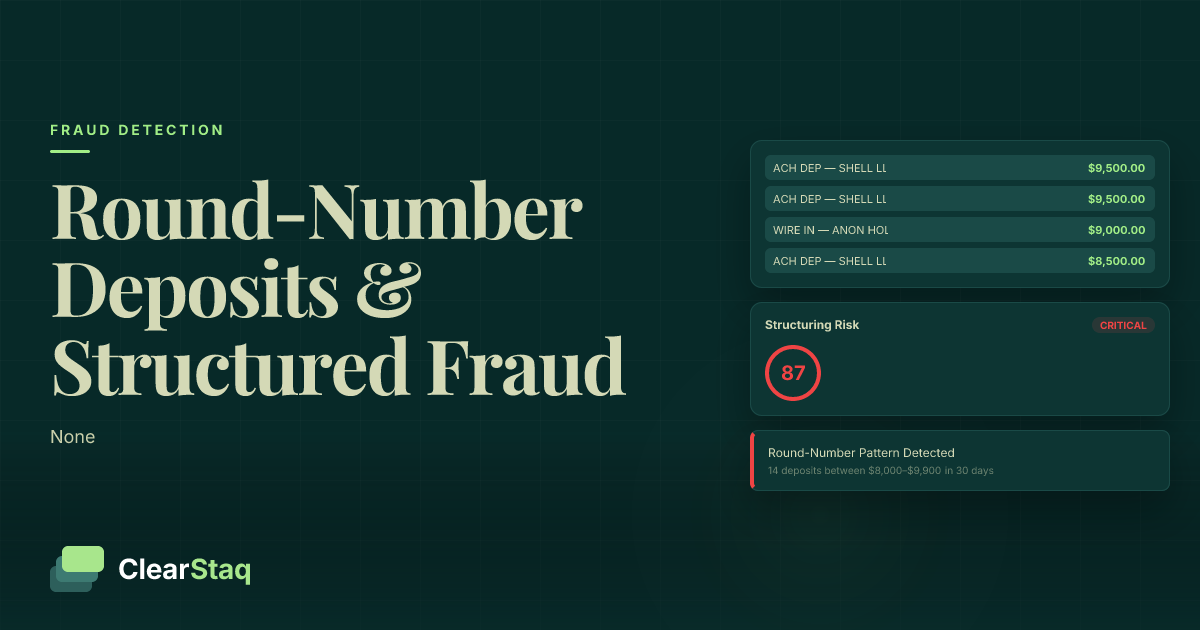
Some applicants — or the brokers packaging their files — move money between accounts right before submission specifically to flatten volatility on paper. Watch for round-number transfers that land within days of the statement cutoff and don't correspond to any client or marketplace payout pattern. This is a fraud signal, not a documentation gap.
8. Document the decision with an audit trail
Write down the 12-month average, the volatility score, the haircut applied, and the cross-check result. If the loan performs poorly in 2026 or an examiner pulls the file in 2027, the underwriting logic needs to hold up on paper, not just in memory.
Troubleshooting
Borrower has 3+ business accounts across different banks. Consolidate deposits by source before calculating volatility — otherwise you're comparing incomplete pictures across accounts and the coefficient of variation is meaningless.
Deposits look steady but include internal transfers. Re-run step 3. A "stable" income pattern that's really the borrower shuffling their own cash between two accounts will pass a lazy review and fail a real one.
One quarter is dramatically stronger than the rest. This is normal for seasonal retail, agriculture, and tax-prep businesses — don't average it away. Weight the qualifying income toward the trailing 12 months, not a blended annual figure that hides the slow season.
Borrower recently switched from W-2 to 1099. You may only have 4-6 months of self-employed statements. Don't extrapolate a full year from partial data — either require additional history or apply a heavier haircut to reflect the shorter track record.
NSF fees are mixed into the volatility signal. Overdraft fees and NSF charges are a separate risk flag, not income volatility. Pull them out of the deposit ledger before calculating the coefficient of variation, and track them separately as a standalone risk indicator.
Marketplace payout amounts don't match platform reporting. Verify 1099 contractor income against the payout schedule the platform actually uses — weekly Uber deposits and monthly Upwork invoices post on different cycles, and comparing raw deposit counts across platforms without adjusting for cycle length produces a false volatility reading.
Tools and resources
- 12 months of bank statements per borrower, all accounts used for income
- A deposit categorization method — manual tagging works for low file volume, automated parsing is the only option once volume climbs past a handful of files a week
- Tax transcripts or 1099s for cross-verification
- A documented volatility threshold and haircut schedule in your credit policy
- Parsing software that reads 900+ statement formats and returns categorized deposits without manual re-keying — ClearStaq processes a statement set in under 5 seconds and applies 27+ fraud signals across the same file, so the volatility calculation and the fraud check happen on the same clean dataset instead of two separate manual passes
What to do next
Once the volatility score and haircut are set, check the file for income smoothing before you sign off — income smoothing patterns show up in the same deposit ledger you just built, and catching them here costs a few extra minutes instead of a charge-off later in 2026.
FAQ
How many months of bank statements do you need to underwrite variable income?
Use 12 months of statements to underwrite variable income borrowers from bank statements. Fewer than 12 months misses a full seasonal cycle for gig, contractor, and small business income.
What's a good volatility threshold for variable income underwriting?
A coefficient of variation under 0.25 behaves close to salaried income; above 0.50 is high volatility and typically calls for a 25-40% haircut on qualifying income. The exact thresholds belong in your written credit policy.
Is gig economy income harder to underwrite than 1099 contractor income?
Gig income is usually more volatile week to week because payouts follow platform algorithms, while 1099 contractor income tends to cluster around project or invoice cycles. Both need 12-month deposit history rather than a 2-3 month snapshot.
Should you count internal transfers as income when underwriting variable income borrowers?
No. Internal transfers between a borrower's own accounts inflate the deposit total without reflecting real earning capacity, and stripping them out is a required step, not an optional check.
How do you detect income smoothing in bank statement underwriting?
Look for round-number transfers landing near the statement cutoff that don't match any client or marketplace payout pattern. That timing and amount pattern is a common income smoothing signal, not a documentation coincidence.
Can automated software replace manual review for variable income files?
Software replaces the manual categorization and averaging work, not the underwriting judgment call. Platforms like ClearStaq parse and categorize deposits in under 5 seconds and cut review time by 95%, leaving the haircut decision to the underwriter.
What tax documents cross-check bank statement income for self-employed borrowers?
Schedule C on a personal tax return or a business tax transcript cross-checks bank deposit totals for self-employed borrowers. Net income after deductions on the return is usually lower than gross deposits and should be treated as the more conservative figure.
How much does income volatility typically reduce a qualifying income figure?
Moderate volatility (0.25-0.50 coefficient of variation) typically triggers a 10-25% haircut, and high volatility above 0.50 triggers 25-40% in most credit policies. The specific percentage is a lender policy decision, not a fixed industry standard.
One last thing
The number that actually predicts default risk for variable income borrowers isn't the average monthly deposit — it's the coefficient of variation from step 4. Two borrowers can show the exact same $6,000 average with wildly different risk profiles: one swings between $5,200 and $6,800, the other between $1,900 and $11,000. Underwrite the second one like the first and the file is mispriced before the ink dries in 2026.
Related guides
ClearStaq Team
Content Team
The ClearStaq team builds AI-powered tools for bank statement parsing, fraud detection, and income verification.